
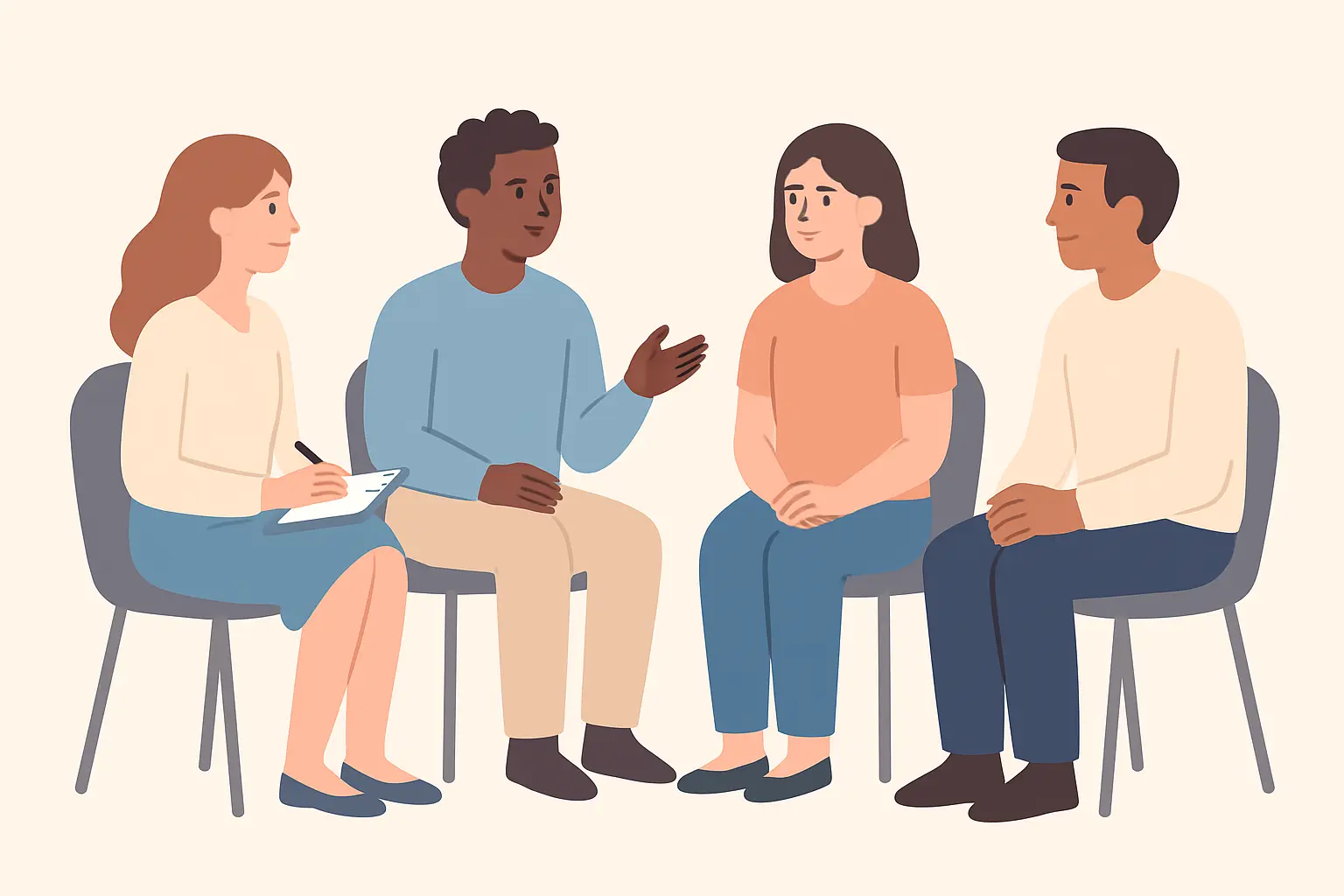
How to Conduct a Focus Group for Your Dissertation (Step by Step)
Focus groups fail for predictable reasons — a group too large for anyone to speak, a discussion guide that reads like a survey, or a moderator who can’t stop one participant from dominating the room. Knowing how to conduct a focus group for your dissertation properly, from recruitment through analysis, is what turns ninety minutes of conversation into usable qualitative data. This guide walks through every stage, grounded in the methodological standards most supervisors expect you to follow.
Focus groups are a distinct method from one-on-one interviewing — the group dynamic itself is the data source, not just a way of collecting several individual opinions at once. If your project uses individual interviews instead, see our guide to conducting semi-structured interviews for your thesis, which covers one-to-one interview design, probing techniques, and analysis in depth.
Quick answer: Recruit 6–10 participants per group (the range recommended by Krueger and Casey’s widely used focus group methodology), design a discussion guide of 5–8 open-ended questions organized from broad to specific, get institutional ethics approval and written informed consent before recruiting, record with participant consent, moderate to balance airtime and manage dominant voices, transcribe verbatim, and analyse using thematic or content analysis that treats group interaction — not just individual comments — as data.
What focus groups are good for (and when to avoid them)
Focus groups excel when you want to understand how people talk about a topic collectively — shared language, points of disagreement, and how opinions shift when participants respond to each other, not just to a moderator. They’re a poor fit for sensitive or stigmatizing topics where participants may not disclose honestly in front of peers, and a poor fit when you need each individual’s full personal narrative in depth, which one-on-one interviewing handles better. If your topic involves trauma, illegal behaviour, or workplace conflict among colleagues who’ll continue working together, consider individual interviews instead.
Step 1: Get ethics approval before recruiting
Institutional ethics approval (from your university’s research ethics committee or equivalent body) is required before you contact a single participant, not after you’ve already scheduled sessions. Your ethics application should specify: the number and size of groups, your recruitment method, how you’ll obtain informed consent, how recordings and transcripts will be stored and anonymized, and your plan for withdrawal (participants can typically withdraw individual comments up to a stated point, though not always retroactively remove comments other participants have already responded to — this nuance is worth clarifying explicitly in your consent form).
Step 2: Decide group size and number of groups
Krueger and Casey’s widely cited methodology for applied focus group research recommends groups of roughly 6 to 10 participants as the practical sweet spot: small enough that everyone gets meaningful airtime, large enough to generate a genuine range of views and cross-talk. Groups smaller than 6 can put pressure on individuals to talk more than they naturally would; groups larger than 10–12 tend to fragment into side conversations and reduce how much detail any individual contributes. For topics that are especially complex or where you want deeper individual elaboration, a smaller “mini-group” of 4–6 participants is a recognized variant.
On number of groups: a single focus group is rarely sufficient for a dissertation, since you can’t distinguish a genuine pattern from something specific to that particular group’s dynamic. Three to five groups per key participant category is a common range in student dissertations, though the right number depends on your research question, resources, and when you reach thematic saturation — the point where additional groups stop surfacing new themes.

Step 3: Recruit participants
- Define clear inclusion criteria. Decide upfront what makes someone eligible (role, experience, demographic characteristics relevant to your research question) and screen against it.
- Aim for a degree of homogeneity within each group. Participants who share a relevant characteristic (e.g., all first-year students, all clinical staff at a given grade) tend to speak more freely than a group with a steep power or experience gradient — a group mixing junior staff with their direct managers, for instance, often produces guarded rather than candid discussion.
- Recruit more than your target number. No-shows are common. Recruiting 8–10 people for a target group size of 6–8 accounts for last-minute dropouts.
- Use purposive or snowball sampling through relevant channels — professional networks, student societies, gatekeeper organizations, or social media groups relevant to your population — and always disclose your university affiliation and research purpose in the recruitment message.
Step 4: Design your discussion guide
A discussion guide is not a survey with the questions read aloud — it’s a flexible route map for the moderator. A workable structure runs 5–8 core questions organized from broad to specific:
- Opening question: low-stakes, gets everyone talking early (e.g., “Tell us briefly how you first became involved with X”).
- Introductory questions: orient the group toward the topic broadly.
- Transition questions: move from general awareness toward the specific focus of your research.
- Key questions: the 2–4 questions that generate the core data for your research questions — allow the most time here.
- Ending question: summarizes or invites anything not yet covered (“Is there anything important about this topic we haven’t discussed?”).
Keep questions open-ended and avoid leading phrasing. Write probes in advance for each key question (“Can you say more about that?” / “Did others experience it differently?”) so you’re not improvising them mid-session. Pilot the guide with 2–3 people beforehand if possible — it’s the single most effective way to catch confusing wording before it costs you a real session.
Step 5: Set up recording and informed consent
- Written informed consent from every participant before the session starts, covering what participation involves, how data will be used, confidentiality limits (you can promise confidentiality but not anonymity within the group — other participants will know who said what), and the right to withdraw.
- Audio (or video, if analysing non-verbal dynamics) recording with explicit consent, using two recording devices if possible in case one fails — a lost recording of a group session cannot be re-created the way a missed individual interview sometimes can.
- Group confidentiality agreement. Ask participants at the start to agree not to discuss what other participants said outside the group — you can’t legally enforce this, but stating it explicitly sets a norm that improves candor.
Step 6: Moderate the session
Moderation is the skill that determines data quality more than any other single factor. Core techniques:
- Balance airtime actively. If one participant dominates, redirect gently: “That’s helpful — I’d like to hear how others see it.” Don’t let silence from quieter participants go unaddressed; direct a question to them by name if needed.
- Stay neutral. Avoid visibly agreeing or disagreeing with any comment, verbally or through body language — participants read moderator reactions and adjust what they say accordingly.
- Use silence deliberately. A pause after a question often produces a more thoughtful answer than immediately re-phrasing or moving on.
- Manage disagreement productively. Disagreement between participants is often the most valuable data in a focus group — don’t rush to smooth it over; ask each side to elaborate.
- Consider a co-moderator or note-taker. A second person tracking who’s speaking, non-verbal reactions, and timing frees the lead moderator to focus entirely on the discussion.
- Keep to time. Sessions of 60–90 minutes are typical; beyond about two hours, participant fatigue reduces data quality noticeably.
Step 7: Transcribe the recording
Transcribe as close to verbatim as your analysis method requires, including who is speaking (label participants by pseudonym or code, e.g., P1, P2), overlapping speech, and notable non-verbal cues if relevant to your analysis (laughter, long pauses). Focus group transcription is more demanding than individual interview transcription because of overlapping speech and multiple voices — budget significantly more time per hour of audio than you would for a one-on-one interview. If you’re transcribing multiple sessions, our guide to the best interview transcription tools for researchers compares options for automated first-pass transcription that you then manually correct.
Step 8: Analyse the data
The defining methodological point for focus group analysis is that the unit of analysis includes group interaction, not just individual statements in isolation. A comment that shifts after another participant disagrees, or a point multiple participants independently converge on, is analytically meaningful in a way a simple tally of individual opinions misses.
- Thematic analysis (Braun and Clarke’s six-phase approach) is the most common method for student dissertations: familiarize with the data, generate initial codes, search for themes, review themes, define and name themes, and produce the write-up.
- Content analysis is a more structured, often partly quantitative alternative — useful if you want to report how frequently certain themes occurred across groups, alongside qualitative depth.
- Note group-level patterns explicitly in your findings — where groups converged, where they diverged, and where the group dynamic itself (not just what was said) shaped the outcome.
- Use qualitative analysis software (NVivo, ATLAS.ti, or a manual coding framework in a spreadsheet for smaller projects) to keep coding systematic and auditable across multiple transcripts.
Common mistakes to avoid
- Treating a focus group like a group interview. If the moderator asks each participant the same question in turn without encouraging cross-talk, you lose the group-interaction data that justifies using a focus group over individual interviews in the first place.
- Recruiting a group with a steep power imbalance. Mixing participants with very different status or authority (managers and their direct reports, for example) tends to suppress candid disagreement.
- Running only one group per participant category. A single group’s dynamic can produce misleading patterns that look like findings but are actually artifacts of that specific group.
- Over-structuring the discussion guide. A guide with too many rigid, closed questions collapses the group discussion into a series of individual answers rather than an interactive conversation.
- Skipping the pilot session. Confusing wording, a guide that runs too long, or technical recording issues are far cheaper to catch in a pilot than in your first real data-collection session.
FAQ
How many participants should be in a dissertation focus group?
Krueger and Casey’s methodology, widely used in applied qualitative research, recommends 6 to 10 participants per group. Smaller mini-groups of 4-6 are appropriate for complex topics needing deeper individual elaboration, while groups above 10-12 tend to fragment and reduce how much detail each participant contributes.
How many focus groups do I need for a dissertation?
There’s no fixed number — it depends on your research question and when you reach thematic saturation (the point where additional groups stop surfacing new themes). Three to five groups per key participant category is a common range in student dissertations, but always justify your number against saturation rather than an arbitrary target.
What is the difference between a focus group and a group interview?
A focus group is designed to generate interaction between participants — disagreement, building on each other’s points, shared language — as the primary data source. A group interview typically involves the moderator asking each participant the same question in sequence, closer to several individual interviews conducted in the same room, without the same emphasis on interactional data.
Can I record a focus group without a co-moderator or note-taker?
Yes, especially for a smaller, well-piloted study, but a co-moderator or note-taker is strongly recommended where feasible. Tracking who is speaking, non-verbal reactions, and pacing while simultaneously moderating the discussion is demanding, and a second person improves both data quality and your ability to manage a dominant participant.
Should I use focus groups or one-on-one interviews for my dissertation?
Choose focus groups when you want to understand how people discuss a topic collectively and how views shift through interaction. Choose one-on-one interviews for sensitive topics, when you need each participant’s full individual narrative in depth, or when a power imbalance between potential participants would suppress honest discussion in a group setting. See our guide to conducting semi-structured interviews for the individual-interview approach.
Write your thesis with AI
Structure, draft, cite, and format your thesis faster with Tesify’s AI writing tools, automatic bibliography, and plagiarism checker. Free to start, no credit card required.




Leave a Reply