

Key finding: A gerontology or aging thesis in the United States can draw on four federal or university-run datasets that match different questions: the Health and Retirement Study for work, wealth and health transitions after age 50, the National Health and Aging Trends Study for disability and function among Medicare beneficiaries aged 65 and older, the National Study of Caregiving for unpaid family caregivers, and NHANES for measured health and nutrition across all ages. Each requires registration or an application, and each has conditions of use you must read before you plan your analysis.
This guide sorts the sources by the research question they answer, explains who runs each one, and shows how to turn a dataset into a feasible thesis design. It complements the broader directory of free datasets and open data repositories by going one level deeper for older-adult research, whether your degree is in nursing, social work, public health, psychology or gerontology itself.
Start from the question, not the dataset
Students often pick a famous dataset first and then search for a question it can answer. Reverse that. Write your question in one sentence, name the population (for example community-dwelling adults aged 65 and older), the outcome (for example difficulty with bathing or dressing) and the comparison (for example by living arrangement). Then check which survey measures all three. A dataset that has the outcome but not the comparison will force you to change your question halfway through the thesis, which is the most common reason a secondary-data proposal stalls.
1. Health and Retirement Study (HRS)
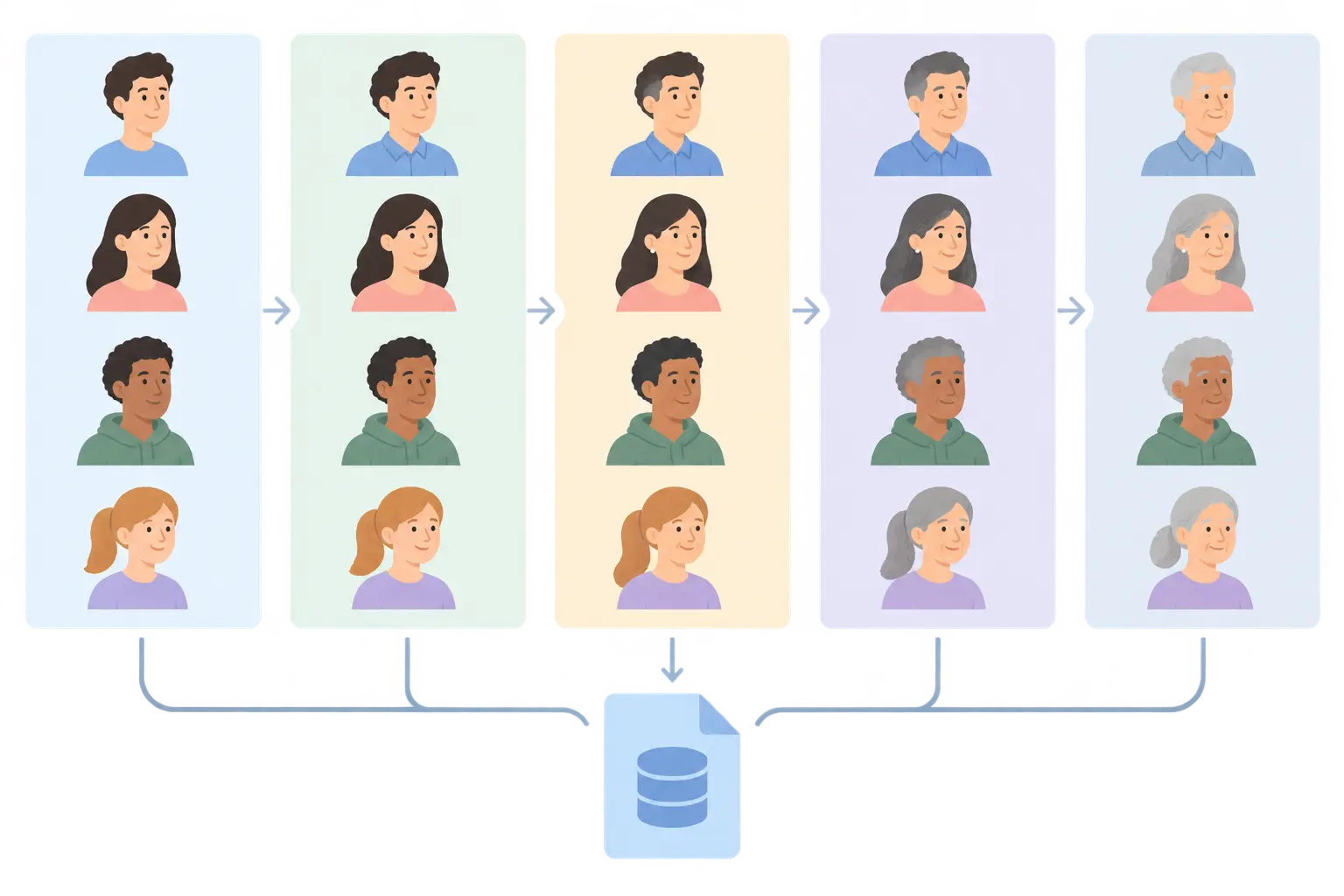
The Health and Retirement Study is a longitudinal panel survey of Americans over age 50, run by the Survey Research Center at the University of Michigan’s Institute for Social Research with funding from the National Institute on Aging and the Social Security Administration. Respondents are re-interviewed about every two years, and the questionnaire covers work and retirement, income and assets, health insurance, physical health and functioning, cognition and health care use. Access to the public data is free after registration through the study’s website.
Best for: questions that link economic circumstances to health over time, such as how retirement timing relates to changes in cognitive scores, or how wealth shocks relate to depressive symptoms. Because it follows the same people for many years, it supports growth-curve and survival designs that a one-time survey cannot.
Watch out for: the volume. The dataset is large and the documentation is long, so plan a month to learn the variable naming and the survey weights before you analyze anything. Cite the specific wave and file version you used.
2. National Health and Aging Trends Study (NHATS)
NHATS gathers information on a nationally representative sample of Medicare beneficiaries aged 65 and older. It began in 2011 and its files are produced and distributed through the NHATS website with funding from the National Institute on Aging. Annual interviews track how health and functioning change with age and cover the disablement process and its consequences, including end-of-life care; the sample is periodically refreshed so researchers can study both national disability trends and individual trajectories.
Access: researchers register on the NHATS website to download public-use files. The site lists conditions you must accept, including not identifying participants, reporting only aggregate results, not uploading the data to large language models and citing the study in publications. Read those conditions before you open a file, and mention them in your methods chapter.
Best for: function and disability questions, such as mobility limitations, falls, assistive device use, and how these differ by living arrangement, education or race and ethnicity. If your thesis is in nursing or occupational therapy, this is often the most direct match for an older-adult function question.
3. National Study of Caregiving (NSOC)
NSOC periodically gathers information on family and unpaid caregivers of NHATS participants, launched in 2011, and since 2021 it has collected data annually. Because it focuses on the caregiver rather than the care recipient, it is the right source for questions about caregiving tasks, hours, burden and support. Researchers register and agree to strict conditions of use; the NHATS site describes the files as sensitive or restricted and distributed through that site, so check the access route and timeline for the exact files you need.
Best for: social work, nursing and public health theses on family caregiving, for example how the intensity of help with daily activities relates to caregiver stress, or how support from other relatives differs across caregiving situations.
4. NHANES
The National Health and Nutrition Examination Survey is run by the National Center for Health Statistics at the Centers for Disease Control and Prevention. It combines interviews, physical examinations and laboratory tests, and it covers people of all ages, which means you can restrict the sample to older adults or compare them with younger groups. Public-use files are free to download; restricted files that carry additional information are available through the NCHS Research Data Center.
Best for: measured rather than self-reported outcomes: blood pressure, body measures, laboratory markers, dietary intake and oral health. If your design needs an objective health measure for older adults, NHANES often beats a self-report survey.
Matching the source to your question
| Your question is about | Start with | Why |
|---|---|---|
| Retirement, wealth and health transitions | HRS | Follows adults over 50 across many waves with economic and health measures |
| Disability, mobility and daily-activity limitations | NHATS | Built around the disablement process among Medicare beneficiaries aged 65 and older |
| Family and unpaid caregiving | NSOC linked to NHATS | Interviews the caregivers rather than the care recipients |
| Objective health measures and nutrition | NHANES | Combines examination, laboratory and dietary data |
You can also search the NACDA collection, the National Archive of Computerized Data on Aging held at the University of Michigan’s ICPSR, to find further aging datasets, including archived waves of studies such as the HRS.
Survey weights, design effects and what your committee will ask
All four sources use complex sampling designs, so unweighted results do not describe the national population. Read each study’s user guide for the weight variable that matches your analysis, and use survey procedures in your statistical software rather than ordinary commands, so the standard errors reflect clustering and stratification. State in your methods chapter which weight you used, why, and whether you restricted the sample, because restricting to a subgroup can change which weight is appropriate. If you have not used survey-weighted analysis before, the guide to free statistical software for students lists packages that support it. If you plan to estimate a causal effect from observational data, the guide to directed acyclic graphs for causal inference helps you decide which variables to adjust for and which to leave out.
Documenting the data in your methods chapter
Committees reading a secondary-data thesis look for the same handful of facts, so put them in one place. Name the dataset and the organization that runs it, the exact years or waves you used, the file version and the date you downloaded it. Describe the target population and the sampling design in two or three sentences, state the unweighted and weighted sample sizes before and after each exclusion, and list every variable you recoded with the original and the new coding. Explain how you handled missing data, and say whether the answers came from the participant or from a proxy. Finally, add a short paragraph on the conditions of use you accepted. A reader should be able to repeat your sample selection from this section alone, and writing it as you work saves days at the end.
Three illustrative thesis designs
The designs below are illustrative, not studies you can copy.
- Function and living arrangement (NHATS). Do older adults who live alone report more difficulty with self-care activities than those living with a spouse, after adjusting for age, chronic conditions and cognition? A cross-sectional weighted regression suits a master’s thesis.
- Retirement timing and cognition (HRS). Is later retirement associated with a slower decline in a cognitive score over a defined number of waves? A growth-curve model fits a doctoral project with strong quantitative training.
- Caregiving intensity (NSOC). Is the number of hours spent helping with daily activities associated with caregiver-reported stress, and is the association weaker when other relatives share the tasks? A regression with an interaction term is feasible with the right file.
Ethics, data use agreements and timelines
Because these are secondary datasets with de-identified records, many institutions treat analysis as exempt or minimal risk, but the determination belongs to your institution’s review board, not to you. Some files, particularly restricted or sensitive ones, need an application, a data use agreement signed by your institution, and secure storage, and the review can take weeks. Start the paperwork before you finish your literature review, not after. Whichever source you choose, keep a log of the exact file versions, download dates and any variables you recoded, and cite the dataset using the citation the study provides.
Common mistakes with aging datasets
- Ignoring survey weights and presenting sample percentages as national estimates.
- Treating a cross-sectional association as an effect of aging when the design only compares different people at one time.
- Mixing waves without checking that a variable’s wording or coding stayed the same.
- Reporting individual-level details that could identify a participant, which the conditions of use forbid.
- Forgetting that proxy respondents answer for some participants and may shift results.
Where Tesify fits
After you choose a dataset and a question, Tesify’s thesis workspace helps you structure the data and methods sections; 9,000+ students have written 15,000+ chapters with Tesify. Every word stays 100% written by you, and Tesify cannot obtain the data, accept a data use agreement for you or run your analysis.
Frequently asked questions
Which dataset is best for a nursing thesis on older adults?
For function, mobility and daily-activity questions among Medicare beneficiaries aged 65 and older, NHATS is usually the closest match; for objective clinical measures, consider NHANES.
Are these datasets free?
The HRS public data are free after registration, NHATS public-use files require registration and acceptance of conditions, and NHANES public-use files are free to download. Restricted files can involve additional steps or fees, so check each site.
Can I use the data with an artificial intelligence tool?
The NHATS conditions of use state that users may not upload the data to large language models. Read the terms of any dataset before you place data in an online tool.
Do I need ethics approval to analyze these datasets?
Often a light review or exemption applies, but your institution’s review board decides. Submit a short description of the dataset and your plan and wait for their determination.
How long does it take to get access?
Registration for public files can be quick, while restricted or sensitive files can take longer because of applications and data use agreements, so apply early and build the wait into your timeline.
Can I combine NHATS and NSOC?
Yes, because caregivers in NSOC are identified through NHATS participants, which lets you link a care recipient’s function to the caregiver’s experience. Follow the study’s instructions for linking and the conditions of use.
Which sample size should I report?
Report the weighted and unweighted sample sizes for your analytic sample after restrictions, and explain each exclusion so a reader can reproduce your selection.
Where can I find more aging datasets?
Search the NACDA collection at ICPSR and the study websites listed above, and check each dataset’s documentation for the population, years and variables before you commit to it.
Write your thesis with AI
Structure, draft, cite, and format your thesis faster with Tesify’s AI writing tools, automatic bibliography, and plagiarism checker. Free to start, no credit card required.




Leave a Reply