
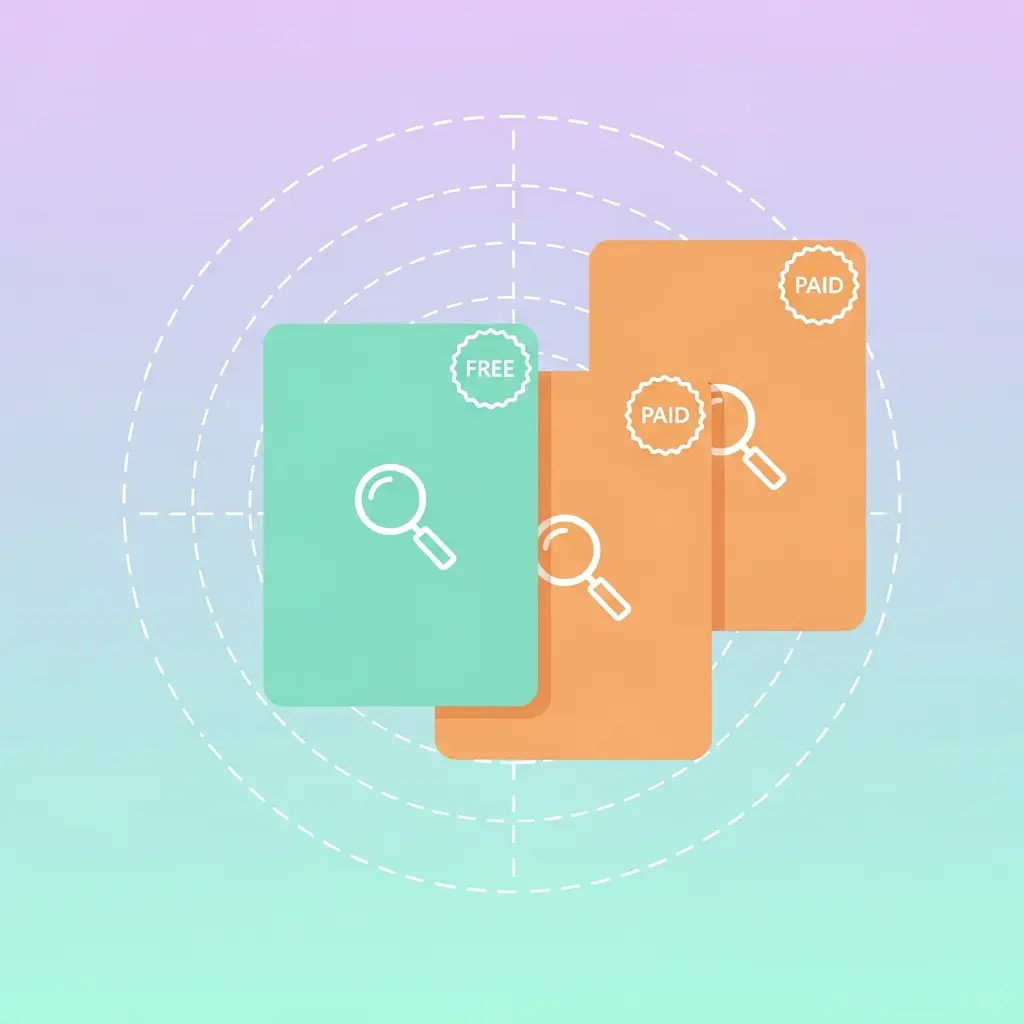
Free vs Paid AI Detectors in 2026: GPTZero vs Originality.ai vs Copyleaks Compared
The moment you submit a thesis in 2026, there is a real chance it passes through an AI detector before a human reads a single word. Free vs paid AI detectors are no longer a curiosity — they are part of the academic infrastructure at thousands of institutions across the UK, US, Australia, Canada, and Ireland. Knowing which tools are in use, what they actually measure, and where they fail is not about gaming the system. It is about understanding the risk landscape for every student who writes.
This comparison covers the three most widely discussed standalone AI detectors: GPTZero, Originality.ai, and Copyleaks. It examines what each tool offers on its free tier, what paid upgrades unlock, how their accuracy and false-positive rates compare in independent 2026 testing, and — critically — which ones universities have actually deployed. The verdict is honest: no detector is reliable enough to be used as sole evidence of academic misconduct, but understanding their individual weaknesses helps you write with confidence and appeal if you are ever wrongly flagged.
At-a-Glance Comparison Table
| Feature | GPTZero | Originality.ai | Copyleaks |
|---|---|---|---|
| Free tier | ~10,000 words/month | No free plan (limited trial credits) | ~10 pages/month (no account needed) |
| Paid entry price | ~$9.99/month (annual) | $12.95/month (annual) or $30 one-time pay-as-you-go | ~$10.99/month |
| AI detection accuracy (controlled benchmarks) | 99.3% (own benchmark); 88% independent | 99.4% on pure AI content (independent) | 96.8% on pure AI content (independent) |
| False-positive risk on native English | Low–moderate (0.24% self-reported; ~9–18% independent) | Low (13% on mixed/edited content) | Moderate (27% on mixed/edited content) |
| False-positive risk on non-native English | High (up to 61% in Stanford study) | Not independently verified for ESL specifically | Moderate (self-reports 0.03%; independent data limited) |
| Plagiarism checking | Paid add-on | Included (2 credits per 100 words) | Included |
| LMS integration | Education tier (classroom use) | None (publisher/agency focused) | Canvas, Moodle, Blackboard |
| Primary audience | Students, educators | Content publishers, agencies | Educators, institutions |
| API access | Paid plans | Enterprise tier only | Business plans |
GPTZero: Best Free Tier, Strong Benchmarks
GPTZero launched in late 2022 as a student project and has since become the most recognised standalone AI detector in the Anglophone world. Its free tier is the most accessible of the three tools reviewed here: users can scan approximately 10,000 words per month without creating an account, with individual scan limits around 10,000 characters. For a student running a final check before submission, that is usually enough for a chapter at a time.
What the free plan includes and excludes
The free plan covers the basic AI detection scan — a percentage score indicating how much of the text is estimated to be AI-generated — along with sentence-level highlighting. It does not include batch uploads, the plagiarism checker, deep-scan mode, or the writing feedback tools. For five advanced scans per month, the free tier includes a limited allowance. Paid plans, which start around $9.99 per month billed annually (approximately $14.99/month on a monthly basis), unlock 150,000 words of scanning, the plagiarism add-on, and API access for higher tiers.
Accuracy and the self-reported vs independent gap
GPTZero publishes an official benchmark claiming 99.3% overall accuracy and a 0.24% false-positive rate — figures derived from a 3,000-sample internal test. In independent 2026 testing using a broader sample mix, accuracy on purely AI-generated content from major models typically falls in the 88–95% range. The false-positive rate on student writing is independently estimated at 9–18%, significantly above the headline figure.
The most alarming finding comes from a Stanford study that tested GPTZero against essays by non-native English writers: the false-positive rate in that sample reached 61.3%. That number does not mean one in two ESL essays will be flagged — the study used a specific dataset — but it indicates a structural bias: AI detectors trained predominantly on native-English text treat predictable, lower-variance phrasing as a signal of machine authorship, even when the writer is simply a careful, non-native speaker. If your first language is not English, see also our deeper treatment of plagiarism and AI detection tools for non-native English writers.
GPTZero’s Chicago Booth benchmark
In early 2026, GPTZero announced strong performance in the University of Chicago Booth School of Business academic benchmark — an independent evaluation specifically covering academic text. GPTZero topped the recall rankings in that benchmark, with a very low false-positive rate on the controlled dataset used. This is a meaningful data point, but note that controlled academic benchmarks use well-structured, clearly AI-generated or clearly human-written texts; real student work, which often mixes sources, edited AI drafts, and genuine prose, is a harder problem.
Verdict on GPTZero
For students who want to run a pre-submission self-check to understand what a detector sees in their writing, GPTZero’s free tier is the most practical starting point. It is not a guarantee of pass or fail — it is a tool for building situational awareness.
Originality.ai: Highest Accuracy, No Free Plan
Originality.ai launched in late 2022 with a different target market in mind: content agencies and publishers who commission high-volume written output and need to verify it is not AI-generated before publishing. That heritage shapes everything about how the tool is priced and positioned.
Pricing structure
There is no ongoing free tier. New users receive a small number of trial credits at signup, but these are exhausted quickly. The Pay-As-You-Go option costs $30 for 3,000 credits (credits expire after two years). The Pro subscription is $12.95/month on annual billing or $14.95/month month-to-month, giving 2,000 monthly credits that expire at the end of each billing cycle. The Enterprise tier, at $136.58/month annually, provides 15,000 credits, API access, priority support, and 365-day scan history. One credit covers 100 words; running the combined AI-detection and plagiarism check costs 2 credits per 100 words.
For a 10,000-word thesis, a combined scan costs 200 credits — about $1 at Pay-As-You-Go rates. That is actually affordable as a one-off. The problem for students is that pay-as-you-go requires purchasing at least $30 worth of credits up front.
Accuracy
Originality.ai performs well on independent benchmarks for pure AI content detection, scoring 99.4% accuracy against pure-AI content in multiple 2026 comparisons. On mixed or edited content (human text lightly revised by AI, or AI text edited by a human), its false-positive rate is documented at around 13% — lower than Copyleaks (27%) but above the published GPTZero benchmark. A January 2026 study published by the Journal of Advances in Information Technology reported Originality.ai achieving 100% accuracy across tested LLM and human samples, though that study’s sample characteristics and methodology have not been independently replicated at scale.
Who Originality.ai is for
Bluntly: it is built for agencies, not students. The credit system, the absence of a free tier, the lack of LMS integration, and the editorial-focused feature set (readability scores, content grade, team seats for editorial workflows) all point toward professional content operations. A student checking their own thesis would be better served by GPTZero’s free tier or Copyleaks’ free scan allowance. If you are a researcher who commissions writing and needs to verify deliverables at volume, Originality.ai is competitive.
Copyleaks: University-Ready, Inconsistent on Edited Text
Copyleaks has been in the plagiarism-detection space since 2015, which gives it a track record and institutional trust that GPTZero and Originality.ai cannot match. In 2022 it expanded into AI detection, and by 2026 it has become the most institutionally embedded of the three tools in this comparison — particularly in North America.
Free tier and pricing
Copyleaks allows scanning approximately 25,000 characters (roughly 10 pages or 2,500 words) without creating an account. For comparison, that is sufficient to check a substantial chapter of a thesis once. Paid personal plans start around $10.99/month and include a monthly credit allowance; 1 credit covers up to 250 words. Annual billing reduces costs by approximately 20%. Education and enterprise plans add LMS integration, administrative dashboards, and multi-seat management.
Accuracy and limitations
On purely AI-generated text, Copyleaks scores approximately 96.8% accuracy in independent 2026 benchmarks — lower than Originality.ai (99.4%) and GPTZero’s controlled-benchmark result (99.3%), but still strong. The more concerning metric is its false-positive rate on mixed and edited content, which independent testing places around 27%: roughly one in four documents that contain some AI assistance alongside substantial human writing may receive an elevated AI flag.
Copyleaks self-reports a 0.03% false-positive rate, a figure that refers to a specific benchmark on clearly human-written documents and does not reflect real-world performance on edited academic writing. For detailed data on how accuracy numbers vary by study methodology, our AI detection accuracy statistics roundup for 2026 covers false-positive rates across all major tools including Turnitin.
LMS integration and institutional presence
Copyleaks integrates natively with Canvas, Moodle, and Blackboard — the three learning management systems that dominate higher education. In early 2025, Southern Methodist University announced it was replacing Turnitin with Copyleaks, citing its AI detection capabilities and Canvas integration. This adoption pattern is significant: Copyleaks is likely the AI detector most students will encounter through their institution’s official submission portal, even if they never hear its name explicitly.
The False-Positive Problem Every Student Needs to Know
AI detection false positives — flagging genuinely human-written work as AI-generated — are not an edge case in 2026. They are a documented, recurring problem that has resulted in wrongful academic misconduct investigations at institutions across the world.
The false-positive risk is highest in three scenarios:
- Non-native English writers whose careful, patterned phrasing reduces linguistic variance (the Stanford study found rates up to 61.3% for GPTZero on ESL essays).
- Highly formulaic sections such as methodology chapters, abstract structures, and literature review boilerplate — precisely the sections most likely to appear in a thesis.
- Short text fragments — all three detectors perform less reliably on passages under 300 words, where statistical patterns are less meaningful.
If your work is ever flagged, the response is not to panic or to alter your writing. The appropriate steps are to document your process (draft history, notes, source lists, browser history from research sessions), request a human review, and reference published peer-reviewed research on detector unreliability. Our guide on what to do when your thesis is flagged as AI-written walks through the full appeal process in detail.
One often-overlooked risk factor is academic vocabulary choices. If you are wondering whether reaching for a synonym tool creates detection risk, our guide on whether a thesaurus is allowed in academic writing covers the evidence on AI detectors and synonym use.
What Universities Actually Use in 2026
The honest picture of institutional AI detection is more fragmented than many students assume. Turnitin remains the dominant platform at most UK, Australian, and large US universities — its 2023 AI detection layer, built on top of its established plagiarism infrastructure, is the tool most students are actually checked against. GPTZero, Originality.ai, and Copyleaks are used by some institutions and many individual instructors, but they are not the central institutional layer in the same way.
| Tool | Institutional use pattern | Who typically uses it |
|---|---|---|
| Turnitin | Dominant: built into submission portals at most large universities in UK, AU, NZ, Canada | Institutions (enterprise contract) |
| GPTZero | Education tier adopted by K-12 schools; some individual university instructors | Individual educators; schools |
| Copyleaks | Growing university adoption via Canvas/Moodle integration; replacing Turnitin at some US institutions | Institutions; LMS-native workflow |
| Originality.ai | Minimal institutional presence; primarily content agencies and editorial teams | Publishers; content teams |
A significant counter-trend is also visible: a number of universities are scaling back AI detection use entirely, citing false-positive concerns, the cost of investigations, and the lack of a legally defensible evidentiary standard. Many UK and Australian institutions now officially require corroborating evidence — such as viva-voce questioning or portfolio assessment — before a detector flag can form the basis of a misconduct case. The detector score alone is not, and should not be, treated as proof.
For a full breakdown of which institutions have adopted which tools and how much they spend on AI detection contracts, the comparison of plagiarism checkers for students including Turnitin and Copyleaks covers institutional adoption in more depth.
Using AI Detectors Ethically and Defensively
There is an important distinction between using an AI detector to understand what institutional tools will see in your writing — which is entirely legitimate — and using them to iteratively rewrite work until a detector score drops, which is ethically problematic and increasingly flagged by institutions as a form of academic misconduct in its own right.
The defensively ethical use of AI detectors as a student looks like this:
- Run your completed draft through a free-tier check to understand its current score.
- If the score is unexpectedly high, examine which sections are flagged. Formulaic passages (abstract, methodology boilerplate) may read as AI-like simply because they follow a well-established template.
- Revise those sections not to lower a score, but to express your own analytical voice more clearly — add specific examples from your data, reference particular arguments from your literature review, or restructure sentences to reflect your genuine reasoning.
- Keep a record of your revision process, including earlier drafts, as evidence of genuine authorship.
For the broader evidence on why current detectors are considered unreliable and how institutions are grappling with the policy problem, our comparison of tools used to address AI-detection false positives examines the institutional and ethical dimensions in detail.
Where Tesify Fits In
Tesify is an AI-assisted academic writing platform — it helps you write and structure your thesis more effectively. It is not an AI detector, and it is not a detector-beating tool. Its role in this landscape is upstream of the detection question entirely.
When you use Tesify’s AI Editor to work on your thesis, the output is your writing, informed by AI assistance. The tool helps you structure arguments, suggest academic phrasing, and maintain consistency — but the ideas, the analysis, and the voice remain yours. That is fundamentally different from pasting a prompt into a general-purpose chatbot and submitting the output.
Tesify also includes a built-in plagiarism checker that helps you verify your citations are properly attributed before you submit. It does not offer a standalone AI detection score — because running your own work through an AI detector and then optimising for the output is exactly the kind of iterative score-chasing that institutions are beginning to treat as a misconduct signal. The better approach is to write well, document your process, and be transparent about any AI tools you have used, as most institutions’ updated AI policies require.
For citation integrity specifically, Tesify’s Auto Bibliography ensures every source you reference is formatted correctly and consistently — eliminating a category of error that sometimes triggers plagiarism flags in poorly formatted reference lists.
Final Verdict: Free vs Paid AI Detectors in 2026
| Use case | Best choice | Why |
|---|---|---|
| Student pre-submission self-check (free) | GPTZero | Most generous free tier; strong controlled accuracy; student-facing UI |
| Understanding what your institution’s tool will see | Copyleaks | Most likely to match institutional detection layer in US/CA settings; Canvas-integrated |
| Agency/publisher content verification at volume | Originality.ai | Best accuracy on pure AI content; combined AI + plagiarism in one credit spend |
| Non-native English writers concerned about false positives | None reliably | All three have elevated false-positive risk for ESL writing; document process instead |
| Best overall writing + integrity platform for thesis students | Tesify | Thesis-specific AI writing aid + plagiarism checking; focuses on quality, not score manipulation |
The fundamental takeaway for 2026 is this: no AI detector is accurate enough to be used as standalone evidence of academic misconduct, and any result — whether from a free GPTZero scan or a paid Originality.ai report — should be treated as probabilistic and context-dependent, not conclusive. The best defence against an unjust flag is a well-documented writing process, a distinctive academic voice, and a clear understanding of your institution’s AI policy.
Frequently Asked Questions
Is GPTZero free to use?
GPTZero offers a free tier that includes approximately 10,000 words per month and up to 10,000 characters per scan. Advanced features such as batch uploads, the plagiarism checker, and deep-scan mode require a paid plan starting around $9.99/month billed annually.
Which AI detector has the lowest false-positive rate for students?
No detector has a zero false-positive rate in real-world use. Independent 2026 benchmarks show GPTZero performing best on controlled datasets, but all three tools produce significantly higher error rates on non-native English writing and heavily edited text. Treat any single detector result as indicative, not conclusive.
Do universities use GPTZero, Originality.ai, or Copyleaks?
Turnitin remains the dominant institutional tool. GPTZero has a dedicated Education tier used by K-12 schools and some university instructors. Copyleaks is integrated with Canvas and has been adopted by institutions including Southern Methodist University. Originality.ai is primarily used by content publishers and editors rather than universities directly.
Can AI detectors tell if I used ChatGPT to help edit my thesis?
They attempt to, but accuracy drops considerably on edited or mixed-source text. All three tools perform better on purely AI-generated content than on human writing that was lightly assisted or edited by AI. A passage where you wrote the ideas and used AI to smooth a sentence or two may or may not be flagged — results are inconsistent across tools and documents.
For a Korean-language overview of how ChatGPT-generated text interacts with plagiarism detection systems, see the Korean-language guide to ChatGPT and thesis plagiarism.
Is Originality.ai worth paying for as a student?
For most students, probably not. Originality.ai is built for content publishers and agencies who need to verify large volumes of text. Its credit-based pricing ($14.95/month for 2,000 credits, where 1 credit = 100 words) makes it expensive for occasional thesis checks. GPTZero’s free tier or Copyleaks’ free scan allowance is more practical for a student checking their own work once or twice.
What should I do if my thesis is wrongly flagged as AI-generated?
Document your writing process: drafts, notes, search histories, and timestamps all serve as evidence of genuine authorship. Request a human review from your institution and point to peer-reviewed research on AI detector false-positive rates. Many institutions now require additional corroborating evidence before acting on a detector flag alone, and that academic norm is increasingly formalised in official policies.
Write your thesis with AI
Structure, draft, cite, and format your thesis faster with Tesify’s AI writing tools, automatic bibliography, and plagiarism checker. Free to start, no credit card required.




Leave a Reply