
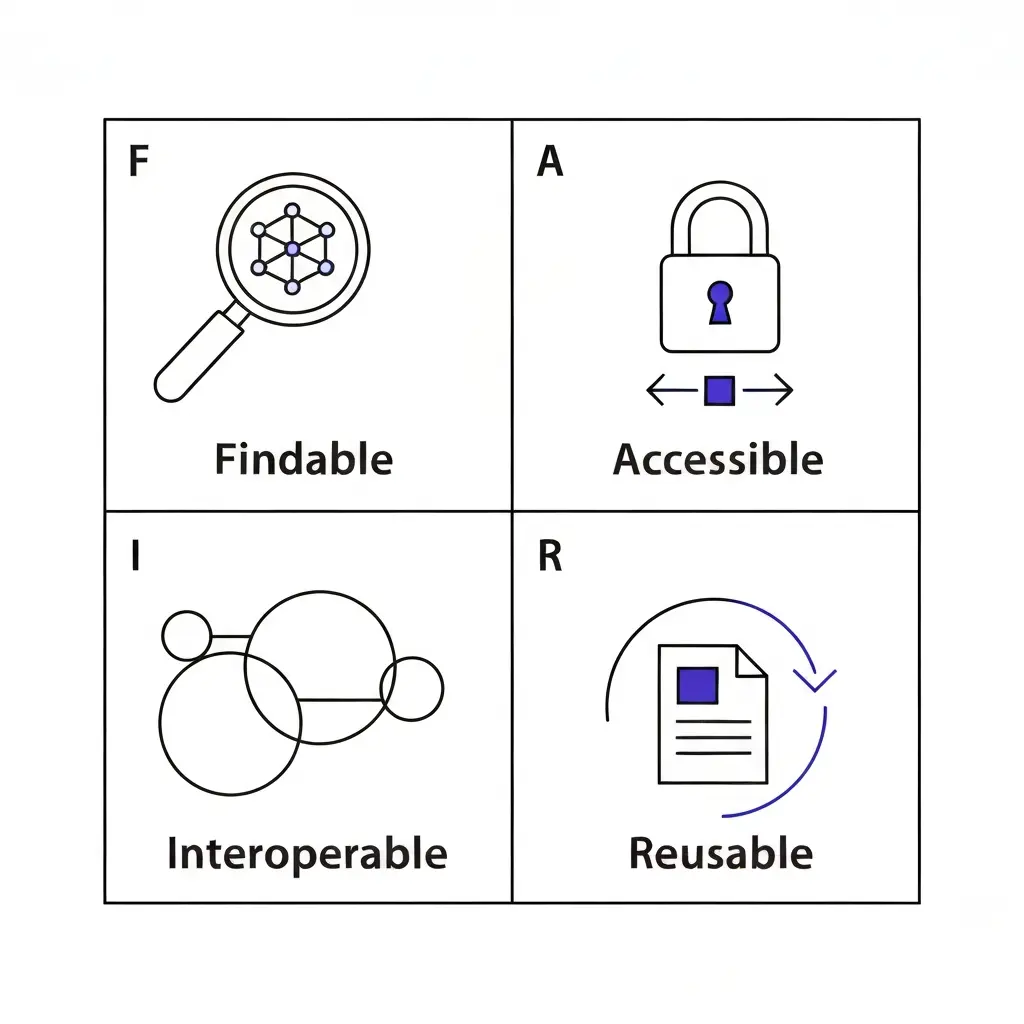
FAIR Data Principles for Researchers: A Complete Guide to Research Data Management in 2026
Research data has a reproducibility problem that predates any single discipline. When a study cannot be replicated — whether because the dataset has been lost, the methodology is underspecified, or the file format is proprietary and unreadable a decade later — science accumulates a silent debt. The FAIR data principles for researchers represent the most widely adopted international framework for preventing that debt from accruing in the first place. Codified in a landmark 2016 paper by Wilkinson et al. in Scientific Data and now mandated by funders from UKRI to the National Institutes of Health, FAIR provides a concise, measurable standard against which any dataset can be evaluated. This guide explains where FAIR came from, what each of the fifteen sub-principles demands in practice, how to apply them to a thesis or dissertation dataset, and why “FAIR” is not synonymous with “open.” For the broader context of why data management and reproducibility matter, see our detailed treatment of the reproducibility crisis in research.
Origins: From the Lorentz Workshop to a Global Standard
Video: The FAIR principles explained — Maastricht University (official university channel)
The principles did not emerge from a single institution or regulatory body. Their origin traces to a workshop convened at the Lorentz Center in Leiden, Netherlands, in January 2014, organised at the request of the Netherlands eScience Center and the Dutch Techcentre for the Life Sciences. Stakeholders representing academia, industry, funding agencies, and scholarly publishers gathered to debate what a twenty-first-century scientific data publishing environment needed to do — and, critically, to do for machines, not merely for human readers.
A first draft was circulated through the FORCE11 community and refined through two years of open comment before formal publication. The canonical reference remains: Wilkinson, M.D., Dumontier, M., Aalbersberg, I.J. et al. (2016). “The FAIR Guiding Principles for scientific data management and stewardship.” Scientific Data, 3, 160018. DOI: 10.1038/sdata.2016.18. The paper’s abstract opens with a line that remains the clearest statement of intent: the authors wished to provide guidelines to enhance the findability, accessibility, interoperability, and reuse of digital assets, with an explicit emphasis on “enhancing the ability of machines to automatically find and use the data.”
In 2017 the GO FAIR Initiative was established as a bottom-up, stakeholder-driven, self-governed movement to operationalise the principles across Europe and beyond, eventually feeding into the European Open Science Cloud (EOSC). GO FAIR operates through three activity pillars: GO CHANGE (policy and incentives), GO TRAIN (skills development), and GO BUILD (technical standards and infrastructure). The initiative’s prominence has helped make FAIR data fluency an expected competency for any researcher working with externally funded projects in the UK, EU, and North America.
The Fifteen Sub-Principles: A Practitioner’s Breakdown

The four headline letters each contain multiple sub-principles — fifteen in total — published verbatim by GO FAIR and cited directly from the 2016 Wilkinson paper. The following exposition uses those exact formulations and translates each into the practical decisions a researcher must make.
Findable (F1–F4)
Findability is the precondition for everything else. A dataset that cannot be located — by a search engine, a metadata harvester, or a colleague — delivers no scientific value beyond the immediate project team.
| Sub-principle | Exact wording (GO FAIR / Wilkinson et al. 2016) | What it means in practice |
|---|---|---|
| F1 | (Meta)data are assigned a globally unique and persistent identifier | Every dataset needs a DOI, ARK, or equivalent PID — not a URL that can rot. |
| F2 | Data are described with rich metadata | A minimal title and author is insufficient. Methods, variables, temporal/geographic scope, and collection instruments must be described. |
| F3 | Metadata clearly and explicitly include the identifier of the data they describe | The metadata record must contain the dataset’s PID — the link between description and data must be explicit, not inferred. |
| F4 | (Meta)data are registered or indexed in a searchable resource | The dataset record must be discoverable through a search interface — a repository with metadata harvesting (e.g., Zenodo, which is indexed by DataCite and Google Dataset Search). |
F1 is arguably the single most actionable principle for researchers new to FAIR. A Digital Object Identifier (DOI) issued by a trusted repository resolves this requirement immediately. The DOI system, governed by the International DOI Foundation, ensures that an identifier persists even if the dataset’s host URL changes — unlike a bookmark or a university file-server path.
Accessible (A1–A2)
Accessibility is where FAIR is most frequently misunderstood. The “A” does not mean “freely downloadable by anyone.” It means that the conditions under which access can be obtained are clearly specified and that retrieval is possible through a standardised, open protocol.
| Sub-principle | Exact wording | Practical implication |
|---|---|---|
| A1 | (Meta)data are retrievable by their identifier using a standardised communications protocol | HTTPS is the standard protocol. Data should be retrievable by resolving the PID. |
| A1.1 | The protocol is open, free, and universally implementable | No proprietary transfer protocol. Any system, anywhere, must be able to send the request. |
| A1.2 | The protocol allows for an authentication and authorisation procedure, where necessary | Controlled-access datasets (e.g., those containing sensitive personal data) can still satisfy A1 by providing an authenticated access route — a login or data-access agreement form. |
| A2 | Metadata are accessible, even when the data are no longer available | If a dataset must be withdrawn (e.g., after a participant withdraw consent), the metadata record must remain — so that other researchers know the dataset existed and why it is unavailable. |
Sub-principle A2 is particularly consequential for longitudinal studies and clinical research. It establishes a principle of “metadata permanence” that requires repositories to maintain tombstone records for withdrawn datasets. Zenodo’s policy, for instance, explicitly commits to this: every record, even one that has been restricted or retracted, retains its DOI landing page and metadata stub indefinitely.
Interoperable (I1–I3)
Interoperability is the most technically demanding of the four dimensions and the one most dependent on community standards. A dataset achieves interoperability when it can be combined with other datasets, processed by automated workflows, and understood by software systems that were not involved in its creation.
| Sub-principle | Exact wording | Practical implication |
|---|---|---|
| I1 | (Meta)data use a formal, accessible, shared, and broadly applicable language for knowledge representation | Use open, machine-readable formats: CSV rather than .xlsx (where possible), JSON-LD, RDF, or domain-specific exchange formats (e.g., NetCDF for climate data, BIDS for neuroimaging). |
| I2 | (Meta)data use vocabularies that follow FAIR principles | Variable names, subject headings, and controlled terms should come from published, stable ontologies — for example, MeSH for biomedical research, the Getty Art & Architecture Thesaurus for humanities, or Darwin Core for biodiversity data. |
| I3 | (Meta)data include qualified references to other (meta)data | If your dataset builds on, derives from, or supplements another dataset, that relationship must be explicitly typed — e.g., using DataCite’s isPartOf, isDerivedFrom, or isVersionOf metadata fields. |
I2 is where many early-career researchers underestimate the work involved. Writing “education level: low / medium / high” in a survey dataset is informal and ambiguous. Using the ISCED-2011 classification from UNESCO, and referencing the published terminology in the metadata, means any researcher — or automated system — can precisely interpret what those values represent. The DataCite Metadata Schema (version 4.6, released 2026) now includes expanded support for controlled vocabulary linkage, reflecting the maturation of this infrastructure.
Reusable (R1–R1.3)
Reusability is the ultimate goal that the preceding three dimensions serve. A dataset is reusable when a researcher who was not involved in its creation can decide, from the metadata alone, whether it is appropriate for their purpose — and can then use it without having to contact the original team for clarification.
| Sub-principle | Exact wording | Practical implication |
|---|---|---|
| R1 | (Meta)data are richly described with a plurality of accurate and relevant attributes | Go beyond mandatory fields. Describe sample size, instruments used, date range, geographic scope, and any known limitations of the data. |
| R1.1 | (Meta)data are released with a clear and accessible data usage license | Apply a machine-readable licence. Creative Commons CC BY 4.0 is the most widely accepted for open data; CC BY-NC or custom institutional licences for restricted datasets. |
| R1.2 | (Meta)data are associated with detailed provenance | Document how the data were generated: instruments, software versions, transformation steps, any cleaning decisions. A README or codebook deposited alongside the data files satisfies this requirement. |
| R1.3 | (Meta)data meet domain-relevant community standards | In clinical research, CDISC standards; in psychology, the BIDS extension for behavioural data; in ecology, Darwin Core. Disciplinary alignment ensures that peers can evaluate the data against known quality criteria. |
R1.1 deserves particular attention for thesis researchers. Many universities now require students to specify a data licence as part of the submission process. Choosing a licence is not merely a bureaucratic formality: it is the legal instrument that allows — or prohibits — secondary analysis. CC0 (no rights reserved) maximises reuse but may be inappropriate for datasets containing commercially sensitive materials; CC BY 4.0 (attribution required) is the standard recommendation from most funders and repositories including Zenodo and Figshare.
FAIR vs. Open: An Essential Distinction
One of the most persistent misconceptions about the FAIR framework is the conflation of “FAIR” with “open access.” The GO FAIR initiative addresses this directly in its published FAQ: “FAIR data does not mean open data.” The distinction rests on sub-principle A1.2, which explicitly permits authentication and authorisation as part of the access protocol. This means a dataset containing identifiable personal data — interview transcripts, clinical records, biometric measurements — can satisfy all fifteen FAIR sub-principles while remaining behind a controlled-access wall.
The practical configuration for a restricted-access FAIR dataset involves three elements. First, the metadata record is publicly visible and richly described, so that any researcher can assess the dataset’s relevance to their needs. Second, the access conditions — data sharing agreement, institutional review board approval, identifiable requestor — are clearly stated in the metadata. Third, the metadata record persists even if the data themselves are withdrawn, satisfying A2. Repositories such as the UK Data Service and the Australian Data Archive provide this controlled-access infrastructure as a standard service.
The complementary pair “FAIR and Open” (sometimes written FAIR/O) describes the highest-ambition configuration: data that satisfies all fifteen principles and carries an open licence. Major funders increasingly require FAIR/O for publicly funded research, but the FAIR-without-Open configuration remains legitimate and legally necessary for any dataset whose openness would conflict with participant consent, privacy regulations, or intellectual property obligations. A researcher working with NHS patient records, for example, may be required by their institution’s ethics committee to implement restricted access regardless of FAIR aspirations.
For guidance on articulating these distinctions in a manuscript, the article on how to write a data availability statement provides templates for open, restricted, on-request, and no-data scenarios.
Persistent Identifiers and Metadata: The Practical Infrastructure of FAIR
The FAIR principles are technology-agnostic: they specify what must be true of data, not which tools must implement it. In practice, however, two infrastructure components underpin the entire framework — persistent identifiers (PIDs) and structured metadata.
Persistent Identifiers
A persistent identifier is a reference to a digital object that does not break when the object moves. The most widely used PID for datasets is the DOI (Digital Object Identifier), governed by the International DOI Foundation and registered for research datasets primarily through DataCite. When a researcher deposits a dataset in Zenodo, the repository automatically mints a DOI and registers it with DataCite, satisfying F1 in a single step.
For researchers themselves, the ORCID iD (Open Researcher and Contributor ID) functions as a persistent identifier for the person rather than the dataset. Linking an ORCID iD to every dataset deposit establishes unambiguous attribution, which matters both for credit and for compliance with funder requirements. ORCID integration is now standard across Zenodo, Figshare, Dryad, and the OSF, as well as in manuscript submission systems such as ScholarOne and Editorial Manager.
Other PID types relevant to researchers include:
- ROR (Research Organisation Registry): persistent identifier for institutions, enabling unambiguous affiliation metadata.
- RAiD (Research Activity Identifier): PID for research projects, enabling dataset provenance to be linked to the grant that funded it.
- Handle: the underlying resolver system on which DOIs are built; also used independently by some institutional repositories.
Structured Metadata
Rich, machine-readable metadata is the mechanism through which the other principles are implemented. The dominant metadata schemas in use across general-purpose repositories are:
- DataCite Metadata Schema (v4.6, released March 2026): the standard used by Zenodo, Dryad, and Figshare. Includes mandatory fields (identifier, creator, title, publisher, publicationYear, resourceType) and recommended fields covering description, subject, rights, funding reference, and relatedIdentifier — the last of these satisfying I3 directly.
- Dublin Core: a simpler fifteen-element schema widely used by institutional repositories. Sufficient for basic discoverability but less expressive than DataCite for scientific data.
- Schema.org Dataset: the vocabulary used by Google Dataset Search to index research data. Repositories that expose schema.org markup in their HTML pages gain crawlability from the world’s most widely used search infrastructure.
Domain-specific metadata standards add a further layer of interoperability within disciplinary communities. In clinical trials, the CDISC Study Data Tabulation Model (SDTM) provides a standardised structure for submission datasets. In neuroimaging, the Brain Imaging Data Structure (BIDS) specification defines file naming, directory organisation, and required metadata files. In ecology, Darwin Core terms provide a controlled vocabulary for organism occurrence data. Researchers should consult their disciplinary community or institutional data librarian to identify the applicable standard before beginning data collection, since retrofitting metadata structure after the fact is significantly more laborious.
Choosing a FAIR-Compliant Repository
A repository does not guarantee that a dataset deposited within it is FAIR — the researcher must provide adequate metadata — but the choice of repository determines which FAIR infrastructure is available. The following table summarises the major general-purpose repositories recommended for thesis researchers and early-career academics in 2026.
| Repository | PID issued | Metadata schema | Access modes | Storage limit (free) |
|---|---|---|---|---|
| Zenodo | DOI (DataCite) | DataCite v4.6, schema.org | Open, restricted, closed, embargoed | 50 GB per record |
| Figshare | DOI (DataCite) | DataCite, Dublin Core | Open, restricted | 20 GB per account |
| Dryad | DOI (DataCite) | DataCite, Dryad custom | Open (CC0 licence required) | 300 GB per submission (fee above 50 GB) |
| OSF (Open Science Framework) | DOI (DataCite) | Schema.org, Dublin Core | Open, private, restricted | 50 GB per project |
| UK Data Service | DOI, Handle | DDI, Dublin Core | Open, SafePod (controlled) | No stated limit; ESRC-funded datasets prioritised |
For discipline-specific repositories, the re3data.org registry indexes more than 3,000 research data repositories with filtering by subject, country, content type, and access conditions. Selecting a community-recognised repository for your discipline — rather than a general-purpose one — improves compliance with R1.3 (domain-relevant community standards) and signals quality to reviewers and hiring committees.
OSF is particularly valuable for researchers who also wish to preregister their study. Combining data deposit with a preregistered analysis plan on the same platform creates an auditable record of the relationship between planned and executed analysis — a workflow described in detail in the guide to how to preregister a study on OSF and AsPredicted.
Making Your Thesis Dataset FAIR: A Step-by-Step Approach
Most thesis students encounter FAIR requirements late in the research process — at the data availability statement stage, when the supervisor requests a DOI, or when the institution’s digital submission portal asks for a data deposit link. The following sequence is most efficiently applied during the research design phase, but can be partially retrofitted after data collection.
Step 1: Plan at the Design Stage
Write a Data Management Plan (DMP) before data collection begins. Many funders and institutions now provide DMP templates through the DMPTool (US) or DMPonline (UK). A DMP forces decisions about file formats, storage locations, access conditions, and eventual deposit — decisions that are far more costly to reverse after a dataset of thousands of rows has been collected in a proprietary format.
Step 2: Use Open File Formats
Wherever possible, collect and store data in non-proprietary formats that will be readable without licenced software. For tabular data: CSV (preferred) or TSV. For qualitative data: plain text (.txt) or PDF/A. For structured data: XML or JSON. For quantitative analysis scripts: .R, .py, or .do files should be included alongside the data so that transformations are transparent (R1.2 — provenance).
Step 3: Apply a Controlled Metadata Schema
Most repositories guide users through a metadata form at the point of upload. Fill every field, not just the required ones. For a survey dataset, the metadata description should include: survey instrument (with a link to or copy of the questionnaire), sampling frame, response rate, date(s) of data collection, geographic scope, anonymisation procedures, and any known missing data. A separate README.txt or codebook.csv file deposited alongside the data files will satisfy R1 and R1.2 even when the repository’s metadata form is insufficiently granular.
Step 4: Assign a Licence
Select the licence before uploading. For data that can be fully open: CC BY 4.0 (attribution required) is the default recommendation of Zenodo, Dryad, and most UK and EU funders. For data with sensitivity concerns: CC BY-NC (non-commercial use only), CC BY-ND (no derivatives), or a custom institutional licence. For data that cannot be shared: a “closed” deposit with a public metadata stub satisfying A2 is still a FAIR-compliant choice.
Step 5: Deposit and Obtain a DOI
Upload files to the chosen repository, complete the metadata form, and publish the record. The repository issues a DOI immediately on publication (Zenodo) or within 24 hours (Dryad). Copy this DOI into your thesis as the canonical dataset reference and into the data availability statement in any associated manuscripts.
Step 6: Link to Related Outputs
Use the repository’s relatedIdentifier field to link the dataset to the thesis DOI (if institutional repositories issue one), any pre-prints, and any published articles. This satisfies I3 and creates a web of linked scholarly objects that automated systems — grant reporting tools, citation trackers, research information systems — can traverse without manual intervention.
Funder Mandates and Institutional Requirements in 2026
FAIR data compliance has shifted from a best-practice recommendation to an enforceable grant condition across most major research funding systems.
UKRI (UK Research and Innovation) published a draft new research data policy framework for consultation in spring 2025, consolidating requirements across its seven research councils. The framework updates and streamlines expectations for data management plans and FAIR compliance. Current requirements per council vary: EPSRC expects appropriately structured metadata to be published online within twelve months of data generation; ESRC requires deposit with a responsible data repository within three months of grant end.
National Institutes of Health (NIH) implemented its Data Management and Sharing Policy in January 2023, requiring a Data Management and Sharing Plan (DMSP) for all NIH-funded research generating scientific data. Compliance is assessed against FAIR principles; datasets must be deposited in an NIH-recognised repository.
Horizon Europe (the EU Framework Programme for 2021–2027) operates on an “open by default” basis for research data. Projects are expected to submit a Data Management Plan and to make data FAIR and open unless there are legitimate grounds (privacy, security, commercial) for restriction. The European Open Science Cloud (EOSC) provides the federated infrastructure for FAIR data discovery and access.
At the institutional level, most Russell Group universities in the UK and research universities in the US and Australia now require doctoral students to submit a data management plan as part of the thesis examination process, and many require a dataset DOI in the final thesis. Students should consult their institutional research data management service early — most offer deposit support, DMP consultation, and controlled-access repository access at no cost to the student.
For researchers managing their own bibliography and source documentation during this process, the practical guide to citation tools and Zotero covers how reference managers integrate with repository workflows.
Frequently Asked Questions
What is the difference between FAIR data and open data?
FAIR data is not necessarily open data. The “A” in FAIR permits authentication and access controls where necessary (sub-principle A1.2), meaning restricted or confidential datasets can still be fully FAIR if their metadata is publicly visible and the access conditions are clearly specified. Open data, by contrast, is freely downloadable by anyone without restriction. The two frameworks are complementary, and “FAIR and Open” (FAIR/O) represents the highest ambition, but FAIR without open remains a valid and sometimes legally required configuration — for example, for datasets containing personal health data or commercially sensitive information.
Do I need to make my thesis dataset FAIR if my research is self-funded?
Funder mandates apply only to externally funded research, but institutional requirements may extend to all thesis submissions regardless of funding source. Many universities now require a data availability statement and a dataset DOI from all doctoral candidates at the point of thesis submission. Beyond compliance, a FAIR deposit increases the citability and discoverability of your data — which benefits your academic career even if no funder requires it. The cost is modest: depositing a well-described dataset in Zenodo or OSF takes roughly one to three hours for a well-organised project.
Which is the best repository for thesis researchers?
Zenodo is the most broadly recommended general-purpose option: it is CERN-hosted, free, issues DOIs via DataCite, supports open and restricted access, and imposes no size limit on records up to 50 GB. For discipline-specific deposit, re3data.org lists over 3,000 subject repositories and allows filtering by discipline, access type, and country. Researchers in the UK with ESRC funding should use the UK Data Service. Those combining dataset deposit with study preregistration should consider OSF, which integrates both functions.
What exactly is a persistent identifier and why does FAIR require one?
A persistent identifier (PID) is a reference to a digital object that remains stable even if the object is moved to a different server or URL. The most common PID for datasets is the DOI (Digital Object Identifier), which resolves via the doi.org resolver to the current location of the dataset. FAIR sub-principle F1 requires a PID because ordinary URLs are fragile — server migrations, institutional changes, and domain discontinuations routinely break them. A DOI issued by a DataCite member repository guarantees that the dataset can always be located by its identifier, satisfying both F1 (findability) and A1 (retrieval via standardised protocol).
What should a FAIR-compliant README file contain?
A FAIR-compliant README addresses sub-principles R1 (rich description), R1.2 (provenance), and R1.3 (community standards). It should include: project title and authors with ORCID iDs; date(s) of data collection; geographic and temporal scope; data collection instruments (with version numbers or questionnaire appended); file inventory with descriptions of each file; variable definitions and units (or a link to a separate codebook); software and version required to open each file; known limitations or missing data; ethical approvals and consent procedures; and the chosen data licence. The Cornell Research Data Management Service Group publishes a widely-used README template that covers all of these elements.
Can qualitative data (interview transcripts, field notes) be FAIR?
Yes, though the access configuration will typically be restricted rather than open. Transcripts and field notes containing personal data must be anonymised before deposit, or deposited under controlled access with a data-sharing agreement, to comply with GDPR (in Europe) and equivalent privacy regulations elsewhere. The metadata record can still be fully public, describing the research context, interview protocol, sample characteristics, and access conditions — satisfying the FAIR principles for findability, accessibility (under defined conditions), and reusability (for other qualitative researchers who can apply for access). Plain text (.txt) or PDF/A formats are preferred for long-term preservation.
References
- Wilkinson, M.D., Dumontier, M., Aalbersberg, I.J. et al. (2016). The FAIR Guiding Principles for scientific data management and stewardship. Scientific Data, 3, 160018. https://doi.org/10.1038/sdata.2016.18
- GO FAIR Initiative. (2016–2026). FAIR Principles. Retrieved from https://www.go-fair.org/fair-principles/
- FORCE11. (2014–2016). Guiding Principles for Findable, Accessible, Interoperable and Re-usable Data Publishing. https://force11.org/info/guiding-principles-for-findable-accessible-interoperable-and-re-usable-data-publishing-version-b1-0/
- UKRI. (2025). UKRI developing new research data policy framework. Retrieved from https://www.ukri.org/news/ukri-developing-new-research-data-policy-framework/
- Zenodo. (2026). Principles. CERN. https://about.zenodo.org/principles/
- GREI Community. (2025). Metadata Recommendations for Repository Adoption from the Generalist Repository Ecosystem Initiative. Retrieved from https://medium.com/@blog-grei/metadata-recommendations-for-repository-adoption-from-the-generalist-repository-ecosystem-2c68f099c706
- NFDI4Chem. Open data vs. FAIR data: A comparison. Retrieved from https://nfdi4chem.de/open-data-vs-fair-data-a-comparison/
Write your thesis with AI
Structure, draft, cite, and format your thesis faster with Tesify’s AI writing tools, automatic bibliography, and plagiarism checker. Free to start, no credit card required.





Leave a Reply