

Engineering PhD Statistics 2026: Completion Time, Funding & Attrition
Engineering PhD completion statistics show a 10-year completion rate of 57% for women and 64% for men, according to Council of Graduate Schools (CGS) baseline research — figures that sit close to the broader science and engineering doctoral average, even though engineering is generally described in the same research as a faster-completing, higher-funded field than many STEM peers. Roughly 80% of engineering graduate students carry funding, and NSF-supported research suggests nearly a third of engineering doctoral candidates will not ultimately finish their program.
If you’re deciding whether to start an engineering PhD, trying to benchmark your program’s attrition against national data, or simply want sourced numbers instead of anecdotes, this roundup pulls from the National Science Foundation (NSF), its National Center for Science and Engineering Statistics (NCSES), and the Council of Graduate Schools.

Key Findings at a Glance
- 10-year completion rate: 57% (women), 64% (men) — Council of Graduate Schools.
- Roughly one-third of engineering doctoral students do not complete their PhD, per NSF-supported research.
- Approximately 80% of engineering graduate students hold funding.
- 24% of STEM PhD students seriously consider leaving their program, versus a 36%-43% attrition range for graduate students overall.
- Engineering is generally characterized as a comparatively fast-completing, high-completion discipline relative to many STEM and non-STEM peers.
- Research assistantships are the most common primary funding source for doctorate recipients across most fields, per NSF’s Survey of Earned Doctorates.

Engineering PhD Completion Rates
The Council of Graduate Schools’ widely cited baseline study of PhD completion and attrition — tracking cohorts across sciences, engineering, social sciences, and humanities — found engineering’s 10-year completion rate split by gender: 57% for women and 64% for men. That gender gap has been a persistent finding in doctoral-completion research and is one reason CGS and NSF both continue to track completion data disaggregated by gender within STEM fields.
Separately, more recent NSF-funded research on “current trends in attrition considerations of graduate engineering students” estimates that nearly one-third of engineering doctoral students will not finish their programs — a figure broadly consistent with the CGS gender-split data once you average across both groups.
Funding Coverage for Engineering PhD Students
Funding is one of the strongest structural advantages engineering PhD students have relative to many other doctoral fields. Approximately 80% of engineering graduate students carry some form of funding, and NSF’s Survey of Earned Doctorates (SED) — the annual census of new U.S. research doctorate recipients — identifies research assistantships as the most common primary source of support for doctorate recipients in most fields, engineering included.
| Metric | Figure | Source |
|---|---|---|
| Engineering graduate students with funding | ~80% | NSF-supported attrition research |
| Most common primary funding source (doctorate recipients, most fields) | Research assistantships | NSF Survey of Earned Doctorates |
| Funding cited as a major attrition driver in engineering | Less commonly than in other STEM/non-STEM fields | NSF-supported attrition research |
That last row matters: unlike fields where funding insecurity is a leading driver of attrition, NSF-supported research on engineering graduate attrition specifically notes that funding and time-to-completion are less likely to be major attrition factors for engineering students compared to other STEM or non-STEM disciplines — pointing instead toward advisor relationships, research-fit, and personal circumstances as more commonly cited factors.
Attrition and Why Engineering PhD Students Leave
NSF-supported research on STEM PhD persistence found that 24% of STEM PhD students seriously consider leaving their program — a lower figure than the 36%-43% attrition range reported for graduate students more broadly across all fields. Within engineering specifically, “critical events” research funded by NSF has examined the specific moments (qualifying exams, advisor changes, funding gaps, personal circumstances) that precede a student’s decision to leave, though this research characterizes contributing factors rather than assigning a single dominant cause.
Where a specific study does not isolate one cause, the factors below are drawn from that broader qualitative literature rather than a single measured statistic, and should be read as context rather than precise data: commonly discussed contributors include advisor mismatch, shifting research direction mid-program, competing job offers from industry, and the multi-year isolation that can accompany lab-based research.
Engineering vs Other Doctoral Fields
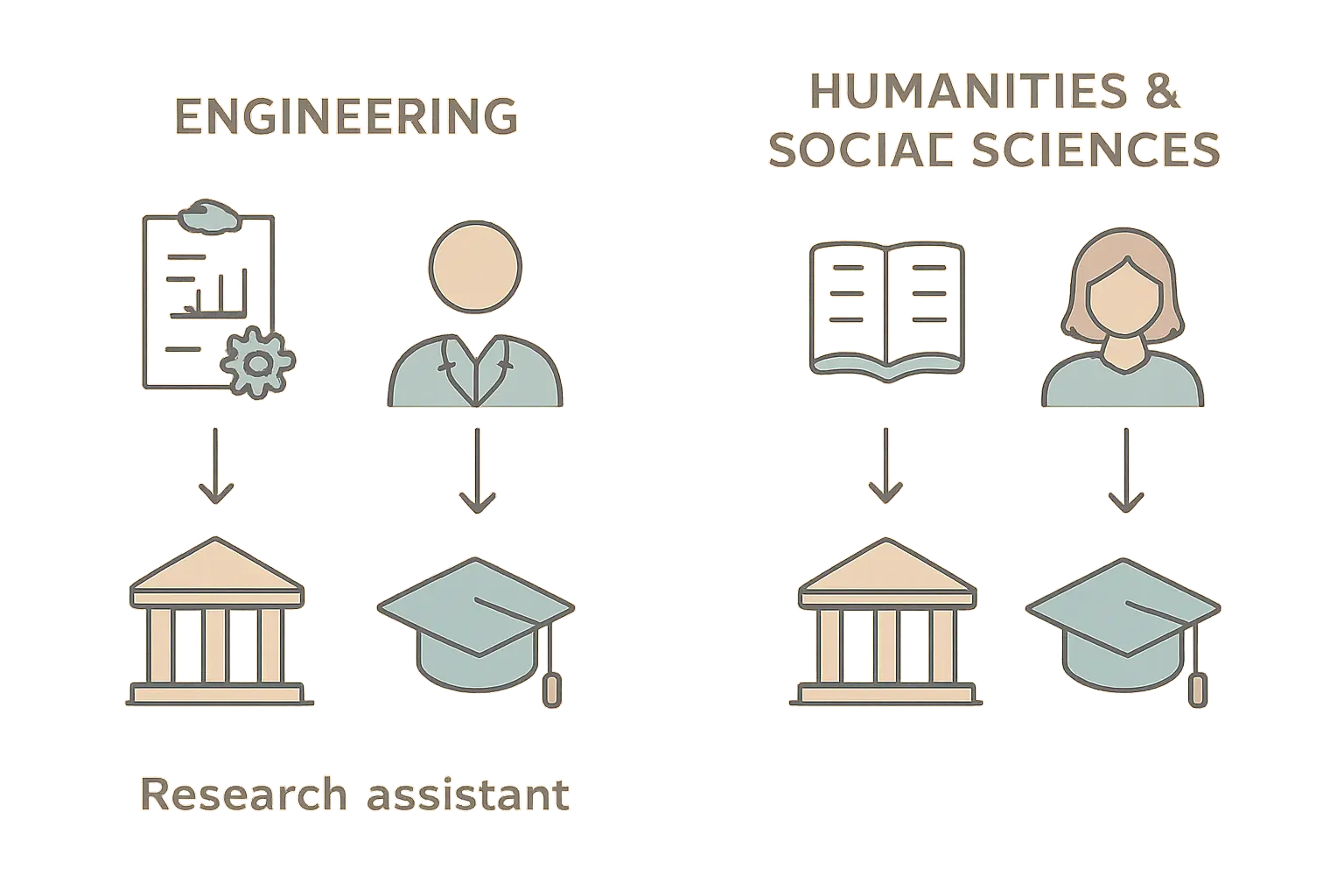
Council of Graduate Schools research generally categorizes engineering as a comparatively high-completion, faster-completing discipline relative to fields like humanities and some social sciences, where funding is often less consistent and time-to-degree tends to run longer. This lines up with the funding data above: engineering’s ~80% funding coverage rate, concentrated in research assistantships, gives most candidates a more predictable financial runway than disciplines where funding is patchier or restricted to the first year or two.
| Discipline group | General completion pattern (CGS characterization) |
|---|---|
| Engineering | Comparatively high-completion, faster time-to-degree |
| Sciences (broadly) | Generally similar to engineering; varies by subfield |
| Social sciences | Longer average time-to-degree in CGS baseline data |
| Humanities | Longest average time-to-degree and lowest 10-year completion in CGS baseline data |
How Long Does an Engineering PhD Take?
None of the sources reviewed for this article publish a single, current, engineering-specific median years-to-degree figure with a verifiable citation, so we’re not going to invent one. What the data does support is the relative framing above: engineering is characterized as faster-completing than humanities and some social sciences in CGS’s cross-field research, and its strong funding coverage is one plausible structural reason why. If your program has published its own department-level time-to-degree data, that figure will be more precise for your specific situation than any national average.
Related Data and Resources
For a country-by-country breakdown of doctoral completion and dropout patterns across all fields, see our PhD completion and dropout rate statistics by country. If you’re specifically writing up an engineering thesis right now, our complete guide to writing an engineering thesis covers structure and discipline conventions, and our IEEE citation style guide is the reference most engineering and CS theses will need for numbered in-text citations. For the career payoff question that often follows a completion-rate search, our academic job market statistics piece covers tenure-track odds and PhD outcomes across fields.
Nursing PhD candidates face a structurally different completion picture — higher overall completion rates but a longer average timeline — which we cover in our nursing dissertation statistics roundup.
Whatever stage of an engineering doctorate you’re at, keeping a multi-chapter, citation-heavy thesis organized is one of the more manageable parts of the process to solve — Tesify is commonly used by engineering PhD students to structure chapters and manage IEEE-format references without it doing the technical analysis or original research for you.
Frequently Asked Questions
What percentage of engineering PhD students complete their degree?
The Council of Graduate Schools’ baseline study found a 10-year completion rate of 57% for female engineering PhD students and 64% for male engineering PhD students. More recent research summarized by NSF-funded studies suggests roughly one-third of engineering doctoral students do not finish their program.
Are most engineering PhD students funded?
Yes. Approximately 80% of engineering graduate students have funding, and NSF data shows research assistantships are the most common primary funding source for doctorate recipients across most fields, including engineering.
Is engineering a fast-completing PhD discipline?
Relative to many other doctoral fields, engineering is generally characterized in Council of Graduate Schools research as a comparatively high-completion, faster-completing discipline, with funding and time-to-degree being less commonly cited as attrition drivers compared to some STEM and non-STEM fields.
What share of engineering PhD students consider leaving their program?
NSF-funded research on STEM PhD persistence found that nearly 24% of STEM PhD students seriously consider leaving their program, a lower rate than the 36%-43% attrition range reported for graduate students more broadly.
How does engineering PhD funding compare to other fields?
NSF Survey of Earned Doctorates data shows research assistantships are the most common primary support source for doctorate recipients across most fields, and engineering PhD funding rates (around 80% funded) are generally reported as comparatively strong versus humanities and some social science fields, though exact cross-field comparisons vary by data source and year.
Using This Data to Plan Your Own Engineering PhD
The gender gap in the CGS completion figures (57% vs 64%) is worth flagging to your own department or graduate school if you haven’t seen equivalent local data — national averages are a starting point, not a substitute for your program’s own numbers. Combined with the funding and attrition data above, the clearest actionable takeaway is that engineering’s structural advantages (higher funding coverage, shorter average time-to-degree) don’t eliminate the roughly one-in-three chance of non-completion, so treating advisor fit and early milestone planning as seriously as funding is worth the effort.
Write your thesis with AI
Structure, draft, cite, and format your thesis faster with Tesify’s AI writing tools, automatic bibliography, and plagiarism checker. Free to start, no credit card required.






Leave a Reply