
Developmental Editing vs Copy Editing vs Proofreading for Thesis Writers (2026)
When students say they need someone to “edit their thesis,” they rarely mean the same thing. A student who has a well-structured argument but writes in broken English needs copyediting. A student who writes fluently but whose chapters do not cohere into a unified argument needs developmental editing. A student who has a polished, well-argued thesis but wants a final error-check before submission needs proofreading. Conflating these three types of editing leads to wasted money, inappropriate interventions, and, in the worst case, academic misconduct concerns.
This guide explains the three levels of thesis editing clearly: what each involves, what it does not involve, the university policy landscape across the UK, US, and Australia, the typical costs, and a step-by-step guide to deciding which type of editing — if any — your thesis needs at each stage of its development.
The Three Levels of Editing: An Overview
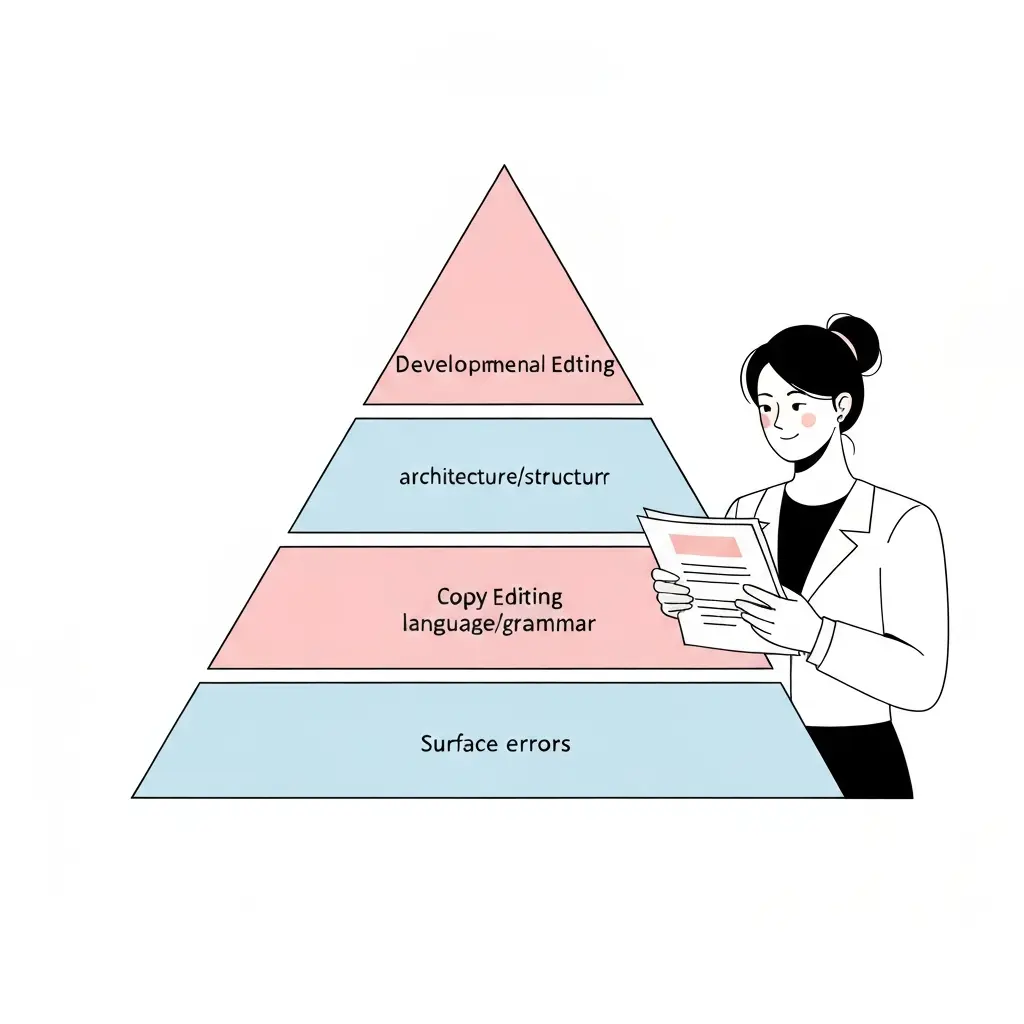
The three types of editing operate at fundamentally different levels of a text. Developmental editing works at the level of ideas, structure, and argument. Copy editing works at the level of language: sentences, vocabulary, grammar, and style. Proofreading works at the level of surface errors: spelling mistakes, missed punctuation, and formatting inconsistencies. Each type of editing requires different skills, different tools, and different timing in your thesis development.
A useful metaphor: writing a thesis is like constructing a building. Developmental editing is architectural review — checking whether the structure is sound, the rooms are in the right places, and the building serves its purpose. Copy editing is interior finishing — ensuring the walls are smooth, the surfaces are even, and the craftsmanship is consistent. Proofreading is the final walkthrough — checking for chips in the paint, loose fittings, and minor defects before the client takes possession.
It makes no sense to apply interior finishing before the architectural review is complete. The sequence of editing types should always follow this order: developmental → copy → proofread.
Developmental Editing: What It Is and What It Is Not
Developmental editing — sometimes called substantive editing or structural editing — addresses the highest-level questions about a thesis:
- Does the research question drive the entire thesis logically and consistently?
- Is the literature review structured around the key debates, or is it an annotated bibliography in disguise?
- Does the methodology chapter justify the chosen research design with sufficient rigour?
- Do the findings/results answer the research question?
- Does the discussion interpret findings correctly in relation to the literature?
- Is the conclusion proportionate to what the thesis has actually argued and found?
- Are chapter transitions logical?
- Is there repetition or contradiction between chapters?
A developmental editor for a thesis provides feedback at the chapter and section level — not sentence by sentence. Their output is typically a detailed report or editorial letter identifying structural issues, gaps in argumentation, and recommendations for reorganisation. They do not rewrite your text; they tell you what needs to be rethought and why.
What Developmental Editing Is Not
Developmental editing is emphatically not writing the thesis for the student. It is not producing ideas, arguments, or evidence that the student does not already have. It is not choosing the student’s theoretical framework. These distinctions matter because they define the ethical boundary between legitimate support and academic misconduct — a boundary that is contested in some institutional contexts.
When Developmental Editing Is Appropriate for a Thesis
Most supervisors effectively provide developmental editing feedback throughout the thesis process. Where external developmental editing for a thesis is sought, it is typically in the following contexts:
- After supervisor feedback has been given and the student needs help interpreting and implementing structural revisions
- For students returning to a thesis after a long interruption who need help reassessing the coherence of the overall argument
- For students writing in a second language where the structural logic of academic argument in English is genuinely unclear to them
- For post-submission revisions after a viva voce / oral defence, where major revisions have been requested
Copy Editing: The Language-Level Polish
Copy editing operates at the language level. A copy editor works through your thesis sentence by sentence, addressing:
Grammar and Syntax
- Subject-verb agreement errors
- Tense inconsistencies (particularly in literature reviews and methodology chapters)
- Pronoun reference ambiguities
- Sentence fragments and run-on sentences
- Misplaced modifiers
Vocabulary and Register
- Informal vocabulary replaced with academic equivalents
- Contractions removed (“don’t” → “do not”)
- Imprecise word choices corrected
- Discipline-specific terminology used correctly and consistently
- Hedging language appropriate to the discipline applied where missing
Style and Consistency
- Consistent use of British or American English (not mixed)
- Consistent hyphenation, capitalisation, and number formatting throughout
- Consistent use of key terms (no synonym drift for technical terms)
- Paragraph length and structure checks (though full PEEL/TEEL restructuring falls closer to developmental editing)
Citation Formatting Consistency
- Citation style (APA, Harvard, Vancouver, Chicago, MLA) applied consistently throughout
- In-text citations match reference list entries
- Reference list formatted correctly for the specified citation style
Copy editing does not address argument quality, evidence selection, or whether the thesis’s conclusions are warranted by the data. That is developmental editing territory. A copy editor’s job is to make sure your ideas are expressed as clearly, correctly, and consistently as possible — not to assess whether those ideas are the right ones.
For a framework of academic register standards that inform copy editing decisions, see our academic voice style guide. For citation format reference, see our guides on APA citation format and Harvard referencing.
Proofreading: The Final Error-Check
Proofreading is the final pass through a text — and it should happen only after developmental and copy editing are complete. A proofreader is not looking for structural or stylistic improvements; they are looking for errors that have survived all previous editing stages:
- Spelling errors: Including correctly spelled words used in the wrong context (their/there/they’re; principle/principal; affect/effect)
- Typographical errors: Missing words, repeated words, transposed letters
- Punctuation errors: Missing full stops, incorrect comma use, apostrophe errors
- Formatting inconsistencies: Heading styles that have drifted, inconsistent spacing, page number errors
- Numbering errors: Figure and table numbers that do not match their captions or references in the text
- Minor citation errors: Missing page numbers in direct quotations, incorrect publication years in isolated citations
Proofreading at professional level uses a printed copy, marks corrections against a style sheet, and typically requires two passes through the document. The proofreader does not rewrite sentences, restructure paragraphs, or add missing content — they correct what is demonstrably wrong according to clear rules. For a complete self-proofreading system, see our thesis proofreading guide with 50-point checklist.
Side-by-Side Comparison Table
| Dimension | Developmental Editing | Copy Editing | Proofreading |
|---|---|---|---|
| Level of intervention | Structure, argument, organisation | Sentences, grammar, style, citations | Surface errors, typos, formatting |
| When in thesis development | During drafting or after major draft | After structure is finalised | Final stage, before submission |
| Does it address argument quality? | Yes — primary concern | No | No |
| Does it correct grammar? | Incidentally, if flagrant | Yes — central concern | Errors only; not stylistic choices |
| Does it rewrite sentences? | No — provides feedback/recommendations | Yes — edits language directly | No — marks errors for correction |
| Permitted for thesis? | Grey area — check institutional policy | Generally yes — widely permitted | Always yes |
| Typical turnaround (80,000 words) | 2–4 weeks | 1–3 weeks | 3–7 days |
| Typical cost per 1,000 words (UK, 2026) | £10–25 | £5–12 | £2–5 |
University Policy: What Is Permitted?
University policies on external thesis editing vary, and the differences matter. The following represents the general policy landscape as of 2026, but institutional policies change and vary — always check your specific institution’s guidance.
UK Universities
The UK Council for Graduate Education (UKCGE) has published guidance stating that proofreading and language copyediting are generally acceptable, provided the editor corrects language without contributing to the intellectual content. Developmental editing — where a third party comments on argument structure, contributes ideas, or substantially reorganises the thesis — falls outside acceptable practice in most UK institutions. The University of Cambridge, UCL, and the University of Edinburgh all have explicit policies permitting language proofreading and copyediting while prohibiting content-level intervention.
US Universities
US policies vary considerably by institution. Most graduate schools explicitly address this in their Academic Integrity or Dissertation Handbook. A reasonable generalisation: grammar and language editing is almost universally permitted; structural editing that could influence the analytical content of the dissertation is almost universally not. Students at US institutions who seek external editing are advised to declare it in their acknowledgements section to demonstrate transparency.
Australian Universities
Universities Australia has adopted the position that professional editing is acceptable “provided that it is restricted to improvements in the communication and presentation of the research, and that the research questions, design, data and conclusions remain the work of the candidate.” This closely mirrors the UK UKCGE guidance. Monash University, the University of Melbourne, and the University of Sydney all have explicit policy statements permitting language editing consistent with this framework.
The Safe Test
When in doubt, apply the following test: if the editing process requires the editor to make intellectual judgements about the quality or validity of your arguments, evidence, or conclusions, it crosses into territory most universities would consider problematic. If the editing process addresses only how your ideas are expressed — not whether they are correct, complete, or sufficiently argued — it is almost universally acceptable. When uncertain, ask your supervisor.
When to Use Each Type of Editing
The following guidance is based on where most thesis students actually need help, based on the types of issues that arise at different stages of thesis development.
When to Consider Developmental Feedback
- After completing your first full draft and receiving supervisor feedback that your argument is not clear or your chapters are poorly organised
- After a viva voce in which major revisions have been requested and you are uncertain how to address them
- If you are writing in a second language and the logical structure of academic argument in English is not intuitive to you
- If your thesis has been partially written and then put aside for more than six months
Note: in most cases, a good supervisor provides developmental feedback. If your supervisor is not providing sufficient feedback, the first step is to request more structured guidance — not to seek an external developmental editor.
When to Use Copy Editing
- When you are a non-native English speaker and are not confident in your grammatical accuracy or academic register
- When your supervisor’s feedback consistently highlights language errors rather than content issues
- When your argument is solid but your writing is informal, inconsistent, or imprecise in ways you are aware of but struggle to correct yourself
- After the structure is finalised — not before. Copy editing a draft that will be substantially restructured is expensive and wasteful.
When to Use Proofreading
- Always, in the final two weeks before submission — either self-proofread using a structured checklist or hire a professional proofreader
- After copy editing is complete — proofreading corrects errors introduced by the editing process as well as those in the original
- After any substantial revision (e.g., post-viva corrections) — revisions introduce new errors
Typical Costs for Thesis Editing in 2026
Editing costs vary by editor qualification, market (UK vs US vs Australia), language background of the student, and document complexity. The following figures represent typical ranges for academic editing services in 2026:
| Service Type | UK Rate | US Rate | Cost for 80,000-word PhD |
|---|---|---|---|
| Proofreading | £2–5/1,000 words | $3–7/1,000 words | ~£160–400 |
| Copy editing (standard) | £5–9/1,000 words | $8–15/1,000 words | ~£400–720 |
| Copy editing (ESL/heavy) | £9–15/1,000 words | $15–25/1,000 words | ~£720–1,200 |
| Developmental editing | £15–30/1,000 words | $20–45/1,000 words | ~£1,200–2,400 |
The Chartered Institute of Editing and Proofreading (CIEP) in the UK publishes annual guidance on suggested minimum rates — these provide a useful benchmark for assessing whether quotes you receive are appropriate.
Finding Qualified Thesis Editors
Not all thesis editing services are equal. The following sources identify qualified academic editors with verifiable credentials:
- Chartered Institute of Editing and Proofreading (CIEP, UK): Directory of professional editors with verified training and experience. Search specifically for editors with “academic” or “dissertation” specialisms.
- Council of Science Editors (CSE, US): For STEM disciplines specifically.
- Editors Canada: Professional association with member directory.
- Your institution’s writing centre: Many universities have internal editing support services or approved editor lists — often free or subsidised.
- Your discipline’s academic community: Ask your supervisor or PhD cohort for personal recommendations — word-of-mouth recommendations for editors with domain knowledge in your field are valuable.
When commissioning any editing service, ask for: a sample edit of 500 words before commissioning the full project, clarity on exactly which type of editing will be provided, and a written statement of what is and is not within scope. This protects both parties and ensures the service is appropriate for your thesis stage.
For a complete self-editing system that reduces reliance on external editors, see our 50-point thesis proofreading checklist and our comparison of digital writing tools for thesis students.
Frequently Asked Questions
Is it cheating to have your thesis edited?
Language copyediting and proofreading are not academic misconduct — they are equivalent to having a native speaker review your grammar or using a spell checker. Almost all UK, US, and Australian universities explicitly permit this. What is typically not permitted is developmental editing where a third party contributes to your intellectual argument, makes analytical decisions about your evidence, or substantially reorganises your thesis’s argument and structure. When in doubt, check your institution’s Academic Integrity policy and/or ask your supervisor. Transparency is advisable: acknowledge editing support in your acknowledgements section.
What is the difference between substantive editing and copy editing?
Substantive editing is another term for developmental editing — it addresses the structure, organisation, and coherence of the argument. Copy editing addresses language: grammar, vocabulary, style, and citation consistency. The terms are sometimes used inconsistently across different markets (US, UK, Canada, Australia), so when commissioning editing services, ask the editor specifically what they will and will not address. A written scope statement prevents misunderstandings about what was included.
Can my supervisor edit my thesis?
Yes — supervisor feedback on argument structure, chapter organisation, evidence quality, and analytical depth is the normal and expected supervisory relationship. This is not editing in the commercial sense; it is the core function of academic supervision. Supervisors routinely comment on the writing quality of thesis drafts. What supervisors should not do — and what may raise integrity concerns — is rewrite substantial portions of the thesis on the student’s behalf. Comments and suggestions that the student implements themselves are appropriate; extensive ghostwriting by a supervisor is not.
How do I know if I need copy editing or developmental editing?
The clearest signal is the type of feedback you receive from your supervisor. If feedback focuses on grammar, spelling, and unclear sentences, you need copy editing. If feedback focuses on argument structure, chapter logic, gaps in the literature review, or insufficient justification of methodological choices, you need developmental editing (or, more likely, more substantive conversations with your supervisor). If your supervisor’s feedback is broadly positive on content but you are concerned about language accuracy before submission, you need copy editing or proofreading.
How far in advance should I book a thesis editor?
For copyediting, book at least four to six weeks before your planned submission date to allow time for the edit, for you to review and implement the changes, and for a final proofread. Professional thesis editors are often booked two to three months in advance during peak submission periods (April–May and September–October in UK/Australian academic calendars; May–June in US calendars). Proofreaders can often turn around work faster — two to three weeks is usually sufficient for booking notice. Do not leave this until the week before submission.
Write Thesis Prose That Needs Less External Editing
Tesify generates academically appropriate prose with correct grammar, hedging language, and citation formatting — reducing the language errors that typically require costly copy editing. Start with better first drafts and save on editing costs.
Write your thesis with AI
Structure, draft, cite, and format your thesis faster with Tesify’s AI writing tools, automatic bibliography, and plagiarism checker. Free to start, no credit card required.




Leave a Reply