
Quick answer: Thematic analysis in a nursing thesis follows Braun and Clarke’s six-phase process — familiarisation, generating initial codes, searching for themes, reviewing themes, defining and naming themes, and writing up — applied to interview or focus-group transcripts from patients, nurses, or caregivers. The method suits nursing research because it stays close to participants’ own language about lived clinical experience while still producing a structured, defensible set of themes a committee can audit line by line.
This guide is a hands-on companion to the more general content analysis vs thematic analysis comparison and the software-focused how to code interviews in NVivo guide — here the focus is specifically on how the six phases play out on nursing data, worked through one illustrative transcript extract from start to finish.
Step 1: Familiarisation
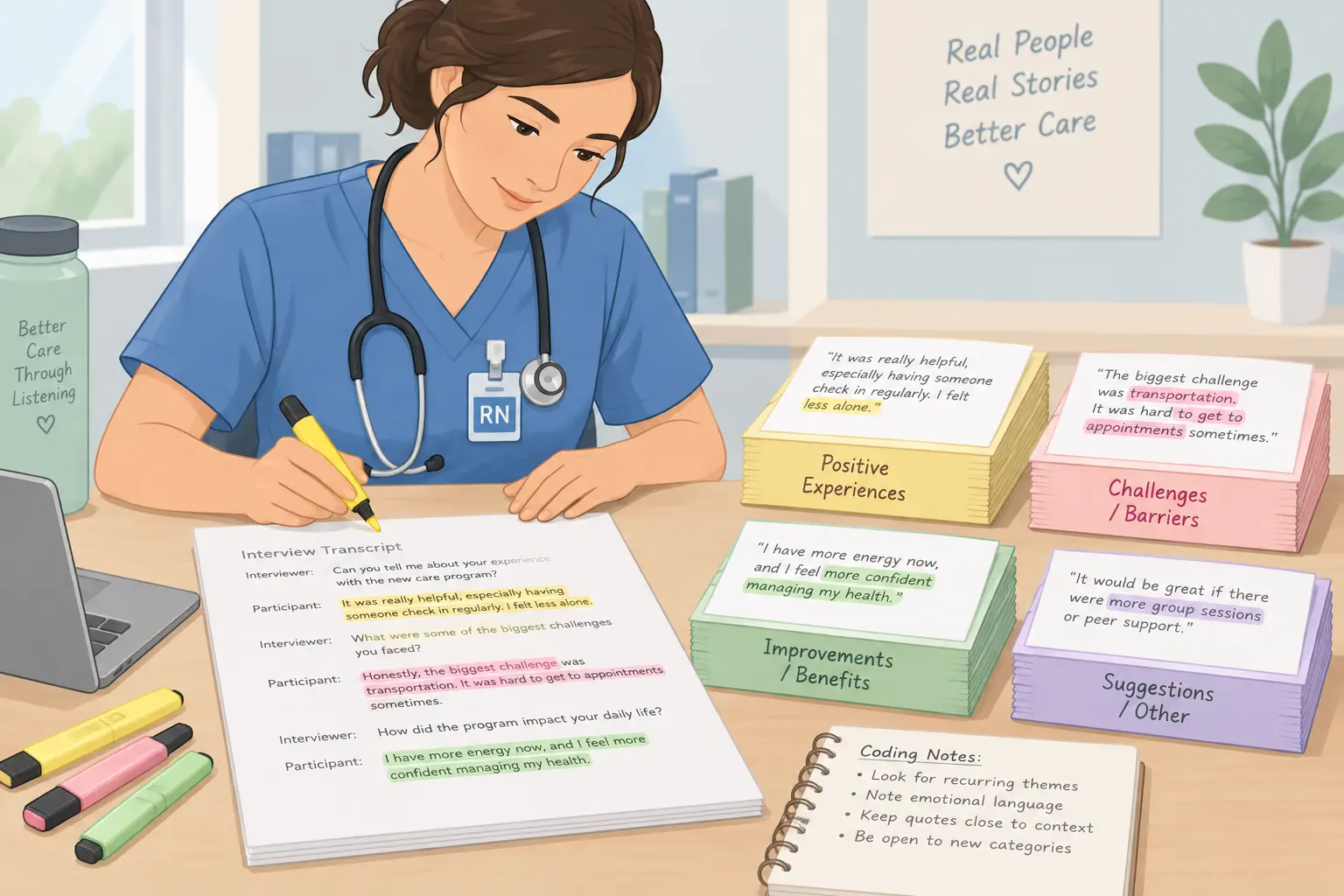
Transcribe verbatim (including hesitations and false starts if you are doing reflexive rather than codebook analysis), then read the full data set at least twice before coding anything. Write brief analytic memos as you read — an initial hunch about a pattern is data too, and dating these memos lets you show your audit trail later. For nursing interviews specifically, note paralinguistic cues your transcriber may have flagged (a long pause before disclosing a difficult clinical incident) — these often mark the passages that carry the most analytic weight.
Step 2: Generating initial codes
Code systematically across the entire data set, not just the sections that seem most interesting — under-coding “boring” transcripts is one of the most common ways a nursing thematic analysis loses credibility at viva. Codes should stay close to the data (semantic codes) or capture an underlying assumption (latent codes); decide up front which level you are working at and be consistent. A single meaningful segment of text often earns more than one code.
Step 3: Searching for themes
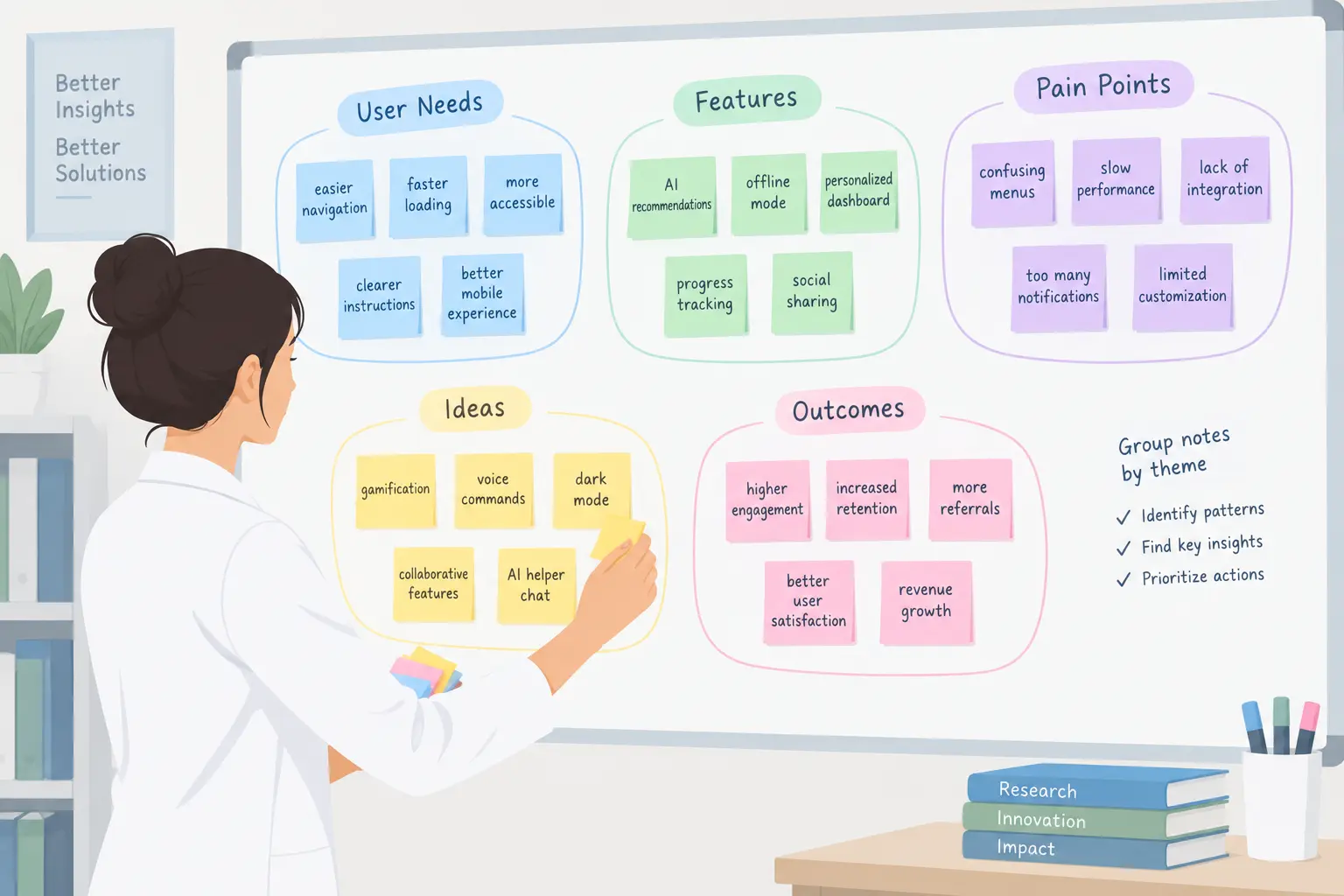
Group codes into candidate themes by asking what they have in common at a higher level of abstraction, not just by surface topic. In nursing research this is where a thematic map on paper or a whiteboard genuinely helps — physically clustering codes reveals whether two codes that look different (say, “hiding fatigue from colleagues” and “downplaying symptoms to patients”) are actually the same underlying theme about performing competence under strain.
Step 4: Reviewing themes (two levels)
First check each candidate theme against its own coded extracts — does every extract genuinely fit? Then check the set of themes against the whole data set — does the map, taken together, tell a coherent and accurate story of the data, and have you missed anything? It is normal and expected to collapse, split, or discard themes at this stage; a nursing thesis reviewer will want to see this iteration described, not hidden.
Step 5: Defining and naming themes
Write a tight, one-paragraph definition of what each theme captures and what it does not, then give it a short, analytic (not merely descriptive) name. “Emotional labour” is an analytic theme name; “nurses feel tired” is a descriptive label that has not yet done the interpretive work a thesis committee expects.
Step 6: Producing the report
Weave illustrative quotations into an analytic narrative — quotes illustrate the theme, they do not replace your interpretation of it. Report your approach to reflexivity: Braun and Clarke’s 2019 clarification of reflexive thematic analysis expects you to state your own positionality (are you a nurse researching nurses? a patient advocate?) and how it shaped your reading of the data, rather than claiming a purely neutral, code-and-count exercise.
Worked example: compassion fatigue among ICU nurses (illustrative)
The transcript extract, codes and themes below are an illustrative, fictional composite built to demonstrate the method — they are not drawn from a real published study and should not be cited as findings.
Illustrative extract
“There was a night… I just went and sat in the med room for a minute because I couldn’t feel anything. Not sad, not anything. I clocked out and I didn’t tell anyone. You just don’t, because everyone else is running the same way.”
Initial codes applied
- Emotional numbing during a shift
- Withdrawing to a private space to cope
- Concealing distress from colleagues
- Normalising the strain as universal (“everyone else”)
Candidate theme
“Performing okay-ness” — the pattern, across several participants’ extracts, of actively concealing emotional depletion rather than disclosing it, often justified by the perception that colleagues are equally depleted and disclosure would add to a shared burden rather than relieve an individual one.
Final theme after review
On reviewing this candidate theme against three other participants’ extracts, it merged with a related candidate theme about avoiding the staff room during breaks, producing a broader final theme: “Invisible depletion: concealment as a coping norm.” The definition written for the report specifies that this theme is about the social norm of concealment itself, distinct from a separate theme in the same analysis about the physical symptoms of fatigue.
Building a coding matrix across participants
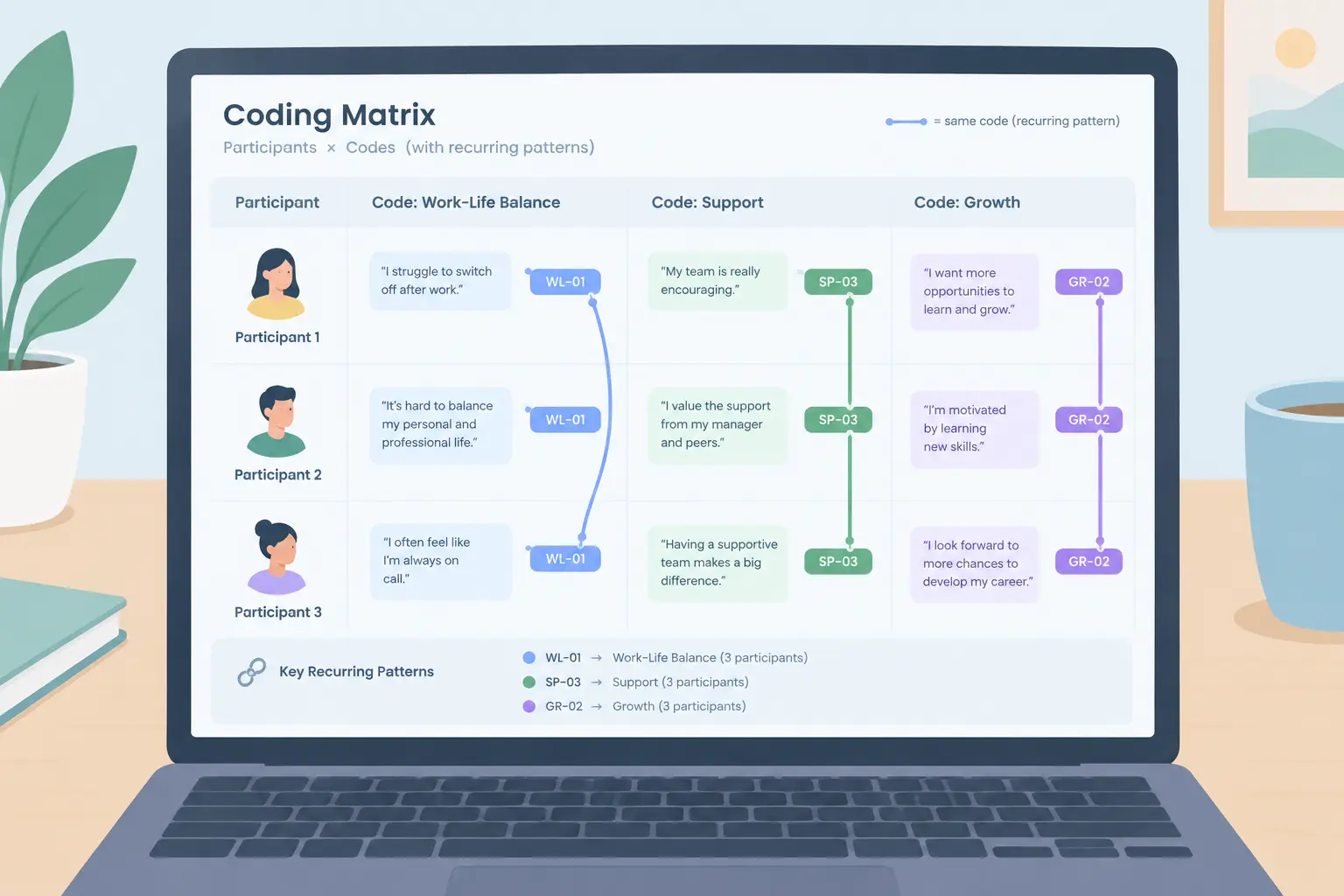
A single extract rarely justifies a theme on its own. Before finalising the theme above, a coding matrix was built across the wider illustrative data set, mapping the same code onto extracts from other participants:
| Participant (illustrative) | Extract focus | Code applied |
|---|---|---|
| P3 | Skips staff-room breaks to avoid conversation about the shift | Withdrawing to a private space to cope |
| P7 | Describes telling a struggling colleague “we’re all fine, just push through” | Normalising the strain as universal |
| P9 | Says she “put a smile on” for the family in the waiting room minutes after a resuscitation attempt failed | Concealing distress from colleagues (extended here to patients’ families) |
Seeing the same underlying pattern recur, with variation, across P3, P7 and P9 — not just the original extract — is what justifies naming this a theme rather than a one-off observation, and it is exactly the kind of matrix a nursing thesis appendix should include to show the analytic work behind the final narrative.
Reflexive vs codebook thematic analysis: which to state in your methods chapter
Name which variant you are using, because they carry different expectations. Reflexive thematic analysis (Braun and Clarke’s current preferred term) treats theme development as an inherently interpretive, researcher-shaped process and does not require, or even recommend, inter-rater reliability statistics. Codebook approaches (including framework analysis and some forms of template analysis) use a structured coding frame, often with more than one coder and a measure of coding agreement, and suit larger or more applied nursing studies such as multi-site quality-improvement evaluations. Stating the wrong assumptions for the variant you actually used — for example, reporting a kappa statistic inside an otherwise reflexive analysis — is a common examiner flag.
Common mistakes in a nursing thematic analysis
- Treating themes as if they simply “emerge” from the data with no researcher interpretation, rather than acknowledging the active, judgement-driven process the method actually is.
- Confusing a topic summary (“nurses talked about workload”) with an analytic theme (what workload talk is doing or means across the data set).
- Reporting saturation as a headcount (“data saturation was reached at 12 interviews”) without describing what stopped producing new codes — see the dedicated guide on data saturation in qualitative research for how to justify this properly.
- Cherry-picking only the most articulate or dramatic quotations rather than showing the range of how a theme appears across participants.
- Skipping the two-level review in Step 4 and moving straight from candidate themes to a final report.
- Presenting the six phases as a strict, one-directional pipeline rather than the iterative process Braun and Clarke describe — it is normal to return to earlier phases as later ones reveal gaps.
- Letting the theoretical framework, if you have one, silently override what the data actually says, rather than describing where the framework and the data agree or push against each other.
A related pitfall specific to clinical settings is unintentionally over-clinicalising participants’ own language — rewriting “I just went numb” as “the participant exhibited symptoms of emotional dissociation” collapses a first-person account into a diagnostic frame the participant never used. Reflexive thematic analysis generally asks you to preserve and analyse participants’ own terms before, or instead of, translating them into clinical vocabulary, and to be explicit in your write-up about which register a given theme name belongs to.
Reporting thematic analysis alongside other qualitative methods
If your nursing thesis combines thematic analysis with focus groups rather than one-to-one interviews, the coding logic above still applies, but group dynamics (who speaks after whom, moments of agreement or challenge) become additional data in their own right — see how to conduct a focus group for your dissertation for the moderation and transcription steps that feed into this analysis. For the wider methodology chapter this section sits inside, including how to justify a qualitative design against a quantitative or mixed-methods alternative, see how to write the methodology chapter of a nursing dissertation or DNP project.
Where Tesify fits
Once your themes are defined and your illustrative extracts chosen, Tesify’s thesis workspace is useful for turning your theme definitions and quotations into clean, well-signposted findings-chapter prose — it will not code your transcripts or generate quotations for you, and doing so would undermine the interpretive record a nursing methods chapter has to demonstrate. Tesify’s AI Editor is best used at the polishing stage, after your coding and theme development are already on paper.
Frequently asked questions
How many interviews do I need for a thematic analysis in a nursing thesis?
There is no fixed number; sample size in reflexive thematic analysis is usually justified by information power (how rich and on-topic each interview is, and how narrow your research question is) rather than a target headcount, though committees commonly expect to see this reasoning made explicit.
Do I need two coders for thematic analysis?
Not necessarily. Reflexive thematic analysis treats a single researcher’s interpretive judgement as the method’s strength, not a weakness to be corrected by inter-rater checks; codebook approaches, by contrast, often do use multiple coders and report agreement.
What is the difference between a code and a theme?
A code is a short label attached to a specific data extract; a theme is a broader pattern of shared meaning built up from multiple codes across the data set.
Can I use thematic analysis on secondary data, such as patient forum posts?
Yes, provided you address the additional ethical and access considerations of using publicly posted but personal material, and note in your methods chapter that the data was not generated through your own interview protocol.
How do I show rigour without inter-rater reliability statistics?
Keep and reference an audit trail: dated analytic memos, a record of how candidate themes changed across review, and a reflexivity statement about your own position relative to the data.
Should I report how many participants mentioned each theme?
Generally no — reflexive thematic analysis is explicitly not about counting frequency, since a rare but analytically important comment can matter more than a common one; describe prevalence in qualitative terms (a few, several, most) rather than exact tallies if you need to at all.
What software should I use to manage the coding?
NVivo, Atlas.ti and MAXQDA are the most common choices in nursing programmes; the coding logic in this guide applies whichever tool you use, since the software organises the process rather than performing the interpretation for you.
Can thematic analysis be combined with a theoretical framework?
Yes — many nursing theses apply thematic analysis within an explicit theoretical lens (for example, a stress-and-coping framework), which shapes which patterns you attend to without dictating the codes in advance.
How do I present a coding matrix in my thesis without breaching confidentiality?
Use participant codes (P1, P2…) rather than names or identifying details, keep the extracts short enough that they cannot identify a specific shift or unit, and check your ethics approval for any additional de-identification requirements specific to clinical settings.
What if two coders disagree on a codebook analysis?
Discuss the disagreement against the coding frame definition rather than simply averaging or picking a winner; document how the disagreement was resolved, since that discussion is itself part of your audit trail and often strengthens rather than weakens the methods chapter.
Write your thesis with AI
Structure, draft, cite, and format your thesis faster with Tesify’s AI writing tools, automatic bibliography, and plagiarism checker. Free to start, no credit card required.





Leave a Reply