
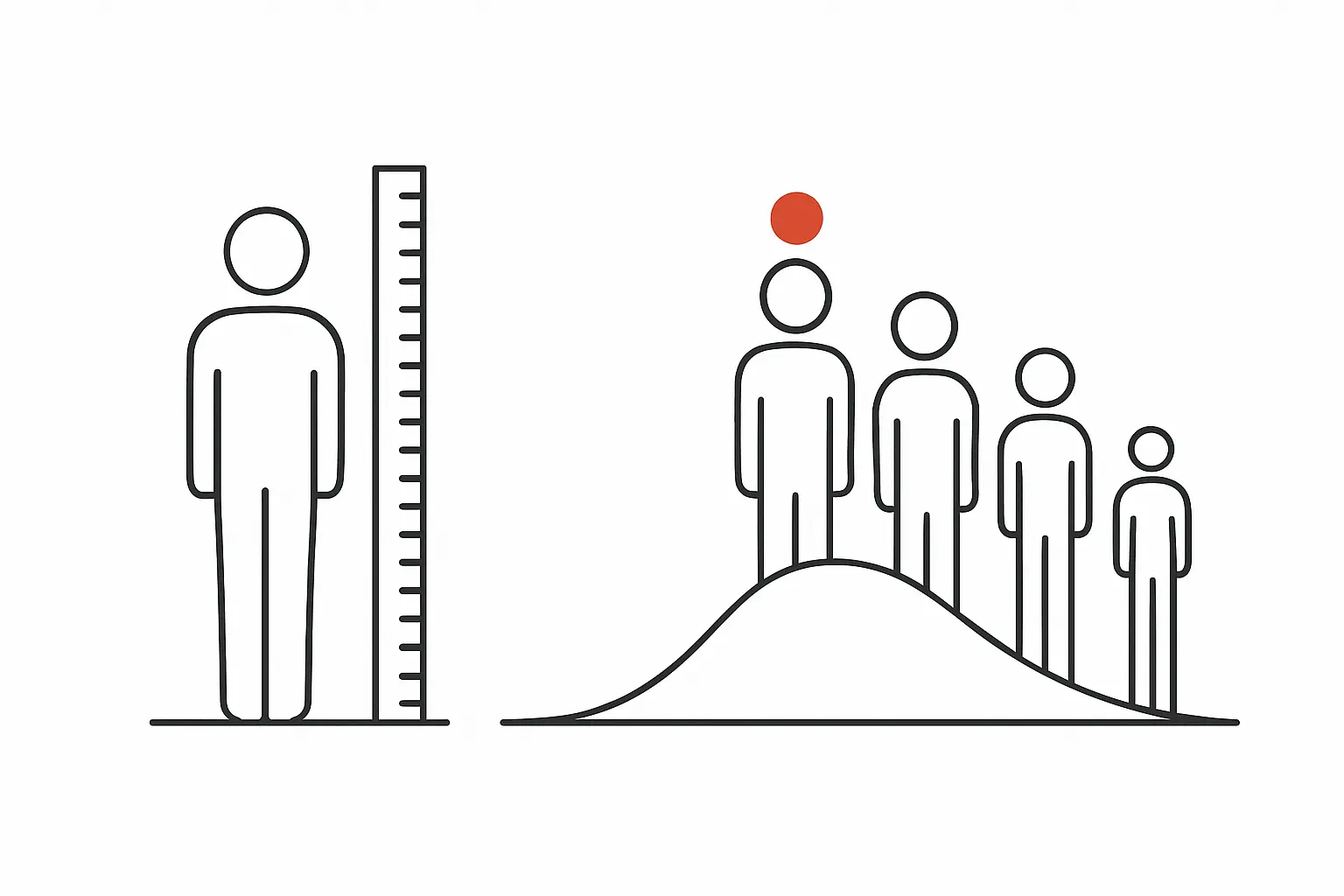
Criterion-referenced assessment judges your work against a fixed published standard. Norm-referenced assessment judges it against how everyone else did. Most UK qualifications — degrees, Higher Nationals, NVQs — are criterion-referenced, which means that in principle every student on your course could achieve the top grade, and none of them is competing with you for it.
That principle is widely disbelieved, and the disbelief is not irrational: quality assurance processes do look at distributions, which makes the system feel norm-referenced from the inside. This page sets out the distinction precisely, where each model genuinely applies, and what follows for how you read feedback and challenge a mark.
The two models
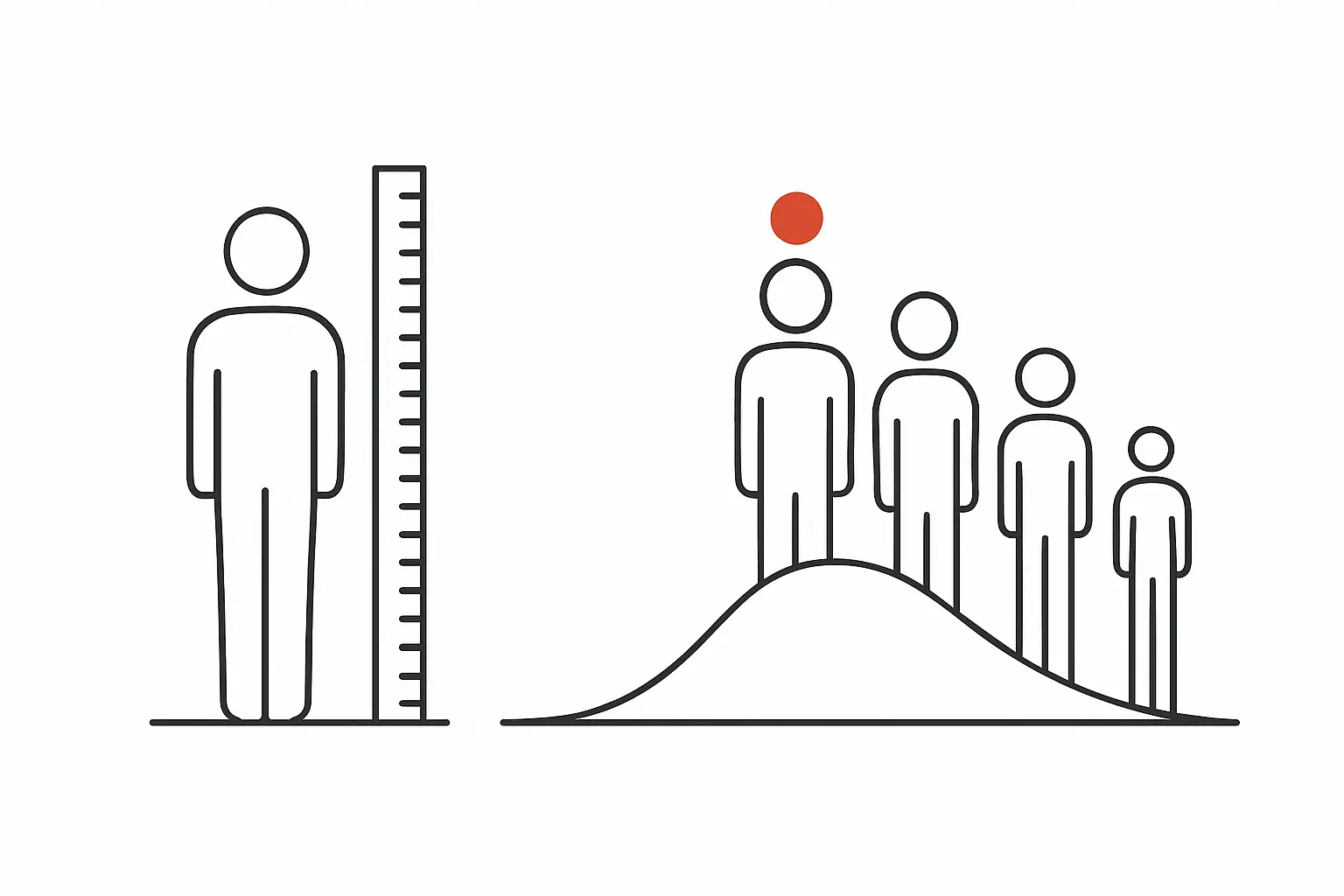
| Criterion-referenced | Norm-referenced | |
|---|---|---|
| Grade answers the question | Did this work meet the stated standard? | How did this work compare to others? |
| Reference point | Published criteria or descriptors | The distribution of the cohort |
| Can everyone get the top grade? | Yes, in principle | No — the top band is defined as a proportion |
| Does a strong cohort hurt you? | No | Yes |
| What you should study | The criteria | Whatever differentiates you from peers |
The practical difference is what you do the night before. In a criterion-referenced system, the highest-value document you can read is the grade descriptor. In a norm-referenced one, it barely helps.
Which UK assessments use which?
Higher Nationals are criterion-referenced. Pass, Merit and Distinction are defined by stated criteria per unit, and there is no quota. Pearson’s own guidance requires that activities be written to allow the full achievement of Pass, Merit and Distinction criteria, and that meeting the higher criteria should not require extra assignments within a unit. Our step-by-step guide to Higher National assignments covers what that means for how you draft.
NVQs and other competence-based qualifications are criterion-referenced in the strongest sense. You are judged competent against an occupational standard or you are not yet competent. There is no ranking, and typically no grade at all.
UK degree classifications are criterion-referenced in principle. Marking is against published criteria, and a First is defined by what the work demonstrates rather than by a percentile. How the individual module marks then combine into a classification is a separate mechanical question, covered in our guide to GPA and degree classification systems.
ECTS grading is the clear norm-referenced case. Under the European Credit Transfer System, grades reflect where a student falls in the distribution of passing students rather than against an absolute standard — which is exactly why converting an ECTS grade to a percentage is unreliable.
Why so many students believe there is a curve

The belief persists because something real sits behind it. UK assessment is subject to internal moderation and external examining, and those processes do look at the spread of marks across a cohort, across years, and across comparable courses elsewhere.
The distinction is what the distribution is used for. An unusual distribution is treated as a signal that the criteria may have been applied inconsistently, or that an assessment was mis-pitched — it prompts a check of the marking, not a redistribution of grades. Nobody is moved down to make room.
Where students encounter something that genuinely feels like a curve, it is usually one of three things: a scaling adjustment applied after a demonstrably faulty assessment; competitive selection that is not assessment at all, such as a capped placement or a scholarship; or an assessor informally calibrating against past cohorts. Only the third is a real deviation from the model, and it is the one moderation exists to catch.
What follows for you
Read the criteria as the specification, not the advice
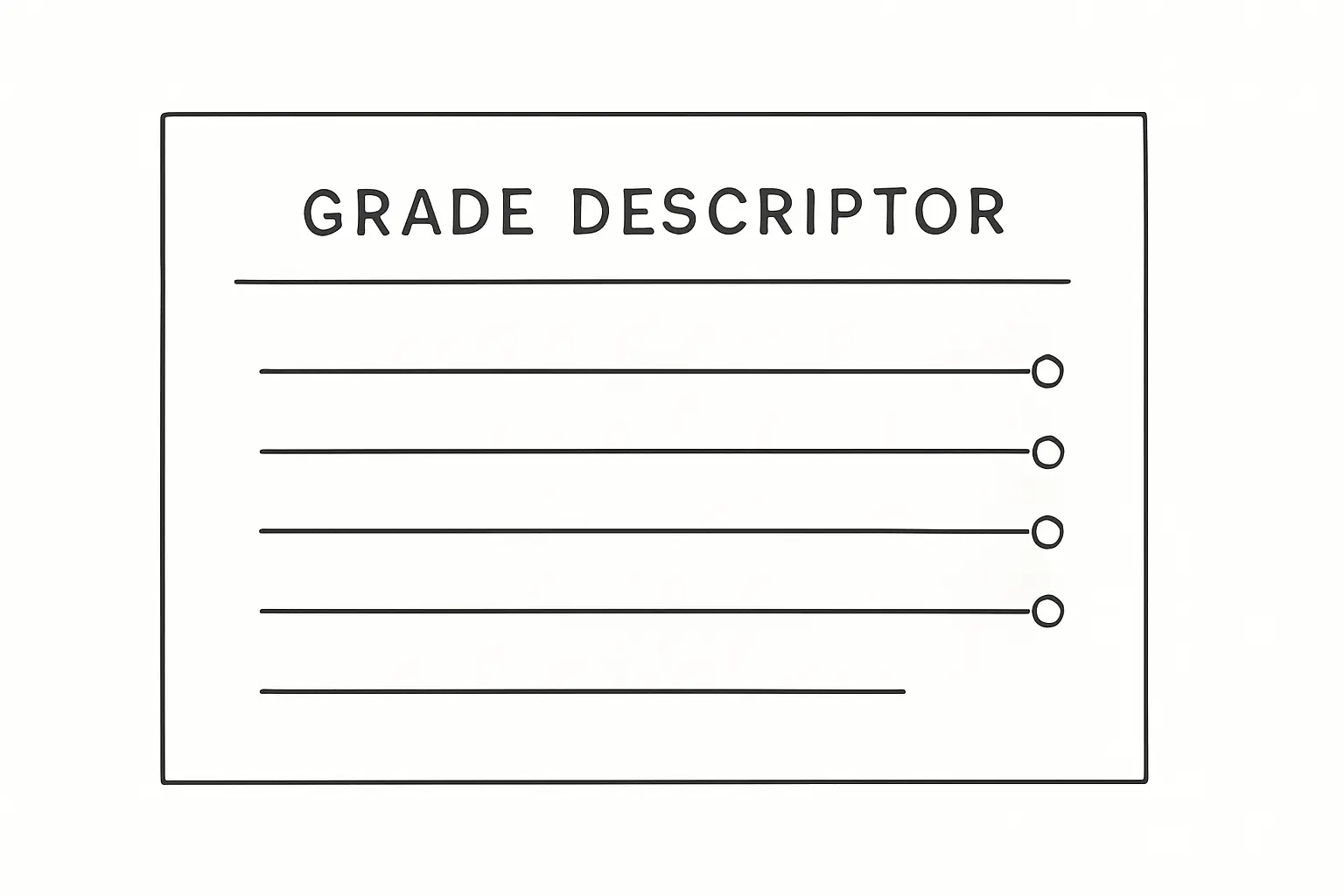
If the standard is fixed and published, it is the thing you are being measured against — so the descriptor for the grade you want is the specification for the document you should write. Working backwards from it is not gaming the system; it is the system operating as designed.
Pay attention to the command verbs, because they carry the level. The gap between “describe”, “analyse” and “evaluate” is what separates the bands, and it is a difference in the kind of thinking demanded rather than in the quantity of writing. Our guide to RQF and FHEQ levels covers how that demand escalates.
Read feedback as a criteria diagnosis
“Too descriptive” is not a style note. In a criterion-referenced system it is a statement that your work met a lower criterion than the one you were aiming at. The fix is structural — change what the writing does, not how it sounds.
The most useful question to ask a marker is therefore not “how do I get a higher mark?” but “which criterion did this not meet, and what would meeting it have looked like?” That question has an answerable form in this model, and it is the one that produces usable advice.
Know what you can actually appeal
This is where the distinction has teeth. In a criterion-referenced system, the arguable ground is that the published criteria were misapplied to your work — that you demonstrated what the descriptor asks for and it was not credited.
What is not arguable is that your work was better than a classmate’s, or that too few people got the top grade. Those are norm-referenced arguments, and they do not engage with the standard your work was actually judged against. Academic appeals procedures generally consider procedural irregularity and similar grounds rather than disagreement with academic judgement, so an appeal that reads as “I deserved more than they did” tends to fail on its own terms.
The honest limitation of the model
Criterion-referencing depends entirely on the criteria being clear enough to apply consistently, and academic criteria are written in language that requires interpretation. “Critical evaluation demonstrating originality of thought” is not a measurable threshold in the way that a competence standard is.
This is why moderation and external examining exist at all, and why competence-based qualifications — where the criterion is observable performance — achieve far more consistent judgements than essay-based ones. It is a real weakness of the model rather than a reason to disbelieve it, and it explains why two markers can reasonably differ on the same script while both applying the same standard.
Frequently asked questions
What is the difference between criterion-referenced and norm-referenced assessment?
Criterion-referenced assessment judges work against a fixed published standard, so everyone who meets it achieves the grade. Norm-referenced assessment judges work against the performance of others, so grades depend on the cohort.
Are UK degrees marked on a curve?
Not in principle. UK degree classifications are criterion-referenced, marked against published criteria rather than allocated by percentile. Moderation processes examine mark distributions to check that criteria were applied consistently, not to cap the number of high grades.
Can everyone on my course get a Distinction?
On a criterion-referenced qualification such as a Higher National, yes in principle. There is no quota; each student’s work is judged against the stated criteria for that grade.
Is ECTS norm-referenced?
Yes. ECTS grades reflect where a student sits in the distribution of passing students rather than against an absolute standard, which is why direct conversion to a percentage or GPA is unreliable.
Why does my tutor talk about the cohort average then?
Because distributions are used as a quality check. An unusual spread suggests the criteria may have been applied inconsistently or the assessment mis-pitched, which triggers a review of the marking rather than a redistribution of grades.
What grounds can I appeal a mark on?
Broadly, that the published criteria were misapplied to your work, or that a procedural irregularity affected the outcome. Arguing that your work was better than another student’s is a norm-referenced argument and does not engage with the standard you were assessed against.
Are NVQs graded?
Typically not. Competence-based qualifications judge whether you have demonstrated the occupational standard, so the outcome is competent or not yet competent rather than a grade.
If the criteria are the specification, the practical problem is turning them into a structure. Tesify maps an outline to your module’s stated criteria and learning outcomes, formats your references and produces an AI-use declaration for submission. It gives you a starting draft to rewrite in your own words — the critical judgement the higher criteria ask for is the part that has to come from you.
Write your thesis with AI
Structure, draft, cite, and format your thesis faster with Tesify’s AI writing tools, automatic bibliography, and plagiarism checker. Free to start, no credit card required.






Leave a Reply