
Where to Get Data for a Social Work Thesis on Child Welfare: AFCARS, NCANDS and NSCAW (2026)
Key finding: Three federally funded data sources cover almost every quantitative question a US child-welfare thesis asks: AFCARS for foster care and adoption caseload data, NCANDS for child maltreatment reports and investigations, and NSCAW for longitudinal well-being outcomes of children who have had contact with the child welfare system. All three are distributed, free of charge, through the National Data Archive on Child Abuse and Neglect (NDACAN) at Cornell University, funded by the Administration for Children and Families’ Children’s Bureau.
This guide explains what each dataset actually contains, who can access which version, and which one answers which kind of research question — the gap most social work students hit is not knowing these three sources are functionally different instruments, not interchangeable “child welfare data.” It complements the broader 40+ free datasets and open data repositories directory, which does not currently break out child-welfare-specific sources at this level of detail.
1. AFCARS (Adoption and Foster Care Analysis and Reporting System)
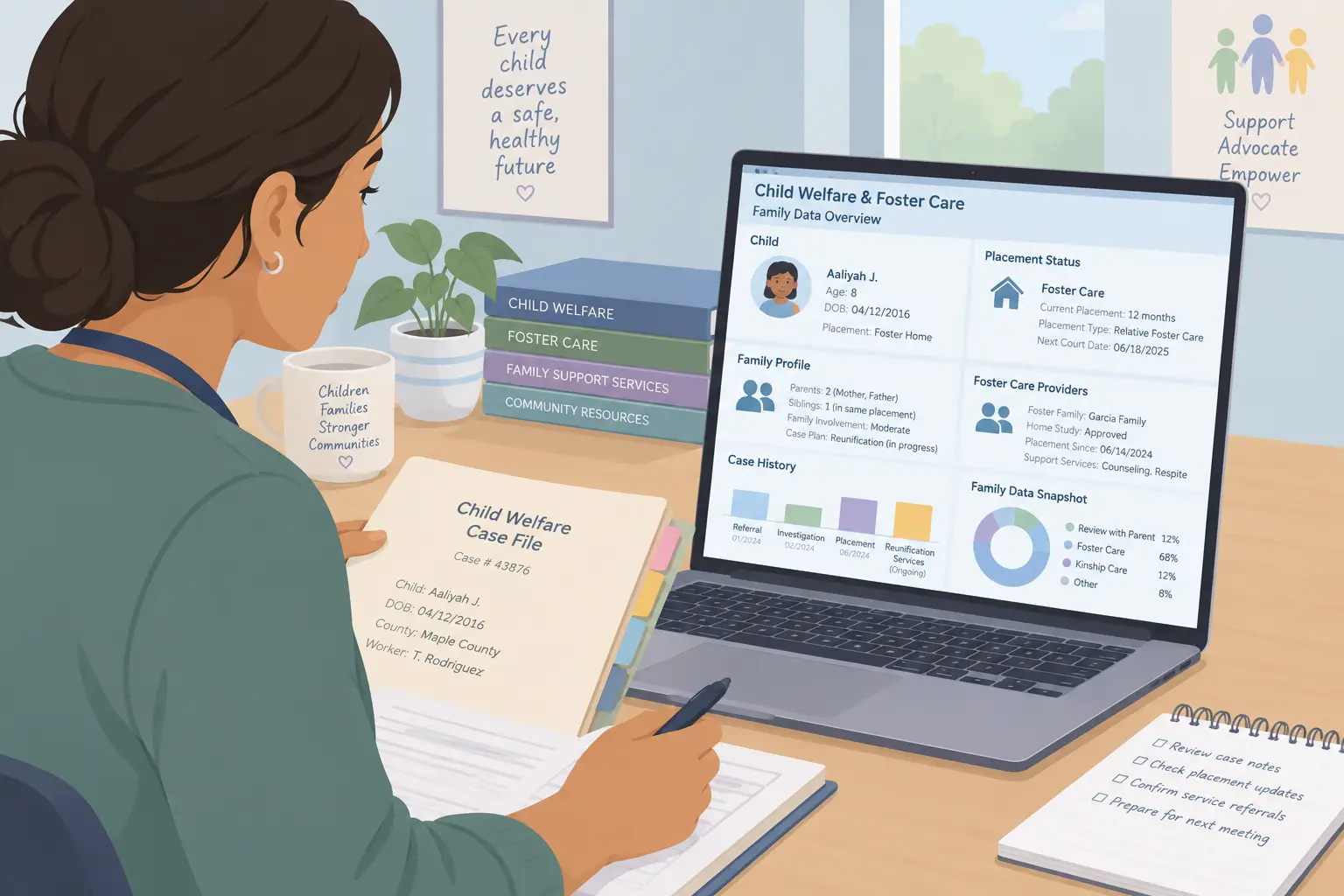
AFCARS is administrative caseload data that every US state and territory is federally required to submit twice a year, covering every child in foster care and every child adopted through the public child welfare system. It records case-level detail: entry and exit dates, placement type (kinship, non-relative foster home, group care), case goal, race and age at entry, and — critically for longitudinal designs — a person-level identifier that lets you follow the same child across multiple submission periods within a state. Access: a public-use “AFCARS Foster Care File” is available via NDACAN at no cost after a straightforward data-use agreement; some variables (small-county geographic identifiers) require an additional restricted-use license because of re-identification risk. Best for: caseload trends, time-to-permanency analyses, placement-type disparities, or re-entry into foster care.
2. NCANDS (National Child Abuse and Neglect Data System)
NCANDS aggregates state child protective services (CPS) records on reports of suspected maltreatment, the investigations or assessments that follow, and their dispositions (substantiated, indicated, unsubstantiated). NDACAN distributes it as two related files: the Child File (case-level, one record per child per report) and the Agency File (state-level aggregate counts and policy context variables). Access: free through NDACAN with a data-use agreement; the Child File requires slightly more documentation because it is case-level rather than purely aggregate. Best for: maltreatment report rates, substantiation-rate disparities by race or maltreatment type, re-referral analyses, or state-policy comparisons using the Agency File’s contextual variables.
3. NSCAW (National Survey of Child and Adolescent Well-Being)
Unlike AFCARS and NCANDS, NSCAW is a longitudinal survey, not routine administrative reporting — it follows a cohort of children after a CPS investigation (whether or not the case was substantiated, and whether or not the child was removed from home) and directly measures developmental, behavioural, educational and mental-health outcomes over multiple waves, using standardised instruments completed by caregivers, teachers and the children themselves. This is the dataset to use when your question is about outcomes and well-being rather than system flow. Access: a restricted-use license through NDACAN is required (it involves identifiable-adjacent survey data on a vulnerable population); the application process is more involved than for AFCARS or NCANDS but is still free. Best for: child well-being trajectories, service-receipt and outcome relationships, or comparing outcomes for children who remained in-home versus those removed.
Choosing the right source for your research question
| Your question is about… | Use |
|---|---|
| How many children are in foster care, for how long, and where they are placed | AFCARS |
| How many maltreatment reports occur, and what happens to them | NCANDS Child File |
| State-level policy or funding context around maltreatment response | NCANDS Agency File |
| Developmental, mental-health or educational outcomes over time | NSCAW |
| Re-entry into care after reunification | AFCARS (longitudinal linkage across submission periods) |
A common thesis design: linking two of the three
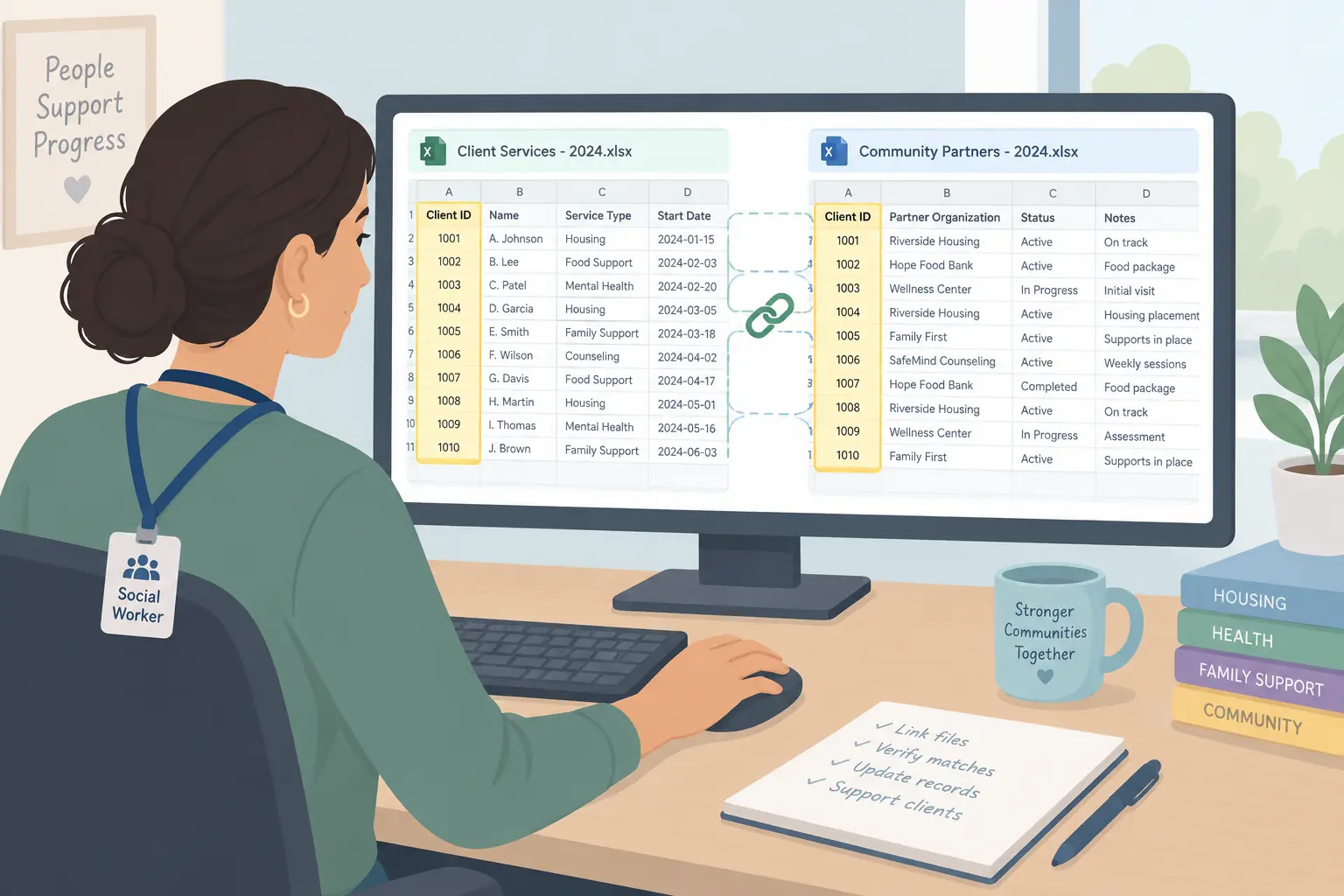
A frequent, well-supported design links AFCARS placement data to NCANDS report history for the same state and time window, to ask whether children with a specific maltreatment-report pattern experience different placement trajectories. This requires care with unit of analysis (a maltreatment report is not the same unit as a foster-care spell) and with the state-specific identifiers each file uses — NDACAN’s documentation for each dataset specifies exactly which linkage variables are usable and which have been altered for disclosure protection. Never assume a state-issued case ID is directly comparable across the two systems without checking the codebook. Once your linked extract is built, free statistical software for students covers the tools (R, JASP, jamovi) commonly used to manage and analyse this kind of merged administrative data at no licensing cost.
Worked example: a linked-data thesis design (illustrative)
The design below is an illustrative composite showing how the linkage logic works in practice, not a description of a specific published study.
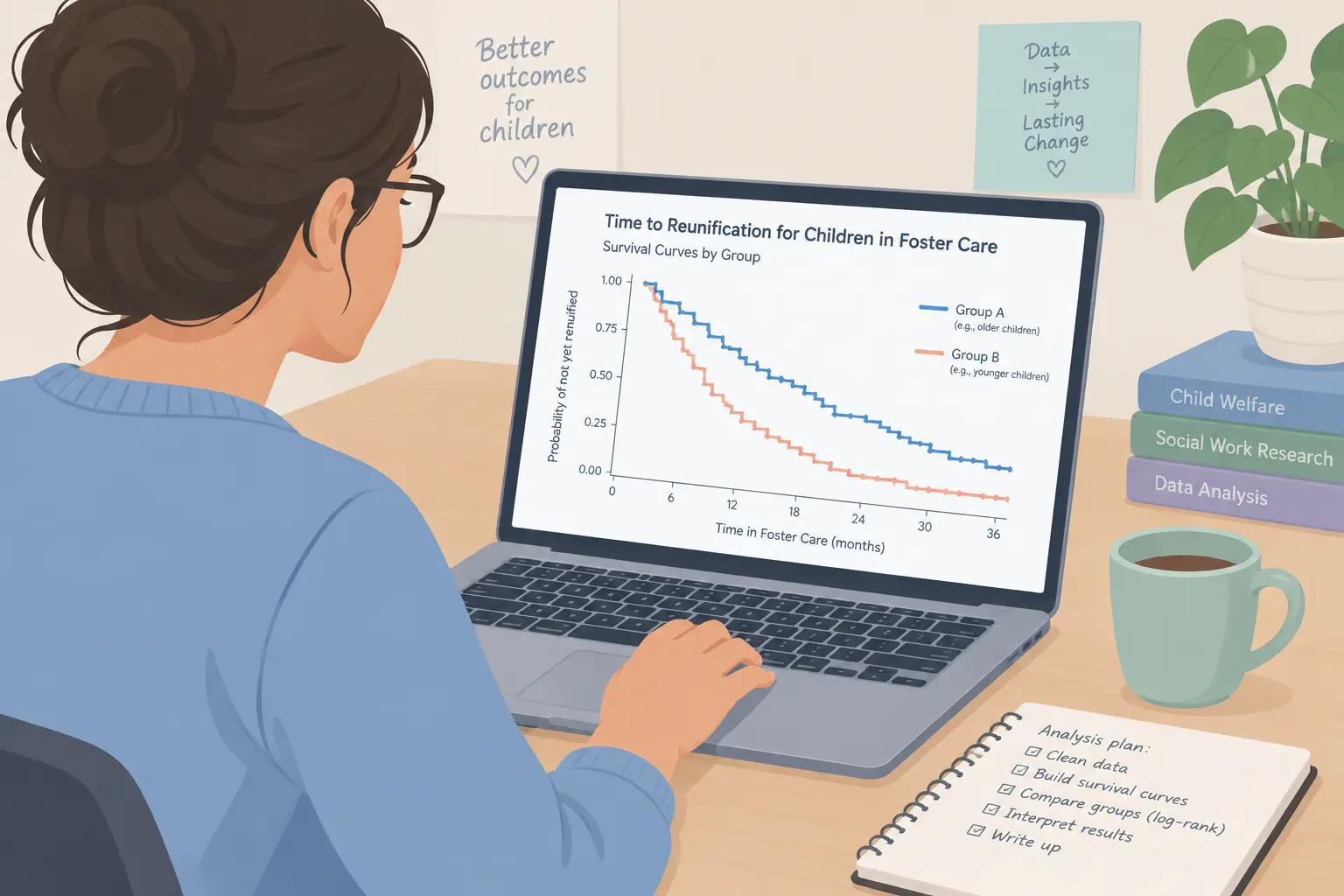
Research question: Among children with a substantiated maltreatment report in a given state and year (NCANDS Child File), does placement type at foster-care entry (kinship versus non-relative foster care, from AFCARS) predict time to reunification?
Data steps: (1) pull the NCANDS Child File for the target state and year, restricted to substantiated reports where the case disposition indicates removal; (2) pull the corresponding AFCARS Foster Care File for the same state and overlapping entry-date window; (3) link the two files using the state-specific linkage variables NDACAN’s codebook designates as valid for that state and year (not every state’s identifiers are consistently linkable across systems, and some years require an intermediary crosswalk file); (4) define the outcome (time from entry to reunification, in days, right-censored for children still in care at the file’s cutoff date); (5) fit a survival model (e.g., Cox proportional hazards) with placement type as the key predictor and standard child-level covariates (age at entry, prior removals, sibling group size) as controls.
What the illustrative design has to justify explicitly: why this state and year were chosen (data completeness, a policy change of substantive interest), how right-censoring was handled, and why placement type is treated as the causal variable of interest rather than a proxy for unmeasured differences in case severity — a limitation nearly every reviewer of child-welfare administrative data will raise.
Other sources worth knowing about
- Kids Count Data Center (Annie E. Casey Foundation) — free, easy-access state and county-level child well-being indicators, useful for contextualising your sample’s geography even though it is not case-level data.
- ChildStats.gov (Federal Interagency Forum on Child and Family Statistics) — an annual compiled report drawing on AFCARS, NCANDS and other federal sources, useful for a literature-review-level national picture before you dive into case-level analysis, and a good place to sanity-check whether your own extract’s counts are in the expected range for your state.
- National Youth in Transition Database (NYTD) — also distributed through NDACAN, tracks outcomes for youth ageing out of foster care (education, employment, housing stability), a distinct population and question set from the younger-child focus of NSCAW.
- National Survey of Children’s Health (NSCH) — a broader, general-population child health survey (not restricted to CPS-involved children); useful only as a comparison population, not as a child-welfare-specific source.
If your design instead calls for a validated instrument to measure a construct directly (parenting stress, caregiver burden, child behaviour) rather than relying on administrative records, instruments and scales for a social work dissertation covers the standardised measures social work committees expect to see reported with reliability and validity statistics.
Reading the codebook before you write your proposal
Every NDACAN dataset ships with a detailed codebook describing variable definitions, missing-data codes, and — for AFCARS and NCANDS specifically — the exact reporting period conventions each state has followed, which can change mid-series when a state migrates its case-management system. Reading this codebook before you finalise your proposal’s research question, rather than after your data-use agreement is approved, avoids the common failure mode of designing an analysis around a variable that turns out to be defined differently than you assumed, or that a specific state simply did not report for several years.
Ethics and data-use agreements
Even the public-use AFCARS and NCANDS files require you to sign a data-use agreement committing to no re-identification attempts and to reporting any accidental disclosure; NSCAW’s restricted-use license typically also requires your institution’s IRB approval on file before NDACAN will release the data, given the vulnerable population involved. Build several weeks into your proposal timeline for the NSCAW application specifically — it is not instant, and committees increasingly expect you to show evidence of having started this process before your proposal defence rather than after. For the wider ethics and consent considerations that apply once you move beyond secondary administrative data toward interviewing families or practitioners, see social work dissertation methodology and research ethics.
Where Tesify fits
Once your data-use agreement is approved and your extract is in hand, Tesify’s thesis workspace is useful for drafting the data-and-methods section describing which file, version and variables you used — it has no access to NDACAN’s restricted data and should never be used to describe results before your own analysis is complete.
Frequently asked questions
Are AFCARS and NCANDS the same dataset?
No. AFCARS covers foster care and adoption caseload; NCANDS covers maltreatment reports and CPS investigations. A child can appear in NCANDS without ever appearing in AFCARS (if the case was not substantiated or the child was not removed), and vice versa in some circumstances.
Do I need IRB approval to use these datasets?
For the public-use AFCARS and NCANDS files, most institutions treat this as exempt secondary-data analysis, but check with your own IRB; for NSCAW’s restricted-use file, IRB approval is typically a prerequisite for NDACAN to release the license.
How far back do these datasets go?
AFCARS and NCANDS have multi-decade time series available through NDACAN, making trend analyses over long periods possible; NSCAW has run in distinct cohort waves rather than as a continuous annual series, so check which wave (or waves) match your target age group and time period.
Can I use these datasets for a state-specific thesis rather than a national one?
Yes — both AFCARS and NCANDS retain a state identifier, so you can subset to a single state; just check the state’s specific reporting completeness notes in the codebook, since data quality and definitions vary somewhat by state.
What is the difference between the NCANDS Child File and Agency File?
The Child File is case-level, one record per child per report, suited to individual-level analysis; the Agency File is state-level aggregate counts plus policy-context variables, suited to state-comparison or policy-evaluation designs.
Is there a cost to access any of these files?
No — NDACAN distributes all three at no cost to researchers who complete the relevant data-use agreement or license application; budget time for the paperwork, not money, especially for NSCAW.
Can undergraduate students access restricted-use files like NSCAW?
Typically the license must be held by a faculty member or the student’s institution rather than an individual undergraduate; check NDACAN’s current investigator-eligibility requirements and involve your supervisor in the application.
Can I link AFCARS and NCANDS data across different states?
Cross-state linkage is far harder than within-state linkage because reporting definitions, thresholds and case-management systems differ by state; a multi-state design is possible but should treat state as a structural variable rather than pooling states as if they used identical definitions.
What should I do if my target state has known data-quality issues in a given year?
NDACAN’s documentation and the Children’s Bureau’s own data-quality reports flag known submission problems by state and year; state this limitation explicitly, consider excluding the affected year, or use it as a robustness-check comparison rather than silently including flagged data.
Do these datasets include information on caseworkers or agency staffing?
Not at the individual caseworker level; the NCANDS Agency File includes some state-level policy and resource-context variables, but caseworker-level staffing or caseload data typically has to come from a separate state-specific administrative request or a workforce survey.
Write your thesis with AI
Structure, draft, cite, and format your thesis faster with Tesify’s AI writing tools, automatic bibliography, and plagiarism checker. Free to start, no credit card required.




Leave a Reply