

Can You Do a PhD Without a Master’s Degree in 2026?
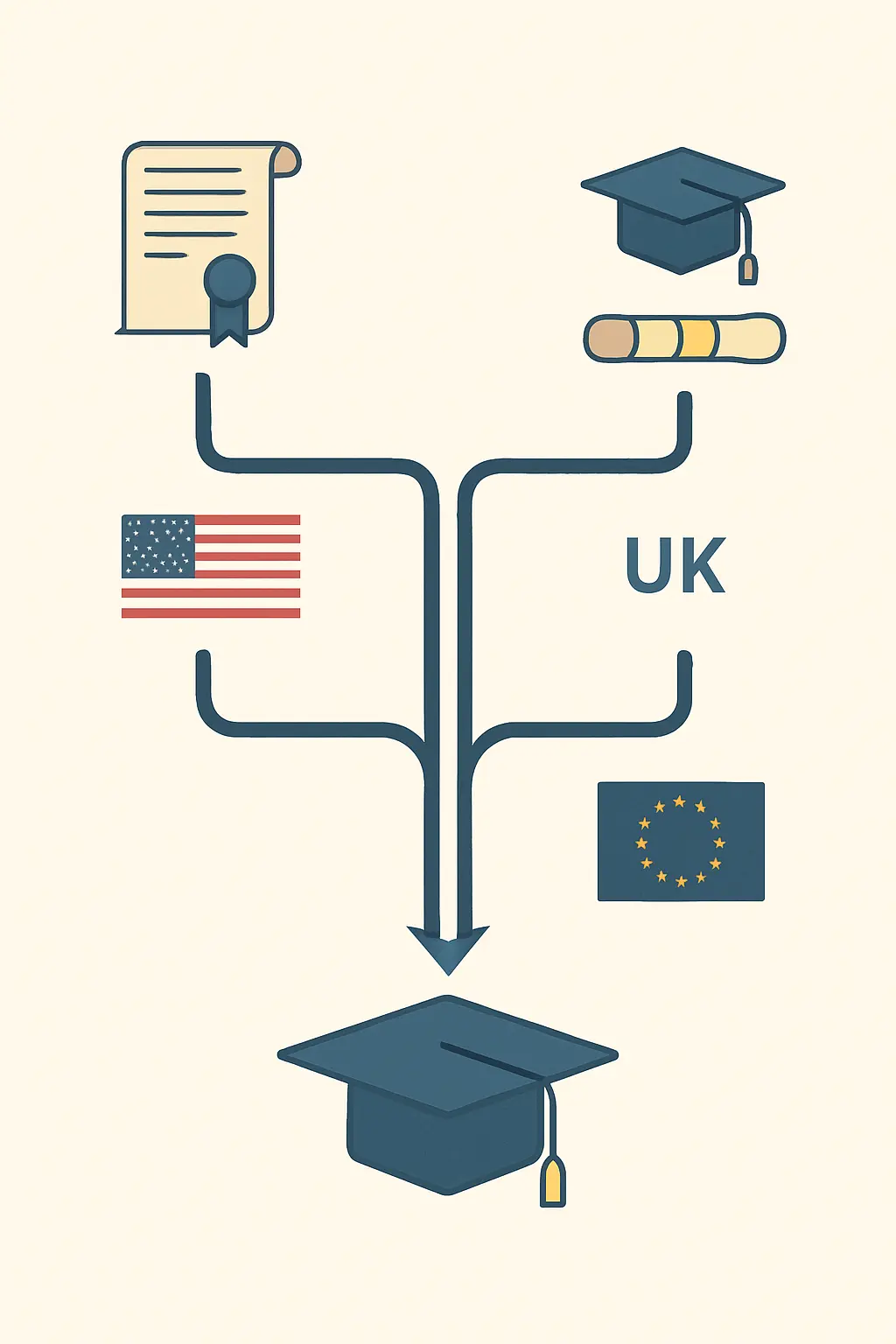
Yes — and in the United States and Canada the direct-entry route is the default, not the exception. Most North American PhD programs admit students straight from a bachelor’s degree and often award a master’s as a milestone along the way. In the UK, Australia, and Ireland you can do a PhD without a master’s, but you will face a higher bar: first-class (or strong 2:1) honours, strong research experience, and either exceptional standing or enrolment in a structured integrated programme. Continental Europe and much of Asia still treat a master’s as a near-mandatory prerequisite.
How does direct-entry PhD work in the US and Canada?
In the United States, the bachelor’s-to-PhD route is the norm across most research universities and STEM graduate schools. Programs are structured to provide the advanced training a UK or European applicant would have completed in a separate master’s: the first one or two years combine taught coursework, methods training, and qualifying or comprehensive examinations, before the student advances to candidacy and begins independent dissertation research.
A master’s degree is frequently awarded automatically at a milestone point — typically after passing qualifying exams or completing the required coursework — meaning many US PhD graduates hold both degrees even though they never enrolled in a standalone master’s programme. For data on how long each route typically takes, see this country-by-country breakdown of PhD duration by field. The full programme typically runs four to six years in STEM fields and five to seven years in the humanities and social sciences.
Canadian universities follow a similar pattern, though practices vary more between institutions and disciplines. Some humanities and social science departments in Canada still give preference to master’s holders, viewing the thesis-based master’s as evidence of independent research capacity. Applicants without a master’s should confirm departmental norms before applying.
Can you do a PhD without a master’s in the UK?
The UK has traditionally expected doctoral applicants to arrive research-ready, which is why a taught or research master’s has been the conventional route. British PhDs run three to four years from enrolment and plunge into original research almost immediately — there is little coursework buffer to compensate for gaps in methodology training.
Direct entry to a UK PhD without a master’s is possible, but it is genuinely competitive. Departments look for applicants with a first-class undergraduate degree in a relevant subject, a substantial dissertation (typically a strong final-year project), and ideally some postgraduate research experience or lab placement. A grade of 2:1 is often described as the minimum, but funded positions and top programmes realistically favour firsts.
Discipline matters considerably. Engineering, computer science, physics, and biomedical sciences departments have longer histories of taking high-achieving bachelor’s graduates directly, particularly those who have worked as research assistants. Humanities and qualitative social science departments tend to be more cautious, expecting applicants to have demonstrated independent scholarly writing at master’s level before they are trusted with a three-year independent project.
What is an integrated PhD programme?
The integrated PhD — sometimes labelled a four-year doctoral programme, an MRes+PhD, or simply an integrated doctorate — is the clearest structural route for UK bachelor’s graduates who want doctoral training without a separate master’s enrolment. The first year delivers intensive research methods teaching, laboratory or archival training, and in some cases a short research project, earning a master’s-level qualification. Years two to four then proceed as a standard PhD.
These programmes are especially common in biological sciences, chemistry, physics, and medicine, where UK Research Councils and Wellcome Trust fund cohort-based Doctoral Training Programmes (DTPs) and Centres for Doctoral Training (CDTs). Admission to an integrated programme is typically more competitive than standard PhD entry, but the award of a master’s in year one provides a safety qualification if the student does not continue to the full doctorate.
Before committing, make sure you understand how the research proposal is handled. Unlike a conventional PhD application — where you usually submit a detailed proposal upfront — many integrated programmes require only a general interest statement, with the project defined during the first year. See our guide on what a thesis proposal should include to understand what supervisors expect when a project crystallises in year one.
What about Australia and Ireland?
Australia offers a structured path from bachelor’s to PhD for graduates who hold first-class honours — a one-year postgraduate qualification that incorporates advanced coursework and an original research thesis of around 20,000–25,000 words. Honours is effectively treated as proof of research readiness, making it the Australian functional equivalent of a UK first with a strong dissertation. Students who do not hold honours but have a bachelor’s with a strong grade-point average may be admitted to a PhD, subject to departmental approval and often with a confirmation of candidature milestone in the first year. Our article on what a confirmation of candidature involves explains how Australian universities use this milestone to formally assess whether a student is ready to continue.
Ireland sits between the UK and continental European models. Most Irish universities accept applications from bachelor’s graduates with first-class honours, particularly for structured four-year doctoral programmes that include taught elements in year one. The Irish Research Council and Science Foundation Ireland fund cohort-based programmes along lines similar to UK Research Councils. For disciplines outside STEM, a master’s is strongly advised, and some departments will not consider applicants without one.
Is a master’s required in Europe and elsewhere?
In most continental European countries — Germany, France, the Netherlands, Italy, Scandinavia — a master’s degree is a formal prerequisite for doctoral enrolment, not merely a preference. The Bologna Process structure, which divides European higher education into three cycles (bachelor’s / master’s / doctorate), is the framework most European universities use, and admission to the third cycle normally requires completion of the second. Exceptions exist at research-intensive institutions with international programmes, but they are uncommon.
Japan, South Korea, China, and most Asian university systems similarly require a master’s as the standard gateway to doctoral study, though direct-entry programmes exist at some elite research universities for exceptionally strong bachelor’s graduates.
When does it make sense to do a master’s first anyway?
Even where direct entry is structurally permitted, a master’s can strengthen your application substantially. If your undergraduate degree was in a related but not identical field, a master’s allows you to pivot disciplines and demonstrate competence. If your undergraduate grade was a strong 2:1 rather than a first, a distinction at master’s level often compensates. If you are unsure whether doctoral research is right for you, a master’s provides a lower-stakes trial: you learn to conduct independent research, write a research thesis, and work with a supervisor, all at a fraction of the time and commitment of a full doctorate.
Financially, the calculus is different in North America, where PhD programmes typically carry stipends and fee waivers. A separate master’s in the US or Canada costs tuition without equivalent funding — which is precisely why most North American doctoral students skip it and enter the PhD directly.
What do PhD admissions committees look for without a master’s?
When reviewing a direct-entry application from a bachelor’s graduate, admissions panels are essentially asking one question: does this person have enough research experience to hit the ground running? The signals they use include:
- Undergraduate degree class. A first (or GPA equivalent of 3.7/4.0 or above) is the standard baseline for competitive applications. A 2:1 alone rarely suffices without compensating evidence.
- Undergraduate dissertation or research project. A high-quality final-year project — ideally on a topic adjacent to the proposed PhD — is the single strongest proxy for doctoral readiness available to a bachelor’s graduate. It demonstrates that you can formulate a research question, conduct a literature review, apply a methodology, and produce a coherent written argument independently.
- Research experience outside coursework. Lab placements, field work, summer research programmes, or roles as a research assistant all signal genuine engagement with the research process beyond taught assessment.
- A focused, credible research proposal. Even where direct-entry programmes do not require a detailed proposal, the personal statement must demonstrate that you understand your field, can identify a gap in the literature, and have thought seriously about how you would address it.
- Supervisor match. Unlike master’s applications, most doctoral admissions require that a potential supervisor has agreed in principle to work with you before the formal application is submitted. Identifying and contacting the right supervisor — and securing a positive response — is often the decisive step.
- References. Two or three references from academics who can speak directly to your research capacity (not just your grades) carry significant weight.
The PhD viva — the oral examination at the end of the doctorate — is the same regardless of whether you arrived with a master’s or a bachelor’s. Our article on PhD viva outcomes covers what examiners assess and how corrections work once you reach that stage.
Many PhD students at this stage also choose to structure their doctorate as a thesis by publication rather than a conventional monograph. If that route interests you, the article on what a thesis by publication involves explains how this format works and which disciplines use it most.
Frequently asked questions
Can I apply for a PhD with only a bachelor’s degree?
Yes, in the US and Canada most PhD programmes accept bachelor’s graduates as standard. In the UK, Australia, and Ireland it is possible with first-class honours or via an integrated programme. In continental Europe a master’s is almost always required before doctoral entry.
What is a direct-entry PhD?
A direct-entry PhD is a doctoral programme that accepts applicants straight from a bachelor’s degree without requiring a master’s first. These are common in North America and available in some STEM fields in the UK and Australia. The programme typically incorporates advanced coursework and methods training in the early years to compensate for the absence of a master’s.
Do US PhD students earn a master’s degree along the way?
Very often yes. Many US doctoral programmes award an en-route or terminal master’s degree — usually after the student passes qualifying examinations or completes a set number of credit hours. The student did not enrol in a separate master’s programme; the degree is conferred as a milestone within the PhD.
How long does a PhD take without a master’s degree?
In the US, a direct-entry PhD typically takes four to six years in STEM and five to seven years in humanities or social sciences. In the UK, an integrated programme (which includes master’s-level training in year one) runs four years. Australian PhDs are generally three to four years after honours entry.
Is it harder to get a PhD without a master’s?
In the US it is neither harder nor easier — the PhD programme is simply designed for bachelor’s graduates. In the UK and Australia, direct entry without a master’s is more competitive: you are applying for a shorter, more intense programme and must demonstrate research readiness through your degree classification, undergraduate dissertation, and experience rather than through a completed master’s thesis.
Which PhD subjects most commonly accept students without a master’s?
STEM fields — particularly physics, mathematics, chemistry, engineering, computer science, and biomedical sciences — have the longest tradition of admitting direct-entry doctoral students. In these disciplines, undergraduate training is more standardised and research skills (lab competency, data analysis, technical problem-solving) are more easily demonstrated during the degree itself. Arts, humanities, and qualitative social sciences tend to require a master’s because independent scholarly writing is harder to assess from undergraduate work alone.
Can you do a PhD without a master’s in the UK in 2026?
Yes. Two main routes exist in 2026. First, direct entry to a standard three-year PhD for applicants with a first-class undergraduate degree in a relevant subject and strong research experience. Second, enrolment in a four-year integrated PhD programme that builds master’s-level training into year one. The integrated route is particularly well established in sciences and medicine through UK Research Council Doctoral Training Programmes and Centres for Doctoral Training.
Should I do a master’s before a PhD even if I don’t have to?
It depends on your situation. A master’s is worth doing if you want to change disciplines, if your undergraduate grade does not make you competitive for doctoral entry, if you want to clarify whether research is the right career path, or if you need time to develop a more focused research proposal. In North America, the financial argument against a separate master’s is strong: funded PhD programmes exist and a master’s typically comes without stipend support. In the UK, a taught or research master’s can substantially strengthen a later PhD application, particularly in competitive or humanities-heavy fields.
Do I need a master’s to apply for a funded PhD scholarship?
Not necessarily. Many funded PhD positions in the UK (UKRI studentships, CDTs, DTPs) and the US (NSF Graduate Research Fellowship, NIH predoctoral awards) are open to bachelor’s graduates. Australian Research Council and NHMRC scholarships similarly do not mandate a master’s — first-class honours is the standard benchmark. However, competition is intense and a master’s degree or equivalent research experience will strengthen any application.
What GPA or degree class do I need to do a PhD without a master’s?
UK programmes generally expect a first-class honours degree (70% or above) for direct entry, though a very strong 2:1 (65%+) may be considered alongside exceptional research experience. US programmes typically look for a GPA of 3.5/4.0 or higher, with the strongest programmes (and fellowships) targeting 3.7+. Australian programmes require first-class honours, which is a separate one-year postgraduate qualification graded on research output.
Write your thesis with AI
Structure, draft, cite, and format your thesis faster with Tesify’s AI writing tools, automatic bibliography, and plagiarism checker. Free to start, no credit card required.






Leave a Reply