
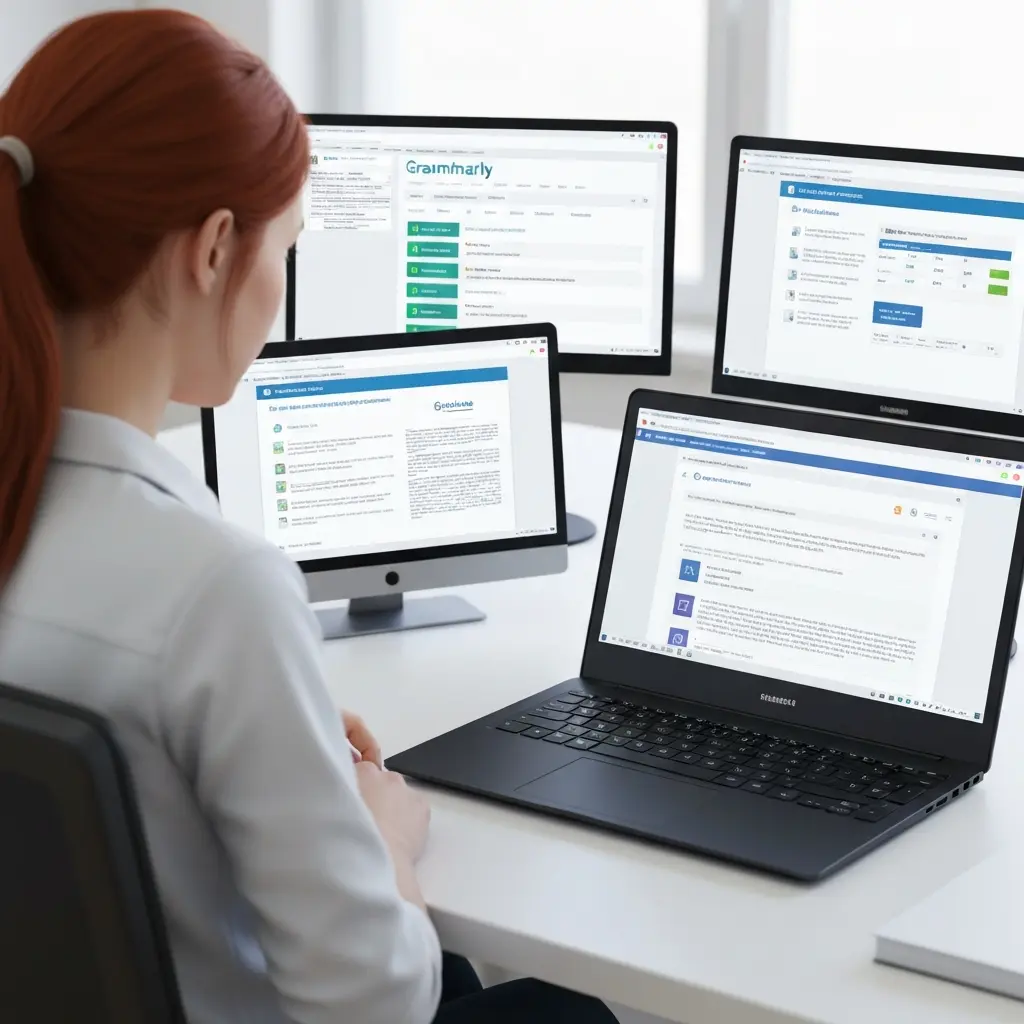
Best Plagiarism Checkers for Students Compared 2026 (Turnitin, Grammarly, Copyleaks, Tesify)
Academic integrity has never been under more scrutiny than in 2026. Universities across the UK, US, Australia, and Europe are deploying increasingly sophisticated detection tools — and the consequences for plagiarism (and now AI-generated content) have sharpened accordingly. Whether you are a final-year undergraduate preparing to submit a dissertation or a postgraduate revising a research paper, finding the best plagiarism checkers for students is no longer optional. It is a core part of responsible academic writing.
This guide offers an objective, tool-by-tool comparison of the six most widely used plagiarism detection tools in 2026: Turnitin, Grammarly, Copyleaks, iThenticate, Quetext, and Tesify. We cover detection accuracy, database size, AI content detection capabilities, pricing, and privacy — everything you need to make a genuinely informed choice.
Why Plagiarism Checking Matters in 2026
Plagiarism detection is no longer simply about catching students who copy-paste from Wikipedia. The 2025–2026 academic landscape involves three distinct integrity challenges: traditional textual plagiarism, paraphrasing-based plagiarism (patchwriting), and AI-generated content. Each requires different detection methods — and most tools now attempt to address all three.
A 2024 survey by Turnitin found that 57% of papers submitted to their platform contained some AI-written content, and 17% were predominantly AI-generated. Universities have responded: as of 2026, over 85% of Russell Group universities in the UK have specific AI-content policies, and the majority use Turnitin’s AI detection layer as part of submission review.
For students, running a pre-submission check serves two purposes: catching accidental plagiarism (improperly cited quotes, forgotten paraphrases) and verifying that your work reads authentically human — not flagged by an AI detector. Tesify’s guide on academic integrity and plagiarism provides the conceptual foundation; this article focuses on the tools.
How Plagiarism Checkers Work
All plagiarism detection tools follow the same fundamental process:
- Parsing: The submitted document is broken into chunks (sentences or phrases).
- Database matching: Chunks are compared against reference databases — web pages, academic journals, past student submissions, books.
- Similarity scoring: Matching sections are flagged with percentage overlap and source identification.
- Report generation: A similarity report highlights matched text and links to source documents.
The critical difference between tools lies in their databases. A tool that only checks publicly accessible web content will miss papers behind journal paywalls, previous student submissions, and grey literature. Turnitin’s proprietary student paper database — containing over 1 billion papers — is the primary reason it remains the institutional standard.
AI detection adds a parallel layer: statistical analysis of text patterns (perplexity and burstiness) to assess whether a passage was likely generated by a large language model rather than written by a human.
Turnitin
Overview
Turnitin is the dominant plagiarism detection system in higher education globally. Founded in 1998, it is used by more than 15,000 institutions in 140 countries. It is not a consumer product — students access it only through their institution’s Learning Management System (LMS) or submission portal.
Database & Accuracy
- 70+ billion web pages (continuously updated)
- 1.5 billion+ student papers
- 200+ million scholarly articles (CrossRef, Gale, ProQuest, and others)
- Content from newspapers, books, and grey literature
Turnitin’s similarity matching is the most comprehensive available. Independent studies consistently rate it as the most accurate tool for academic text, particularly for detecting recycled content from previous submissions.
AI Detection
Turnitin launched AI writing detection in April 2023 and has updated its model continuously. As of 2026, it claims a 98% detection rate for ChatGPT-generated prose and covers GPT-4, Claude 3, and Gemini models. Its false positive rate — flagging human writing as AI — is reportedly below 1% at the 80th percentile confidence setting.
Pricing
- Not available to individual students directly
- Institutional licensing starts at approximately $2 per student per year for large universities
- Turnitin Draft Coach: free browser extension for Google Docs (limited to 3 checks/draft; checks against web content only, not student paper database)
Pros & Cons
| Pros | Cons |
|---|---|
| Largest database; most accurate | Not available to individual students |
| Trusted by 15,000+ institutions | Stores student papers in database |
| Best AI detection accuracy | Institutional interface, not student-friendly |
| Detailed feedback and similarity reports | No real-time checking during drafting |
Grammarly
Overview
Grammarly is primarily a grammar and writing enhancement tool, but its Premium plan includes a plagiarism checker. Its positioning as a student writing tool makes it one of the most-used checkers by students — despite having significantly smaller database coverage than institutional tools.
Database & Accuracy
- 16+ billion web pages
- ProQuest database of academic journals (via partnership)
- Does not access student paper databases
Grammarly’s plagiarism check is reliable for publicly available web content but misses a large proportion of academic plagiarism — especially paraphrased or slightly altered text from journal articles and previous student submissions.
AI Detection
Grammarly added AI detection in 2024 (Premium). It identifies text likely generated by ChatGPT, Claude, and other LLMs, but its detection model is less transparent than Turnitin’s. Users report higher rates of false positives on technical writing. The feature is available on Premium and Enterprise plans.
Pricing (2026)
| Plan | Price | Plagiarism Check |
|---|---|---|
| Free | $0 | No |
| Premium | ~$12/month (annual) | Yes + AI detection |
| Business | ~$15/month/member | Yes + team features |
Copyleaks
Overview
Copyleaks is one of the most accurate non-institutional plagiarism checkers and is the top choice for students who need a reliable standalone tool. It is available directly to individuals, supports 100+ languages, and has invested heavily in AI content detection since 2023.
Database & Accuracy
- Billions of web pages (continuously crawled)
- Academic publications and journals
- Internal repository of previously scanned documents
- Supports 100+ languages including non-Latin scripts
Third-party testing consistently ranks Copyleaks second only to Turnitin for academic plagiarism detection accuracy. Its paraphrase detection — identifying synonymised or structurally altered text — is particularly strong.
AI Detection
Copyleaks AI Detector supports detection of text generated by ChatGPT (all versions), GPT-4o, Claude 3, Gemini, Llama, Mistral, and others. It provides sentence-level confidence scoring, not just a document-level percentage. The tool is available as a standalone product and as part of the Copyleaks platform.
Pricing (2026)
| Plan | Price | Included Words |
|---|---|---|
| Free | $0 | 2,500 words/month |
| Essential | ~$10.99/month | 25,000 words/month |
| Advanced | ~$29.99/month | Unlimited words |
iThenticate
Overview
iThenticate is Turnitin’s sister product, designed specifically for researchers, publishers, and postgraduate students. It accesses the same CrossRef and database infrastructure as Turnitin but is available for individual purchase — making it a viable option for PhD students or researchers who want Turnitin-level accuracy without going through an institutional licence.
- Access to CrossRef database (100+ million scholarly articles)
- Turnitin’s student paper repository (via institutional licence addons)
- API access for publishers and journals
- Pricing: approximately $150/year for individual researchers (plans vary)
iThenticate is overkill for most undergraduates but is the most appropriate self-service tool for PhD students submitting to journals or preparing a monograph for publication.
Quetext
Overview
Quetext is a student-friendly plagiarism checker with a clean interface, a usable free tier, and a DeepSearch technology that goes beyond simple string matching. It is particularly popular among US and UK students for pre-submission checks on essays and short papers.
- Database: billions of web pages + selected academic sources
- Free plan: 2,500 words per check (5 checks/month)
- Pro plan: ~$9.99/month for unlimited checking
- Provides a ColourGrade report (colour-coded similarity breakdown)
- Does not include AI detection as of early 2026 (roadmap feature)
Quetext is an excellent budget option for students checking shorter assignments. For dissertations or theses, its lack of a comprehensive academic database is a meaningful limitation.
Tesify
Overview
Tesify differs from the other tools on this list in that plagiarism checking is integrated into a full academic writing assistant. Rather than uploading a finished document to a standalone checker, students draft, edit, and check their work in a single environment. This workflow integration matters: you can address issues in real time rather than in a separate revision cycle after completion.
- Plagiarism detection integrated directly into the thesis/dissertation writing interface
- Citation management with automatic in-text citation generation (APA, MLA, Chicago, Harvard)
- AI writing detection layer included
- Real-time suggestions as you write
- Supports English and multiple European languages
Tesify’s integrated approach is most valuable for students writing long-form academic documents — dissertations, theses, research papers — where the back-and-forth between a writing tool and a separate plagiarism checker creates unnecessary friction. The 12-month dissertation roadmap on Tesify shows how plagiarism checking fits into the broader writing timeline.
For German-language academic work, equivalent thesis assistance is available via tesify.io; French students can access thesis writing tools at tesify.fr.
Full Comparison Table
| Tool | Database Size | Student Papers DB | AI Detection | Free Tier | Paid Price/Month | Best For |
|---|---|---|---|---|---|---|
| Turnitin | ★★★★★ | Yes | Yes (best) | No (Draft Coach) | Institution only | All institutional submissions |
| Copyleaks | ★★★★☆ | No | Yes (strong) | 2,500 words/month | $10.99 | Individual students, AI detection |
| iThenticate | ★★★★★ | Via institution | Yes | No | ~$12+ (annual plan) | PhD students, researchers |
| Grammarly | ★★★☆☆ | No | Yes (Premium) | Grammar only | $12.00 | Essays, web-based checking |
| Quetext | ★★★☆☆ | No | No (planned) | 2,500 words/check | $9.99 | Essays, short papers, budget users |
| Tesify | ★★★★☆ | No | Yes | Yes | Varies by plan | Thesis/dissertation writers, integrated workflow |
AI Content Detection in 2026: What Students Need to Know
The emergence of reliable AI detection has fundamentally changed what plagiarism checkers do. In 2026, submitting a paper is not just a question of “did I copy this from somewhere?” but also “will this be flagged as AI-generated?”
Key facts about AI detection accuracy:
- Turnitin AI detection is the most widely deployed in higher education. It claims a less-than-1% false positive rate at conservative settings and covers all major LLMs as of mid-2025.
- Copyleaks provides sentence-level confidence scores, making it easier to identify which specific passages may be problematic.
- No tool is 100% accurate. A 2024 Stanford study found that AI detectors misclassify ESL (non-native English) student writing as AI-generated at significantly higher rates. This has prompted many universities to use AI detection only as a first-stage flag, not as definitive evidence of misconduct.
- Paraphrasing tools do not reliably fool detectors in 2026. Humanising tools like Quillbot reduce AI detection scores but do not eliminate them — and using them to conceal AI authorship is itself an academic integrity violation at most institutions.
For a deeper treatment of AI and academic writing, see Tesify’s guide on using AI to write your dissertation and the AI in academic writing statistics 2026 article, which covers detection accuracy data in detail. Authenova’s research on AI content detection benchmarks is also useful for understanding how detection technology is evolving.
Privacy & Data Storage: What Happens to Your Work
This is an under-discussed aspect of plagiarism checker use. When you upload your thesis draft or research paper, what happens to that content?
| Tool | Storage Policy | Database Retention |
|---|---|---|
| Turnitin | Stores papers in global repository by default | Indefinite (opt-out possible via institution) |
| Grammarly | Stores documents; user can delete | Until deleted by user |
| Copyleaks | Does not permanently store after check | Not retained in external database |
| iThenticate | Similar to Turnitin; check policy before use | Varies by subscription |
| Quetext | Stores user submissions on server | 30-day retention (Standard) |
| Tesify | Data stored securely, not shared | User-controlled |
How to Choose the Right Plagiarism Checker
Use this decision framework to find the right tool for your specific situation:
- If you are submitting through your university portal: Your institution uses Turnitin. Use Turnitin Draft Coach (free) for pre-submission checks and focus on understanding the similarity report interpretation guidelines from your university.
- If you are a PhD student or researcher preparing journal submissions: iThenticate is the appropriate tool — it mirrors what journals use.
- If you need a standalone checker with strong AI detection: Copyleaks Essential ($10.99/month) is the best balance of accuracy, AI detection, and privacy for individual students.
- If you are writing a dissertation or thesis and want an integrated workflow: Tesify combines writing support, citation management, and plagiarism checking in one platform — the most efficient choice for long-form academic work.
- If you are on a tight budget checking short essays: Quetext Free (2,500 words/check) or Grammarly Free (grammar only) for basic checks; upgrade to Quetext Pro ($9.99) for longer work.
Remember that no plagiarism checker replaces good academic practice. Checking is the last step; citation discipline, paraphrase practice, and understanding what constitutes plagiarism — covered in Tesify’s guide to avoiding plagiarism — are the foundation.
Frequently Asked Questions
Which plagiarism checker is most accurate in 2026?
Turnitin remains the gold standard for institutional accuracy, with access to over 1.5 billion student papers and 70+ billion web pages. For individual students who cannot access Turnitin, Copyleaks is rated highest for accuracy among non-institutional tools, followed by iThenticate. Grammarly is convenient but limited to web content and lacks the student paper database that catches the most common form of academic plagiarism.
Is Turnitin free for students?
Turnitin is not available directly to individual students as a purchased product — it is licensed to universities and institutions. Students access it through their institution’s LMS or submission portal. Turnitin’s Draft Coach browser extension is free and offers limited plagiarism checks via Google Docs (against web content only, not the student paper database).
Can plagiarism checkers detect AI-generated content in 2026?
Yes, leading tools now include AI detection. Turnitin AI detection claims a 98% detection rate for ChatGPT-generated text with under 1% false positives at conservative settings. Copyleaks AI detection covers GPT-4o, Claude 3, Gemini, Llama, and other models with sentence-level scoring. Grammarly added AI detection to Premium in 2024. However, no tool offers 100% accuracy, and false positives on non-native English writing remain a documented concern.
What is the best free plagiarism checker for students?
The best free options in 2026 are Copyleaks (2,500 words/month with decent academic database coverage) and Quetext (2,500 words per check, five checks free per month). Turnitin Draft Coach is free for Google Docs users but only checks against web content. For documents longer than 5,000 words, a paid plan or institutional Turnitin access is strongly recommended.
Do plagiarism checkers store my work?
Policies vary significantly. Turnitin stores submitted papers in its global database by default (opt-out available for some institutional licenses — check with your institution). Grammarly stores documents until the user deletes them. Copyleaks does not permanently retain documents after checking. Always review the privacy policy of any tool before uploading confidential research, unpublished data, or original thesis content.
What similarity percentage is acceptable in 2026?
There is no universal threshold. Most universities flag submissions above 15–20% similarity for human review. However, similarity scores must always be interpreted contextually: a 25% match may be entirely acceptable if it consists of properly quoted and cited material. A 5% match with no citations may be a serious problem. Follow your specific institution’s guidelines and always discuss borderline results with your supervisor before submission.
Does Grammarly check for plagiarism in academic papers?
Grammarly Premium includes a plagiarism check that scans against over 16 billion web pages and some academic journal content via ProQuest. It does not access the closed databases of student papers that Turnitin uses. This means it can miss text recycled from previous student submissions — which is the most common source of plagiarism in academic work. The free plan does not include any plagiarism checking.
Write Cleaner, Cite Correctly, Submit with Confidence
Tesify combines an AI-powered thesis writing assistant with integrated plagiarism checking and citation management — so you build good academic practice from your first draft, not your last. Over 200,000 students trust Tesify with their most important academic work.
Write your thesis with AI
Structure, draft, cite, and format your thesis faster with Tesify’s AI writing tools, automatic bibliography, and plagiarism checker. Free to start, no credit card required.




Leave a Reply