
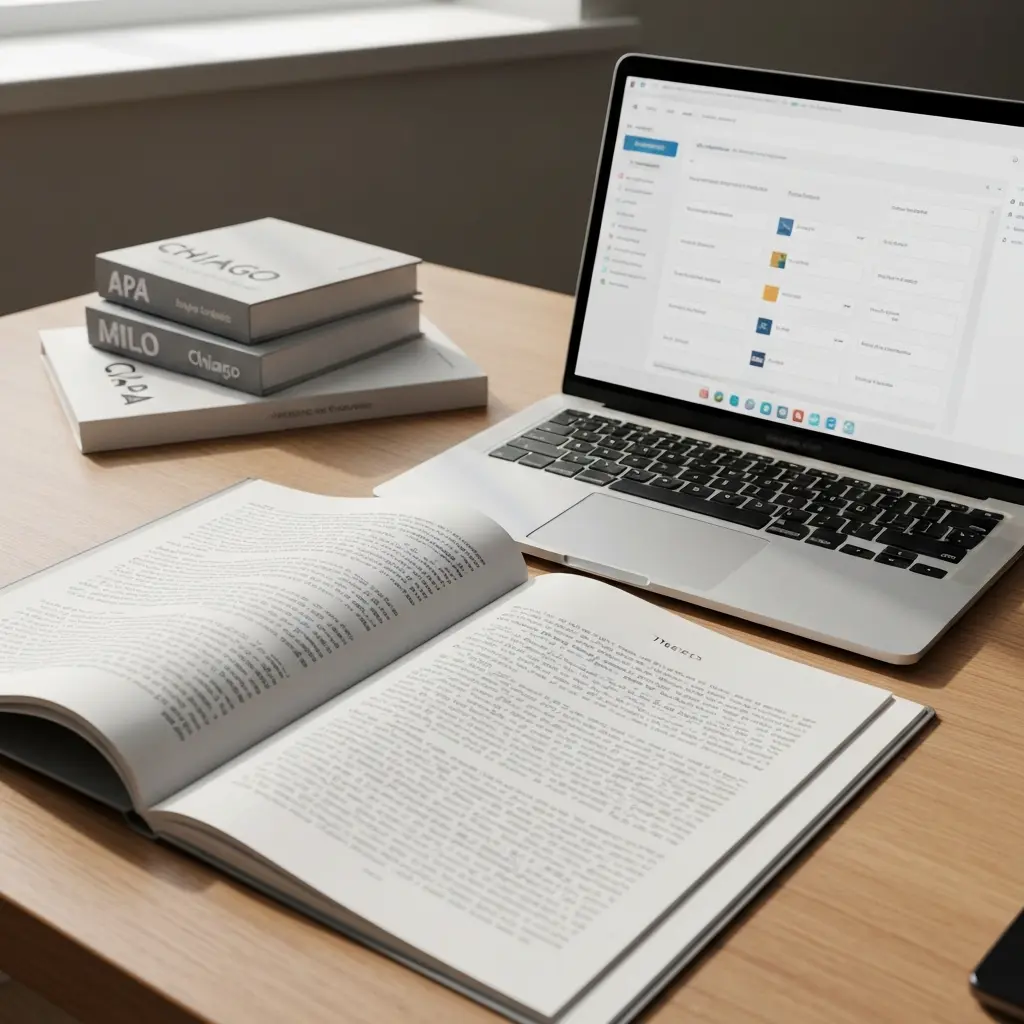
What Citation Style Should I Use for My Thesis? (2026 Decision Guide)
Choosing the wrong citation style for your thesis is one of the fastest ways to lose marks before your examiner has even read your argument. If you are asking what citation style should I use for my thesis, the answer depends on three things: your academic discipline, your university’s regulations, and — occasionally — your supervisor’s personal preference. This guide cuts through the confusion with a clear decision tree, a full breakdown of every major style, and answers to the eight most common questions students ask in 2026.
The short version: most students in social sciences and education use APA, humanities students use MLA or Chicago, history and arts students use Chicago Notes-Bibliography, UK students often use Harvard, medical and health students use Vancouver, and engineering and computer science students use IEEE. But “most” is not a rule — so read on before you commit to a format.
Check Your University Guidelines First
Before consulting any discipline convention, open your university’s thesis submission handbook. Many programmes — especially at postgraduate level — mandate a specific citation style, and deviating from it is an automatic formatting fail regardless of the quality of your research. Look for phrases like “references should follow APA 7th edition” or “the department uses MHRA.”
If your handbook says nothing, email your supervisor and ask directly: “Does the department have a preferred citation style for theses?” Supervisors often have strong preferences even when the department does not publish a formal rule. Getting this wrong costs you credibility before the examiner reads a single finding.
Once you have confirmed there is no mandated style, use the decision tree below to pick the best fit for your discipline. Korean-speaking students can also consult this Korean-language guide to citation methods for native-language guidance.
The Citation Style Decision Tree
Follow the branches in order. Stop at the first match that fits your situation.
Step 1 — Does your university or department specify a style?
Yes → Use that style. Stop here.
No → Continue to Step 2.
Step 2 — What is your broad field?
- Social sciences, psychology, education, business → APA 7th edition
- Literature, linguistics, cultural studies, media → MLA 9th edition
- History, philosophy, law, arts, architecture → Chicago 17th edition
- Medicine, nursing, health sciences, pharmacology → Vancouver
- Engineering, computer science, electronics, physics → IEEE
- UK or Australian programme, no field specified → Harvard
Step 3 — Is your institution UK- or Australia-based?
Yes, and your field is not medicine or engineering → Harvard is often the default even over APA.
No → Stay with your Step 2 answer.
Step 4 — Is your thesis interdisciplinary?
Yes → Use the style of the primary discipline or the style your lead supervisor publishes in.
APA — Social Sciences, Psychology, Education
The Publication Manual of the American Psychological Association, now in its 7th edition (2020), is the most widely used citation style in academic research worldwide. It dominates psychology, sociology, education, nursing, social work, business, and economics programmes. The core principle is author-date in-text citations that pair with a full reference list at the end of the document.
In-text format: (Author, Year) or Author (Year) when the name is part of the sentence.
Example: Studies confirm that spaced repetition significantly improves long-term retention (Kornell & Bjork, 2008).
Reference list entry (journal article):
Kornell, N., & Bjork, R. A. (2008). Learning concepts and categories: Is spacing the “enemy of induction”? Psychological Science, 19(6), 585–592. https://doi.org/10.1111/j.1467-9280.2008.02127.x
Key APA rules for thesis writers:
- Use a hanging indent (0.5 in) for every reference list entry.
- List up to 20 authors; for 21 or more, use an ellipsis after the 19th name.
- Include DOIs as hyperlinks where available.
- Titles of articles and book chapters use sentence case; journal titles use title case.
- Running headers are no longer required in student papers under APA 7.
Use our step-by-step APA citation guide if you need detailed examples for every source type.
MLA — Humanities and Literature
The Modern Language Association Handbook, 9th edition (2021), is the standard for English literature, comparative literature, linguistics, film studies, and many cultural studies programmes — particularly in the United States. MLA uses a parenthetical author-page system rather than author-date, reflecting the humanities convention of close textual analysis where page numbers matter more than publication year.
In-text format: (Author page) — no comma between name and page number.
Example: The narrator’s unreliability signals a deeper collapse of Enlightenment certainty (Pynchon 52).
Works Cited entry (book):
Pynchon, Thomas. The Crying of Lot 49. Lippincott, 1966.
Key MLA rules for thesis writers:
- The bibliography is titled “Works Cited,” not “References” or “Bibliography.”
- Use a container system: a chapter inside a book, or an article inside a journal, is a “contained” work.
- Titles of short works (articles, poems, short stories) go in quotation marks; longer works are italicised.
- MLA does not prescribe specific header formatting — follow your department’s style sheet.
See our MLA format guide with full examples for every source type from books to TikTok videos.
Chicago — History, Arts, and Law
The Chicago Manual of Style, 17th edition, offers two distinct systems that serve different needs within the humanities and social sciences.
Notes-Bibliography (NB): Used in history, literature, arts, and theology. In-text citations appear as superscript footnote numbers, and the bibliography at the end lists full source details. This system allows discursive footnotes — a strength for history theses that need to contextualise sources or add commentary without interrupting the main text.
Author-Date: Used in social sciences (when not using APA), natural sciences, and some law programmes. Functions similarly to APA with parenthetical (Author Year) in-text citations and a reference list.
Notes-Bibliography footnote example:
¹ Antony Beevor, Stalingrad (London: Viking, 1998), 47.
Bibliography entry:
Beevor, Antony. Stalingrad. London: Viking, 1998.
When to use Chicago NB over MLA: If your thesis is primarily in history, art history, or philosophy and involves a large number of archival or primary sources, Chicago NB is almost always the better choice. The footnote system lets you cite primary documents, translations, and editorial notes without cluttering the main text.
Harvard — UK and Australian Universities
Unlike the styles above, Harvard is not governed by a single official manual. It is an author-date family of styles — similar in logic to APA — but each institution publishes its own Harvard guide with minor variations in punctuation, date placement, and abbreviation conventions. If your university says “use Harvard,” always download their specific Harvard guide from the library website rather than relying on a generic template.
In-text format: (Author Year, p. page) or (Author Year).
Example: Student engagement declines sharply after week six of online programmes (Smith 2022, p. 14).
Reference list entry (journal article):
Smith, J. (2022) ‘Online engagement dynamics in postgraduate education’, Higher Education Research, 45(3), pp. 10–28.
Harvard is the dominant default style at most UK universities for programmes that do not have a field-specific requirement. If you are at a UK institution studying anything outside medicine or engineering, Harvard is likely either mandated or strongly expected.
Vancouver — Medicine and Health Sciences
The Vancouver system, formally the International Committee of Medical Journal Editors (ICMJE) style, uses a numbered reference system where sources are cited as superscript or bracketed numbers in the order they first appear in the text. It is the standard for medicine, nursing, dentistry, physiotherapy, and public health theses.
In-text format: Numbered superscripts or square brackets in order of first appearance.
Example: Nicotine replacement therapy doubles the odds of successful cessation at 12 months.¹
Reference list entry (journal article):
1. Hartmann-Boyce J, Chepkin SC, Ye W, Bullen C, Lancaster T. Nicotine replacement therapy versus control for smoking cessation. Cochrane Database Syst Rev. 2018;5:CD000146.
Key Vancouver rules:
- References are numbered in order of citation, not alphabetically.
- The same source always keeps its first-assigned number, even if cited again later.
- Journal title abbreviations follow MEDLINE conventions.
- Only the first six authors are listed; for seven or more, use “et al.” after the sixth.
IEEE — Engineering and Computer Science
The Institute of Electrical and Electronics Engineers citation style is the standard for engineering, computer science, electronics, telecommunications, and related STEM fields. Like Vancouver, it uses a numbered reference system — but numbers appear in square brackets in the text and sources are listed in the order they were cited.
In-text format: [Number] in square brackets.
Example: Deep learning models have achieved near-human accuracy on ImageNet classification benchmarks [3].
Reference list entry (journal article):
[3] Y. LeCun, Y. Bengio, and G. Hinton, “Deep learning,” Nature, vol. 521, no. 7553, pp. 436–444, May 2015.
Key IEEE rules:
- Author first names are abbreviated to initials.
- Article titles appear in quotation marks; journal and conference titles are italicised.
- Volume, issue, page range, and month are all required for journal articles.
- Conference papers include the conference name, location, and year.
Read our full IEEE citation format guide for examples covering software, datasets, standards, and patents.
Style Comparison at a Glance
| Style | In-Text Format | Bibliography Name | Primary Disciplines | Current Edition |
|---|---|---|---|---|
| APA | (Author, Year) | References | Psychology, education, social sciences, business | 7th (2020) |
| MLA | (Author page) | Works Cited | Humanities, literature, linguistics, film | 9th (2021) |
| Chicago NB | Footnote numbers | Bibliography | History, philosophy, arts, theology, law | 17th (2017) |
| Harvard | (Author Year) | References / Bibliography | UK/AUS general, business, social sciences | Institution-specific |
| Vancouver | Numbered [n] or superscript | References | Medicine, nursing, health sciences, dentistry | ICMJE 2023 |
| IEEE | [Number] | References | Engineering, CS, electronics, physics | IEEE 2023 |
Automate Your Bibliography with Tesify
Manually formatting 80 references at 11 pm the night before submission is how citation errors happen. Tesify’s Auto Bibliography feature (product ID: cmmkk9c7j00017n9vp664a9cw) generates perfectly formatted reference lists in APA, MLA, Chicago, Harvard, Vancouver, and IEEE from a DOI, URL, ISBN, or plain-text source information. It handles edge cases — missing authors, organisational authors, preprints, software citations, and AI-generated sources — that trip up every generic citation tool.
You can switch between styles in one click if your supervisor changes their mind mid-thesis. Every generated reference is cross-checked against the official style manual rules and flagged if the source data is incomplete. See how it compares to the competition in our full citation generator comparison for 2026.
Frequently Asked Questions
What citation style should I use if my thesis is interdisciplinary?
Use the style of the dominant discipline in your thesis — whichever field contributes most of your theoretical framework and literature. If genuinely 50/50, use the style your primary supervisor publishes in. When in doubt, ask your supervisor directly before writing your first reference.
Is Harvard the same as APA?
No. Both use an author-date system, but Harvard is not a single standardised style — it varies by institution. APA is maintained by the American Psychological Association and has a definitive official manual. Harvard punctuation, abbreviations, and formatting details differ between universities, so always use your specific institution’s Harvard guide rather than APA rules as a proxy.
Can I mix citation styles in one thesis?
No. You must use a single, consistent citation style throughout your entire thesis — including appendices. Mixing styles is treated as a formatting error and will be flagged by examiners. If you have been using the wrong style partway through, use a tool like Tesify Auto Bibliography to convert all references at once.
What citation style does Harvard University use?
Despite the name, Harvard University does not mandate the Harvard citation style across the board. Different schools and departments at Harvard University use different styles: the natural sciences use APA or Nature style, the humanities use Chicago, and professional schools often have their own requirements. Always check your specific programme’s guidelines.
What is the difference between Chicago Notes-Bibliography and Chicago Author-Date?
Chicago Notes-Bibliography uses footnotes or endnotes with superscript numbers in the text, paired with a bibliography. It is used in history, arts, and theology. Chicago Author-Date uses parenthetical (Author Year) citations in the text, paired with a reference list. It is used in social and natural sciences. Both come from the same Chicago Manual of Style but serve different disciplinary conventions.
My supervisor cited the wrong style in my feedback — what should I do?
Email your supervisor to confirm which specific style and edition they are referring to. In rare cases, supervisors confuse Harvard and APA or use outdated editions. Once confirmed in writing, update your references accordingly. Tesify Auto Bibliography can switch all references from one style to another automatically — paste your source list, select the new style, and regenerate.
How do I cite AI-generated content like ChatGPT in my thesis?
Each major style now has guidance for citing AI tools. In APA 7, cite ChatGPT as a personal communication or algorithmic tool depending on whether the output is retrievable. In MLA 9, treat the AI as the author and specify the version and date. Chicago and IEEE have similar emerging conventions. Always check the most recent official guidance from your style body, as these rules updated significantly in 2023 and 2024. Your institution may also have specific AI disclosure requirements separate from citation rules.
Does the citation style affect my thesis grade?
Yes, indirectly. Most thesis marking rubrics include a category for academic presentation and referencing, typically worth 5–15% of the total mark. Consistent, accurate citation in the correct style earns full marks in that category. Inconsistent or incorrect formatting — mixed styles, missing fields, wrong punctuation — loses marks even if your research is excellent. Using an automated bibliography tool eliminates most formatting errors.
Format Every Reference Perfectly — Without the Stress
You have spent months on your research. The last thing you need is to lose marks because a DOI is missing or a publisher name is in the wrong place. Tesify’s Auto Bibliography generates accurate, submission-ready references in APA, MLA, Chicago, Harvard, Vancouver, and IEEE — from any source, in seconds.
Write your thesis with AI
Structure, draft, cite, and format your thesis faster with Tesify’s AI writing tools, automatic bibliography, and plagiarism checker. Free to start, no credit card required.




Leave a Reply