

How to Turn Your Thesis Into a Publishable Journal Article in 2026 (Without Rewriting From Scratch)
You submitted your thesis months ago. It passed. It is sitting in a university repository, readable by almost no one except the three examiners who marked it. The research that took years of your life — the late nights, the failed pilots, the rewritten literature reviews — could reach a global audience of practitioners and fellow researchers. But converting an 80,000-word dissertation into a lean, submission-ready journal article feels, from the outside, like starting from zero.
It is not. If you know where your thesis already maps to journal structure, the core work is selection, compression, and reframing — not reinvention. This guide walks you through exactly how to turn your thesis into a journal article in 2026: which chapters become which sections, what to cut without guilt, how to pitch your discussion to an editor rather than an examiner, and how Tesify’s AI editor and auto bibliography reformatter eliminate the most time-consuming mechanical work.
Why Most Theses Stay Unpublished
The gap between completing a thesis and submitting to a journal is not primarily a quality problem. Most postgraduate research contains publishable material. The gap is structural and psychological. Structurally, a thesis is written to demonstrate competence to an examining committee: it over-explains background, includes exhaustive literature reviews, justifies every methodological choice in granular detail, and often hedges conclusions to protect against examiner challenge. A journal article needs to do the opposite — it assumes a specialist reader, advances a single sharp argument, and trusts the reader to understand why you made common methodological choices without lengthy justification.
Psychologically, graduates look at 80,000 words and assume the conversion task is enormous. Once you understand that journal articles typically run 6,000–9,000 words and that most of what you cut is scaffolding rather than research, the task becomes manageable. You are not losing your work. You are distilling it.
Which Part of Your Thesis Becomes an Article?
Before you open a single chapter, decide what claim you are making. A thesis is permitted to contain multiple studies, sub-questions, and theoretical excursions. A journal article is not. The first and most important decision is to identify the single strongest argument your thesis makes — one research question with one clear finding — and commit to publishing that. Everything else either gets cut or becomes a separate article later.
If your thesis ran multiple studies, each study is potentially its own article. If it was a single empirical study with a broad framing, find the slice where your contribution is most original and specific. The narrower your claim, the easier it is to place. A PhD chapter on “factors affecting student engagement with online learning” becomes far more publishable when narrowed to “the effect of asynchronous video length on module completion rates among part-time postgraduate students.”
For those who completed a thesis by publication, one or more chapters may already be formatted as journal manuscripts — your conversion task is lighter, focused on updating and choosing a new submission target.
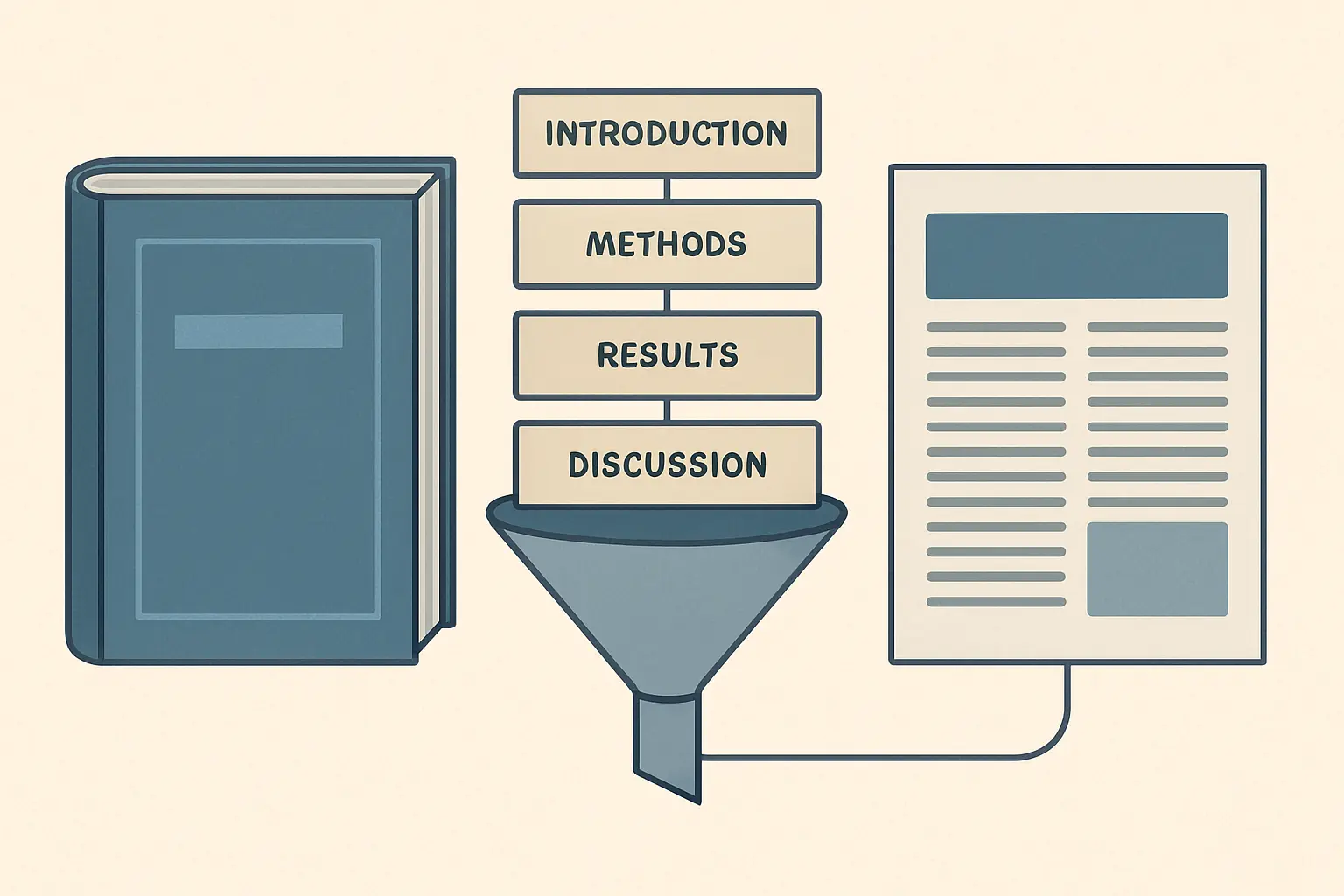
Chapter-to-IMRaD Mapping
IMRaD — Introduction, Methods, Results, Discussion — is the dominant structure for empirical journal articles across science, social science, and health disciplines. Your thesis chapters map onto it as follows:
| Thesis Chapter | IMRaD Section | Conversion notes |
|---|---|---|
| Introduction / Chapter 1 | Introduction | Compress to 400–700 words. State the gap and your contribution in the first two paragraphs. |
| Literature Review / Chapter 2 | Introduction (background) | Condense to 3–5 key references that directly justify your study. Cut the historical overview entirely. |
| Methodology / Chapter 3 | Methods | Remove philosophical justification (positivism, interpretivism paragraphs). State what you did and why, briefly. |
| Findings / Chapter 4 | Results | Report only what supports your chosen claim. Move subsidiary findings to supplementary material or a future article. |
| Discussion / Chapter 5 | Discussion | This needs the heaviest rewrite. See the section below. |
| Conclusion / Chapter 6 | Discussion (end) or merged | Compress to one paragraph of implications and one of limitations. Many journals fold conclusions into the final Discussion paragraphs. |
Cutting from 80k to 8k: What to Remove
This is where graduates freeze. The answer is that most of what you wrote served the examination, not the reader. Remove it without guilt.
Cut unconditionally
- Epistemological scene-setting. Paragraphs explaining what ontology and positivism are. Journal readers know. If your paradigm choice is unusual, one sentence suffices.
- The full literature review. Keep only the citations that directly position your gap. A journal introduction is not a survey paper.
- Methodological justification passages. If you used a survey, you do not need a paragraph defending surveys as valid. State your instrument, your sample, your procedure.
- Reflexivity sections written for ethics boards. Unless your journal explicitly requires them (some qualitative journals do), condense to one sentence or remove entirely.
- Appendices and supplementary instruments. Move to an online supplement if necessary; many journals accept supplementary files.
- Redundant signposting. Thesis chapters often begin “In this chapter, I will…” and end “This chapter has shown…” Remove all of it. Journal readers do not need to be walked through structure verbally.
Cut judiciously
- Secondary findings not central to your argument. They may support a second article.
- Extended quotes from qualitative data. Two well-chosen excerpts illustrate a theme better than six.
- Tables duplicating what the text already states. Keep one or the other.
If you are uncertain what to keep, a useful heuristic: every paragraph in your Methods and Results should answer “what did you do / find?” Every paragraph in your Introduction and Discussion should answer “so what?” If a paragraph answers neither question, it belongs in your thesis, not your article.
Reframing the Discussion for a Journal Audience
The discussion chapter is where thesis-to-article conversions most commonly fail. Thesis discussions are written partly to demonstrate that you understand the wider field, partly to defend your choices against imagined examiner challenge, and partly to show humility about limitations. Journal discussions need to do something different: they need to advance a claim about what your findings mean for theory or practice, connect to two or three high-impact papers already published in that journal, and end with a direct statement of contribution.
The single most effective revision: read the three most-cited articles from your target journal published in the last two years, note how they open and close their Discussion sections, then mirror that structure. Editors read hundreds of submissions; articles that feel native to the journal’s culture are easier to champion.
If you are working on rewriting the discussion section and finding the argumentative shaping difficult, see our guide to writing your discussion chapter faster with AI help.
Choosing a Target Journal
Choose your journal before you begin revising, not after. The journal determines your word limit, citation style, required sections, and expected tone. Submitting without this step wastes weeks on revisions that do not fit anywhere.
A practical selection process
- List five journals where the papers you cited most heavily are published. Your thesis bibliography is your journal shortlist.
- Check scope statements carefully. Many rejections come from scope mismatch, not quality. Read the “aims and scope” page and one recent editorial.
- Check recent acceptance rates if available (many high-impact journals publish these). Target journals where your work has a genuine fit, not merely prestige.
- Decide on open access early. If your funder or institution mandates open access, check whether the journal is gold OA or offers a hybrid route. Factor in Article Processing Charge (APC) costs by publisher before you commit.
- Check preprint policy. Many researchers now post to arXiv or SSRN before formal submission. If you want to do the same, verify the journal permits it. See our guide to the best preprint servers and repositories in 2026.
For discoverability of field-specific journals, Elsevier’s Journal Finder and the JANE tool at jane.biosemantics.org allow you to paste your abstract and receive ranked journal suggestions based on semantic similarity to published content — a useful starting point when you are uncertain which discipline cluster your work best fits.
Reformatting Your References
This step is where most graduates lose a disproportionate amount of time. Your thesis may use APA 7. Your target journal uses Vancouver, or Chicago author-date, or a house style specific to that publisher. Manually reformatting 40–80 references across citation styles is tedious, error-prone, and takes hours.
Tesify’s auto bibliography feature restyled your reference list to match any target journal’s citation requirements automatically. Paste your references in, select the target style, and the reformatted bibliography is ready to copy into your manuscript. It handles the edge cases — edited book chapters, conference proceedings, datasets, preprints — that generic citation converters typically mangle.
If you are weighing reference manager options for the longer term, our comparison of Zotero vs Mendeley vs EndNote for Word users covers which tools integrate most cleanly with the journal submission workflow.
Self-Plagiarism: What the Rules Actually Say
A common anxiety: is it self-plagiarism to publish from your own thesis? The short answer is no — under the right conditions. Most universities deposit theses in institutional repositories, making them technically “published” in the broad sense. Journals are aware of this; the majority explicitly permit submission of work derived from a thesis, provided you disclose the relationship in your cover letter.
The rules tighten when the overlap is verbatim and undisclosed, or when you submit the same manuscript simultaneously to multiple journals (dual submission). Always disclose in your cover letter that the work derives from a thesis, note the repository link, and check the specific journal’s self-archiving policy. The Committee on Publication Ethics (COPE) publishes clear guidance on text recycling that most journals follow.
For a broader grounding in academic integrity practices — covering citation, paraphrasing, and the boundary between legitimate reuse and misconduct — the guide to avoiding plagiarism in academic work on Tesify provides a useful foundation before you finalise your manuscript.
For a detailed breakdown of what counts as self-plagiarism versus legitimate text recycling in academic work, see our article on self-plagiarism and text recycling rules explained.
How Tesify Accelerates the Whole Process
Two parts of the thesis-to-article conversion are genuinely mechanical: polishing academic English sentence by sentence, and reformatting references. Both consume time without adding intellectual value. Tesify’s AI editor handles both.
The AI editor reads your converted draft and flags sentences that are too long, too hedged, or structurally awkward for a journal manuscript. It suggests academic alternatives without changing your argument or inserting content — it edits, it does not write for you. For non-native English speakers in particular, this pass can mean the difference between a desk reject and peer review. Our comparison of best AI editing tools for non-native English researchers shows where Tesify sits against alternatives like Trinka and Paperpal.
The auto bibliography reformatter solves the reference-style problem described above. When you target a second or third journal after an initial rejection, restyling 60 references to the new house style takes under a minute rather than an afternoon.
For researchers working on the literature review section — which becomes the Introduction’s background paragraph — the guide to writing your literature review faster with AI covers how to compress a 10,000-word review chapter into the 400 words a journal introduction needs without losing the argumentative thread.
Start your first draft in Tesify — free
Upload your thesis chapter, let Tesify’s AI editor flag what to cut and sharpen, then use auto bibliography to reformat your references to your target journal’s style — all in one place.
Frequently Asked Questions
How long does it take to turn a thesis into a journal article?
For most researchers, the active revision work takes two to four weeks once you have identified your target journal and your core argument. The majority of the time is spent on the discussion rewrite and cutting the literature review. Using AI editing tools reduces the line-editing pass from days to hours. The subsequent peer review process at the journal typically takes two to six months after submission.
Can one thesis produce multiple journal articles?
Yes, and this is common with multi-study PhDs. Each discrete study or chapter with its own research question can typically become a separate article, provided there is no duplicate submission (submitting the same text to two journals simultaneously) and you are transparent about the thesis origin in each cover letter. A thesis with three chapters often produces two to three articles over a two-year post-submission window.
What should I say in my cover letter about the thesis origin?
Be direct and brief. A single sentence in the cover letter is sufficient: “This manuscript is derived from a doctoral thesis deposited at [University Name] in [Year], available at [repository URL]. The manuscript has not been submitted elsewhere.” Disclosing the relationship is standard practice and is expected, not penalised. Hiding it is what creates problems.
What happens if my journal article is rejected?
Rejection is the norm, not the exception — even strong papers are frequently rejected at the first target journal. Read the editor’s and reviewers’ comments carefully; most contain actionable guidance. Revise accordingly, retarget a journal at the same or adjacent tier, reformat your references to the new style (Tesify’s auto bibliography makes this fast), and resubmit. If you receive an R&R (Revise and Resubmit), our guide on how to write a response to reviewers walks you through structuring a professional point-by-point reply.
Does Tesify’s bibliography tool handle all citation styles?
Tesify’s auto bibliography covers the major styles used in academic publishing — APA 7, MLA, Chicago, Harvard, Vancouver, IEEE, and AMA — plus house styles for major publishers where these are publicly specified. If your target journal uses a specific variant, you can verify the output against the journal’s author guidelines and make manual adjustments where needed.
Is a master’s thesis worth publishing, or is it only PhDs that get published?
Master’s theses are published regularly, particularly in applied fields, health sciences, education, and social sciences. The bar is the quality of the research, not the degree level. A well-designed empirical master’s study with a clear, focused contribution is publishable. The conversion process is identical — map to IMRaD, cut the scaffolding, reframe the discussion, choose an appropriate journal for the scope of the claim.
Write your thesis with AI
Structure, draft, cite, and format your thesis faster with Tesify’s AI writing tools, automatic bibliography, and plagiarism checker. Free to start, no credit card required.






Leave a Reply