
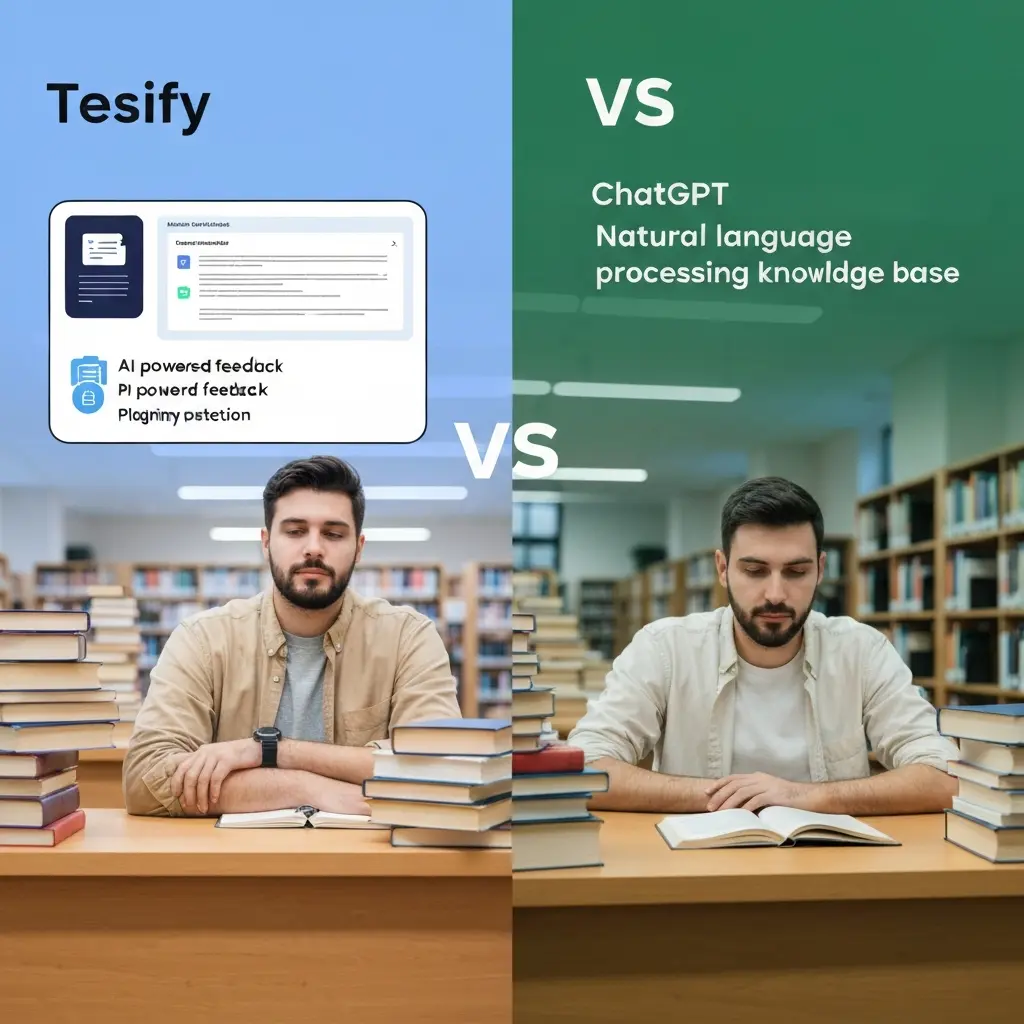
Tesify vs ChatGPT for Thesis Writing: The Honest 2026 Comparison
When you are staring at a blank chapter and a submission deadline two months away, the temptation to reach for AI is understandable. But choosing the wrong tool can cost you marks — or your degree. The debate around Tesify vs ChatGPT for thesis writing comes down to one fundamental question: do you need a tool that writes for you, or a tool that makes your writing better? This comparison gives you a clear, evidence-based answer for 2026.
ChatGPT dominates mainstream conversation about AI writing tools, but it was not designed for academic work. Tesify was. Built with input from educators and academic writers, Tesify operates as a coaching platform rather than a content generator — a distinction that matters enormously when your supervisor can spot AI-generated text and your university runs every submission through detection software.
The Core Difference: Coach vs Generator
The most important thing to understand before this comparison is that Tesify and ChatGPT are not the same category of tool. ChatGPT is a large language model designed to generate fluent text in response to prompts. Give it a question and it produces paragraphs. Tesify, by contrast, is an academic writing assistant designed to review, critique, and improve the text you have already written.
This matters because thesis examiners do not assess how well an AI can summarise your topic — they assess how well you understand it, how you construct arguments, how you engage with the literature, and how you justify your methodological choices. A tool that writes for you cannot teach you those skills, and it cannot help you defend your work in a viva.
Tesify’s approach is closer to having a senior academic reviewer read your drafts. It analyses argument strength, logical flow, evidence integration, and academic register — then gives you structured, actionable feedback aligned to the conventions of academic writing at postgraduate level. This is fundamentally different from asking ChatGPT to “write a 500-word methodology section.”
Academic Integrity and Detection Risk
In 2026, virtually every UK, US, and Australian university has deployed AI detection software alongside traditional plagiarism tools. Turnitin’s AI writing detection is now embedded in the submission workflows of over 16,000 institutions. Using ChatGPT to draft thesis content and submitting it as your own work is a form of academic misconduct at most institutions — regardless of whether you edit the output afterwards.
ChatGPT’s own testing confirms the risk: in multiple controlled comparisons, ChatGPT generated substantial prose even when users prompted it to avoid doing so. The tool is optimised for helpfulness, not for academic integrity compliance. It does not know your university’s AI use policy. It does not know whether your course permits generative AI assistance or prohibits it entirely.
Tesify was built from the ground up with academic integrity in mind. It does not generate text for submission. It provides feedback, suggestions, and structured guidance — leaving you as the author. If you are working in a course environment where AI assistance is permitted but AI generation is not (an increasingly common distinction in 2026 university policies), Tesify sits firmly on the right side of that line. ChatGPT does not.
Feedback Quality for Thesis Chapters
In head-to-head testing with the same thesis introduction draft, Tesify and ChatGPT produced markedly different outputs. When asked to evaluate a thesis statement, ChatGPT polished the wording but failed to identify that the claim lacked a clear connection to the research questions in the preceding paragraph. Tesify flagged the same sentence as structurally weak, identified why it failed to orient the reader, and suggested a specific reformulation approach — without writing the new version.
This pattern holds across chapter types. For a methodology section, ChatGPT will rewrite unclear sentences and improve grammar. Tesify will identify whether your justification for choosing a qualitative approach is academically sufficient, whether your sampling rationale would satisfy an examiner, and whether your ethical considerations section meets the conventions of your discipline. These are the things that determine your grade.
For chapters that require deep subject-matter alignment — such as a dissertation methodology chapter or a literature review — Tesify’s feedback is calibrated to academic expectations in a way that ChatGPT’s general-purpose suggestions simply are not.
Citation and Bibliography Support
This is one of the clearest advantages Tesify holds over ChatGPT for thesis work. Tesify includes an Auto Bibliography feature that generates correctly formatted references in APA 7th edition, MLA 9th edition, Chicago 17th edition, and Harvard style. You input your sources and the tool formats them accurately — including in-text citations, DOIs, access dates for web sources, and secondary citation handling.
ChatGPT will attempt to format citations if you ask, but it has well-documented hallucination problems with references. It fabricates DOIs, invents publication dates, creates non-existent journal volumes, and generates plausible-looking but entirely fictional citations. This is one of the most dangerous failure modes for thesis writers: a convincing-looking reference that does not exist will be flagged during examination or peer review.
For a deeper look at how different citation tools compare, see our guide to the best citation generators compared in 2026, which includes accuracy tests across all major styles.
Thesis Workflow Fit
A thesis is not a single writing session — it is a multi-month project with distinct phases: topic selection, proposal, literature review, data collection, analysis, drafting, revision, and final submission. How does each tool fit into that arc?
ChatGPT strengths in the thesis workflow: early brainstorming, generating draft interview questions, summarising long papers for initial literature scanning, writing acknowledgements, and explaining statistical concepts in plain English. These are all legitimate uses that do not involve submitting AI-generated text.
Tesify strengths in the thesis workflow: chapter-by-chapter feedback throughout the drafting phase, automated bibliography building as your reference list grows, plagiarism checking before submission, and structured review of your conclusion against your research questions. These are the high-stakes tasks where accuracy and academic alignment matter most.
If you are just starting your thesis journey, our complete guide on how to write a thesis from topic to defence covers the full workflow and where AI tools fit at each stage.
Head-to-Head Comparison Table
| Feature | Tesify | ChatGPT (Plus) |
|---|---|---|
| Academic integrity compliant | Yes | Risk (generates text) |
| Auto bibliography (APA/MLA/Chicago/Harvard) | Yes — accurate | Prone to hallucination |
| Plagiarism checking | Integrated | Not included |
| Chapter-specific academic feedback | Structured & deep | Generic feedback |
| Argument structure analysis | Yes | Limited |
| Text generation capability | No (coach model) | Yes (extensive) |
| Brainstorming support | Yes | Excellent |
| AI detection risk | None | High if text submitted |
| Best for thesis writers | Primary tool | Supporting role only |
When to Use Each Tool
Use Tesify when:
- Reviewing any chapter draft before sending to your supervisor
- Building your reference list and bibliography
- Checking whether your argument structure holds up
- Running a final plagiarism check before submission
- Getting feedback on your thesis introduction or conclusion
- Working within strict university AI-use policies
Use ChatGPT (carefully) when:
- Generating initial topic brainstorm lists before you have written anything
- Drafting non-submission materials like email templates to supervisors
- Getting plain-English explanations of statistical methods you are studying
- Creating mock interview questions for pilot testing
- Summarising papers to decide which ones merit full reading (verify before citing)
For a broader view of the AI tool landscape, our full guide to the best AI thesis writing tools compared in 2026 covers eight platforms tested across the same academic tasks. You can also see how Grammarly, QuillBot, and Tesify compare for academic writing if grammar and paraphrasing are your primary concern.
Frequently Asked Questions
Is Tesify or ChatGPT better for thesis writing?
Tesify is purpose-built for academic work — it provides structured feedback, citation support, and plagiarism-aware assistance without generating text for you. ChatGPT is a general-purpose AI that can draft text quickly but offers no built-in academic integrity guardrails. For thesis writing specifically, Tesify delivers more relevant, examiner-aligned feedback.
Can I use ChatGPT to write my thesis without getting caught?
Most universities now use AI detection tools alongside plagiarism checkers. Using ChatGPT to write substantial thesis sections risks academic misconduct penalties. It is safer to use AI tools that assist rather than generate, such as Tesify, which is designed around academic integrity policies.
Does Tesify generate thesis text automatically?
No. Tesify is designed as a coaching and feedback platform, not a text generator. It analyses your writing, flags weaknesses in argument structure, and suggests improvements — but you write the content. This approach keeps your work original and examiner-ready.
How much does Tesify cost compared to ChatGPT?
ChatGPT Plus costs $20/month for GPT-4 access. Tesify offers student-focused pricing plans starting at a comparable level, with features specifically tailored to thesis workflow including auto-bibliography and plagiarism integration that ChatGPT does not include.
What can Tesify do that ChatGPT cannot?
Tesify provides automatic bibliography generation in APA, MLA, Chicago, and Harvard formats, integrated plagiarism checking, chapter-specific feedback aligned to academic conventions, and a thesis structure guide. ChatGPT can assist with drafting but provides none of these academic-specific features natively.
Ready to write a better thesis?
Tesify gives you expert-level feedback on every chapter, auto-generates your bibliography in any citation format, and checks for plagiarism — all in one academic-integrity-compliant platform. Start your free trial at Tesify.app and submit with confidence.
Write your thesis with AI
Structure, draft, cite, and format your thesis faster with Tesify’s AI writing tools, automatic bibliography, and plagiarism checker. Free to start, no credit card required.




Leave a Reply