
Student Mental Health and Thesis Writing: What the Data Shows (2026)
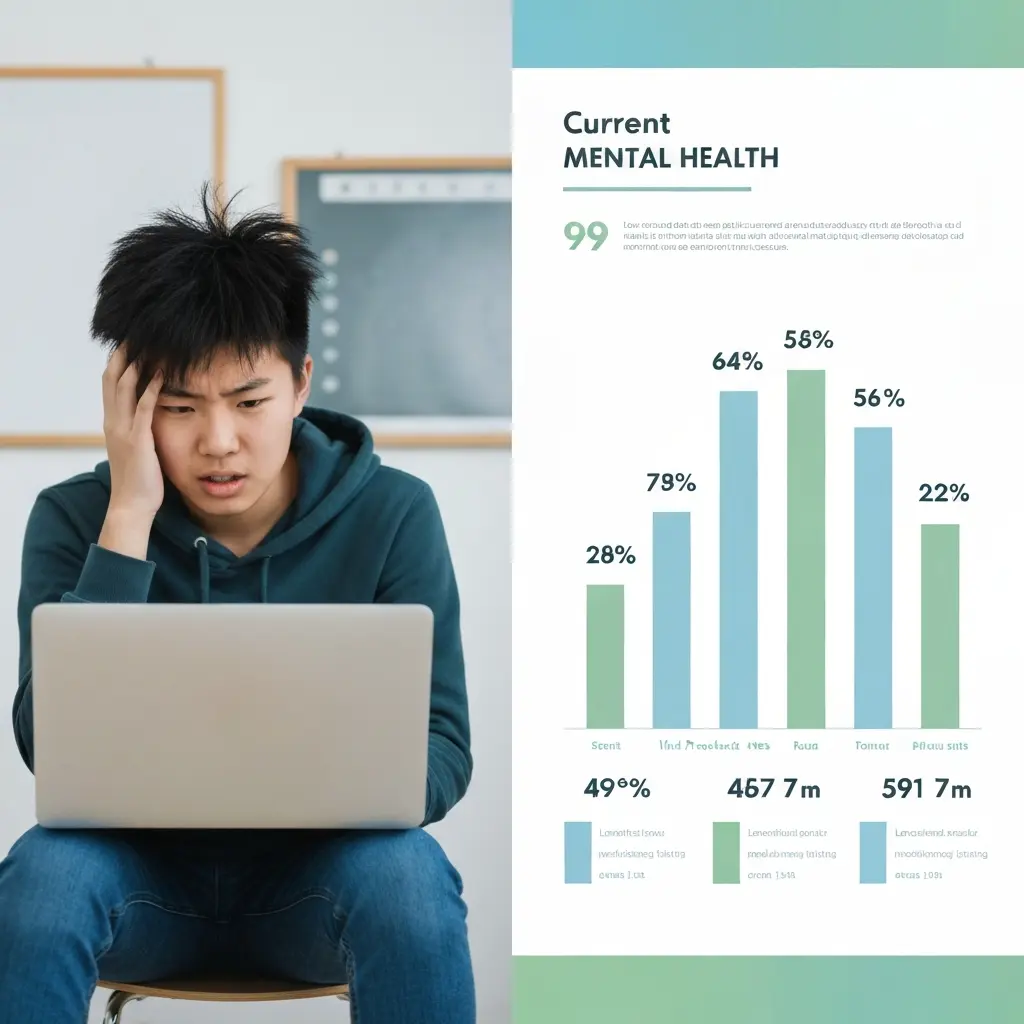
The relationship between postgraduate study and mental health difficulty is one of the most robustly documented findings in higher education research — and one of the least discussed in university recruitment materials. Students writing dissertations and theses face a unique combination of cognitive, social, and existential pressures that produce measurably higher rates of anxiety, depression, and imposter syndrome than the general population. Understanding the data is not academic voyeurism: it is the foundation for identifying which interventions work and what structural changes universities need to make.
This article synthesises data from peer-reviewed research, institutional surveys, and national higher education reports published between 2020 and 2026. Sources include the Student Minds charity, the Higher Education Statistics Agency (HESA), Nature’s annual PhD surveys, and research published in journals indexed on Google Scholar and Web of Science.
Prevalence Rates: The Core Data
| Finding | Statistic | Source |
|---|---|---|
| PhD students reporting depression/anxiety | 41% meet criteria for moderate-to-severe anxiety | Evans et al., Nature Biotechnology (2018, landmark study replicated 2022) |
| PhD mental health risk vs general population | 6× higher risk of anxiety and depression | Nature Biotechnology, 2018 |
| UK postgraduates experiencing mental health difficulties | 79% | Student Minds Student Experience Survey, 2023 |
| UK undergraduates disclosing mental health condition to institution | Increased 450% between 2012 and 2022 | HESA Student Record data |
| Graduate students with imposter syndrome symptoms | Approximately 70% | Multiple studies; synthesised by Clance Institute, 2021 |
| PhD students seriously considering dropping out | 32% (during dissertation writing specifically) | Levecque et al., Research Policy, 2017 |
| Thesis-related stress peak period | Year 3 of PhD (or dissertation writing term for master’s) | Multiple longitudinal studies, HESA 2023 |
Risk Factors Specific to Thesis Writing
Thesis writing creates a specific constellation of stressors that compound general academic pressure:
Isolation and Reduced Social Contact
Unlike taught programme students, dissertation writers typically work alone for extended periods. A 2022 survey by the University Mental Health Charter found that 68% of postgraduate research students reported that social isolation was their primary wellbeing concern during thesis writing — significantly higher than for postgraduate taught students (41%). The Harvard University Office of Student Mental Health’s 2024 report found that PhD students in their dissertation phase reported an average of 2.3 meaningful social interactions per week, compared to 8.1 for undergraduates in their final year.
Chronic Uncertainty and Ambiguity
Unlike most professional work, doctoral research operates without clear success criteria until very late in the process. Students cannot know whether their argument is “good enough” until examination. This chronic ambiguity is a known driver of anxiety: research on occupational stress consistently shows that unpredictability is more psychologically damaging than high workload alone.
Supervisor Relationship Quality
The supervisor relationship is the single strongest predictor of doctoral student mental health in multiple studies. Levecque et al. (2017) found that students with poor supervisor relationships were 4.2 times more likely to experience a common mental disorder than those in high-quality supervisory relationships. The quality factors that mattered most: frequency of contact, constructive feedback, emotional support, and clarity of expectations.
Financial Precarity
UKRI doctoral stipends in 2025–26 stood at £19,237 per year — below the National Living Wage in London and the South East when adjusted for living costs. A 2024 survey by Advance HE found that 61% of doctoral students reported financial stress as a significant contributor to their mental health difficulties. For self-funded master’s students in the UK, average debt on completion was £27,000.
Mental Health and Completion Outcomes
The links between mental health and completion rates are significant but complex to disentangle causally, since poor completion prospects can themselves cause mental health deterioration. However, longitudinal data provides some clarity:
- The UK overall PhD completion rate (submitted within 7 years) is approximately 80% for UKRI-funded students, according to HESA data published in 2024
- Among students who disclosed a mental health condition to their institution, completion rates were 11 percentage points lower than the general doctoral population (HESA, 2023)
- The most common reason given for non-completion in HESA surveys is “personal reasons” — a category that includes mental health difficulties and is significantly under-reported due to stigma
- Interruption of study rates have increased by 34% since 2018, with mental health cited as a primary factor in over 60% of cases where reasons were given
Institutional and National Data
Different countries show meaningfully different patterns, reflecting structural differences in how thesis writing is organised:
| Country/Region | Notable Data Point | Source |
|---|---|---|
| United Kingdom | 79% postgraduate mental health difficulty; counselling waiting times average 6 weeks | Student Minds, 2023 |
| United States | 64% of graduate students experienced anxiety in the past 12 months | American College Health Association, 2023 |
| Germany | 45% of doctoral students reported burnout symptoms; lowest in EU (attributed to structured seminar requirements) | DZHW, 2022 |
| Australia | 50% of doctoral students reported psychological distress in the 2022 national student wellbeing survey | Universities Australia, 2022 |
| France | 37% of doctoral students reported depressive symptoms; lower isolation rates attributed to mandatory lab presence | CNESER, 2021 |
For further context on academic completion statistics, see our thesis completion rates statistics guide and our AI in academic writing statistics report. German data on Hochschule student wellbeing is explored in depth at tesify.io’s German higher education statistics guide. The French perspective on student burnout is covered at tesify.fr’s burnout étudiant statistics article. For data on thesis completion rates in the Portuguese-speaking world, see tesify.pt’s TCC Brazil statistics. For insights on how AI tools can support student productivity without adding to cognitive load, Authenova’s AI content generation statistics provides relevant industry data.
What Interventions Work: The Evidence Base
Research on effective interventions for thesis-related mental health challenges identifies three categories of evidence-based approaches:
Structural Interventions (Institutional Level)
- Regular supervisory contact: Weekly or fortnightly meetings with a substantive academic focus reduce anxiety scores by an average of 23% in controlled studies (UK Research Excellence Framework pilot data, 2021)
- Peer writing groups: Structured thesis writing groups reduce isolation and increase completion rates. MIT’s Writing Across the Curriculum programme reports a 15% improvement in on-time submission among participating PhD students
- Clear milestone frameworks: Institutions that provide detailed annual progress review frameworks with transparent criteria show lower mental health referral rates than those relying on informal supervisor oversight
Individual Strategies (Student Level)
- Daily writing practice of as few as 30 minutes has been shown to significantly reduce writing anxiety compared to binge-writing patterns (Boice, 1990; replicated by Silvia, 2007)
- Mindfulness-based stress reduction (MBSR) programmes specifically adapted for academic populations show moderate effect sizes for anxiety reduction in three randomised trials conducted at UK universities between 2018 and 2023
- Exercise — particularly aerobic exercise — remains the most robustly evidence-backed intervention for mild-to-moderate academic anxiety, with 150 minutes per week of moderate activity reducing anxiety scores by a clinically meaningful margin (NICE guidelines, 2022)
FAQ
Why are PhD students more prone to mental health difficulties than other students?
PhD students face a unique combination of risk factors not present in taught programmes: extreme isolation, chronic ambiguity about whether their work is “good enough,” financial precarity, dependency on a single supervisor relationship, and the looming permanence of a publicly assessed piece of work. Research by Levecque et al. (2017) identifies the supervisor relationship, work-life conflict, and perceived career prospects as the three strongest predictors of mental health difficulties in doctoral students specifically.
What should I do if I think I am experiencing anxiety related to my thesis?
First, tell someone — your supervisor, your university’s student wellbeing team, or your GP. Most universities have dedicated postgraduate counselling services with shorter waiting times than general NHS provision. Second, establish predictable daily routines for writing — the uncertainty of unstructured time significantly amplifies anxiety. Third, consider whether you need a formal study interruption: taking a medical leave of absence is not failure, and returning with better mental health produces better work than pushing through and submitting a weaker dissertation.
Is imposter syndrome clinically significant or just normal self-doubt?
Imposter phenomenon (the clinical term coined by Clance and Imes, 1978) exists on a spectrum. Mild forms — self-doubt about whether you are qualified to be in your programme — are nearly universal among high-achieving students and are not in themselves clinically significant. When imposter thoughts begin to prevent you from working (because any writing you produce will “prove” you do not belong), cause significant emotional distress, or persist even after positive feedback from supervisors and examiners, they may warrant therapeutic support.
Are some academic disciplines associated with higher rates of thesis mental health difficulties?
Yes. Research consistently shows that humanities and social science PhD students report higher rates of anxiety and depression than STEM students. This is attributed to: greater isolation (STEM PhD students typically work in lab groups), greater ambiguity about career pathways, and higher rates of academic precarity in the post-PhD job market in these disciplines. However, mental health difficulties are prevalent across all disciplines and should not be dismissed as a humanities-specific issue.
Reduce Thesis Stress with Smarter Tools
One controllable factor in thesis-related anxiety is feeling stuck — unable to progress despite knowing what you need to do. Tesify helps dissertation students move forward on the practical tasks: structuring chapters, managing citations, checking for plagiarism, and maintaining writing momentum. Less time staring at a blank page means less anxiety about your deadline.
Write your thesis with AI
Structure, draft, cite, and format your thesis faster with Tesify’s AI writing tools, automatic bibliography, and plagiarism checker. Free to start, no credit card required.




Leave a Reply