
Education dissertations have a sampling problem most other social-science fields do not face in quite the same form: you cannot simply recruit participants directly. Between you and your target population sits a school, a district, or a university administration that controls whether you get in at all — and that gatekeeping reality shapes your sampling design as much as any statistical consideration does. This is the population, sample and access structure built specifically for that constraint.
1. Target Population vs Accessible Population
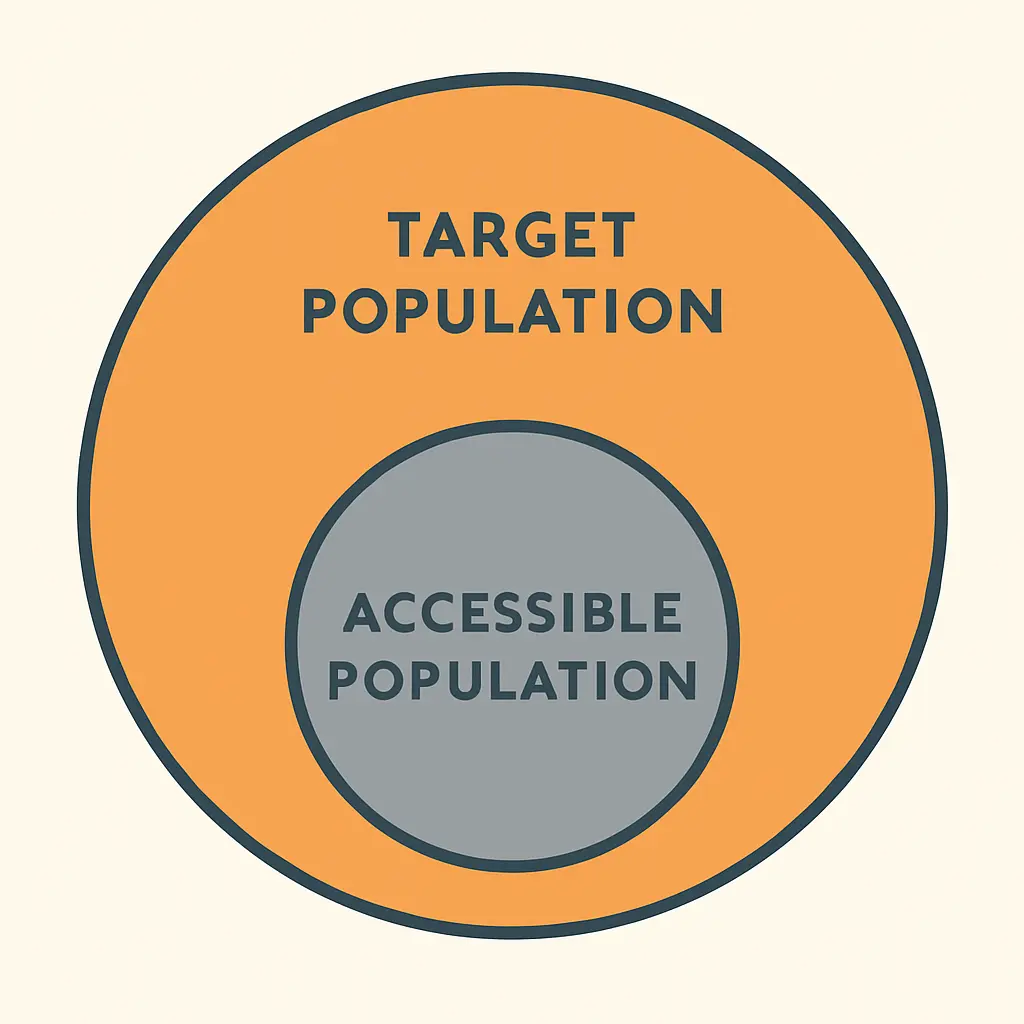
Your target population is the group your research question is actually about — “elementary teachers in Title I schools,” “first-generation college students at public universities.” Your accessible population is the narrower group you can realistically reach given the districts, schools, or institutions willing to grant you access, your own professional network, and practical constraints like geography and time. These two populations are rarely identical in education research, and the gap between them is a legitimate, expected limitation to name explicitly — not something to obscure by describing your accessible population in language that implies it represents the full target population.
2. The Gatekeeper Chain
Access to schools and districts typically runs through a chain of gatekeepers, and skipping a level in that chain is one of the most common causes of an education dissertation’s access falling through late in the process. The typical sequence is: district-level research office approval (many US districts require a formal external-research-request process, sometimes with its own timeline of months), then building-level principal approval, then, depending on your design, individual teacher consent to participate or to allow access to their classroom, then parental consent and/or child assent if minors are directly involved as participants (see our guide on parental consent for school-based research for that specific requirement). Each gatekeeper can independently decline or delay, and a positive answer from one level does not guarantee approval at the next — plan your access timeline assuming the slowest realistic case, not the fastest.
3. Common Sampling Methods in Education Research
Which sampling method fits your design depends on both your research question and the access reality you are working within:
- Convenience sampling — recruiting from schools or districts where you already have a professional connection or established access; common, defensible when stated honestly as a limitation, but the weakest for generalizability claims.
- Purposive sampling — deliberately selecting schools or participants that meet specific criteria relevant to your research question (a particular curriculum, demographic profile, or program status), common in qualitative education research.
- Stratified sampling — dividing your accessible population into meaningful strata (school size, urbanicity, demographic composition) and sampling within each, used when you want your sample to reflect known variation in the target population.
- Cluster sampling — sampling whole schools or classrooms rather than individual students, often the practical necessity in education research since individual-level random sampling across a district is rarely logistically possible.
4. Nested Data: Students in Classrooms in Schools

Education data is almost always nested — students within classrooms, classrooms within schools, schools within districts — and this structure has direct consequences for your sampling and analysis plan, not just a detail to mention in passing. If your outcome of interest varies systematically by classroom or school (which it usually does, given teacher and school-level effects), treating individual students as fully independent observations understates your true sampling variability. State the nesting structure explicitly in your sampling section, and note in your methods chapter whether your analysis plan (multilevel modeling, for example) accounts for it — our guide to choosing a statistical test for an education dissertation covers multilevel models for exactly this nested-data situation.
5. Negotiating Access: A Practical Sequence
Start the access process earlier than feels necessary — district research-approval processes commonly run on their own academic-calendar timeline and can take months, independent of how quickly your own dissertation timeline needs to move. A practical sequence: identify the district’s formal external-research-request process (most large US districts publish one), submit your IRB-approved protocol alongside that request since districts typically require evidence of institutional ethics approval before considering a study, identify a specific building-level contact (a principal or, ideally, a teacher willing to advocate for your study internally) rather than a cold approach, and have a concise, non-technical one-page summary of your study ready for gatekeepers who will not read your full proposal. Build a realistic buffer into your timeline for a request to be delayed, redirected to a different office, or declined outright, requiring you to identify a second site.
6. Sample Size Considerations
Sample size planning in education research is shaped as much by what access will realistically deliver as by a formal power calculation, and being upfront about that tension is more defensible than presenting a power-calculated target number that your actual access could never have delivered. For quantitative designs, report the sample size a power analysis indicates you need for your planned statistical test and effect size of interest, but also report your realistic access ceiling (how many schools or students the districts you have access to can actually supply) and address directly what happens to your analysis plan if the realized sample falls short of the power-calculated target. For qualitative designs, sample size is typically justified by saturation — the point at which additional participants stop producing new themes — rather than a pre-specified number, though many education qualitative studies do state a target range informed by comparable published studies.
7. How This Differs From the Consent Requirement
Sample and access is a related but distinct question from parental consent and child assent, and conflating the two in your methods chapter is a common source of confusion for both students and readers. Access is about whether the institution (district, school) will let you conduct research within its walls at all — a gatekeeper decision made by administrators, not individual families. Consent is about whether individual participants (or their parents, for minors) agree to take part once institutional access has already been granted. You need institutional access before you can even approach individual participants for consent, and having consent from willing families does not substitute for the institutional-level approval that must come first. Structure your methods chapter to reflect this order explicitly: access negotiation, then IRB approval, then individual recruitment and consent.
8. A Worked Example
“The target population for this study is elementary teachers in Title I schools within [state]. Given access constraints, the accessible population was limited to teachers within two districts that granted external-research approval, representing 14 Title I elementary schools. A stratified sample was drawn within these schools by grade band (K-2, 3-5) to ensure representation across early and upper elementary teaching contexts, yielding a final sample of 62 teachers across 11 schools that agreed to participate. This sample is not representative of Title I teachers statewide, and findings should be interpreted as applicable to teachers in demographically and administratively similar districts rather than generalized broadly.”
9. Common Mistakes
- Describing an accessible population as if it were the target population without naming the access-driven gap between them.
- Skipping a level in the gatekeeper chain (assuming principal approval substitutes for required district-level approval, for example) and having a study delayed or blocked as a result.
- Treating nested students as fully independent observations in the analysis plan without accounting for classroom- or school-level clustering.
- Underestimating district approval timelines, leaving no buffer for delay, redirection, or an outright decline requiring a second site.
For the specific parental consent and child assent requirements that apply once you have school-level access, see our guide to parental consent for school-based research, and for the datasets available if primary access proves unworkable, see our guide to US education datasets for a dissertation.
Frequently Asked Questions
What’s the difference between target population and accessible population?
Your target population is who your research question is actually about; your accessible population is the narrower group you can realistically reach given district and school access constraints. Naming the gap between them explicitly is expected, not optional.
Do I need district approval if the principal already said yes?
Usually yes. Many districts require formal external-research approval independent of individual principal consent, and a positive answer at one gatekeeper level does not guarantee approval at another — check the district’s specific process rather than assuming.
Why does nested data matter for my sampling plan?
Students are nested within classrooms and schools, and outcomes usually vary systematically at those levels. Treating individual students as fully independent observations understates sampling variability — state the nesting structure explicitly and note whether your analysis plan (such as multilevel modeling) accounts for it.
How long should I budget for gaining district access?
Longer than feels necessary — district research-approval processes commonly run on their own academic-calendar timeline and can take months. Build in a buffer for delay, redirection, or an outright decline requiring a second site.
Plan Your Sample and Access Strategy With Confidence
Tesify’s AI-powered academic writing tool helps education students define their target and accessible populations, choose a defensible sampling method, and write an access plan that survives a district’s actual approval process.
Write your thesis with AI
Structure, draft, cite, and format your thesis faster with Tesify’s AI writing tools, automatic bibliography, and plagiarism checker. Free to start, no credit card required.






Leave a Reply