
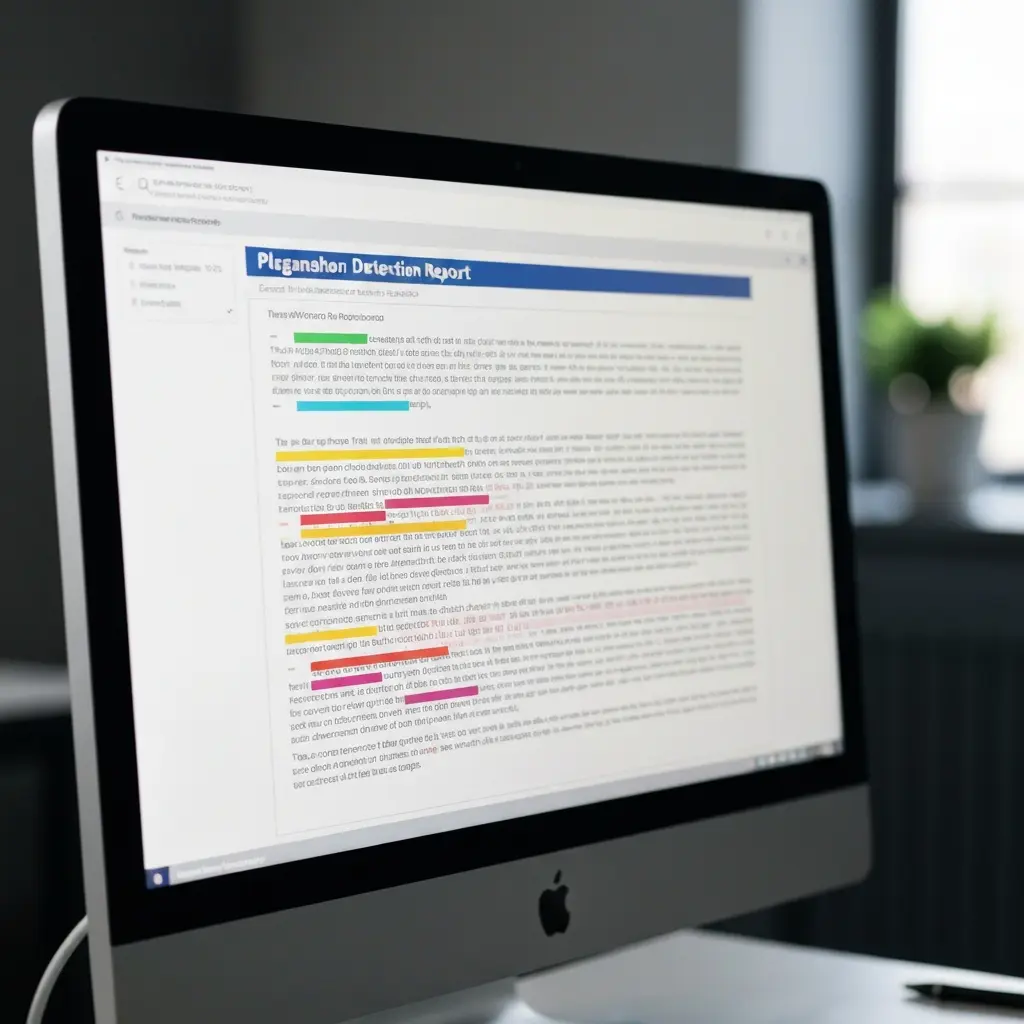
Plagiarism Checker Free: Best Options for Students 2026
You are three days from your dissertation deadline and you need a plagiarism checker free tool that will actually show you what your university’s system will see. Not something that gives you a green tick on 500 words before hitting a paywall. Not a tool that checks against a tiny database that misses the sources your examiner actually knows. You need a real answer, fast.
This guide ranks the best free and low-cost plagiarism detection tools available to students in 2026, benchmarked against the criteria that matter: database size, AI detection capability, citation analysis, and how closely the results mirror what Turnitin or your institutional system will produce. We also cover where the free options fall short — and what the most accurate alternative looks like.
Why You Must Check Before You Submit
The stakes for a dissertation are categorically different from a seminar paper. Universities treat plagiarism in final dissertations as serious academic misconduct — the consequences range from a mark of zero to expulsion. In 2024–25, UK universities reported a 34% increase in academic misconduct cases involving plagiarism in postgraduate theses, driven in part by students who genuinely did not realise their similarity scores were too high.
The problem is rarely outright copying. It is more often: insufficient paraphrasing, forgotten in-text citations on passages you did paraphrase, self-plagiarism from your own previous work, or AI-generated text that matches patterns in other AI-generated documents. A pre-submission plagiarism check lets you fix these issues before they become formal misconduct complaints.
Running your dissertation through a reliable plagiarism detector online before submission is not cheating — it is due diligence. Every serious academic does it.
How Plagiarism Checkers Actually Work
Understanding the mechanics helps you interpret results accurately. Most plagiarism checkers operate through one of two models:
Similarity Matching
The tool compares your text against a database — academic journals, websites, previously submitted student papers, books — and calculates what percentage of your text matches existing content. The database size determines coverage. Turnitin’s database includes over 1.8 billion student papers, 98 million academic works, and hundreds of millions of web pages. Free tools typically cover a fraction of that.
AI Detection
Newer tools add a layer that analyses linguistic patterns distinct to AI-generated text: low perplexity, uniform sentence structure, low “burstiness” in vocabulary. This is a separate analysis from similarity matching and requires different technology. Not all free tools include it in 2026.
Citation Analysis
Some academic-specific tools also check whether citations in your bibliography actually correspond to real sources and whether your in-text citations match your reference list. This is unique to academic writing tools — general web-based plagiarism checkers do not do this.
The Best Free Plagiarism Checkers for Students in 2026
1. Tesify Plagiarism Checker (Free Plan)
Purpose-built for academic writing. Tesify’s free plan includes plagiarism checking calibrated specifically for dissertation and thesis content — checking against academic journal databases, not just the open web. It also flags potential AI-detection concerns alongside similarity scores, and integrates directly with the writing workflow so you can fix issues in context. The most relevant tool for dissertation students. Try Tesify’s Plagiarism Checker free.
2. Grammarly Plagiarism Checker
Grammarly’s plagiarism detector is included in the free browser extension for limited checks. It checks against web content and published articles. Coverage is reasonable for catching internet-sourced passages but does not have deep access to academic paper repositories. Useful as a first pass for web-sourced content, but not sufficient as a pre-submission check for academic work.
3. Duplichecker
Fully free, no account required for basic checks. Checks against indexed web pages. The database is smaller than commercial alternatives, which means it will miss academic journal matches. Useful for checking if something you have written is too close to a web source, but not reliable for academic paper similarity.
4. Quetext
Quetext offers a free tier with a limited word count per month. Its DeepSearch technology compares against academic sources, web content, and books. The similarity highlighting is clear and actionable. Free users are limited to around 2,500 words per check — insufficient for a full dissertation but useful for chapter-by-chapter checking.
5. PaperRater
Free online checker with plagiarism detection and grammar analysis bundled. Database coverage is primarily open web and publicly available academic content. Useful for undergraduate work; less suited to postgraduate dissertations where the relevant sources are paywalled academic journals.
6. Copyscape (Basic)
Originally built for web content copyright, Copyscape’s free version checks against indexed web pages. Not designed for academic use but useful for catching any sections that are too close to freely available internet sources.
Accuracy Comparison: Free Tools vs Institutional Systems
| Tool | Database Depth | Academic Papers | AI Detection | Free Tier |
|---|---|---|---|---|
| Turnitin (institutional) | 1.8B+ documents | Extensive | Yes | No |
| Tesify | Academic-focused | Yes | Yes | Yes |
| Grammarly | Web + publications | Limited | Limited | Yes (limited) |
| Quetext | Web + academic | Moderate | No | Yes (2,500 words) |
| Duplichecker | Web only | Minimal | No | Yes |
What Free Tools Consistently Miss
Free plagiarism checkers have a consistent blindspot that matters enormously for dissertation submissions: they do not have access to the academic paper databases that contain your actual sources. Here is what that means in practice:
- Paywalled journal articles: The papers you cite in your literature review — from JSTOR, Scopus, Web of Science, EBSCO — are behind paywalls. Free tools cannot check against them. Turnitin can, because it licenses these databases.
- University repository theses: Other students’ dissertations submitted to your university and similar institutions are in Turnitin’s database. A free tool will not flag similarity to a thesis from Durham or Melbourne that covered a similar topic last year.
- Self-plagiarism: If you reuse sections from your own previous essays or coursework, Turnitin will catch it because those were also submitted through Turnitin. Free tools have no visibility of this.
This is why a free tool giving you a 2% similarity score does not mean your institutional submission will produce the same result. The gap can be significant.
AI-Generated Content Detection in 2026
Free plagiarism checkers are increasingly incorporating AI detection, but coverage is uneven. In 2026, the tools with meaningful AI detection in their free tiers include:
- Tesify: Includes AI writing pattern analysis alongside similarity scoring — relevant if you have used any AI assistance in your drafting process
- Grammarly: Limited AI detection in the browser extension; more comprehensive in paid plans
- Copyleaks: Has a dedicated AI detection mode but the free tier is significantly limited in word count
If you have used any AI writing tools — even for editing — running an AI detection check before submission is now essential at institutions using Turnitin or GPTZero Enterprise.
For more on how plagiarism rates look across academic institutions, see: Plagiarism Rates in Universities: 2026 Statistics and Research Data.
The Best Plagiarism Checker for Dissertations Specifically
A dissertation creates specific needs that general-purpose plagiarism checkers are not designed for:
- Full-document length: Dissertations are 10,000–80,000 words. Free tools with word count limits require you to check in fragments, which can miss cross-section issues.
- Citation verification: Checking that your bibliography entries are real is as important as checking for text similarity. Only academic-specific tools do this.
- Chapter-level analysis: Understanding which chapter or section has the highest similarity score lets you focus your revisions.
- Integration with writing workflow: Fixing issues in context — rather than exporting, checking, editing separately — saves hours in the pre-submission crunch.
Tesify addresses all four. The plagiarism checker is built into the dissertation writing platform, operates on full-document length, and flags both similarity issues and citation problems within the same interface.
Check your dissertation before your university does
Tesify’s built-in plagiarism checker is free to start and built specifically for academic submissions. Know your similarity score, fix the issues, and submit with confidence.
How to Use a Plagiarism Checker Effectively
Running a check is only useful if you know how to interpret and act on the results. Here is the process:
- Check early, not just before submission: Run chapter-level checks as you complete each section. Fixing issues in your methodology chapter at month three is far less stressful than fixing everything a week before submission.
- Understand what is flagged: Not all similarity is plagiarism. Quoted material with proper citation, standard technical terminology, and your own previously submitted work with disclosed reuse are different from uncited paraphrases.
- Focus on unintentional matches: The matches you need to fix are passages where you paraphrased a source but did not cite it, or where your phrasing is too close to the original even with a citation.
- Use the AI detection score separately: If you used any AI tools in your writing process, treat the AI detection result as a separate review pass from the similarity check.
- Keep a record: If your institution allows AI-assisted editing with disclosure, document what tools you used and export your plagiarism report for your records.
For context on how academic institutions approach these issues, see: How to Avoid Plagiarism in Academic Writing in 2026.
Also relevant: Best Free Plagiarism Checkers Accuracy Comparison 2026 for a detailed head-to-head of the leading free tools.
Frequently Asked Questions
Is there a completely free plagiarism checker for students?
Yes. Duplichecker, PaperRater, and the basic version of Grammarly all offer free plagiarism checking with no payment required. Tesify offers a free plan specifically designed for dissertation and thesis submissions, with academic database coverage. The trade-off is that fully free tools have database limitations and word count caps that may not give you the pre-submission accuracy you need.
How accurate are free plagiarism checkers compared to Turnitin?
Free tools are significantly less accurate for academic writing because they lack access to paywalled journal databases, institutional thesis repositories, and previous student submissions. A free tool may show 3% similarity while Turnitin produces 18% because Turnitin can check against sources the free tool cannot see. Academic-specific tools like Tesify narrow this gap by focusing their database coverage on the sources that matter for dissertation work.
What plagiarism percentage is acceptable for a dissertation?
Most universities set a threshold of 10–20% similarity for postgraduate dissertations, but the number alone is not the deciding factor. Examiners review the highlighted matches manually to determine whether they represent genuine plagiarism, quoted material, or common academic phrasing. A 15% score with all matches properly cited is less concerning than a 7% score with unattributed paraphrases. Check your institution’s specific guidance.
Can a plagiarism checker detect self-plagiarism?
Institutional systems like Turnitin can detect self-plagiarism if your previous work was submitted through the same system. Free online tools generally cannot, as they do not have access to your submission history. If you are reusing sections from previous essays or coursework in your dissertation, you must cite your own work and check whether your institution’s policy allows it.
Does checking my dissertation with a free tool count as submitting it for plagiarism purposes?
No. Running your work through a third-party plagiarism checker before submission does not register as a submission with your institution. It is a private check. However, be aware that some tools store uploaded documents in their database, which could theoretically affect future similarity reports. Check the privacy policy of any tool you use. Tesify does not add your dissertation to a shared plagiarism database.
What is the best plagiarism checker for a PhD thesis?
For a PhD thesis, you need a tool with broad academic database coverage, full-document length support, and citation verification. Tesify’s academic-focused plagiarism checker meets all three requirements and is free to start. For the most comprehensive check, use it in combination with your institution’s pre-submission Turnitin access if your university offers it.
Don’t let plagiarism derail your dissertation
Tesify’s built-in plagiarism checker is free to use and built for dissertation submissions. Check your whole document, identify issues chapter by chapter, and fix them before your institution sees the report.





Leave a Reply