
Ivy League Admission Tips: What Top Applicants Do Differently in 2026
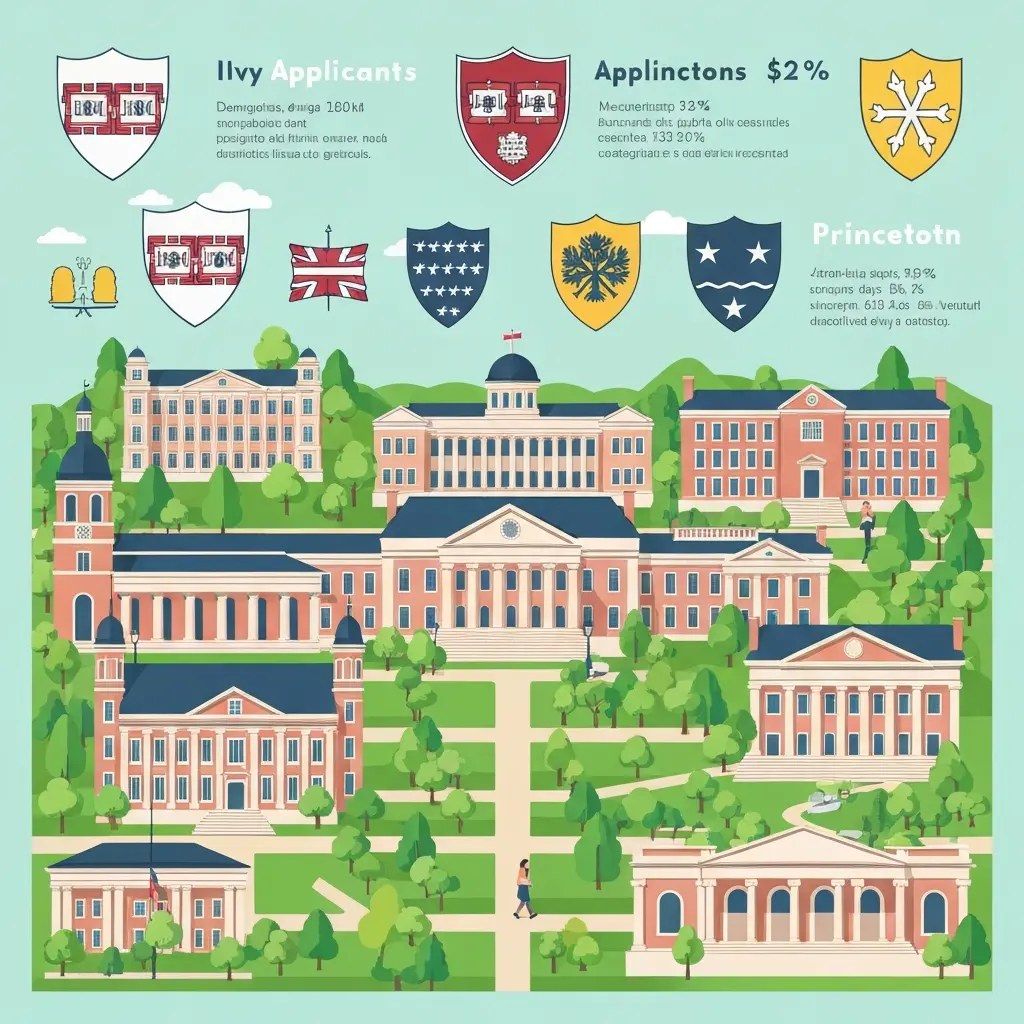
Ivy League admission is the most competitive in the world — Harvard’s Class of 2028 had a 3.6% acceptance rate, Yale 3.7%, Columbia 3.9%, and Princeton 4.6%. These numbers intimidate most applicants into thinking the process is arbitrary. It is not. While luck plays a role, the distinguishing characteristics of successful Ivy applicants are well-documented — and largely learnable. This guide synthesises insights from published admissions data, former admissions officer accounts, and the most recent research on what actually moves the needle.
Academic Requirements: The Floor, Not the Ceiling
Strong academic performance is necessary but insufficient. The “academic floor” at Ivy League schools:
- SAT/ACT: Average accepted SAT at Harvard 2025 was 1580 (out of 1600); Yale 1560; Princeton 1570. Most accepted students are in the 99th percentile — but many 99th-percentile applicants are rejected.
- GPA: Harvard reported 76% of admitted students had a 4.0 unweighted GPA. But perfect GPA alone does not matter — course rigor does. A 3.9 in 12 AP courses is stronger than a 4.0 in standard courses.
- AP courses: Most accepted students take 8–12 AP courses with scores of 4–5. Selective loading in areas of your spike is more valuable than breadth.
Post-Supreme Court ruling on race-conscious admissions (SFFA v Harvard and UNC, 2023), Ivy League schools have shifted further toward holistic assessment — but academic metrics remain the primary screen at the initial review stage.
The Spike Theory: Why Depth Beats Breadth
The most consistent finding from former Ivy admissions officers (including numerous accounts from former Harvard, Yale, and Princeton admissions staff) is the “spike” principle: an applicant with extraordinary depth in one area — a published mathematician, a nationally ranked debater, a student who built a nonprofit with documented impact — consistently outperforms an applicant with good grades and participation in 10 clubs.
Why? Because Ivies are building an incoming class, not just admitting individual students. They need people with specific, extraordinary capabilities. “Well-rounded” describes the class; individual applicants should have a distinctive spike.
Spike examples across domains:
- Research published in or presented at a national/international venue
- Entrepreneurship with documented revenue, impact, or users
- Athletic recruitment (D1 athletes have dramatically higher admission rates)
- Fine arts with national recognition
- Civic leadership with measurable community impact
Writing Essays That Stand Out
The Common App personal essay (650 words) is read in context of everything else in the file. Former admissions officers consistently describe essays that work:
- Specific over generic: “I discovered my love of chemistry when…” is weaker than “In May 2024, I spent three weeks trying to synthesise…”
- Intellectual curiosity over hardship narratives: Essays about intellectual obsession, genuine passion for learning, and the unexpected place a curiosity led you consistently score higher than essays where hardship is the dominant theme
- Voice authenticity: Admissions officers read 2,000+ essays; an essay that sounds like a 17-year-old wrote it genuinely (not one polished to sound like a 45-year-old consultant) stands out
- Show the reader something the rest of the file does not show: If your activities list shows science competitions, do not write your essay about science. Write about something else — a contradiction, a failure, an unexpected interest
The supplemental essays (each school has specific prompts — “Why Harvard?”, “Why Yale?”) should demonstrate genuine familiarity with the specific institution. Research 3–5 specific professors, courses, programmes, or initiatives at each school that align specifically with your spike.
Securing Strong Recommendations
Ivy League recommendations from teachers should:
- Come from teachers who know you well in subjects you care about most — not the subjects you got the highest grade in
- Be specific: name specific moments, projects, questions you asked in class, or intellectual contributions that surprised the teacher
- Be enthusiastic: phrases like “among the top students I have taught in 20 years” (with specific evidence) are what admissions officers value
- Be differentiated from each other: two letters that say the same thing are worse than one strong one
Give your recommenders your “brag sheet” — a document summarising your activities, achievements, your spike, and what you are hoping they can address about you. Do this 6–8 weeks before deadlines.
Research Experience for Competitive Applications
Research experience has become increasingly important in Ivy League applications, particularly for STEM applicants. Options for high school students:
- Research Science Institute (RSI) — MIT summer programme, highly competitive, exceptional for application
- Garcia Research Scholars — Stony Brook, particularly strong for materials science
- University lab cold-email outreach — many professors supervise motivated high school researchers informally
- Science fair research — Intel ISEF / Regeneron STS participation is one of the strongest available signals
For postgraduate applicants to Ivy League programmes, research experience becomes even more critical. See our graduate school USA application guide for PhD and master’s specific guidance.
Once admitted, Ivy League academics demand the highest academic writing standards. Tesify is designed to meet those standards — structured AI thesis writing assistance that keeps your voice primary and your academic integrity intact.
Frequently Asked Questions
What GPA do you need for Ivy League admission?
76% of admitted Harvard students had a 4.0 unweighted GPA; Princeton and Yale show similar statistics. However, GPA alone is insufficient — course rigor matters enormously. Admissions officers assess your GPA in context: a 3.9 in 12 AP courses at a competitive school is stronger than a 4.0 in standard classes. Most accepted students are in the top 1% academically, but many students with perfect academic records are rejected because the academic benchmark is a floor, not a deciding factor.
What is the acceptance rate for Harvard in 2026?
Harvard’s Class of 2028 (applying in 2024) had an acceptance rate of 3.6% — the lowest in Harvard’s history at the time. Acceptance rates at all Ivy League schools have been declining for a decade and are not expected to recover meaningfully. The Class of 2029 and 2030 are likely to show similar or lower rates as application volumes continue to increase with the widespread adoption of Common App.
What makes an Ivy League application stand out?
According to former admissions officers and published research, the distinguishing factors are: a clear “spike” (extraordinary depth in one domain rather than modest achievement in many), a coherent application narrative where all components reinforce a consistent picture of who you are, essays that demonstrate genuine intellectual curiosity and specific voice, recommendations that are enthusiastic and specific, and demonstrated impact (not just participation) in extracurricular activities. Academic perfection is assumed; distinction comes from what you have built, created, or contributed.
Excel Academically Once You Are Admitted
Getting into an elite university is one challenge. Meeting its academic writing standards once you are there is another. Tesify helps thesis and dissertation students at top universities write to the standard their institution expects — with AI-assisted structuring, auto bibliography, and plagiarism detection.
Write your thesis with AI
Structure, draft, cite, and format your thesis faster with Tesify’s AI writing tools, automatic bibliography, and plagiarism checker. Free to start, no credit card required.





Leave a Reply