
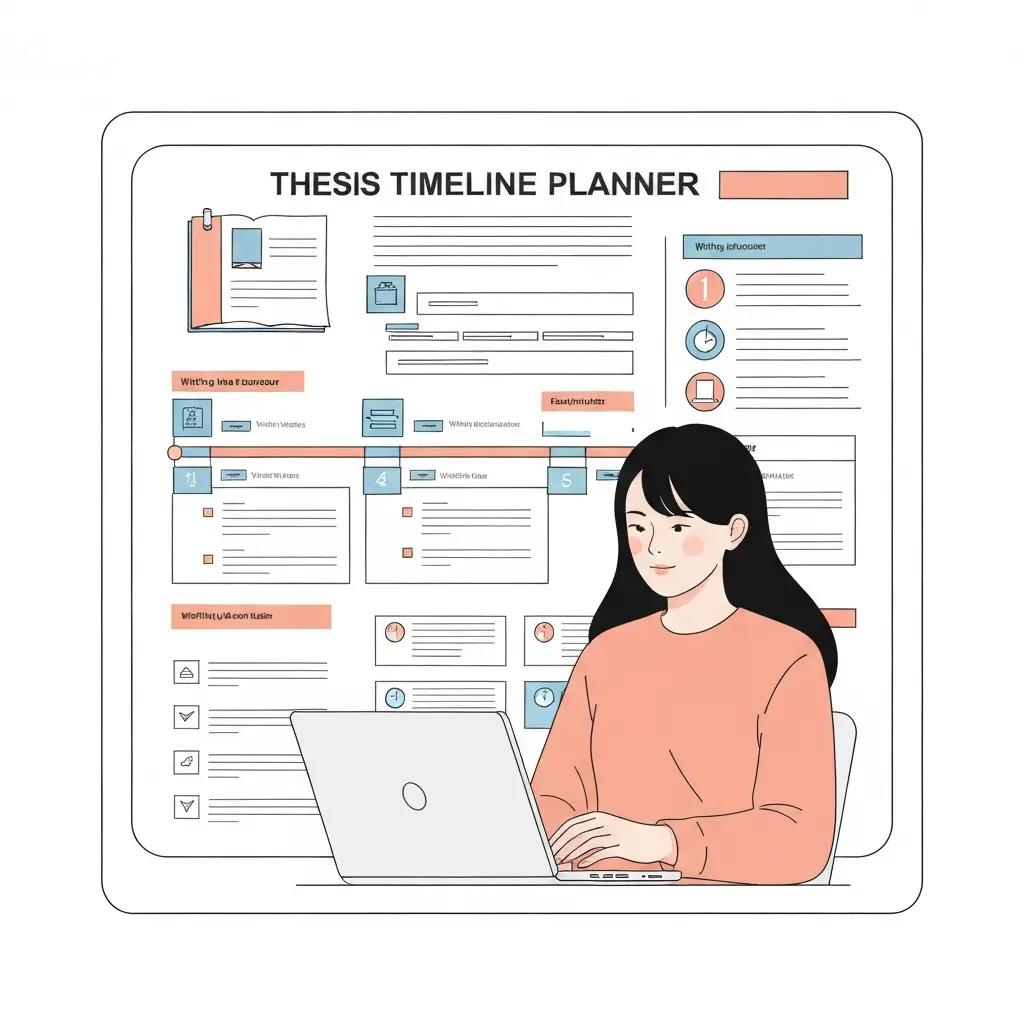
How to Manage Your Time When Writing a Thesis: A Step-by-Step Plan 2026
Time management is the skill that separates thesis completers from non-completers — more than intelligence, more than supervisor quality, more even than topic choice. Yet most students arrive at thesis-writing stage without any formal training in managing months-long, self-directed writing projects. This guide gives you a concrete, research-backed time management system for thesis writing, from setting your first milestone to the final submission day.
Step 1: Backward Planning from Your Submission Deadline
Backward planning (working from deadline to present) is more effective than forward planning because it reveals whether your plan is actually feasible — something most students discover too late when planning forward.
The process:
- Write your submission date at the top of a page.
- Work backwards: when must the complete draft be with your supervisor for final comments? (Allow 4 weeks minimum for substantive feedback)
- When must each chapter be complete? (Work backwards from the supervisor deadline)
- When must first drafts be done? (Allocate 50% of remaining time to first drafts, 50% to revision)
- When must data collection be complete? When must analysis be complete?
- When must your literature review be substantively complete?
If this backward plan places your literature review completion date in the past, your plan is not feasible and needs immediate revision — more hours per week, a scope reduction, or a supervisor conversation about the timeline.
Step 2: Set Chapter-Level Milestones with Specific Dates
Vague goals (“finish the literature review by Easter”) produce vague progress. Specific, measurable milestones produce specific outcomes. For each chapter, set:
- Completion date: a specific calendar date, not “in three weeks”
- Word count target: not aspirational, realistic
- Sub-milestones: first draft, supervisor feedback incorporated, second draft, final polishing
Example milestone plan for a 12-month master’s dissertation:
| Milestone | Target Date |
|---|---|
| Research question confirmed, ethics submitted | Month 1 |
| Literature review first draft (6,000 words) | Month 3 |
| Ethics approval received, data collection begins | Month 4 |
| Data collection complete | Month 6 |
| Methodology chapter first draft (3,000 words) | Month 6 |
| Analysis complete, findings chapter first draft (5,000 words) | Month 8 |
| Discussion chapter first draft (5,000 words) | Month 9 |
| Full complete draft to supervisor (20,000 words) | Month 10 |
| Supervisor feedback incorporated | Month 11 |
| Final proofread, plagiarism check, formatting | Month 12 (weeks 1–2) |
| Submission | Month 12 (week 3) |
Step 3: Build a Daily Writing Routine
The research is unambiguous: daily writing outperforms binge writing for thesis productivity. Boice’s (1990) foundational studies, replicated multiple times, show that academics who write daily produce significantly more output and report less anxiety than those who write in concentrated “binge” sessions.
The evidence-backed daily routine for thesis writing:
- Write first thing in the morning, before email, social media, or other tasks — cognitive resources are highest before noon for most people
- Set a time commitment, not a word count — “I will write for 60 minutes” is more reliable than “I will write 1,000 words”
- Use the 45-minute minimum rule — 45 minutes is enough to make meaningful progress; less than this often does not justify the cognitive startup cost
- End each session with a note about where to start next time — this eliminates the “where was I?” delay at the start of each session
- Separate writing from editing sessions — drafting and editing use different cognitive processes; switching between them slows both
Step 4: Tools That Support Thesis Time Management
The most useful time management tools for thesis writers in 2026:
- Notion or Obsidian: for milestone tracking, chapter outlines, and research notes in an integrated system
- Forest or Freedom: for blocking distracting apps and websites during writing sessions
- Google Calendar / iCal: for blocking specific writing times and setting milestone reminders
- Tesify: specifically designed for thesis writing, with chapter-by-chapter AI-assisted drafting that keeps you moving through your structure rather than stalling — addresses the “what do I write next?” paralysis that kills momentum
- Toggl / Clockify: time tracking to understand where your time actually goes (most students are surprised)
- A physical whiteboard or printed milestone tracker: visible, non-digital progress tracking has psychological benefits that digital tools sometimes cannot replicate
Step 5: What to Do When You Stall
Thesis stalls are predictable and usually fall into one of five categories. Each has a specific intervention:
- Unclear about what to write next → Write an outline of the section or paragraph before writing prose. If you cannot outline it, you do not understand it well enough yet — go back to reading.
- Perfectionism / cannot move past a paragraph → Write deliberately imperfect first drafts. Write “[CHECK THIS]” placeholders for facts you need to verify rather than stopping to look them up.
- Overwhelmed by the size of the project → Reduce your focus to the next paragraph, not the next chapter. Use the Tesify chapter-by-chapter structure to avoid looking at the whole thesis at once.
- Motivation collapse → This is normal and documented. See our data on academic stress and performance and the evidence-based interventions in thesis mental health data.
- Supervisor relationship problems → Act early. Most UK universities have a formal process for supervisor mediation. The UKCGE and your students’ union can advise.
Frequently Asked Questions
How many hours a day should I write my thesis?
Research on academic productivity suggests 2–4 hours of focused writing per day is optimal for most researchers — beyond this, the quality of output diminishes significantly. Daily writing of 45–90 minutes of genuinely focused work consistently produces more output than occasional binge sessions of 6–8 hours. If you are writing full-time on your thesis, protect 3–4 hours of morning writing time and use afternoons for reading, admin, data analysis, and other thesis work.
How long should each thesis chapter take to write?
This varies enormously, but rough guidelines for a master’s dissertation: literature review (2,500–6,000 words) typically takes 4–8 weeks including reading; methodology (2,000–4,000 words) 2–3 weeks; findings (3,000–6,000 words) 3–5 weeks including analysis; discussion (4,000–6,000 words) 3–5 weeks. These are writing times — factor in reading time, data collection, analysis, and revision as separate phases. The first full draft is typically 40–60% of total project time; revision takes the rest.
Is it normal to feel behind on your thesis?
Yes — surveys of postgraduate research students consistently show that 60–70% feel behind their planned schedule at some point during their thesis. This is partly because most initial plans are over-optimistic (the planning fallacy) and partly because thesis work involves inherent uncertainty. The key question is not “am I behind?” but “is my revised plan still feasible?” Regular milestone reviews — ideally fortnightly with your supervisor — allow early course correction before a minor delay becomes a serious problem.
Should I write my thesis in order from start to finish?
Not necessarily. Many experienced researchers recommend writing the methodology chapter early (it is the most straightforward to draft once you have finalised your design), then findings, then discussion, and writing introduction and abstract last. The literature review is often written iteratively — an initial draft early, updated as you complete your research and discover new relevant papers. Writing in the order that feels most natural and progresses most easily is generally better than forcing a strictly sequential approach.
Stop Stalling, Start Writing
The biggest time management challenge for thesis writers is not finding time — it is using the time you have productively. Tesify eliminates “what do I write next?” with chapter-by-chapter structure and AI-assisted drafting, so every writing session produces tangible progress.
Write your thesis with AI
Structure, draft, cite, and format your thesis faster with Tesify’s AI writing tools, automatic bibliography, and plagiarism checker. Free to start, no credit card required.





Leave a Reply