
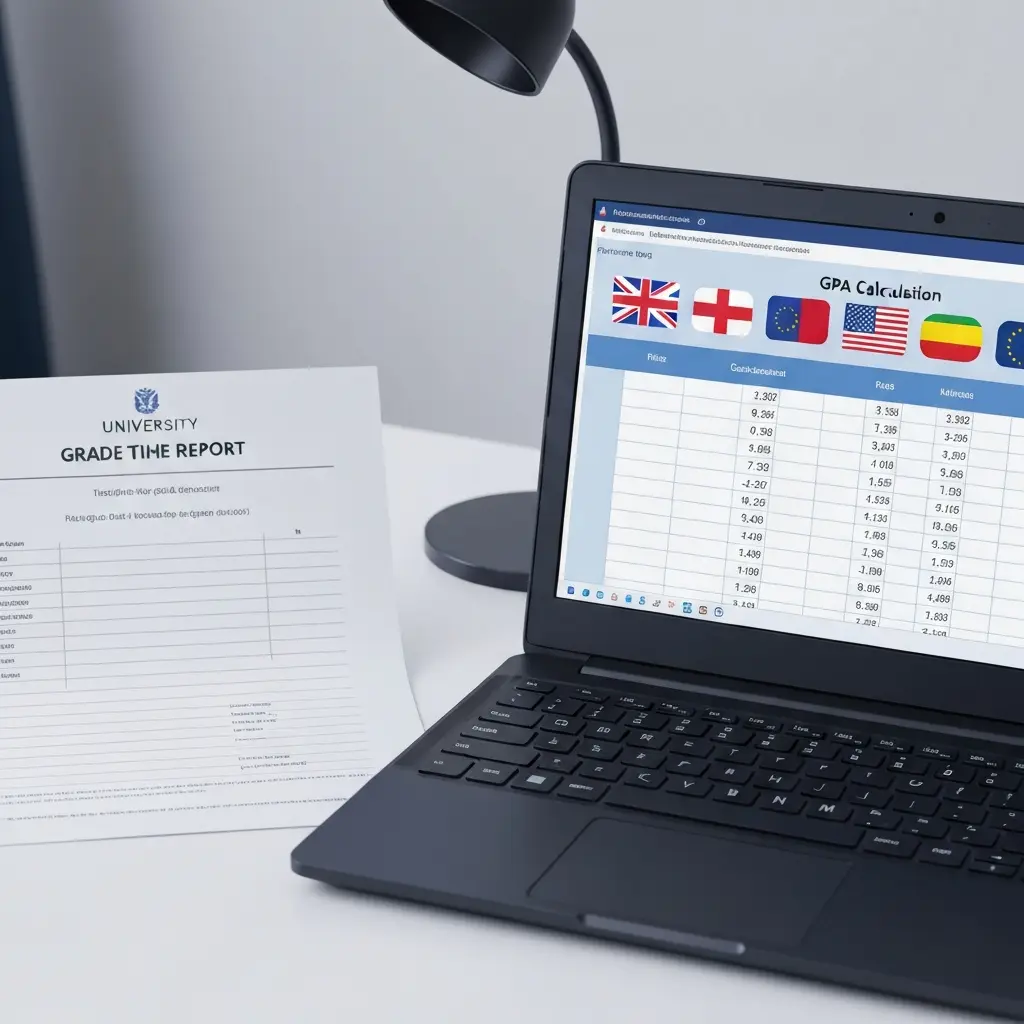
GPA Calculator for University in 2026: UK, US, and International Systems Explained
Understanding your GPA is one of the most practically important things a university student can do — yet the calculation method differs dramatically depending on whether you are studying in Boston, Birmingham, Berlin, or Buenos Aires. A student holding a GPA calculator result of 3.5 and a student holding a UK 2:1 are both excellent performers, but those numbers mean almost nothing to each other’s universities without a conversion. In 2026, with more students applying internationally for graduate programmes, scholarships, and competitive employers than ever before, knowing how to calculate, interpret, and convert your grade point average is not optional — it is essential.
This guide gives you the calculation formulas, conversion tables, and worked examples you need for the US 4.0 scale, UK degree classification system, ECTS European grades, and a dozen national systems. It is built on the frameworks used by admissions offices at universities including Oxford, MIT, and the University of Toronto — the same standards your graduate school applications will be evaluated against.
Multiply each course’s grade points (A=4.0, B=3.0, etc.) by its credit hours to get quality points. Sum all quality points, divide by total credit hours, and round to two decimal places. UK students use percentage averages converted to degree classifications (First, 2:1, 2:2, Third). A UK First Class corresponds approximately to a US GPA of 3.7–4.0.
What Is GPA and Why Does It Matter?
GPA stands for Grade Point Average. It is a single numerical summary of your academic performance across all courses taken at a university, standardised to a common scale. The 4.0 scale used across North American universities allows institutions, graduate schools, scholarship committees, and employers to compare academic records across different universities, programmes, and grading cultures.
GPA matters in five high-stakes contexts:
- Graduate school admissions: Most US graduate programmes publish minimum GPA requirements (commonly 3.0 for master’s, 3.3+ for competitive PhDs).
- Scholarships: Major scholarships including Fulbright, Rhodes, and Marshall have GPA thresholds.
- Employment: Many consulting firms (McKinsey, BCG, Bain) and investment banks screen applications by GPA, typically filtering below 3.5.
- Academic probation: Most universities place students on academic probation if their GPA drops below 2.0.
- Honours designation: Graduation honours (Cum Laude, Magna Cum Laude, Summa Cum Laude) are determined by GPA thresholds set by each institution.
How to Calculate US GPA (4.0 Scale)
The US GPA system is built on a straightforward formula that converts letter grades to numerical points, weights them by credit hours, and averages them. Here is the complete process.
Step 1: Convert Letter Grades to Grade Points
| Letter Grade | Grade Points (Standard) | Percentage Equivalent (approx.) |
|---|---|---|
| A+ | 4.0 | 97–100% |
| A | 4.0 | 93–96% |
| A- | 3.7 | 90–92% |
| B+ | 3.3 | 87–89% |
| B | 3.0 | 83–86% |
| B- | 2.7 | 80–82% |
| C+ | 2.3 | 77–79% |
| C | 2.0 | 73–76% |
| C- | 1.7 | 70–72% |
| D+ | 1.3 | 67–69% |
| D | 1.0 | 63–66% |
| D- | 0.7 | 60–62% |
| F | 0.0 | Below 60% |
Step 2: Apply the GPA Formula
GPA = Sum of (Grade Points × Credit Hours) ÷ Total Credit Hours Attempted
Step 3: Worked Example
| Course | Grade | Grade Points | Credit Hours | Quality Points |
|---|---|---|---|---|
| Introduction to Literature | A | 4.0 | 3 | 12.0 |
| Statistics I | B+ | 3.3 | 4 | 13.2 |
| History of Art | A- | 3.7 | 3 | 11.1 |
| Research Methods | B | 3.0 | 3 | 9.0 |
| Total | 13 | 45.3 |
GPA = 45.3 ÷ 13 = 3.48
UK Degree Classification System
The United Kingdom does not use a GPA scale. Instead, undergraduate degrees are awarded as Honours classifications based on the weighted average of your module marks. The classification boundaries vary slightly by institution, but the standard UK framework is as follows:
| Classification | Percentage Range | US GPA Equivalent (approx.) | Common Notation |
|---|---|---|---|
| First Class Honours | 70% and above | 3.7–4.0 | 1st |
| Upper Second Class Honours | 60–69% | 3.3–3.7 | 2:1 |
| Lower Second Class Honours | 50–59% | 2.7–3.3 | 2:2 |
| Third Class Honours | 40–49% | 2.0–2.7 | 3rd |
| Ordinary Degree (Pass) | Below 40% | Below 2.0 | Pass |
How UK Universities Calculate Your Final Classification
Most UK universities weight the final year more heavily than earlier years. A common weighting structure is:
- Year 1 (Foundation year): 0% (pass/fail only)
- Year 2: 30–40% of final classification
- Year 3: 60–70% of final classification
Some universities use a “best of” rule — if your overall average places you in a 2:1 but your best 90 credits are at First Class level, you may be awarded a First. Check your specific university’s classification regulations, which are publicly available. International students planning to apply to UK universities should also review the complete studying abroad guide for 2026 for a full picture of entry requirements, tuition costs, and visa timelines across all major destinations.
Scottish Degree System
Scottish universities use a slightly different honours scale. A 4-year Honours degree in Scotland awards:
- First Class: 70%+ (equivalent to English 1st)
- Upper Second: 60–69% (equivalent to 2:1)
- Lower Second: 50–59% (2:2)
- Third Class: 40–49%
Scotland also offers a 3-year Ordinary degree (General degree), which carries no Honours classification.
ECTS European Grading System
The European Credit Transfer and Accumulation System (ECTS) is used across EU member states, Norway, Iceland, and Liechtenstein under the Bologna Process. Unlike the US system, ECTS uses norm-referenced grading — grades reflect where a student falls in the distribution of passing students at that institution.
| ECTS Grade | Definition | % of Passing Students | US GPA Equivalent |
|---|---|---|---|
| A | Excellent | Top 10% | 3.7–4.0 |
| B | Very Good | Next 25% | 3.3–3.7 |
| C | Good | Next 30% | 2.7–3.3 |
| D | Satisfactory | Next 25% | 2.0–2.7 |
| E | Sufficient | Lowest 10% | 1.0–2.0 |
| F/FX | Fail | — | 0.0 |
Other National GPA Systems
Canada
Canadian universities use a 4.0 or 4.3 scale depending on institution. The University of Toronto uses a 4.0 scale; McGill uses a 4.0 scale; some provinces use a 9-point scale. Generally, the conversion from percentage is: 85–100% = A (4.0), 73–84% = B (3.0–3.9), 60–72% = C (2.0–2.9).
Australia
Australian universities typically use a 7-point scale or Grade Point Average on a 4.0 scale, with descriptors: High Distinction (85–100%, 7), Distinction (75–84%, 6), Credit (65–74%, 5), Pass (50–64%, 4), Fail (below 50%, 0). For international applications, Australian HDs often convert to a US GPA of 3.7–4.0.
Germany
Germany uses an inverse 1–5 scale where 1.0 is the highest (sehr gut / very good) and 4.0 is the minimum pass. A 5.0 is a fail. The system is predominantly criterion-referenced. Conversion to US GPA: 1.0–1.5 = 3.7–4.0, 1.5–2.0 = 3.3–3.7, 2.0–2.5 = 3.0–3.3, 2.5–3.0 = 2.7–3.0. For more on how German universities assess academic performance, see this overview of German university rankings.
France
France uses a 20-point scale. A score of 16–20 is très bien (very good, equivalent to an A/First); 14–15 is bien (good, B); 12–13 is assez bien (fairly good, B-/C+); 10–11 is passable (pass, C); below 10 is a fail.
Spain and Latin America
Spain uses a 10-point scale: 9–10 = Matrícula de Honor/Sobresaliente (A, 4.0 GPA equivalent), 7–8.9 = Notable (B, 3.0–3.7), 5–6.9 = Aprobado (C, 2.0–3.0), below 5 = Suspenso (fail). The grading of Spanish TFG (final degree project) follows the same scale; for context see how Spanish university TFG approval rates distribute across this scale.
India
Most Indian universities use a percentage system or a 10-point CGPA scale introduced under NAAC guidelines. 90–100% / 9.0–10.0 CGPA corresponds to US GPA 4.0; 75–89% / 7.5–8.9 CGPA to 3.5–3.7; 60–74% / 6.0–7.4 to 3.0–3.5. Many US graduate programmes now explicitly list CGPA minimums for Indian applicants.
Grade Conversion Tables
When applying internationally, you will often need an official credential evaluation from a body such as WES (World Education Services), NARIC (UK), or ENIC. However, the following tables provide working approximations used by most admissions offices.
| US GPA | UK Class | ECTS | German Grade | Australian Grade | French Score |
|---|---|---|---|---|---|
| 4.0 | 1st | A | 1.0–1.3 | HD (7) | 16–20 |
| 3.7 | 1st | A/B | 1.3–1.7 | HD (7) | 15–16 |
| 3.3 | 2:1 | B | 2.0–2.3 | D (6) | 14–15 |
| 3.0 | 2:1 | B/C | 2.3–2.7 | CR (5) | 12–14 |
| 2.7 | 2:2 | C | 2.7–3.0 | CR (5) | 11–12 |
| 2.0 | 2:2/3rd | D | 3.0–3.7 | P (4) | 10–11 |
Cumulative GPA vs. Term GPA
Your transcript typically shows two GPA figures: term GPA (calculated only from the current semester’s courses) and cumulative GPA (calculated from all courses taken across all semesters). Graduate schools and employers almost always ask for your cumulative GPA. However, an upward trend — strong final-year grades — can compensate for a weaker start when accompanied by a compelling application narrative.
Most graduate programme applications also ask for your major GPA (GPA in courses within your declared major) separately from your overall GPA. A student who struggled in elective courses but excelled in their core major will want to highlight the major GPA prominently.
Weighted vs. Unweighted GPA
The weighted/unweighted distinction matters most for high school students applying to US undergraduate programmes. At the university level, most institutions calculate a standard unweighted GPA. However, graduate schools occasionally encounter this question when students come from institutions using weighted systems.
- Unweighted GPA: A = 4.0 in every course, regardless of difficulty. Standard for most university transcripts.
- Weighted GPA: Adjusts upward for advanced courses (AP, honours, accelerated). Common in US high schools. Maximum is often 5.0.
When a graduate school application asks for your GPA, always report the unweighted cumulative GPA as it appears on your official transcript. Do not recalculate it yourself.
GPA Requirements for Graduate School
Graduate programme GPA requirements vary significantly by field and institution. These benchmarks reflect published admissions data from leading programmes as of 2026:
| Programme Type | Typical Minimum GPA | Competitive GPA |
|---|---|---|
| MBA (Top 10 US) | 3.0 | 3.5–3.9 |
| Law School (Top 14 US) | 3.0 | 3.7–3.9 |
| Medical School (US MD) | 3.0 | 3.7–3.9 |
| STEM Master’s (US) | 3.0 | 3.3–3.8 |
| PhD (Research, US) | 3.3 | 3.7–4.0 |
| UK Master’s | 2:2 (some accept 3rd) | 2:1 or First |
| UK PhD | 2:1 | First Class |
Students preparing competitive international graduate school applications will benefit from pairing strong GPA work with strong academic writing. Tesify’s complete step-by-step thesis writing guide covers how to structure and execute a high-quality thesis submission. Before submitting any major piece of assessed work, also review how to avoid plagiarism in academic writing — a key concern for international students submitting work at institutions with unfamiliar standards. Tools available through Authenova can also support the thesis and dissertation writing that accompanies graduate study.
How to Improve Your GPA
Improving a GPA requires understanding the mathematics of averaging and making strategic decisions, not just working harder in general.
The Mathematics of GPA Recovery
The further you are into your degree, the harder it is to move your cumulative GPA significantly — because each new semester’s grades are diluted by the increasing total credit count. A student with a 2.5 GPA after 60 credits who earns a 4.0 in their next 15 credits will have a cumulative GPA of approximately 2.68 — an improvement, but modest. This is why acting early matters: a 0.5 GPA improvement in your first year has three to four times the impact of the same improvement in your final year.
Proven Strategies
- Retake low-scoring courses: Many universities replace the original grade with the retake grade in GPA calculations (grade forgiveness). Check your institution’s specific policy.
- Take courses strategically: Identify high-credit, high-stakes courses and invest disproportionate preparation effort in them — they move the GPA needle most.
- Use pass/fail options wisely: Some universities allow you to take elective courses pass/fail, protecting your GPA while still fulfilling distribution requirements.
- Seek grade appeals: If you believe a grade was awarded in error or without following published criteria, formal grade appeals have a documented success rate at most universities.
- Improve academic writing quality: Many GPA losses in humanities and social sciences trace to writing quality rather than content knowledge. Systematic improvement in argument structure, evidence integration, and citation accuracy can raise marks by 5–10 percentage points.
Frequently Asked Questions
What is a good GPA for university?
In the US, a GPA of 3.5 or above (on the 4.0 scale) is generally considered excellent and makes you competitive for graduate school and prestigious employers. A 3.0 GPA is the typical minimum for graduate programme admission. In the UK, the equivalent is a 2:1 (Upper Second Class Honours, roughly 60–69%) as the baseline for graduate study and most graduate employers. A First Class Honours (70%+) corresponds approximately to a US GPA of 3.7–4.0.
How do I convert my UK degree classification to a US GPA?
UK degree classifications convert to US GPA approximately as follows: First Class Honours (70%+) = 3.7–4.0 GPA; Upper Second Class 2:1 (60–69%) = 3.3–3.7 GPA; Lower Second Class 2:2 (50–59%) = 2.7–3.3 GPA; Third Class Honours (40–49%) = 2.0–2.7 GPA. These are approximate equivalences — individual graduate programmes and employers may use different conversion frameworks, and WES or NARIC can provide official evaluations.
How is GPA calculated in the United States?
US GPA is calculated by assigning grade points to each letter grade (A=4.0, A-=3.7, B+=3.3, B=3.0, B-=2.7, C+=2.3, C=2.0, etc.), multiplying each course’s grade points by its credit hours to get quality points, summing all quality points, and dividing by total credit hours attempted. For example: a 3-credit course with A (4.0) = 12 quality points; a 4-credit course with B+ (3.3) = 13.2 quality points. Total: 25.2 quality points divided by 7 credits = 3.60 GPA.
What is the difference between a weighted and unweighted GPA?
An unweighted GPA uses a standard 4.0 scale where an A earns 4.0 regardless of course difficulty. A weighted GPA adjusts grade points upward for more challenging courses. Most universities report unweighted GPAs. Graduate school applications typically use the unweighted cumulative GPA. Some secondary schools use weighted GPAs, which universities recalculate on an unweighted basis when evaluating applicants.
How does the ECTS grading scale work?
The European Credit Transfer and Accumulation System (ECTS) uses a letter scale from A to F, where A is awarded to the top 10% of passing students, B to the next 25%, C to the next 30%, D to the next 25%, and E to the lowest 10% of passing students. F is a fail. ECTS grades are relative (norm-referenced), not absolute. When converting to US GPA: A=4.0, B=3.0–3.3, C=2.0–2.3, D=1.0–1.7.
Does a low GPA mean I cannot get into graduate school?
A low cumulative GPA does not automatically disqualify you from graduate school. Many programmes consider GPA alongside GRE/GMAT scores, research experience, publications, statement of purpose, letters of recommendation, and relevant work experience. Some programmes allow you to demonstrate an upward grade trajectory. Contacting target programmes directly to ask about their holistic review process is always advisable.
How do I calculate my GPA if some courses use pass/fail grading?
Pass/fail courses are typically excluded from GPA calculation because they carry no grade points. Your cumulative GPA is calculated only from courses with letter grades. The credits for passed courses still count toward your degree requirements, but they do not affect your GPA positively or negatively. Some universities treat a “Pass” as equivalent to a C (2.0) for GPA purposes — check your institution’s specific policy.
Can Tesify help me with academic performance and thesis planning?
Yes. Tesify supports students throughout their academic journey — from structuring dissertations and theses to formatting citations, improving academic writing style, and planning research methodology. Whether you are managing a heavy course load that affects your GPA or preparing a high-stakes thesis submission, Tesify’s AI-assisted academic tools help you work more efficiently and write more precisely. It is used by students at universities across the UK, US, Germany, and beyond.
Your Thesis Deserves the Same Attention as Your GPA
Your dissertation or thesis is the single highest-stakes piece of academic work you will submit. Tesify helps you structure, write, cite, and refine it — so that your final grade reflects the quality of your thinking, not the hours lost to formatting.
Write your thesis with AI
Structure, draft, cite, and format your thesis faster with Tesify’s AI writing tools, automatic bibliography, and plagiarism checker. Free to start, no credit card required.





Leave a Reply