
Desk-Based vs Primary-Data Dissertation in 2026: Which Should You Choose?
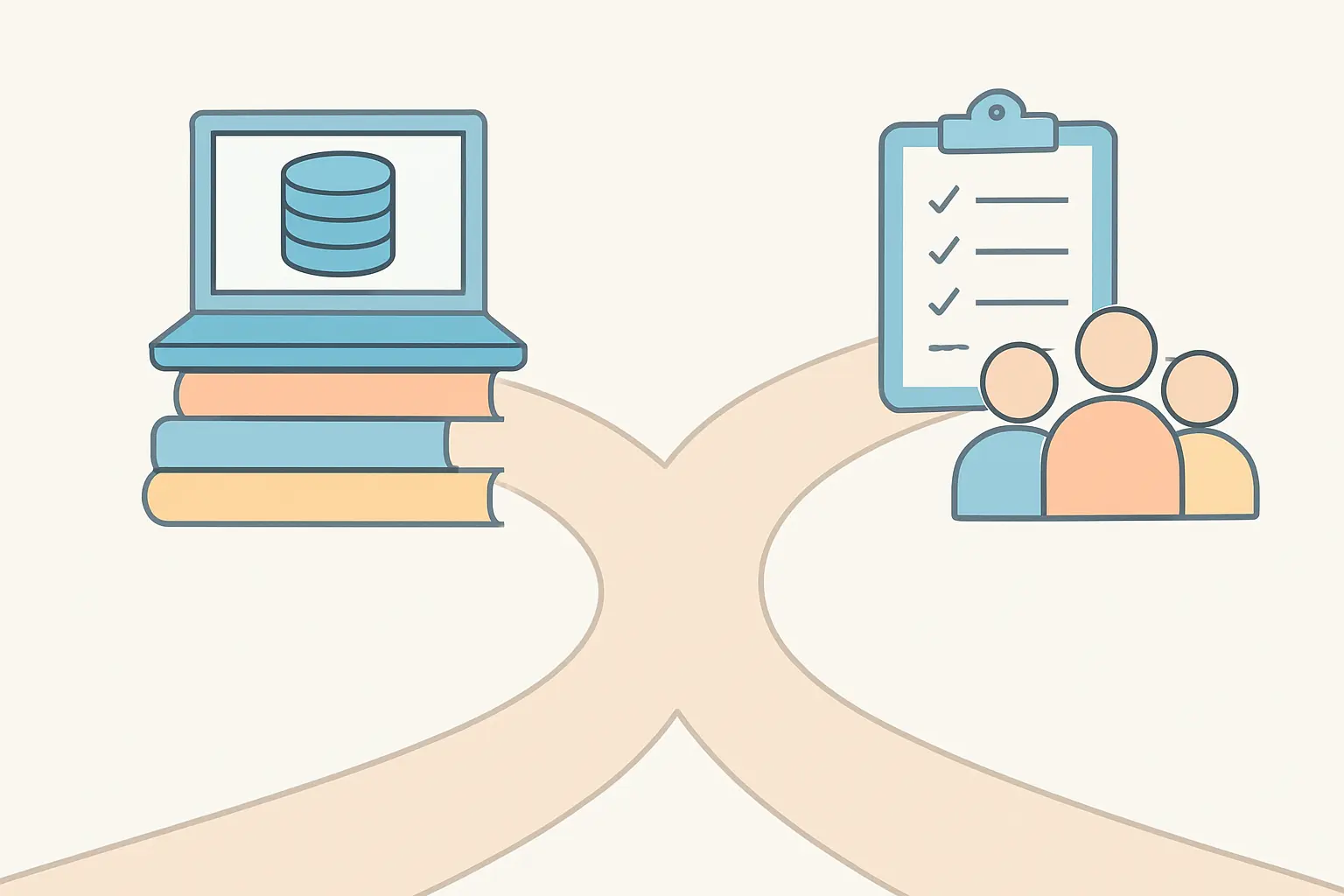
A desk-based dissertation answers its research question using existing sources — literature, published datasets, documents or archives. A primary-data dissertation generates new data through surveys, interviews, experiments or observation. Both are fully credit-bearing; the choice affects your timeline, your ethics route and your risk profile.
The comparison at a glance
| Factor | Desk-based | Primary-data |
|---|---|---|
| Data source | Existing literature, datasets, documents, archives | Data you collect yourself |
| Ethics route | Often light-touch or exempt; not automatic | Full review almost always required |
| Typical lead time before analysis | Days to weeks | Two to four months |
| Main failure mode | Descriptive summary with no argument | Too few participants, too late to fix |
| Dependency on other people | Low | High — participants, gatekeepers, ethics panel |
| Rigour is demonstrated by | Transparent, reproducible search and selection | Sound design, sampling and instrument quality |
| Suits students who | Work part-time, study remotely, have tight deadlines | Have access to a population and time to spare |
Is a desk-based dissertation easier?
No, and assuming so is the fastest way to write a weak one. What a desk-based dissertation removes is logistical risk. What it adds is analytical burden.
When you collect your own data, novelty is built in — nobody else has your dataset, so describing it is already a contribution. When you work from existing sources, everything you are looking at is already public. Your contribution has to come entirely from how you select, synthesise and interpret it.
That is why desk-based dissertations fail in a characteristic way: they become a long summary of what other people found, with a conclusion that says more research is needed. The marker’s question is always the same — what do you now know that you could not have known by reading the sources separately?
What counts as a desk-based dissertation?
It is a family of designs, not one thing, and naming yours precisely matters because each has its own quality criteria.
- Systematic review. A protocol-driven search with pre-registered inclusion criteria and a PRISMA flow diagram. The most rigorous and most demanding option; see our step-by-step systematic literature review guide.
- Scoping or narrative review. Maps a field or synthesises a debate. Less prescriptive than a systematic review but still needs an explicit, reportable search strategy.
- Secondary data analysis. Statistical analysis of an existing dataset — a national survey, an official statistics release, an open research dataset. Methodologically closest to a quantitative primary study.
- Document or policy analysis. Systematic analysis of a defined corpus of documents, using a coding framework.
- Archival or historical research. Work with primary historical sources, which are “primary” in the historian’s sense but require no participants.
- Conceptual or theoretical dissertation. Argument-driven work developing or critiquing a framework. Accepted in philosophy, law and parts of theory-heavy social science; rarely accepted elsewhere.
Do not write “desk-based” in your proposal and stop there. Write “a scoping review of X using a defined search of three databases” — the specificity is what a supervisor signs off.
Does a desk-based dissertation still need ethics approval?
Usually a lighter route, but “no participants” does not mean “no ethics”, and treating it as automatic exemption is a common and costly error.
Reviews of published literature are typically exempt or handled by a self-assessment form. Secondary analysis of an existing dataset is where it gets less obvious: if the data are genuinely anonymised and openly published, most committees treat this as low risk, but many still require a formal application, and some datasets carry their own access agreement with conditions your university must accept.
Document analysis of sensitive material, work involving identifiable individuals, and anything touching special-category personal data will attract full review regardless of who collected the data originally. Submit the self-assessment either way and keep the response — our guide on whether you need ethical approval for your dissertation covers the decision points in detail.
When should you choose primary data?
Choose it when your research question genuinely cannot be answered from what already exists. That is the honest test, and it is answered in your literature review, not before it.
Primary data is the right call when you have secured access to a population others cannot reach, when the phenomenon you care about is local or recent enough that no dataset covers it, or when your programme requires it — many psychology, nursing and marketing programmes mandate empirical data collection, and some professional accreditations depend on it.
It is the wrong call when you are choosing it because it sounds more impressive. A well-executed review beats an underpowered survey with 23 responses in every marking rubric.
What actually goes wrong in each route?
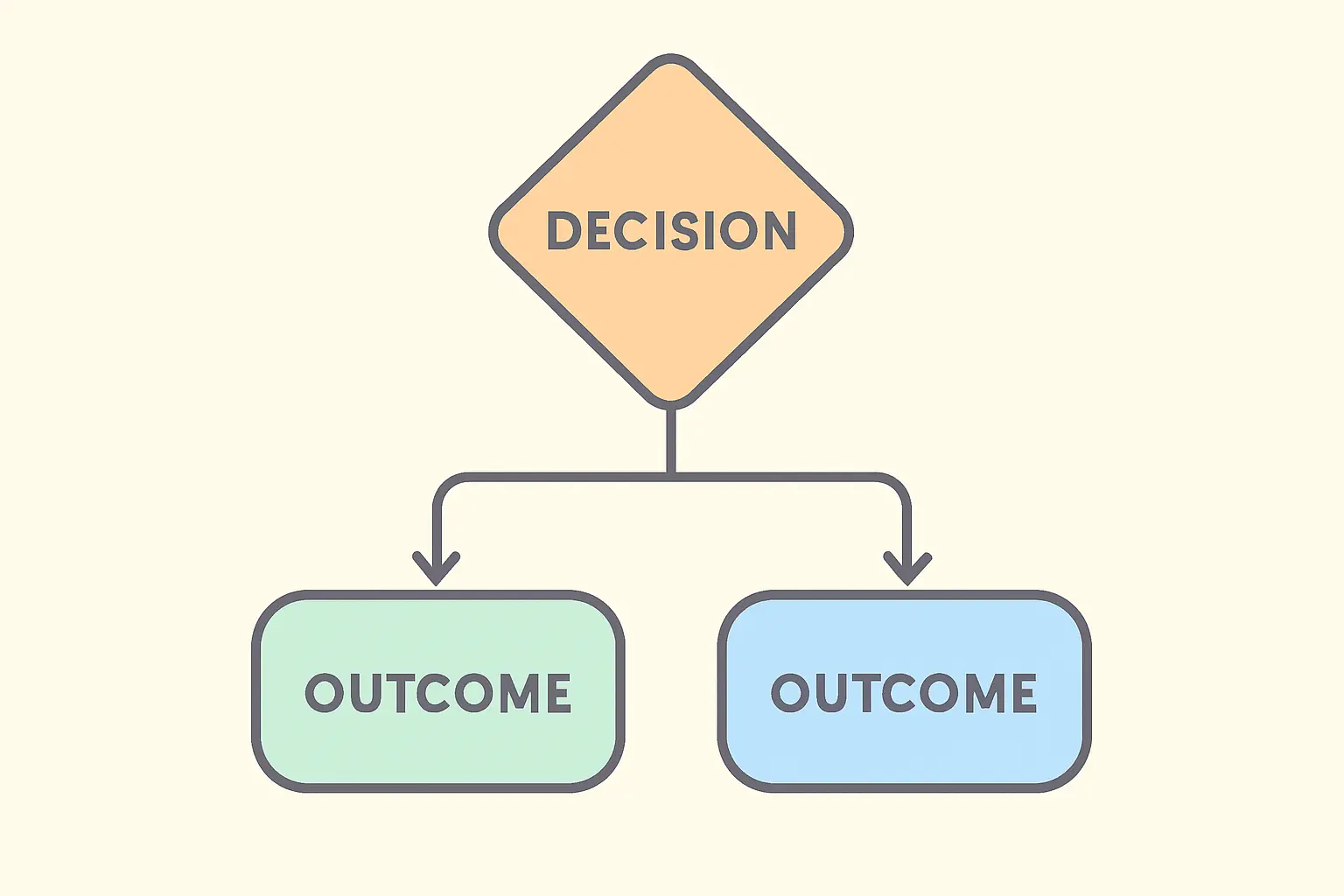
Primary-data projects fail late. Ethics approval takes longer than expected, recruitment underperforms, and by the time you know your sample is too small the deadline is close. The damage is concentrated at the point where you have the least room to recover. Underpowered samples are the single most common cause, which is why sampling strategy deserves proper attention early — see sampling methods in research.
Desk-based projects fail early and invisibly. The work proceeds smoothly, the word count fills, and the problem only surfaces at marking: there is no argument. Nobody stops you, because nothing external is failing. The safeguard is to write your central claim as a single sentence before you start synthesising, and test every section against it.
A decision procedure you can actually use
- Check your programme regulations first. If empirical data collection is mandatory, the decision is made. Read the handbook before anything else.
- Write your research question, then ask what data would answer it. Not what data you can get — what would actually answer it. If existing sources would, that is your answer.
- Count backwards from your deadline. Subtract ethics approval, recruitment, and data collection. If what remains is under six weeks of analysis and writing, primary data is a risk you should think hard about.
- Audit your access honestly. “I’ll post it in a Facebook group” is not a sampling strategy. If you cannot name where your participants come from, you do not have access yet.
- Check dataset availability before committing to secondary analysis. Confirm the dataset exists, that you can obtain it, and that it contains the variables you need — many students discover the third point too late.
Whichever route you take, tighten the question first. Our guide to writing research aims and objectives is the step that makes this decision straightforward, because a precise question usually declares its own method.
Can you combine both?
Yes, and at master’s level it is common: a substantial review that establishes the gap, plus a small primary study that probes it. Done well it is the strongest structure available to you.
Done badly it is the worst, because you take on both risk profiles at once — the analytical demand of the review and the logistical dependency of data collection — inside a single word count. If you attempt it, deliberately make one component the main contribution and the other supporting, and say which is which in your methodology.
Frequently asked questions
Is a desk-based dissertation worth fewer marks?
No. Marking rubrics assess the quality of the research, not the source of the data. A rigorous review scores higher than a poorly executed primary study. Where the difference shows up is in the criteria applied: desk-based work is judged heavily on the transparency of your search and selection, and on the depth of synthesis.
Do I need ethics approval for a literature-based dissertation?
Usually only a light-touch self-assessment, but you should still complete whatever form your department requires and retain the outcome. Full review can still be triggered by sensitive documents, identifiable individuals, or datasets governed by an access agreement.
How many sources does a desk-based dissertation need?
There is no fixed number, and chasing one is a mistake. What matters is that your search strategy is explicit and reproducible, and that your inclusion and exclusion criteria justify the final set. A systematic review that screens 400 records and includes 18 is entirely normal.
Can I switch from primary data to desk-based mid-project?
Often yes, and it is a legitimate recovery route when recruitment fails or ethics approval is delayed. Speak to your supervisor as soon as the risk is visible rather than when the deadline is close, because the change usually needs formal approval and may require a revised ethics submission.
Which route is better for a part-time or distance student?
Desk-based work suits both far better. It removes dependency on physical access to a population, on gatekeepers, and on committee timetables, and it can be paused and resumed around work commitments in a way that active data collection cannot.
What is the difference between secondary data analysis and a literature review?
A literature review analyses what other researchers concluded. Secondary data analysis takes their raw data — or an existing dataset such as a national survey — and runs your own analysis on it to answer a new question. The second is analytically closer to a primary quantitative study.
Once you have chosen your route, Tesify helps you build the scaffolding around it — a chapter outline matched to your design, a formatted bibliography, and an AI-use declaration for submission.
Write your thesis with AI
Structure, draft, cite, and format your thesis faster with Tesify’s AI writing tools, automatic bibliography, and plagiarism checker. Free to start, no credit card required.






Leave a Reply