
Thematic Analysis: A Complete Step-by-Step Guide for Students 2026
Thematic analysis is one of the most widely used qualitative research methods in the social sciences, psychology, education, and health research. It provides a flexible, systematic way to identify patterns of meaning across qualitative data — interview transcripts, focus group recordings, open-ended survey responses, or documentary sources. Despite its popularity, many students apply thematic analysis inconsistently, producing findings that are descriptive rather than analytical. This guide provides a rigorous, step-by-step framework for conducting and writing up thematic analysis to dissertation standard.
Thematic analysis was formalised by Braun and Clarke (2006) in a landmark paper that remains among the most cited in qualitative methodology. Their six-phase approach provides a clear procedure while allowing for both inductive and deductive analysis, making it adaptable across research contexts. Understanding which variant you are using — and being able to justify that choice — is a marker of methodological sophistication that examiners reward.
What Is Thematic Analysis?
Thematic analysis is a method for identifying, analysing, and interpreting patterns of meaning — “themes” — within qualitative data. Unlike grounded theory or discourse analysis, thematic analysis is not tied to a specific theoretical framework, which makes it flexible and widely applicable. It is appropriate when your research question asks how or what rather than why at a theoretical level.
A theme in thematic analysis is not simply something that comes up frequently in your data. It is a pattern that captures something important about the data in relation to your research question. Frequency is not the criterion — relevance and coherence are. A theme that appears in three out of twenty interviews can be analytically significant if it illuminates something important about the phenomenon under study.
Thematic analysis is used across disciplines. In psychology, it might analyse interview data from therapy participants. In education research, it might examine teacher reflections. In health research, it might code patient narratives about treatment experiences. Its versatility is both a strength and a challenge: without methodological rigour, it can become little more than impressionistic summary.
Inductive vs Deductive Thematic Analysis
Before you begin, decide whether your analysis will be inductive or deductive.
- Inductive thematic analysis — codes and themes emerge from the data itself, without being mapped to a predetermined framework. Your findings are driven by what participants say or do. This approach is appropriate when you are exploring a topic with limited prior research.
- Deductive thematic analysis — codes and themes are informed by existing theory or prior research. You approach the data with specific questions or categories in mind. This is appropriate when you are testing whether an established framework applies in a new context.
Most student dissertations use an inductive approach, as it aligns with exploratory, small-scale qualitative research. However, you must be transparent about your chosen approach in your methodology chapter — and consistent throughout your analysis.
The Six Phases of Thematic Analysis
Braun and Clarke’s six-phase framework provides the most widely accepted procedure for thematic analysis. It is iterative, not linear — you may move back and forth between phases as your understanding develops.
Phase 1: Familiarisation with Your Data
Before coding, immerse yourself in the data. Read all transcripts multiple times. Note initial observations, patterns, and ideas in the margins. If you conducted interviews, consider re-listening to recordings alongside transcripts to capture non-verbal nuance.
At this stage, resist the urge to code immediately. The goal is depth of familiarity, not efficiency. Braun and Clarke emphasise that analytic rigour in thematic analysis begins with genuine engagement with the data — not superficial scanning.
Phase 2: Generating Initial Codes
Coding is the systematic process of labelling data segments that are relevant to your research question. A code is a short label that describes what a data segment means. See the full coding section below for detail on this phase.
Phase 3: Searching for Themes
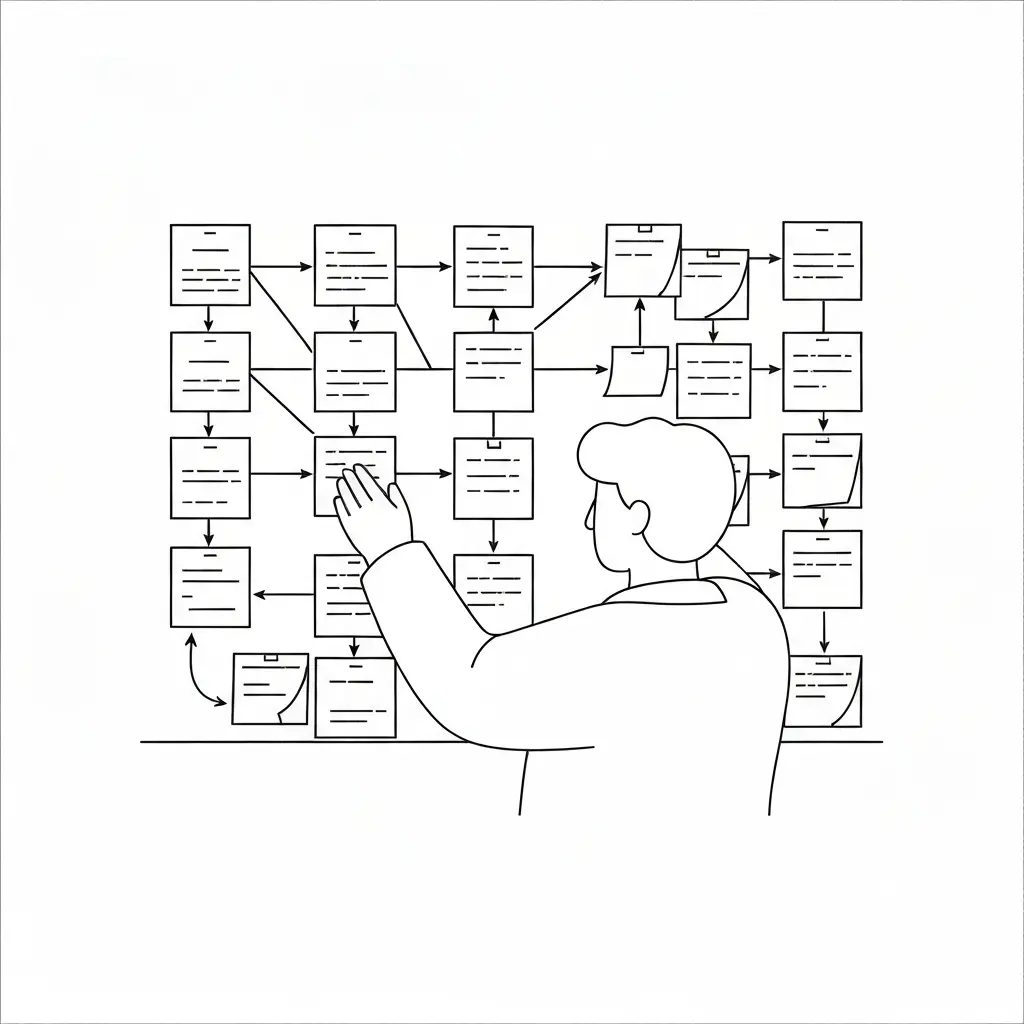
Group related codes into potential themes. At this stage, you are looking for patterns that connect multiple codes. Use a thematic map — a visual diagram showing relationships between codes and candidate themes — to organise your thinking.
Phase 4: Reviewing Themes
Review candidate themes against your full data set. Ask: Does this theme hold when tested against all the data? Is it internally coherent? Does it capture something distinct from other themes? You will likely collapse some themes, split others, and abandon some entirely at this stage.
Phase 5: Defining and Naming Themes
For each final theme, write a clear definition: what is this theme about, what does it capture, and how does it relate to your research question? The name of the theme should convey its essence — not a one-word label (“family”), but a phrase that captures the analytical point (“family as a barrier to treatment-seeking”).
Phase 6: Writing Up
The write-up is where you produce the findings narrative that weaves together your themes, supporting data extracts, and analytical interpretation. See the writing section below for guidance on this phase.
Phase 2: How to Code Data
Coding is the analytical heart of thematic analysis. Work systematically through your data, line by line or segment by segment. Assign codes that describe what is happening in each data segment. A single segment can receive multiple codes.
Practical guidance for coding:
- Code as close to the data as possible — let the data language inform your codes
- Use in-vivo codes (the participant’s own words) where they capture meaning precisely
- Do not aim to code everything — focus on material relevant to your research question
- Keep a coding log noting decisions and rationale as you go
Software such as NVivo, Atlas.ti, or MAXQDA can facilitate systematic coding and retrieval of coded segments. Alternatively, a well-organised spreadsheet or printed transcripts with colour-coded highlighters work for smaller data sets. The tool does not determine the quality of the analysis — your analytical engagement does.
Phases 3 and 4: Developing and Reviewing Themes
Theme development requires moving from the level of individual codes to the level of interpretation. As you group codes into potential themes, ask: what does this pattern tell me about the phenomenon under study? What is its significance in relation to my research question?
A well-developed theme is:
- Internally coherent — all codes within the theme are conceptually related
- Distinct — it captures something different from other themes
- Data-supported — multiple data extracts provide evidence for it
- Analytically meaningful — it advances understanding of the research question
Most thematic analyses produce between three and six themes. Fewer than three themes may indicate insufficient analytical depth. More than eight themes often indicates that coding has remained at a descriptive level without sufficient abstraction.
Reflexivity in Thematic Analysis
Reflexivity is the practice of critically examining how your own background, assumptions, and position as a researcher shape your analysis. In thematic analysis, reflexivity is not an optional extra — it is a methodological requirement for demonstrating rigour.
Write a reflexivity statement in your methodology that acknowledges:
- Your relationship to the research topic (personal experience, professional background)
- Assumptions you held before data collection
- How these may have influenced your interview questions, coding choices, or theme interpretations
Reflexivity does not invalidate your findings — it contextualises them. Claiming objectivity in qualitative research is a methodological error. Acknowledging subjectivity, and managing it transparently, is what distinguishes rigorous qualitative research from anecdote.
Writing Up Thematic Analysis
The write-up presents your themes, supported by data extracts, and interpreted in relation to your research question. Structure your findings chapter with a section for each theme. Within each section:
- Name and define the theme
- Present supporting data extracts (direct quotes from transcripts)
- Interpret the extract — what does it show, how does it relate to the theme?
- Connect to relevant literature where appropriate
Data extracts should be presented in quotation marks and attributed to a participant code (e.g., “P3, Interview 2”). Do not simply list extracts without interpretation — the narrative around the quote is where your analytical contribution lies.
For guidance on structuring your research methodology chapter as a whole, see our guide to writing a research methodology. If you are working on a systematic review, see our companion article on conducting a systematic literature review.
Common Mistakes to Avoid
Students commonly make the following errors in thematic analysis:
- Treating frequency as significance — a theme’s importance is analytical, not numerical
- Descriptive rather than interpretive themes — themes should answer “so what?” not just “what?”
- Ignoring disconfirming data — engage with data that does not fit neatly into themes
- Presenting only confirming extracts — your write-up should acknowledge complexity
- Failing to maintain an audit trail — keep records of coding decisions for transparency
- Confusing thematic analysis with content analysis — thematic analysis is interpretive; content analysis is quantitative
Frequently Asked Questions
How many participants do I need for thematic analysis?
There is no fixed minimum for thematic analysis, but most qualitative researchers suggest that 6–12 semi-structured interviews provide sufficient data richness for a focused study. For broader topics or more heterogeneous populations, 15–25 participants may be appropriate. Quality and depth of data matters more than sample size.
What is the difference between thematic analysis and grounded theory?
Thematic analysis identifies and reports patterns of meaning in data. Grounded theory is a more rigorous methodology that aims to generate new theory from data, using constant comparative analysis and theoretical sampling. Grounded theory is more demanding and more appropriate for studies that aim to build theoretical frameworks, while thematic analysis is suitable for describing and interpreting experience.
How do I ensure rigour in thematic analysis?
Rigour in thematic analysis is demonstrated through: maintaining an audit trail of coding decisions, writing a reflexivity statement, seeking member checking (sharing findings with participants for feedback where feasible), using thick description in your write-up, and engaging fully with disconfirming data. Some researchers use peer debriefing or inter-rater reliability checks for additional rigour.
Can thematic analysis be used with secondary data?
Yes. Thematic analysis can be applied to any qualitative data — including secondary data such as social media posts, policy documents, published narratives, media content, or archival materials. The same six-phase procedure applies, but your methodology section should explain how the secondary data was selected and why it is appropriate for your research question.
What software is best for thematic analysis?
NVivo and Atlas.ti are the most widely used qualitative data analysis software packages for thematic analysis. Both allow systematic coding, code retrieval, and visualisation of thematic maps. MAXQDA is another strong option. For smaller datasets (under 10 interviews), a well-organised spreadsheet or annotated PDF transcripts are entirely adequate — the software does not determine analytical quality.
Need Help with Your Qualitative Dissertation?
Tesify helps students structure methodology chapters, write up thematic findings clearly, and ensure their qualitative research meets academic standards. Whether you are coding for the first time or writing up complex multi-theme analyses, expert guidance is available.





Leave a Reply