
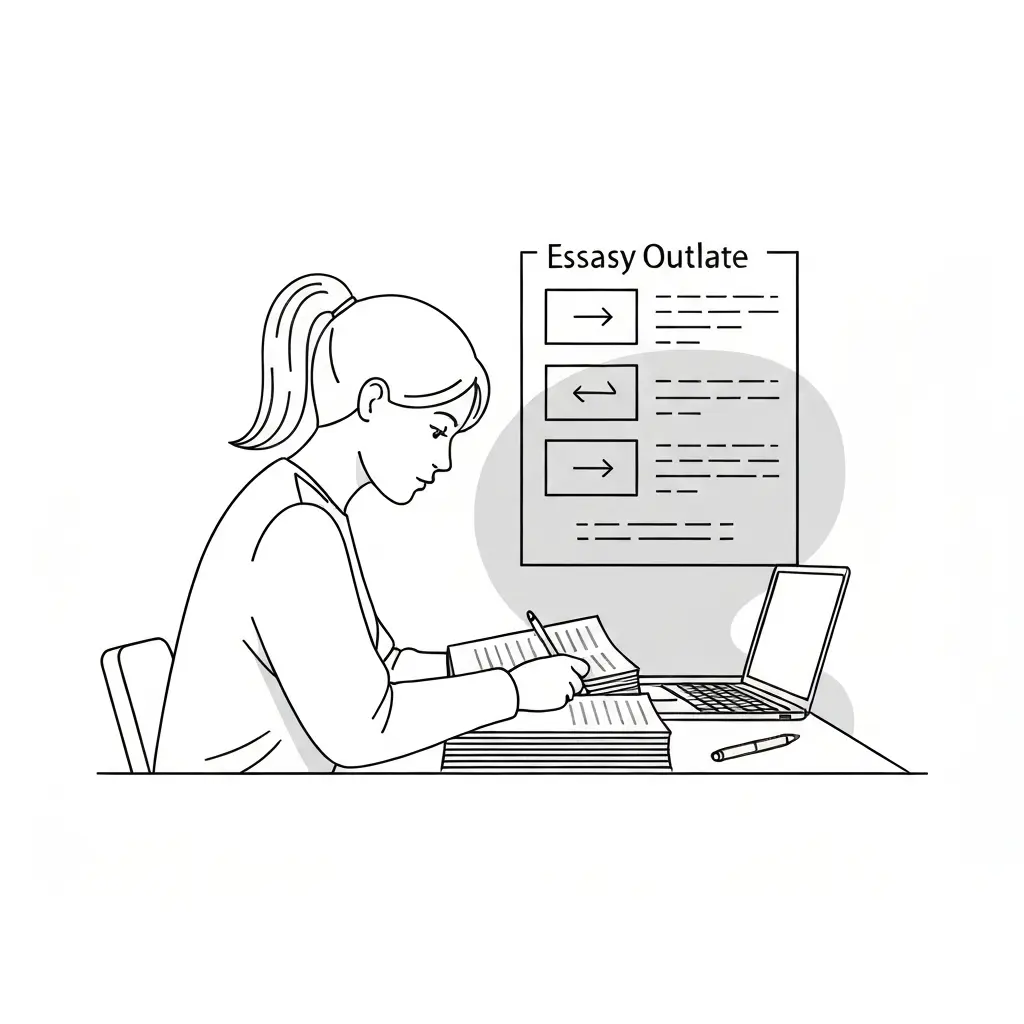
Academic Writing Tips: 15 Proven Strategies to Write Better Essays and Papers
Academic writing is one of the most demanding skills university students must develop — and one of the most poorly taught. Whether you are writing a 500-word essay or a 20,000-word dissertation, the same core principles determine whether your work earns a first-class mark or a resit. These academic writing tips distil years of academic convention into actionable strategies you can apply immediately, from sentence-level clarity to dissertation-wide argument structure.
Most students write the way they speak — discursively, casually, and without a clear evidential chain. Academic writing demands the opposite: precision, economy, and a rigorous relationship between claims and evidence. The good news is that academic writing is a learnable craft, not an innate talent. With the right techniques, any student can produce work that reads as authoritative, well-structured, and analytically sharp.
1. Understand Your Assignment Brief
Before you write a single word, dissect the assignment brief. Most students underperform not because they lack knowledge, but because they answer a different question than the one asked. Identify the command word: “discuss,” “analyse,” “evaluate,” and “compare” each require a fundamentally different type of response.
- Discuss — present multiple sides of an argument with supporting evidence
- Analyse — break the topic into components and examine each critically
- Evaluate — weigh evidence and reach a substantiated judgement
- Compare — identify similarities and differences between two or more things
Write the question in your own words before you begin. If your paraphrase captures the same meaning, you understand what is being asked. If it diverges, reread the brief.
2. Plan Before You Write
Planning is not wasted time — it is writing time. A 30-minute planning session reduces overall writing time and produces a structurally superior paper. Use an outline to assign your word count across sections, ensuring proportionality. A 2,000-word essay with 600 words on the introduction has a structural problem before a sentence is written.
Effective planning tools include:
- Mind maps — to generate and cluster ideas visually
- Reverse outlines — written after a draft to assess whether structure holds
- Argument maps — to trace the logical chain from claim to evidence to conclusion
3. Build a Strong Thesis Statement
A thesis statement is a one-to-two sentence declaration of your central argument. It is the essay’s spine — every paragraph should either support or complicate it. A strong thesis is specific, contestable, and provable within the scope of the assignment.
Weak: “Climate change is an important issue.”
Strong: “Despite international pledges, carbon pricing mechanisms have failed to deliver emissions reductions at the scale required, primarily because political economy constraints consistently dilute policy ambition.”
The strong version is debatable, specific, and signals a clear analytical direction. Place your thesis at the end of your introduction paragraph so readers know what they are about to encounter.
4. Master Paragraph Structure
Every body paragraph should follow a clear structure. The PEEL method — Point, Evidence, Explanation, Link — is widely taught, but the key principle is that every paragraph advances one idea and one idea only. Paragraph sprawl — where multiple unrelated points appear in a single block — is among the most common weaknesses in undergraduate writing.
- Point — state the paragraph’s central claim in the first sentence
- Evidence — cite relevant sources, data, or examples
- Explanation — interpret the evidence; do not assume it speaks for itself
- Link — connect back to the thesis or forward to the next paragraph
Keep paragraphs between 150 and 250 words. Below 150 words, a paragraph is likely underdeveloped. Above 300, it usually needs splitting.
5. Use Evidence and Analysis Together
One of the most common academic writing failures is quotation without analysis — what academics call “quote dumping.” Dropping a citation into your essay without interpreting it signals that you do not fully understand the material. Every piece of evidence must be followed by your analysis of what it means in the context of your argument.
The ratio of evidence to analysis should shift as you progress through your degree. Undergraduate work may be 60% evidence, 40% analysis. Postgraduate work often reverses this — your interpretation carries more weight than the source material itself.
6. Maintain an Academic Tone
Academic writing is formal, precise, and objective. Avoid contractions (“don’t,” “can’t”), slang, and first-person opinion statements without evidential backing (“I think,” “I feel”). Use hedging language where certainty is not warranted: “suggests,” “indicates,” “appears to,” “the evidence implies.”
Formal academic writing does not mean complex academic writing. Clarity is a virtue. Long sentences with multiple subordinate clauses are harder to read, not more impressive. Aim for an average sentence length of 18–22 words. Break anything over 35 words into two sentences.
7. Use Signposting and Transitions
Signposting language guides your reader through your argument. It announces what is coming, summarises what has been said, and shows how sections relate. Without signposting, even well-reasoned arguments feel disjointed.
Useful signposting phrases by function:
- Introducing a new point: “This section examines…” / “A further consideration is…”
- Contrasting: “However…” / “In contrast…” / “Notwithstanding this…”
- Adding to: “Furthermore…” / “In addition…” / “Equally important…”
- Concluding: “In summary…” / “This suggests that…” / “Taken together, these findings indicate…”
8. Cite Sources with Accuracy
Accurate citation is non-negotiable in academic writing. Every claim that is not common knowledge or your own original analysis must be supported by a source. Use your institution’s required citation style — whether APA, MLA, Chicago, or Vancouver — consistently throughout the paper.
Common citation errors to avoid:
- Incorrect page numbers in in-text citations
- Missing DOIs in reference lists
- Inconsistent formatting of author names
- Citing secondary sources without acknowledging you did so
Citation management tools such as Zotero, Mendeley, or a free citation generator can automate formatting and reduce errors significantly.
9. Avoid Common Academic Writing Mistakes
Awareness of typical errors helps you edit more effectively. The most frequent mistakes in student academic writing include:
- Passive overuse — “It was found that…” vs “The study found…” (active is clearer)
- Vague language — “society,” “people,” “things” — always be specific
- Over-reliance on one source — diversify your evidence base
- Sweeping generalisations — “All students struggle with academic writing” (never all, always hedge)
- Paragraph-length introductions — introductions should be proportional, not exhaustive
10. Develop Critical Thinking in Writing
Critical thinking in academic writing means evaluating your sources rather than accepting them uncritically. When you encounter a study, ask: who funded it, what was the sample size, what methodology was used, and are there competing findings? Demonstrating this evaluative stance is what distinguishes a first-class paper from a merit.
At higher degree levels, you are expected to identify gaps in the literature, question consensus positions where evidence warrants it, and position your own argument within an ongoing scholarly debate — not merely summarise what others have said.
11. Engage Deeply with Literature
Reading widely and engaging critically with scholarly literature is the foundation of strong academic writing. Your argument gains authority when it is anchored in peer-reviewed sources. Use databases such as Google Scholar, JSTOR, and your institution’s library to locate relevant literature.
Do not simply summarise sources in sequence. Synthesise them — identify agreements, contradictions, and debates across sources — and position your own argument within that intellectual landscape. This is what a literature review demonstrates, and it is a skill that applies at the paragraph level in every essay you write. For a detailed breakdown, see our guide to writing a literature review.
12. Build a Rigorous Revision Process
First drafts are never final drafts. Build revision time into your writing schedule — at least one full day between completing a draft and revising it. Distance gives you perspective. When you revise, work at three levels:
- Macro level — Does the overall structure support the argument? Are all sections proportional?
- Paragraph level — Does each paragraph have a clear point? Is evidence analysed?
- Sentence level — Are sentences clear, concise, and grammatically correct?
Read your work aloud. Your ear catches awkward sentences that your eye misses on the page.
13. Write Introductions and Conclusions Effectively
Introductions should do three things: provide context, state the problem or question, and declare your thesis. They should not attempt to say everything about the topic. A common error is writing a “funnel” introduction that starts from a cosmic generalisation (“Throughout history, humans have…”) and works down to the specific topic. Start closer to the point.
Conclusions should synthesise — not summarise. Restate your thesis in different language, show what your analysis has demonstrated, and gesture towards implications or further research. Never introduce new evidence in a conclusion.
14. Use AI Writing Tools Wisely
AI writing assistants are now a fact of academic life. Used wisely, tools like Tesify can help you structure arguments, generate outlines, check citation formatting, and overcome writer’s block. The key distinction is between using AI to support your thinking versus using it to replace your thinking.
Always verify AI-generated citations independently — some tools hallucinate sources. Use AI to identify gaps in your argument and to improve sentence clarity, not to generate the substantive claims that should emerge from your own reading and analysis. Students at institutions across the UK, France (tesify.fr), Germany (tesify.io), and Spain (tesify.es) are increasingly using AI to improve the quality and efficiency of their academic work.
15. Stay Consistent Throughout
Consistency across your paper — in formatting, tense, citation style, and terminology — signals professionalism and care. Choose past or present tense for literature review and stick to it. Use the same term for the same concept throughout — switching between “participants,” “respondents,” and “subjects” in a single paper creates unnecessary confusion.
Check formatting: heading levels, margin consistency, font, line spacing, and page numbers should all conform to your institution’s guidelines. These details are small but markers read them carefully.
Frequently Asked Questions
What is the most important academic writing tip for beginners?
The single most valuable habit for beginner academic writers is to plan before writing. An outline forces you to think through your argument logically before committing to words, saving revision time and producing a stronger structure from the start.
How do I improve my academic writing style?
Read academic texts in your field regularly — the vocabulary and sentence structures of academic writing become internalised through exposure. Practice writing topic sentences and check that each paragraph advances exactly one idea. Read your work aloud to catch tonal inconsistencies.
How do I avoid plagiarism in academic writing?
Always cite sources when using others’ ideas, data, or words. Paraphrase carefully — simply changing a few words from a source without citation is still plagiarism. Use a plagiarism detection tool before submission to catch unintentional similarities. Keep detailed notes of sources as you research.
What word count should each section of my essay be?
A typical essay structure allocates roughly 10–15% to the introduction, 70–80% to the body, and 10% to the conclusion. For a 2,000-word essay, that is approximately 200–300 words for the introduction, 1,400–1,600 for the body, and 200 for the conclusion.
How many sources should I use in an academic essay?
Guidelines vary by institution and level of study. A common benchmark is 8–12 sources for a 2,000-word undergraduate essay, and 20–40+ sources for a postgraduate dissertation chapter. Prioritise quality and relevance over quantity — five well-analysed sources outperform 20 superficially cited ones.
Can I use AI tools for academic writing?
Many institutions now permit AI writing assistants for specific tasks such as grammar checking, outline generation, and citation formatting, while prohibiting AI-generated substantive content. Always check your institution’s academic integrity policy. When used ethically, AI tools can improve your writing quality without replacing your intellectual contribution.
Ready to Take Your Academic Writing Further?
Tesify helps students across the UK and Europe structure stronger arguments, check citations, and improve writing clarity — all in one platform. Whether you are working on an essay, dissertation, or research paper, Tesify provides expert guidance at every step.





Leave a Reply