
Thesis vs Dissertation Difference Explained for Every Country 2026
The thesis vs dissertation difference is one of the most frequently Googled questions in academic writing — and for good reason. The two words are used to describe different things in different countries, at different degree levels, and sometimes interchangeably in casual conversation. If you are about to start your research degree and are not sure which word applies to you, you are not alone.
This guide explains the thesis vs dissertation difference systematically and clearly, with country-by-country breakdowns for the UK, USA, Canada, Australia, New Zealand, Germany, France, and beyond. After reading it, you will know exactly what to call your work and what the expectations are — wherever you study in 2026.
The Core Difference: A Simple Explanation
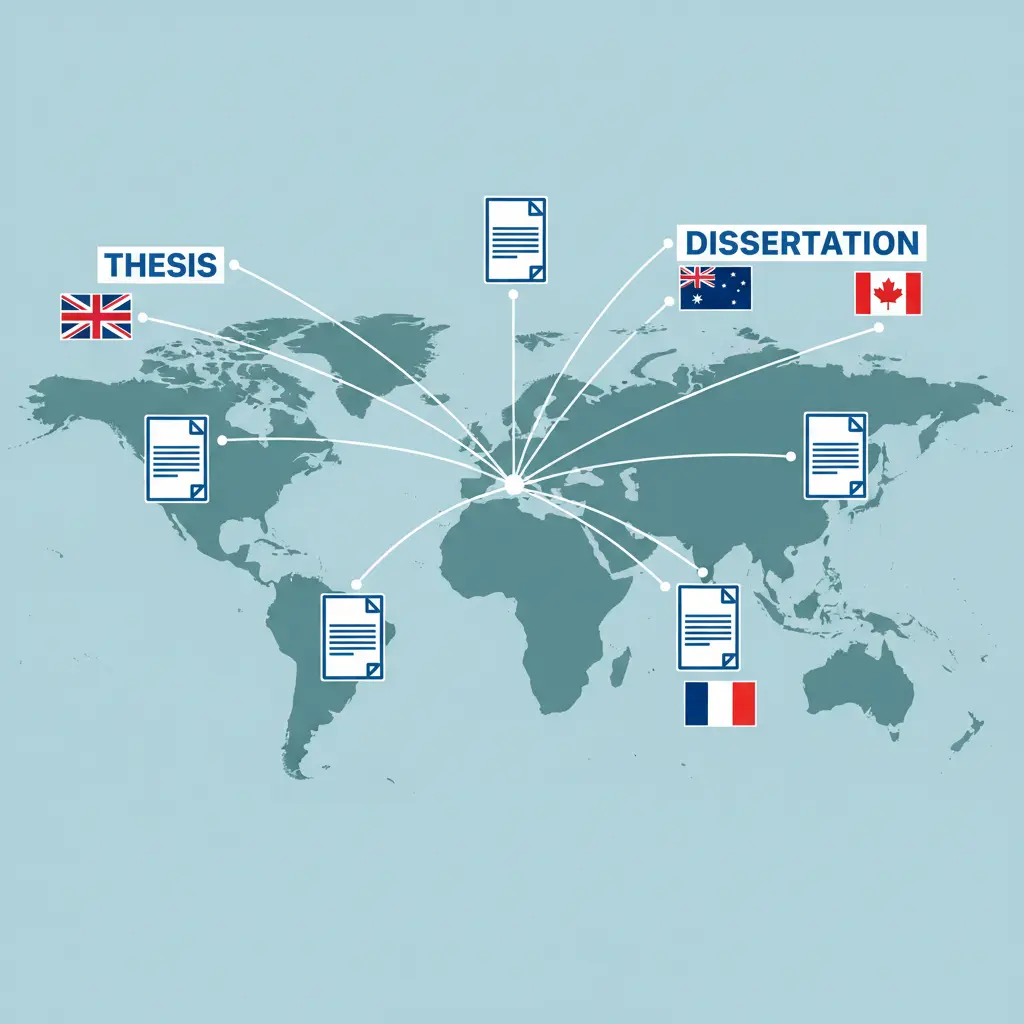
The confusion arises because English-speaking countries inherited two different conventions — one from British academic tradition, one from American. There is no international standard. Both words describe the same type of document: a substantial, independently researched academic work submitted for a university degree.
The key differentiator is:
- In most of the world (UK tradition): thesis = PhD, dissertation = master’s
- In the USA: thesis = master’s, dissertation = PhD
If you study in the UK, Ireland, Australia, or New Zealand, this guide will help you understand what convention your institution uses. If you study in the USA or Canada, the opposite convention likely applies. When in doubt, use whichever term appears in your institution’s official guidelines — that is always the safest choice.
Thesis vs Dissertation in the United Kingdom
The UK follows a clear convention at most universities:
| Degree Level | Term Used | Word Count | Original Contribution Required? |
|---|---|---|---|
| Undergraduate (final year) | Dissertation | 8,000–12,000 words | No (demonstrates research skills) |
| Master’s by Research (MRes, MA, MSc) | Dissertation or Thesis | 15,000–20,000 words | Some original contribution expected |
| PhD | Thesis | 60,000–80,000 words | Yes — must make original contribution to knowledge |
Oxford convention: Oxford uses “thesis” for all postgraduate research degrees including master’s by research. “Dissertation” is generally used for undergraduate final-year projects.
Cambridge convention: Cambridge also uses “thesis” for PhD work. For the MPhil (master’s by research), the submitted work is typically called a “dissertation.”
UCL convention: UCL uses “dissertation” for master’s taught programmes and “thesis” for PhD degrees.
One nuance: in the UK, a master’s taken “by dissertation” (meaning research-only, no taught modules) may call the final document a “thesis” because of its closer resemblance in nature to a PhD. A master’s taken “by coursework plus dissertation” more commonly uses “dissertation.”
Thesis vs Dissertation in the United States
American universities follow the opposite convention from the UK — a fact that causes enormous confusion for international students and cross-national academic readers.
| Degree Level | Term Used (US) | Word Count |
|---|---|---|
| Bachelor’s (senior thesis) | Thesis | 8,000–15,000 words |
| Master’s | Thesis | 15,000–30,000 words |
| PhD / Doctoral | Dissertation | 80,000–100,000 words |
Not all US master’s programmes require a thesis. Many professional master’s degrees (MBA, MEd, MPA) offer a “non-thesis track” in which a capstone project, comprehensive exam, or applied research project replaces the thesis. A “thesis track” is typically required for students planning to continue to doctoral study.
Ivy League conventions: Harvard, Princeton, MIT, Stanford, and Yale all follow the American convention — master’s = thesis, PhD = dissertation.
Canada
Canadian universities generally follow the American convention, but with regional variations influenced by French-Canadian academic tradition in Quebec.
| Province / Institution Type | Master’s Term | Doctoral Term |
|---|---|---|
| English-speaking Canada (Ontario, BC, Alberta) | Thesis | Dissertation |
| Quebec (French universities) | Mémoire (master’s) or Thèse (doctoral) | Thèse |
| Quebec (English universities, e.g., McGill) | Thesis | Thesis or Dissertation |
Australia and New Zealand
Australia and New Zealand primarily follow the British convention:
| Degree Level | Term Used | Notes |
|---|---|---|
| Honours (4th year) | Thesis | Australian honours degrees typically require a 15,000–20,000 word thesis — more substantial than UK undergrad dissertations |
| Master’s by Research | Thesis | |
| Master’s by Coursework | Dissertation | |
| PhD | Thesis | AQF uses “thesis” for all research-based doctorates |
Continental Europe
European countries each have their own traditions, shaped by their own academic history:
| Country | Master’s Term | Doctoral Term | Notes |
|---|---|---|---|
| Germany | Masterarbeit / Master’s Thesis | Dissertation | Published as a book after defence (Habilitation for higher academics) |
| France | Mémoire | Thèse | Licence = undergraduate; Master = mémoire; Doctorat = thèse |
| Spain | TFM (Trabajo Fin de Máster) | Tesis Doctoral | TFG = undergraduate final year project |
| Netherlands | Master’s Thesis / Scriptie | Proefschrift | Defended publicly in a formal ceremony (verdediging) |
| Italy | Tesi Magistrale | Tesi di Dottorato | “Tesi” used for all levels (plus Tesi di Laurea for undergraduate) |
Are They Structurally Different?
Despite different names, a UK PhD thesis and a US PhD dissertation follow essentially the same structure — Introduction, Literature Review, Methodology, Results, Discussion, Conclusion, References — and are assessed on the same criteria: originality, methodological rigour, depth of knowledge, and quality of written presentation.
The meaningful differences between a master’s and doctoral document are not about the name but about scope:
- PhD/Doctoral: Must make an original contribution to knowledge — something that was not previously known. Examined by expert examiners in the field, often through an oral examination (viva voce).
- Master’s: Must demonstrate mastery of existing knowledge and research skills. Original contribution is valued but not always required.
- Undergraduate: Must demonstrate ability to conduct independent research. Originality expectation is low.
For the full structural breakdown, see our thesis structure guide. For the complete writing process, see our guide on how to write a thesis in 2026.
Global Summary Table
| Country | Undergraduate Final Project | Master’s | PhD / Doctoral |
|---|---|---|---|
| UK | Dissertation | Dissertation | Thesis |
| USA | Senior Thesis (at research universities) | Thesis | Dissertation |
| Canada | Thesis (honours programmes) | Thesis | Dissertation |
| Australia / NZ | Thesis (Honours) | Thesis or Dissertation | Thesis |
| Ireland | Dissertation | Dissertation | Thesis |
| Germany | Bachelorarbeit | Masterarbeit | Dissertation |
| France | TER / Mémoire | Mémoire | Thèse |
| Spain | TFG | TFM | Tesis Doctoral |
Frequently Asked Questions
Is a thesis harder than a dissertation?
In the UK, a thesis (PhD) is substantially more demanding than a dissertation (master’s) — it is larger in scope, requires an original contribution to knowledge, and takes 3–4 years to complete. In the USA, a dissertation (PhD) is similarly more demanding than a thesis (master’s). In both traditions, the doctoral-level document represents the highest standard of independent academic research. However, the structural requirements are similar — both follow the same chapter format. The difference is in depth, scale, and the originality requirement.
Can a thesis and dissertation be the same document?
Technically, yes — both words refer to the same type of document: a substantial, independently researched academic work submitted for a degree. The difference is terminological (what your institution calls it), not substantive (what it contains). The structure, assessment criteria, and academic expectations are essentially the same whether your university calls it a thesis or a dissertation. The key is to use whatever term your own institution uses in its official guidelines and assessment rubrics.
What is a thesis defence, and is it different from a dissertation defence?
A thesis defence (called a viva voce in the UK) is an oral examination in which you defend your research to a panel of academic examiners. In the UK, all PhD students undergo a viva; most master’s by dissertation students do not. In the USA, most PhD students defend their dissertation in a public or semi-public defence; master’s students may defend a thesis in a shorter format. The examination involves questions about your methods, findings, and conclusions — and may result in minor or major revisions being required before the degree is awarded.
Which is longer — a thesis or a dissertation?
In the UK: a PhD thesis (60,000–80,000 words) is significantly longer than a master’s dissertation (15,000–20,000 words). In the USA: a PhD dissertation (80,000–100,000 words) is significantly longer than a master’s thesis (15,000–30,000 words). In both traditions, the doctoral-level document is the longer and more demanding. Undergraduate dissertations and theses are the shortest, at 8,000–15,000 words depending on the institution.
What do I call my work if I am an international student?
Use the term your current institution uses in its official guidelines, handbook, or assessment criteria — regardless of what your home country uses. If you are studying a master’s at a UK university, your document is a dissertation. If you are studying a master’s at a US university, your document is a thesis. If your institution’s materials use both terms interchangeably, it is safe to use either. When in doubt, ask your supervisor or departmental administrator which term is preferred.





Leave a Reply