

Thesis Defence Tips: Preparation and Common Questions 2026
The thesis defence — called the viva voce (or simply “viva”) in the UK, and the “defence” in the US — is the final gateway between your years of research and your degree. For most students, it is the most nerve-wracking academic event of their lives. But here is the truth that experienced researchers know: if you have written a solid thesis, the viva is not an attempt to catch you out. It is a conversation about your research — a conversation in which you are the world’s leading expert on your own study.
This guide gives you practical thesis defence tips drawn from viva experiences at Oxford, Cambridge, UCL, Edinburgh, Harvard, MIT, and Stanford. We cover preparation strategies, the most common examiner questions (and how to answer them), how to handle corrections, and how to manage the nerves that are entirely normal before this kind of examination.
What Is a Thesis Defence / Viva Voce?
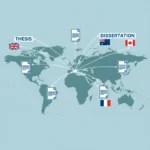
In the UK, a PhD viva is a private oral examination typically lasting 1–3 hours, involving two examiners (one internal to your university, one external) and your supervisor (usually as an observer). In the USA, a PhD defence is often more formal and may be partly public — with a presentation followed by questions from the committee and audience.
| Aspect | UK Viva Voce | US Dissertation Defence |
|---|---|---|
| Format | Private conversation | Presentation + questions (often public) |
| Duration | 1–3 hours (average 1.5 hours) | 1–2 hours total (30 min presentation + Q&A) |
| Examiners | 1 internal + 1 external | Committee of 3–5 faculty |
| Supervisor present? | Often, as observer only | Yes, as committee chair |
| Outcome announced | After private examiner deliberation | Often same day |
Most master’s programmes in the UK do not require a viva for dissertations. US master’s defences do exist but are typically shorter and less formal than PhD defences. For context on the difference between thesis and dissertation levels, see our thesis vs dissertation guide.
Preparation: What to Do in the Weeks Before
Four Weeks Before
- Re-read your thesis in full. Print a copy and read it as if encountering it for the first time. Note anything that now seems unclear, overstated, or that you would phrase differently.
- Map your argument chapter by chapter. Write a 2–3 sentence summary of what each chapter argues and how it connects to the next. If you cannot summarise a chapter in 3 sentences, that chapter may have a structural clarity problem.
- Identify your own limitations honestly. The examiners will find them. If you acknowledge them first — and explain why they do not invalidate your conclusions — you demonstrate intellectual maturity.
Two Weeks Before
- Read your examiners’ recent publications. Understanding what they have published tells you what lens they will bring to your work. If your external examiner has published on methodology, expect methodology questions.
- Prepare answers to the 15 common questions (see below). Practice saying them aloud — speaking fluently about your research is a different skill from writing about it.
- Do a mock viva. Ask your supervisor or a peer to conduct a 45-minute practice session. The discomfort of a mock is much easier to handle than the discomfort of a real viva.
The Day Before
- Re-read your abstract, introduction, and conclusion — the most likely starting points for questions.
- Prepare a clear, one-minute “elevator pitch” summary of your thesis: what you studied, why, how, what you found, and why it matters.
- Get adequate sleep. Cognitive function under examination conditions is heavily sleep-dependent.
The 15 Most Common Examiner Questions
These questions appear across vivas at Oxford, Cambridge, Edinburgh, UCL, Harvard, MIT, and beyond. Prepare thoughtful answers to all of them before your examination.
- “Can you summarise your thesis in two or three minutes?” — This is often the opening question. Practise a clear, confident 2-minute summary ending with your key findings and contribution.
- “What is the original contribution of your thesis to knowledge?” — Know this answer cold. It is the most important single question in a PhD viva. Be specific: “This thesis is the first to…”
- “Why did you choose this methodology over alternatives?” — Demonstrate that your choice was informed and deliberate, not arbitrary.
- “What are the main limitations of your study?” — Name them before the examiner does. Then explain why they do not undermine your conclusions.
- “How generalisable are your findings?” — Qualitative researchers: explain analytical rather than statistical generalisation. Quantitative researchers: discuss sampling strategy and external validity.
- “How does your research relate to [specific paper the examiner wrote]?” — This is why you read your examiners’ work. Have a prepared response connecting or differentiating your work.
- “On page X, you say [claim]. Can you justify that?” — Examiners annotate your thesis before the viva. Expect to be taken to specific passages.
- “If you were starting this research again, what would you do differently?” — Shows reflection and intellectual maturity. Have a genuine answer — not just “nothing.”
- “How would you take this research forward?” — Demonstrates that you understand the broader scholarly conversation and where your work sits within it.
- “Why did you choose this theoretical framework?” — Explain the fit between the framework and your research question.
- “Who is the audience for your research, and what should they do with your findings?” — The “so what?” question. Have a clear practical and theoretical answer.
- “How did you ensure validity and reliability in your study?” — For qualitative: member checking, reflexivity, triangulation. For quantitative: validity tests, reliability statistics.
- “Can you explain the relationship between chapters 2 and 3?” — Tests whether you understand how your thesis fits together as an argument.
- “What are the ethical implications of your research?” — Beyond the standard ethics approval form — what are the broader ethical considerations of your topic?
- “Is there any part of your thesis you would like to change or clarify?” — If you notice an error or infelicity in your thesis, acknowledge it proactively. Honesty is always better than hoping the examiners do not notice.
On the Day: Practical Tips
- Bring an annotated copy of your thesis. You can use sticky notes or a pen to mark key sections. Having your thesis in front of you is a safety net.
- Take time before answering. It is entirely acceptable to say “That is a good question — let me think for a moment.” Pausing is a sign of intellectual care, not weakness.
- Ask for clarification if needed. “Could you say more about what you mean by X?” is a legitimate response to an unclear question. Better to clarify than to answer the wrong question brilliantly.
- Disagree respectfully when warranted. If an examiner challenges a point and you believe your position is correct, defend it with evidence. Examiners sometimes challenge you to see if you can defend your work — not because they think you are wrong.
- Know when to concede. If an examiner identifies a genuine weakness or error, acknowledge it honestly. Say: “That is a fair point — I think a stronger study would have…”
How to Handle Corrections
Receiving corrections after your viva is completely normal — the majority of PhD candidates in the UK receive either minor or major corrections. It does not mean your work is inadequate; it means there are specific improvements to make before the degree is formally awarded.
| Correction Type | What It Means | Typical Timeframe |
|---|---|---|
| Pass (no corrections) | Thesis accepted as submitted | Rare — very few candidates receive this |
| Minor corrections | Typos, small clarifications, bibliographic corrections | 3 months (UK); 1–3 months (US) |
| Major corrections | Significant rewrites required — additional analysis, restructuring | 6–12 months (UK) |
| Referral (resubmit) | Substantial new research required; submit for re-examination | 12–18 months |
When you receive corrections: read the examiner report carefully, address every comment systematically, produce a response document listing how each comment was addressed, and submit for approval. Most corrections are achievable — treat them as professional editing, not a failure.
Possible Outcomes of a Thesis Defence
In the UK PhD system, the possible outcomes are: (1) Award without corrections, (2) Award with minor corrections, (3) Award with major corrections, (4) Award of MPhil instead of PhD (if the research does not meet doctoral standard), and (5) Outright fail (extremely rare — essentially never happens at well-supervised institutions). The most common outcome is award with minor or major corrections. You should plan for this outcome emotionally and practically.
For the full thesis writing process that precedes your defence, see our complete guide on how to write a thesis and our thesis structure guide.
Frequently Asked Questions
How long does a thesis defence last?
UK PhD vivas typically last between 1 and 3 hours, with most lasting 1.5–2 hours. US PhD dissertation defences usually run 1–2 hours total, comprising a 20–30 minute presentation followed by a Q&A session. Master’s defences (where they exist) are usually shorter — 30–60 minutes. The duration varies by discipline and institution, and by how many questions the examiners have prepared. A longer viva is not necessarily a bad sign; some very strong theses generate extensive academic discussion.
How should I dress for a thesis defence?
Dress professionally but comfortably — similar to a job interview in a professional office setting. You want to feel confident and authoritative without being uncomfortable. Business casual is usually appropriate: a smart shirt or blouse with trousers or a skirt. Some students wear a suit; others wear smart casual. There is no universal requirement. Choose clothing that helps you feel confident and focused, not clothing that distracts you with discomfort during a two-hour examination.
What if I cannot answer a question in my viva?
It is acceptable to say: “I don’t know the answer to that specific question, but I can explain my thinking on the broader issue.” Examiners do not expect you to know everything — they expect you to know your own research deeply and to reason carefully about adjacent questions. Do not bluff or guess. If an examiner asks about a paper you have not read, say so honestly and engage with the question conceptually rather than trying to fake familiarity. Intellectual honesty is more impressive than a confident-sounding wrong answer.
Can I fail a thesis defence?
An outright fail (where no degree is awarded and no resubmission is permitted) is extremely rare — essentially unheard of at well-supervised institutions. The much more common “negative” outcome is a requirement for major revisions and resubmission, or an award of a lower degree (e.g., MPhil instead of PhD) if the thesis does not meet doctoral standard. Most supervisors will not allow a student to submit a thesis they believe will fail. If you have a good supervisor relationship and have submitted a thesis your supervisor approved, the outcome is almost always positive with some form of corrections.
What should I do if I disagree with an examiner’s critique?
Respectfully defend your position with evidence. Begin with: “I understand that concern. My reasoning was…” followed by your justification. If the examiner makes a strong counter-argument, acknowledge the merit of their position while maintaining your own where you believe it is correct. Examiners sometimes challenge you specifically to test whether you can defend your work — disagreement done well demonstrates academic confidence. However, if the examiner identifies a genuine error or oversight, acknowledge it honestly rather than defending a weak position.



Leave a Reply