
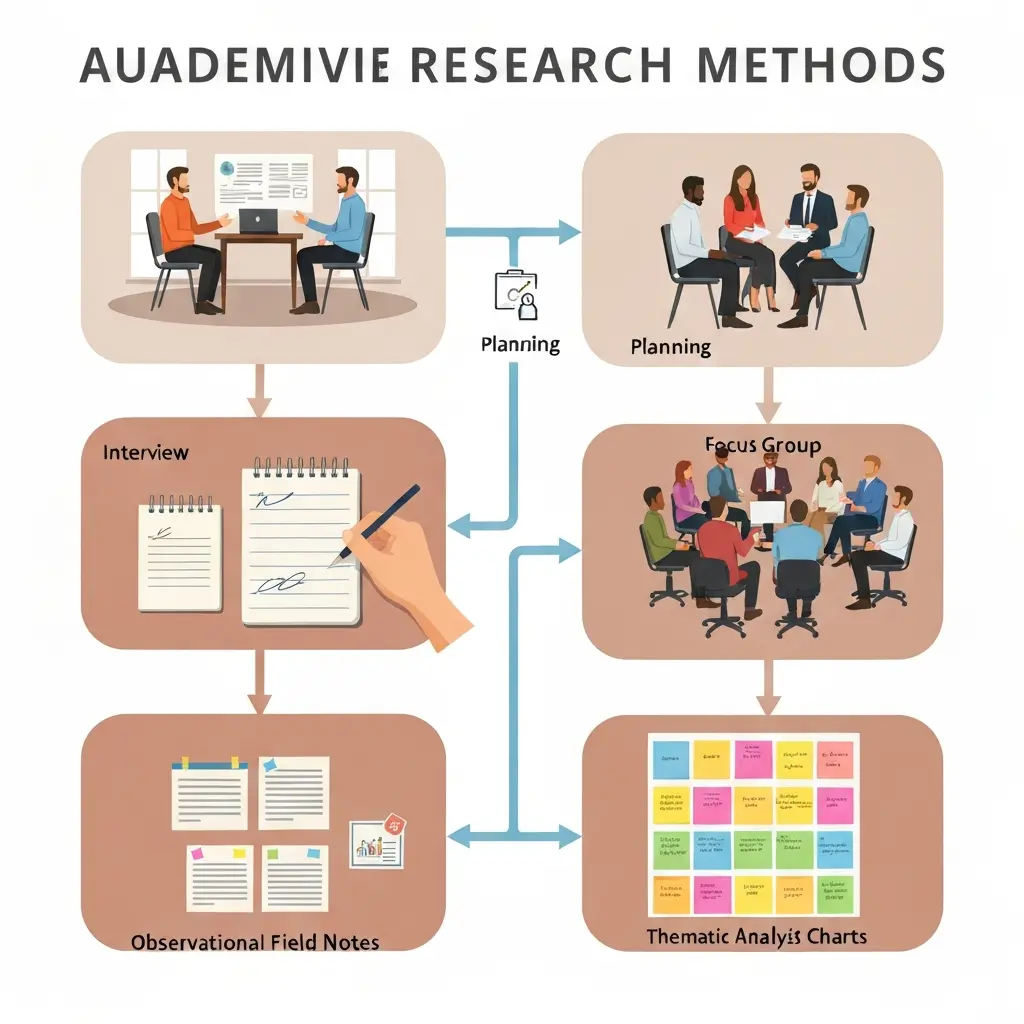
Qualitative Research Methods: The Essential Guide for Dissertation Students (2026)
Choosing qualitative research methods for your dissertation is a significant commitment — it shapes every decision from your research design through to your data analysis and discussion chapter. Unlike quantitative methods, where statistical validity is the primary yardstick, qualitative research requires you to defend your epistemological position, justify your sampling strategy, and demonstrate rigour through transparency rather than replicability.
This guide covers everything a dissertation student needs to know: the philosophical foundations underlying different qualitative approaches, the main data collection methods, the most used analysis frameworks, and how to write a methodology chapter that convinces an academic committee your approach is sound.
Philosophical Foundations: Paradigms and Epistemology
Before selecting a qualitative method, you need to position yourself within a research paradigm — the set of philosophical assumptions that guide how you think knowledge is constructed and how reality can be understood. This is not abstract navel-gazing; it directly determines your methodology choices and needs to be explicitly stated in your dissertation.
Interpretivism
The most common paradigm for qualitative dissertations. Interpretivism holds that social reality is constructed through human interpretation and that understanding comes from grasping the meanings people attach to their actions. This paradigm supports interview-based, ethnographic, and phenomenological research designs.
Constructivism
Often used interchangeably with interpretivism but technically distinct. Social constructivism (following Berger and Luckmann) emphasises that knowledge and meaning are constructed through social interaction — not simply interpreted by individuals. Grounded theory research typically operates within a constructivist framework.
Critical Theory
Research conducted within a critical paradigm is explicitly political — it seeks not just to understand social reality but to critique and change it. Critical discourse analysis and participatory action research are aligned with this paradigm.
Pragmatism
Pragmatism is the paradigm most associated with mixed methods research. It focuses on “what works” rather than ontological purity, selecting methods based on fit with the research question rather than philosophical consistency.
When to Use Qualitative Research Methods
Qualitative methods are appropriate when your research question:
- Asks “how” or “why” rather than “how many” or “how much”
- Explores phenomena that are not well understood and where theory is limited
- Seeks to understand participant perspectives, meanings, or lived experiences
- Requires contextual understanding that cannot be captured by numbers alone
- Examines social processes, cultural practices, or organisational dynamics
Compare this with quantitative methods (which test hypotheses, establish causal relationships, and measure variables at scale) and mixed methods (which combine both). For a detailed comparison of all three, see our mixed methods research guide.
The 6 Main Qualitative Research Approaches
1. Phenomenology
Phenomenological research explores the lived experience of participants — what it is like to experience a particular phenomenon (illness, loss, achievement, transition). Data is typically collected through in-depth interviews with a small number of participants (6-12). Analysis focuses on identifying the essential structures of the experience as described by participants.
Example research question: “What is the lived experience of mature students returning to higher education after a decade in the workforce?”
2. Grounded Theory
Grounded theory aims to generate new theoretical explanations of social processes through systematic data collection and analysis. Unlike most qualitative approaches (where you define your sample before collecting data), grounded theory uses theoretical sampling — you collect data until you reach theoretical saturation (when new data stops producing new theoretical insights). Strongly associated with Glaser, Strauss, and Corbin.
Example research question: “How do first-generation university students navigate the transition from school to undergraduate study?”
3. Ethnography
Ethnography involves sustained immersion in a social setting — typically through participant observation, informal conversations, and fieldnotes — to understand how members of a culture or community understand and organise their world. Dissertations using ethnography typically involve weeks or months in the field. It is time-intensive but produces the richest contextual data.
Example research question: “How do staff in a secondary school construct and negotiate professional identity in the context of academisation?”
4. Case Study Research
Case study research examines a bounded system (a person, organisation, programme, or event) in depth. It is not a method but a research design that typically combines multiple qualitative methods (interviews, document analysis, observation). Yin’s case study methodology is the most widely cited framework. See our detailed guide on case study research methodology.
5. Discourse Analysis
Discourse analysis examines how language constructs social reality — how texts (spoken, written, or visual) produce particular versions of people, events, and objects. Critical Discourse Analysis (CDA, associated with Fairclough) is widely used in education, media studies, and policy research.
6. Narrative Inquiry
Narrative inquiry treats stories as the primary unit of analysis. Participants’ personal accounts are collected (through interviews, written narratives, or life histories) and analysed to understand how people construct meaning from experience through story-telling. Clandinin and Connelly’s work is the foundational reference.
Qualitative Data Collection Methods Compared
| Method | Strengths | Limitations | Best For |
|---|---|---|---|
| Semi-structured interviews | Depth, flexibility, allows probing | Time-intensive; small samples | Exploring individual perspectives |
| Focus groups | Group dynamics; efficient for multiple participants | Dominant voices; social desirability | Shared experiences; community views |
| Participant observation | Naturalistic; rich contextual data | Observer effect; time commitment | Ethnographic studies; practice research |
| Document analysis | Non-reactive; historical depth | Access; document completeness | Policy analysis; institutional research |
| Online/digital methods | Access; asynchronous options | Verification; reduced nonverbal data | Geographically dispersed participants |
For a deep dive into interview methodology specifically, see our guide on designing and conducting academic interviews.
Sampling in Qualitative Research
Qualitative sampling is purposive — you select participants based on their relevance to your research question, not to achieve statistical representativeness. The key sampling strategies are:
- Purposive sampling: Select participants who have the knowledge or experience you need. Most common in qualitative dissertations.
- Snowball sampling: Initial participants refer you to others. Useful for hard-to-reach populations.
- Maximum variation sampling: Deliberately select participants who differ on key characteristics to capture a wide range of perspectives.
- Theoretical sampling: Used in grounded theory — sample is determined by emerging theory as analysis proceeds.
- Convenience sampling: Select whoever is accessible. Pragmatic but must be acknowledged as a limitation.
Sample size is not governed by statistical power calculations in qualitative research. Instead, the appropriate size is determined by reaching theoretical saturation (grounded theory) or by the richness of data needed to answer your research question (typically 8-25 participants for interview studies).
Qualitative Data Analysis Frameworks
Thematic Analysis (Braun & Clarke)
The most widely used analysis framework for qualitative dissertations. Thematic analysis identifies patterns of meaning (themes) across a dataset through a six-phase process: familiarisation, coding, theme generation, reviewing, defining, and writing up. Reflexive thematic analysis (Braun & Clarke’s 2019 revision) emphasises the researcher’s active role in theme construction. See our complete thematic analysis guide.
Framework Analysis
Developed for applied policy research, framework analysis is particularly useful for comparative research with a pre-defined topic guide. It uses a structured matrix approach to manage and analyse data across multiple cases.
Discourse Analysis
Analysis of how language constructs reality — examining not just what is said but how it is said and what social functions language serves. More time-intensive than thematic analysis; typically applied to text rather than interview data.
IPA (Interpretative Phenomenological Analysis)
IPA is specifically designed for phenomenological research. It examines in detail how participants make sense of their personal and social world, through close, ideographic analysis of each case before moving to cross-case patterns.
Establishing Rigour, Validity, and Trustworthiness
Qualitative research does not use the same validity and reliability concepts as quantitative research. Lincoln and Guba’s framework of trustworthiness is the standard alternative:
- Credibility: The qualitative equivalent of internal validity — are your findings an accurate reflection of participant reality? Established through member checking, prolonged engagement, and peer debriefing.
- Transferability: The qualitative equivalent of external validity — can your findings apply to other contexts? Established through thick description that allows readers to judge applicability themselves.
- Dependability: The qualitative equivalent of reliability — would the same study produce consistent findings? Established through audit trails documenting all research decisions.
- Confirmability: The qualitative equivalent of objectivity — are your findings shaped by data rather than researcher bias? Established through reflexivity statements and audit trails.
Writing Your Qualitative Methodology Chapter
Your methodology chapter should follow this structure and answer each question explicitly:
- Research philosophy: What paradigm do you operate within and why? (Interpretivism, constructivism, etc.)
- Research approach: What qualitative approach did you select? (Phenomenology, grounded theory, case study?) Why is it appropriate for your research question?
- Research design: What is the overall design? Single case? Multiple cases? Longitudinal?
- Data collection methods: What methods did you use? How did you develop your interview guide/observation protocol?
- Sampling: Who are your participants? How were they selected? What is the justification for your sample size?
- Data analysis: What analysis framework did you use? Walk the reader through your process step by step.
- Ethical considerations: How did you obtain informed consent? Protect confidentiality? Manage power dynamics?
- Reflexivity: How did your positionality influence the research? What steps did you take to manage this?
- Limitations: What are the acknowledged limitations of your methodology?
For a comprehensive research proposal template that structures these elements for a committee, see our research proposal template guide. You can also use Tesify‘s AI Editor to ensure your methodology chapter matches the academic tone and structure conventions your committee expects.
Frequently Asked Questions
What is the difference between qualitative and quantitative research methods?
Qualitative research collects non-numerical data (interviews, observations, texts) to explore how people understand and experience the world. Quantitative research collects numerical data to measure variables, test hypotheses, and establish causal relationships. Qualitative research asks “how” and “why”; quantitative research asks “how much” and “how many.” Both are valid scientific approaches, appropriate for different research questions and contexts.
How many participants do you need for qualitative research?
There is no universal rule for qualitative sample size. For in-depth interview studies, 8-25 participants is typical for a dissertation. Grounded theory studies continue until theoretical saturation is reached (often 20-30+ participants). Phenomenological studies typically use smaller samples (6-12) to allow deep analysis of each case. Sample size should be justified by the richness of data needed to answer your research question, not by statistical conventions.
What is the most common qualitative research method for dissertations?
Semi-structured interviews combined with thematic analysis is by far the most common qualitative research approach in social science and education dissertations. This combination is accessible, methodologically well-supported in the literature, and manageable within dissertation timeframes. Case study research is the second most common approach at the master’s and PhD level.
How do you ensure validity in qualitative research?
Qualitative research uses “trustworthiness” rather than validity. Credibility is established through member checking (sharing findings with participants for validation), peer debriefing, and prolonged engagement with your data. Dependability is established through detailed audit trails of research decisions. Confirmability is established through reflexivity statements that acknowledge researcher positionality and its potential influence on findings.
Can you use qualitative and quantitative methods in the same dissertation?
Yes — this is called mixed methods research. A common design uses qualitative methods to explore a phenomenon in depth (interviews) and quantitative methods to test whether findings hold at scale (survey). Mixed methods dissertations require a clear rationale for combining approaches, and pragmatism is typically the underlying paradigm. See our mixed methods research guide for a full framework.
Write Your Methodology Chapter with Academic Precision
Tesify helps you structure and write every chapter of your dissertation — including the methodology chapter — with academic tone calibration, citation support, and integrated plagiarism checking.





Leave a Reply