
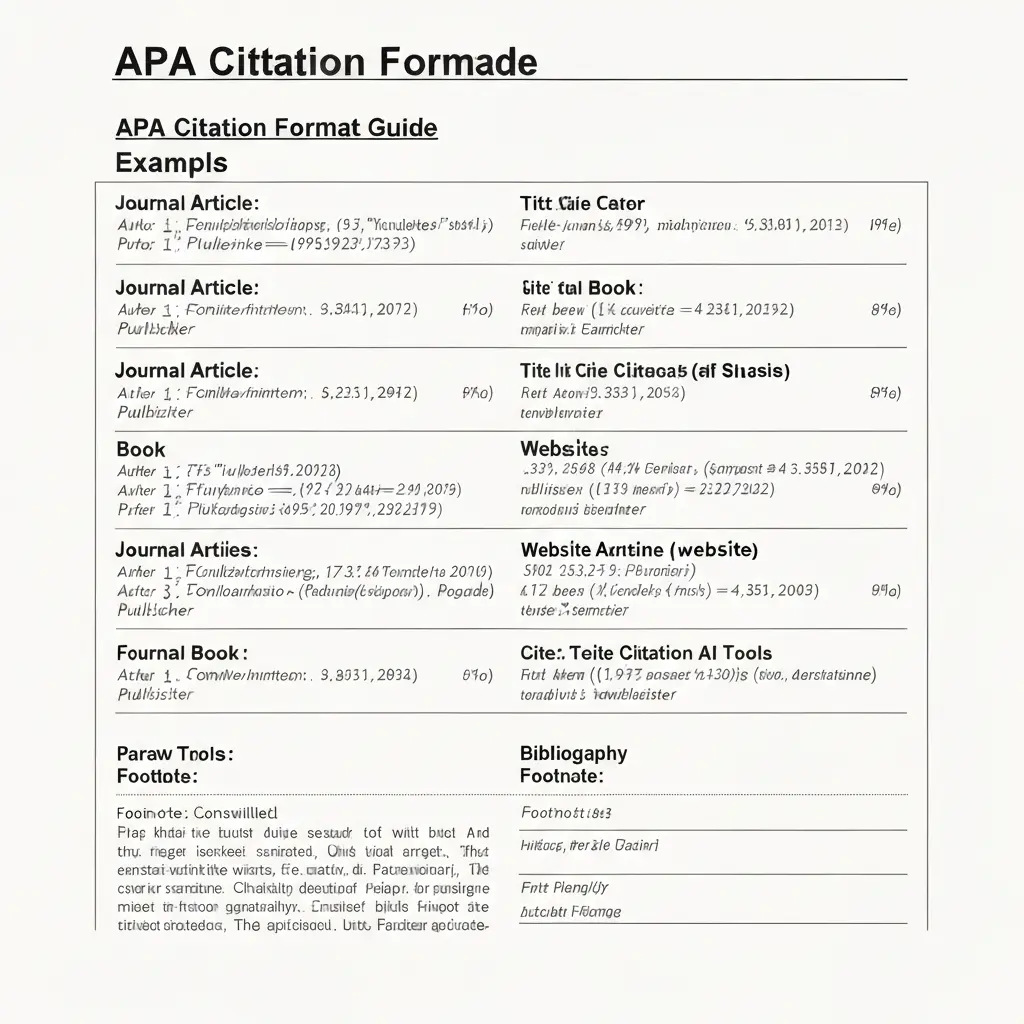
APA Citation Format: Every Rule You Need With Examples for Every Source Type (2026)
Mastering APA citation format is one of those academic skills that pays compound dividends — every paper, every seminar, every thesis becomes easier once you genuinely understand the system. But most guides either bury you in rules without context or gloss over the edge cases that actually trip students up: how do you cite a Twitter thread? A government dataset? An AI-generated image? A podcast episode?
This guide covers APA 7th edition — the current standard — comprehensively and practically, with a real example for every source type. It follows the authoritative rules from the APA Style website and Purdue OWL, two of the most referenced citation authorities in academia.
Understanding the APA Citation System
APA (American Psychological Association) format is based on an author-date citation system. Every in-text citation matches a full entry in the reference list at the end of your document. The relationship is one-to-one: every source you cite in-text must appear in the reference list; every reference list entry must be cited somewhere in the text.
The reference list serves four purposes:
- Allows readers to locate and verify your sources
- Credits the original authors of ideas and data you used
- Demonstrates the depth and quality of your research
- Allows your work to be reproduced or extended by other researchers
APA is used predominantly in psychology, social sciences, education, nursing, and many health sciences disciplines. If you’re unsure whether your field uses APA, check your course style guide or ask your supervisor. For Harvard referencing — the other widely used author-date system — see our Harvard referencing guide.
In-Text Citation Rules: Every Scenario
Basic Format
APA in-text citations include the author’s last name and the year of publication. For direct quotes, add the page number:
- Paraphrase: (Smith, 2023)
- Direct quote: (Smith, 2023, p. 45)
- Narrative citation: Smith (2023) argued that…
Multiple Authors
- One author: (Smith, 2023)
- Two authors: (Smith & Jones, 2023) — always use “&” inside parentheses; “and” in narrative
- Three or more authors: (Smith et al., 2023) — et al. from first citation
- Same author, same year: (Smith, 2023a) and (Smith, 2023b)
No Author
Use the first few words of the title in italics for works with no author: (Student Handbook, 2023)
No Date
Use “n.d.” (no date): (Smith, n.d.)
Multiple Citations in One Parenthesis
Order alphabetically by first author’s surname, separated by semicolons: (Brown, 2021; Smith, 2023; Williams, 2022)
Reference List: Formatting and Structure
The reference list follows these structural rules:
- Starts on a new page with the heading “References” (bold, centred)
- Double-spaced throughout (no extra lines between entries)
- Hanging indent: first line flush left, subsequent lines indented 0.5 inches
- Alphabetical order by first author’s last name
- All author last names first (Smith, A. B., not A. B. Smith)
- Use sentence case for article and chapter titles
- Use title case for journal names and book titles (italicised)
- Include DOI for all journal articles that have one (format: https://doi.org/xxxxx)
APA Citations by Source Type (With Examples)
Journal Article
Format: Author, A. A., & Author, B. B. (Year). Title of article. Journal Name, Volume(Issue), pages. DOI
Example:
Nguyen, T. L., & Patel, R. S. (2024). The effect of AI-assisted writing on essay quality in undergraduate students. Journal of Educational Technology, 41(3), 112–128. https://doi.org/10.1037/edu0000567
Book (Single Author)
Format: Author, A. A. (Year). Title of book: Subtitle in sentence case. Publisher.
Example:
Creswell, J. W. (2023). Research design: Qualitative, quantitative, and mixed methods approaches (6th ed.). SAGE.
Book Chapter (Edited Volume)
Format: Author, A. A. (Year). Title of chapter. In E. Editor & F. Editor (Eds.), Title of book (pp. xx–xx). Publisher. DOI
Example:
Morrison, K. (2024). Epistemological frameworks in qualitative research. In R. Denzin & Y. Lincoln (Eds.), Handbook of qualitative research (6th ed., pp. 78–102). SAGE.
Website
Format: Author, A. A. (Year, Month Day). Title of page. Site Name. URL
Example:
World Health Organization. (2025, January 15). Global student mental health report 2025. https://www.who.int/reports/student-mental-health-2025
Government Report
Format: Author, A. A. (Year). Title of report (Report No. xxx). Publishing Agency. DOI or URL
Example:
National Institute for Health Research. (2024). AI in higher education: Evidence review (Report No. NIHR-2024-022). NIHR. https://www.nihr.ac.uk/reports/ai-education-2024
Dissertation or Thesis
Format: Author, A. A. (Year). Title of dissertation [Doctoral dissertation/Master’s thesis, University Name]. Database. URL
Example:
Adebayo, F. C. (2024). Machine learning approaches to early detection of academic underperformance [Doctoral dissertation, University of Manchester]. ProQuest. https://proquest.com/dissertation/12345
Podcast Episode
Format: Host, A. A. (Host). (Year, Month Day). Title of episode (No. xx) [Audio podcast episode]. In Podcast Name. Production Company. URL
Example:
Rao, P. (Host). (2025, March 10). How AI is changing the PhD experience (No. 87) [Audio podcast episode]. In Research Unlocked. Spotify Podcasts. https://open.spotify.com/episode/abc123
Social Media Post (Twitter/X)
Format: Author, A. A. [@username]. (Year, Month Day). First 20 words of post [Type of post]. Platform. URL
Example:
Miyamoto, K. [@dr_miyamoto_phd]. (2025, February 3). New preprint out: AI hallucination rates in academic writing tasks — our key findings [Tweet]. Twitter/X. https://x.com/dr_miyamoto_phd/status/123456789
YouTube Video
Format: Author, A. A. [Channel name]. (Year, Month Day). Title of video [Video]. YouTube. URL
Example:
APA Style. [APA Style]. (2024, September 12). How to cite AI-generated content in APA 7th edition [Video]. YouTube. https://www.youtube.com/watch?v=example
AI-Generated Content (New in 7th Edition Update)
For content generated by AI tools (ChatGPT, Claude, etc.), APA guidance as of 2024 recommends treating AI as the author with the tool name, the version, and a description of the prompt. This is a contested and evolving area — check your institution’s current AI citation policy.
Format: OpenAI. (Year). ChatGPT (Version) [Large language model]. URL
Example:
OpenAI. (2025). ChatGPT (GPT-4o) [Large language model]. https://chat.openai.com
What Changed in APA 7th Edition
If you’ve used APA 6th edition before, the 7th edition introduced significant changes:
| Element | APA 6th | APA 7th |
|---|---|---|
| Three or more authors | First 6, then et al. | et al. from first citation |
| Publisher location | Required (City, State) | Removed |
| DOI format | doi: 10.xxxx | https://doi.org/10.xxxx |
| Running head | Required for all papers | Only for manuscripts for publication |
| Singular “they” | Not acknowledged | Endorsed as gender-neutral pronoun |
| Student paper format | Single format for all papers | Separate student paper format (simpler) |
12 Common APA Citation Mistakes and How to Fix Them
- Title case in article titles: Article and chapter titles use sentence case (only first word and proper nouns). “The Impact of Social Media on Student Wellbeing” should be “The impact of social media on student wellbeing.”
- Old DOI format: Still writing “doi: 10.1037/…” should be “https://doi.org/10.1037/…”
- Including publisher location: APA 7th removed this requirement. “New York, NY: Wiley” should be just “Wiley.”
- Not italicising journal names: The journal name and volume number are italicised. Issue number is not.
- Et al. threshold: In APA 7th, use et al. for 3+ authors from the very first citation.
- Missing ampersand: Inside parentheses, use “&”: (Smith & Jones, 2023). In narrative: “Smith and Jones (2023) found…”
- Alphabetical order: Reference list must be in strict alphabetical order by first author’s surname, then first initial for same-surname authors.
- No hanging indent: Every reference entry needs a hanging indent (first line flush, rest indented).
- Website “Retrieved from”: No longer required in APA 7th unless the content changes over time.
- Citing the textbook, not the primary source: Always try to cite the original study, not the textbook that mentioned it. Use “as cited in” only when the primary source is unavailable.
- Wrong edition rules: Still using APA 6th formatting (especially for authors and DOIs) is one of the most common errors in 2026.
- Missing “eds.” notation: Edited books need “(Ed.)” or “(Eds.)” after editor names in the reference list.
APA Citation Tools: Which to Trust in 2026
Several tools can help automate APA formatting, but they vary significantly in accuracy:
- Tesify (recommended): APA 7th edition specifically calibrated, integrated within the dissertation writing workflow, zero hallucination. See our automatic bibliography generator guide for full details.
- Zotero: Free and highly accurate; requires manual source entry for non-database sources.
- Purdue OWL: Not a tool but the most authoritative free APA reference guide — use it to verify edge cases.
- Citation Machine / EasyBib: Convenient but known for style version errors; always verify output against official guide.
- ChatGPT: Frequently halluculates citation details and applies incorrect rules — not recommended for citation generation.
For cross-language comparison of APA rules, see the guides at Tesify ES (Spanish APA guide) and Tesify PT (Portuguese APA guide).
Frequently Asked Questions
What is APA citation format used for?
APA citation format is used primarily in psychology, social sciences, education, nursing, and health sciences to document sources used in academic writing. It provides a standardised system for in-text citations and reference lists that allows readers to locate original sources and gives credit to original authors.
What is the difference between APA 6th and 7th edition?
The main changes in APA 7th edition (2019) include: removing publisher location from book references, changing the DOI format to a URL (https://doi.org/), using “et al.” for 3+ authors from the first citation (vs. first 6 authors in 6th edition), removing the running head requirement for student papers, and endorsing singular “they” as a gender-neutral pronoun. Many tools still apply 6th edition rules by default — confirm your tool uses 7th edition.
How do I cite a website with no author in APA?
When a website has no individual author, use the organisation name as the author. If there is no organisation name either, move the title of the page to the author position in your reference list, and use the first few words of the title in italics for your in-text citation: (Student Resources Guide, 2024).
Do I need a DOI for every journal article in APA?
Include the DOI for all journal articles that have one — APA 7th strongly recommends this. If an article was published online and has a DOI, you must include it regardless of whether you accessed the article in print or online. If an article has no DOI but is available online, include its URL. If the article has no DOI and you accessed it in print, no URL or DOI is needed.
How do I cite ChatGPT or other AI tools in APA?
APA guidance for citing AI-generated content (updated 2024) treats the AI company as the author. For ChatGPT: OpenAI. (2025). ChatGPT (GPT-4o version) [Large language model]. https://chat.openai.com. In-text: (OpenAI, 2025). Note that your institution may have specific guidance that differs — always check local policy as well as the APA Style website for the most current guidance.
What is the correct order for a reference list in APA?
APA reference lists are arranged alphabetically by the first author’s last name. When the same author appears multiple times, order by year of publication (oldest first). Same author, same year uses “a”, “b”, “c” suffixes. Works with no author are alphabetised by the first significant word of the title (ignoring articles like “A”, “An”, “The”).
Format Your APA Citations Automatically
Stop checking every comma and colon manually. Tesify generates APA 7th edition citations automatically from DOIs and ISBNs, builds your reference list as you write, and checks your dissertation for consistency before submission.



Leave a Reply