
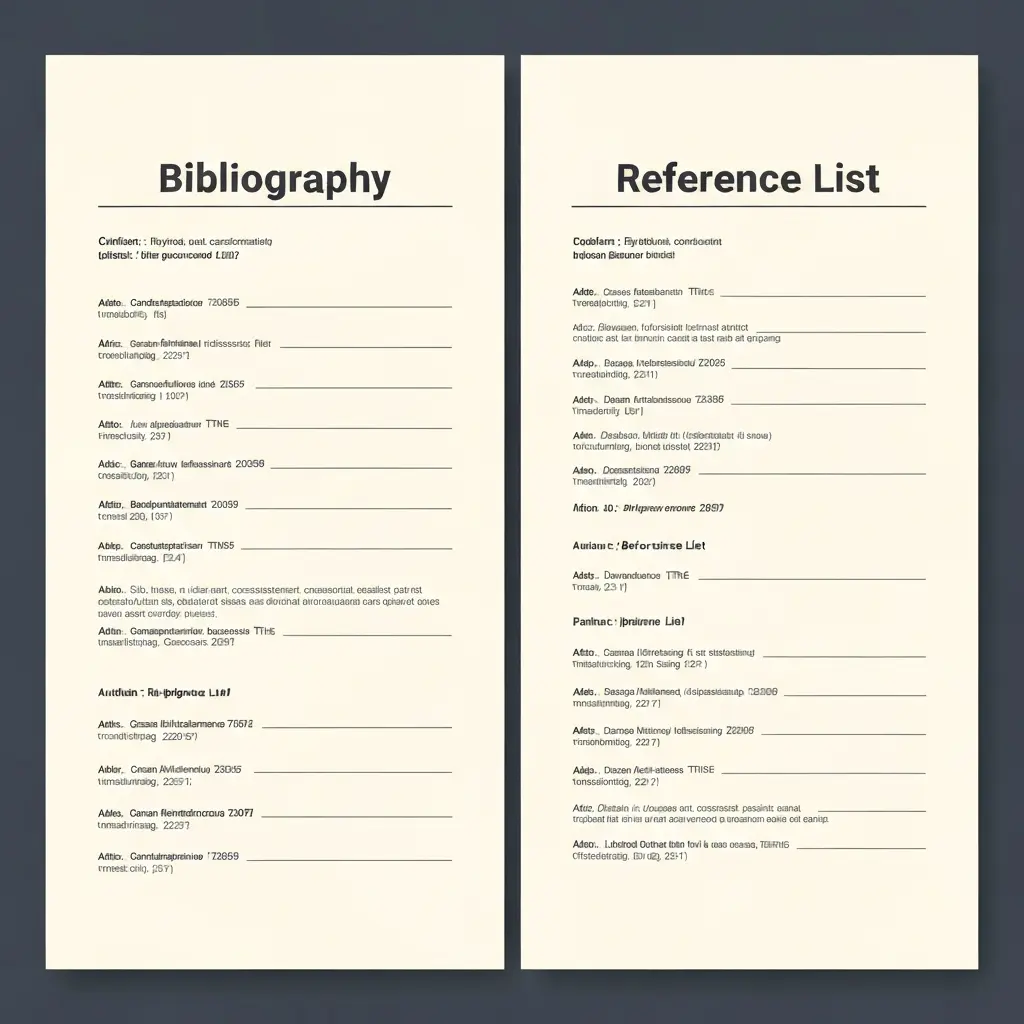
Bibliography vs References: What Is the Difference and When to Use Each
The terms “bibliography” and “reference list” are often used interchangeably by students — but they are not the same thing, and using the wrong term (or wrong format) in your dissertation or essay can cost you marks. The bibliography vs references distinction matters in academic writing because it determines what you include in your list, how it is structured, and which citation style you are following.
This guide explains the exact difference between a bibliography and a reference list, how different citation styles handle them, and how to format each correctly in 2026.
What Is a Reference List?
A reference list is a compilation of all and only the sources you have cited in your text. Every in-text citation must appear in the reference list, and every entry in the reference list must correspond to an in-text citation. The relationship is one-to-one: nothing in the text without a reference list entry; nothing in the reference list without an in-text citation.
Reference lists are associated with author-date citation systems: APA (7th edition), Harvard referencing, and Vancouver. In these systems, you cite sources in the text by author name and year (e.g., Smith, 2024) and the reader can locate the full publication details in the alphabetically ordered reference list at the end of your work.
What Is a Bibliography?
A bibliography includes all sources you read, consulted, or used in preparing your work — whether or not you cited them in the text. It is a broader record of your intellectual engagement with the literature. A bibliography demonstrates the breadth of your research beyond just the works you directly cited.
Bibliographies are associated with footnote citation systems: Chicago Notes and Bibliography style, OSCOLA (Oxford legal citation), and Oxford referencing. In these systems, you cite sources in numbered footnotes or endnotes, and the bibliography at the end collects all sources consulted.
Key Differences at a Glance
| Feature | Reference List | Bibliography |
|---|---|---|
| What it includes | Only cited sources | All consulted sources |
| Associated styles | APA, Harvard, Vancouver | Chicago N&B, Oxford, OSCOLA |
| In-text citations | Author-date (Smith, 2024) | Footnotes or endnotes |
| Ordering | Alphabetical by author | Alphabetical by author |
| Uncited sources | Not included | Included |
Which Styles Use Which?
| Citation Style | End List | In-Text Method |
|---|---|---|
| APA 7th edition | Reference list | Author-date |
| Harvard | Reference list | Author-date |
| Vancouver | Reference list (numbered) | Numbered superscript |
| MLA | Works Cited (= reference list) | Author-page |
| Chicago N&B | Bibliography | Footnotes |
| Chicago Author-Date | Reference list | Author-date |
| OSCOLA (Law) | Bibliography | Footnotes |
Our detailed guides to APA 7th edition, Harvard referencing, MLA format, and Chicago citation style explain how to format entries in each style.
Formatting Rules
Reference list formatting rules (common to APA, Harvard):
- Alphabetical order by first author’s last name
- Hanging indent (first line flush left, subsequent lines indented)
- Double-spaced (APA); single or double (Harvard, check your institution’s guidelines)
- No numbering
- All co-authors listed (up to a certain number depending on style)
Bibliography formatting rules (Chicago Notes and Bibliography):
- Alphabetical by first author’s last name
- Hanging indent
- Single-spaced entries; double space between entries
- Format differs from footnotes: author last name first, slightly different punctuation
- May be divided into sections (Primary Sources, Secondary Sources)
Common Mistakes
- Calling a reference list a bibliography: The terms are not interchangeable. Use the correct term for your citation style.
- Including uncited sources in a reference list: A reference list should contain only cited sources. If you want to include uncited background reading, add a separate “Further Reading” section.
- Missing entries: Every in-text citation must have a reference list/bibliography entry. Cross-check methodically.
- Inconsistent formatting: Mixing formatting conventions from different citation styles within a single list.
- Incorrect ordering: Multiple works by the same author should be ordered by year (oldest first), not alphabetically by title.
Tools for Managing References and Bibliographies
Reference management software makes creating and formatting reference lists and bibliographies dramatically easier:
- Zotero (free): Automatically captures citation data from websites and databases, generates formatted reference lists in any style, and integrates with Word and Google Docs.
- Mendeley (free): Similar to Zotero with PDF annotation features. Owned by Elsevier.
- EndNote: The most powerful reference manager, with full institutional licensing at most UK universities. Best for PhD students managing large libraries.
- Tesify: While not a reference manager, Tesify‘s academic writing assistant helps you check that your bibliography or reference list is correctly formatted and consistent with your citation style. It can also help you integrate sources effectively into your academic prose.
Frequently Asked Questions
Can I include sources in my reference list that I did not cite in the text?
No — a reference list should contain only sources you cited in the text. Including uncited sources in a reference list is incorrect formatting for APA, Harvard, and other reference list styles. If you want to acknowledge background reading you did not directly cite, add a separate “Further Reading” section after your reference list. Examiners may specifically check that every reference list entry corresponds to an in-text citation.
Does Harvard use a bibliography or a reference list?
Harvard referencing uses a reference list — not a bibliography — because it is an author-date system where every in-text citation corresponds to a reference list entry. However, “Harvard” is not a single standardised style — different institutions have different Harvard conventions. Some university guides call it a “bibliography” regardless; what matters is that it contains only cited sources in the author-date format. Always check your specific institution’s Harvard guide.
What is the difference between a bibliography and a works cited page?
A “Works Cited” page is the MLA term for a reference list — it contains only sources cited in the text. A bibliography (in the Chicago Notes and Bibliography sense) contains all sources consulted, including uncited background reading. The terminology differs by citation style: APA and Harvard call it a “reference list”, MLA calls it “Works Cited”, and Chicago N&B and Oxford styles call it a “bibliography”.
Should a bibliography be in alphabetical order?
Yes — both bibliographies and reference lists are ordered alphabetically by the first author’s last name in almost all citation styles. When there are multiple works by the same author, list them chronologically (earliest first). When an author has both single-author and co-authored works, list single-author works first. If a source has no author, alphabetise by the first significant word of the title.
Does a dissertation need a bibliography or a reference list?
It depends on the citation style required by your university or department. Most social science, psychology, and education dissertations use APA or Harvard — both require a reference list. Most law dissertations use OSCOLA — which requires a bibliography. History and humanities dissertations often use Chicago N&B — which also requires a bibliography. Check your dissertation handbook or ask your supervisor to confirm which is required.
Get Your Citations Right with Tesify
Citation errors in dissertations are avoidable. Tesify helps you check the consistency and accuracy of your reference list or bibliography, ensuring every entry matches the in-text citations in your work and is formatted correctly according to your required style.




Leave a Reply