
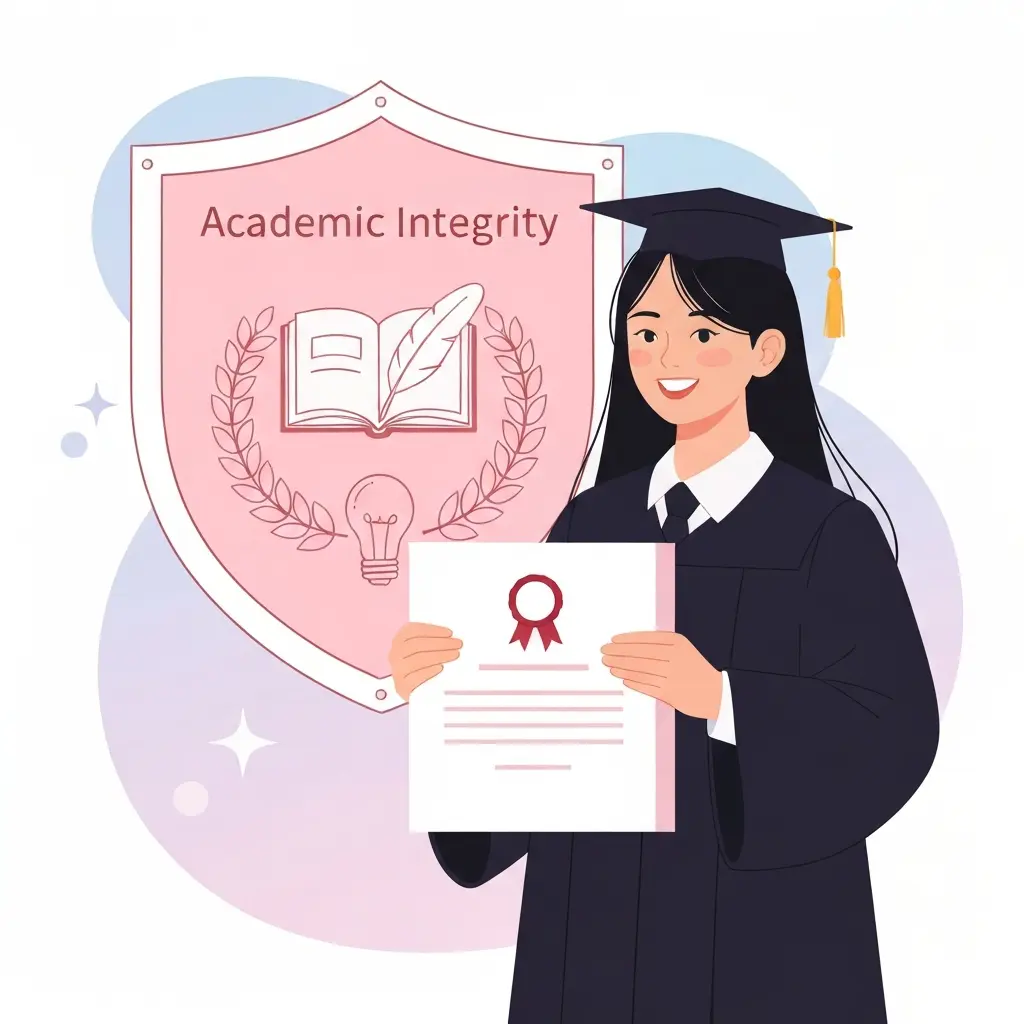
What Is Academic Integrity and Why Does It Matter? (2026 Guide)
Understanding what academic integrity means is fundamental for every student writing a thesis, dissertation, or research project in 2026. Academic integrity is not simply about avoiding plagiarism — it is a comprehensive ethical framework that governs how research is conducted, how sources are acknowledged, how data is collected and reported, and how intellectual work is presented as your own. In an era of increasingly powerful AI writing tools, the principles of academic integrity have never been more important — or more complex — to navigate.
This guide provides a clear, authoritative explanation of academic integrity: what it means, what it requires, how universities enforce it, and how to ensure your thesis meets the highest standards of scholarly ethics.
Defining Academic Integrity
Academic integrity refers to the commitment to honesty, trust, fairness, respect, responsibility, and courage in all academic activities. It underpins the credibility of scholarly knowledge: if researchers fabricate data, plagiarise ideas, or misrepresent their work, the entire edifice of knowledge built on those findings becomes unreliable.
The International Center for Academic Integrity (ICAI), which has studied academic integrity at universities worldwide since 1992, defines it as “a commitment, even in the face of adversity, to six fundamental values: honesty, trust, fairness, respect, responsibility, and courage.”
For thesis writers specifically, academic integrity means:
- Every idea borrowed from another source is cited
- Every quotation is attributed and properly formatted
- Data is collected, reported, and analysed honestly
- Paraphrasing is genuine restatement, not superficial word replacement
- AI tools (if used) are disclosed and used within institutional guidelines
- The work submitted is substantively your own original contribution
The Six Core Principles (ICAI Framework)
The International Center for Academic Integrity identifies six foundational values of academic integrity:
- Honesty: Representing your work, your sources, and your data truthfully
- Trust: Creating an environment where students and researchers can depend on each other’s work being reliable
- Fairness: Ensuring all students are evaluated on the same standards — violations give unfair advantage
- Respect: Acknowledging and valuing others’ intellectual contributions through proper citation
- Responsibility: Taking ownership of your own learning and the standards of your field
- Courage: Reporting violations when you encounter them, and resisting social pressure to cut corners
Types of Academic Integrity Violations
| Violation Type | Definition | Examples |
|---|---|---|
| Plagiarism | Presenting another’s words or ideas as your own | Copying text without citation; submitting someone else’s work |
| Self-plagiarism | Reusing your own previously submitted work without disclosure | Submitting the same essay for two different modules |
| Fabrication | Inventing data, results, or sources | Making up interview responses; falsifying experimental results |
| Falsification | Manipulating or altering real data | Selectively omitting data points; altering images |
| Collusion | Unauthorised collaboration | Having someone else write parts of your thesis |
| Contract cheating | Purchasing or commissioning work | Using essay mills or paid writing services |
| Undisclosed AI use | Using AI without institutional disclosure | Submitting AI-generated text without acknowledgement |
Academic Integrity and AI Writing Tools in 2026
The rapid adoption of AI writing tools has created a genuinely new challenge for academic integrity frameworks. In 2026, most major universities have now developed explicit policies on AI use in student work, though these vary significantly.
Some general principles that have emerged across UK and US institutions:
- AI tools used for grammar checking and editing are generally permitted without disclosure
- AI tools used to generate substantive text (arguments, analysis, literature review) require explicit disclosure and may be restricted or prohibited depending on the assignment
- The intellectual argument, original analysis, and conclusions in your thesis must be genuinely your own
- If you use AI, you are responsible for the accuracy of any AI-generated content, including citations (AI tools can generate false references)
Tools designed specifically for academic writing, like Tesify, are built with academic integrity in mind — helping students improve their writing quality while maintaining the originality and accuracy required for assessed work. Unlike general-purpose AI tools, Tesify’s plagiarism checker verifies your work against academic databases before you submit.
AI is reshaping writing practices across many sectors simultaneously — from academic research to professional content creation. The key in both contexts is using AI as a tool that enhances human creativity rather than replacing it.
Consequences of Academic Integrity Violations
Consequences for academic integrity violations vary by institution and severity, but can be severe:
- Minor violations: Grade reduction, required resubmission, formal warning
- Moderate violations: Module failure, academic probation, suspension
- Serious violations: Degree revocation, permanent academic record notation, professional disqualification
Research fabrication and falsification are particularly serious — cases in medical and scientific research have led to major paper retractions, legal proceedings, and the end of academic careers. In 2023, several high-profile cases involving AI-generated citations that were submitted as genuine scholarly references resulted in disciplinary action at multiple UK universities.
How Universities Enforce Academic Integrity
Universities use several tools and processes to identify and investigate violations:
- Turnitin and iThenticate: Text similarity detection software that compares submitted work against databases of published and student work
- AI detection tools: Increasingly used alongside plagiarism checkers, though still imperfect (accuracy rates vary)
- Oral examinations (viva voce): For theses, the viva examination allows examiners to verify that the student understands and can discuss their own work
- Academic integrity panels: Formal investigation panels with powers to recommend penalties
How to Uphold Academic Integrity in Your Thesis
Practical steps to ensure your thesis meets academic integrity standards:
- Cite everything: Every idea, data point, or argument drawn from another source must be cited, whether quoted directly or paraphrased
- Use reference management software: Zotero, Mendeley, or Tesify’s Auto Bibliography feature to ensure accurate, complete citations
- Run a plagiarism check before submission: Use Tesify Plagiarism Checker or Turnitin to identify any unintentional similarities
- Disclose AI use: Follow your institution’s disclosure policy if you use AI tools at any stage of writing
- Keep research records: Document your data collection, interview notes, and analysis decisions as protection against allegations of fabrication
- Paraphrase genuinely: Do not simply replace words with synonyms — genuinely restate ideas in your own voice, then cite the source
Frequently Asked Questions
What is the difference between academic integrity and academic honesty?
Academic honesty is a component of academic integrity — it specifically refers to truthfulness in representing your work and sources. Academic integrity is a broader ethical framework that encompasses honesty, but also includes trust, fairness, respect, responsibility, and courage. Academic integrity governs the entire culture of scholarly research, not just individual acts of citation or data reporting.
Is accidental plagiarism still a violation?
Yes. Most universities treat plagiarism as a strict liability issue — the intent to plagiarise is not required for it to constitute a violation. Accidental plagiarism (e.g., forgetting to cite a source, or poor paraphrasing that too closely mirrors the original) is still treated as a violation, though penalties are typically less severe than for deliberate plagiarism. This is why checking your work with plagiarism detection software before submission is essential.
Does using AI count as plagiarism?
Using AI without disclosure may be treated as a form of academic dishonesty rather than traditional plagiarism. Most universities’ 2025–2026 policies treat undisclosed or prohibited AI use as a contract cheating violation rather than plagiarism per se. The specific classification and consequences depend on your institution’s policy. Always check your university’s current AI use guidelines before using any AI tool for assessed work.
What plagiarism percentage is acceptable in a thesis?
There is no universal “acceptable” percentage. Turnitin similarity scores are a starting point for investigation, not a verdict — a 15% similarity score may be entirely legitimate (properly quoted and cited sources) or problematic (uncited copied text). Most universities do not set a specific threshold; instead, they evaluate the nature of any similarities. A 5% similarity score could still be plagiarism if those matches are uncited; a 25% score may be acceptable if all matches are properly referenced quotations.
Can I use previously published work in my thesis?
If you have published papers during your PhD, many universities allow you to include them in a thesis by publication format — but this must be disclosed, and the papers must typically be substantially your own work. If you simply incorporate a previously submitted essay or report into your thesis without disclosure, this constitutes self-plagiarism. Always get explicit permission from your supervisor and follow your institution’s regulations on this.
How do I properly paraphrase to avoid plagiarism?
Genuine paraphrasing involves reading the source material, setting it aside, and restating the idea in your own words, then citing the source. It is not sufficient to simply replace words with synonyms while keeping the same sentence structure — this is superficial paraphrasing and still constitutes plagiarism. A good paraphrase changes the structure of the sentence, uses your own vocabulary, and captures the meaning of the original while making it part of your own argument.
Write with Integrity — Tesify Checks for Plagiarism
Tesify’s Plagiarism Checker scans your thesis against millions of academic publications, web pages, and student submissions before you submit. Identify any unintentional similarities and fix them with confidence — so you never have to worry about accidental integrity violations.
Check your thesis with Tesify — free plagiarism scan available




Leave a Reply