
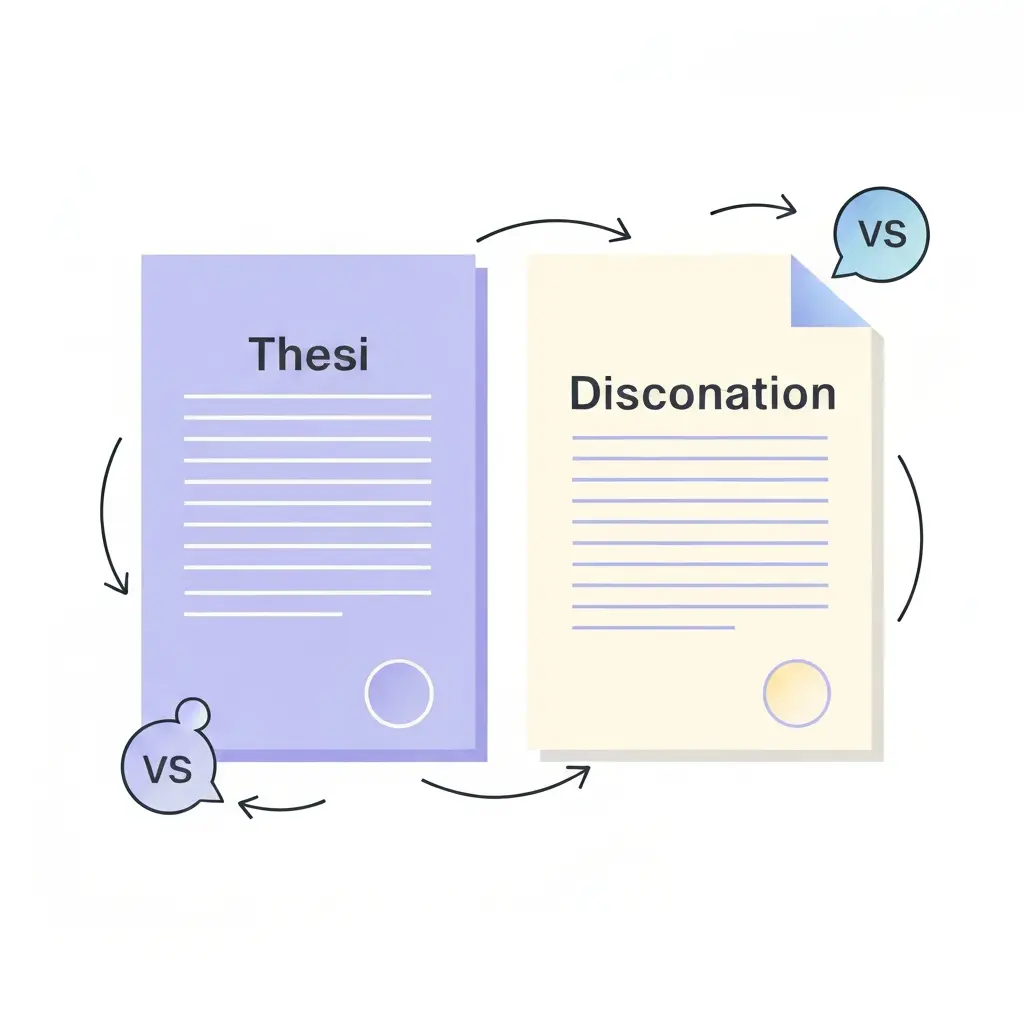
Thesis vs Dissertation: What Is the Difference in 2026?
Ask ten academics to define the difference between a thesis and a dissertation and you will get at least three different answers. The confusion is understandable: the terms are used interchangeably in some countries, distinctly in others, and the conventions have shifted over time. If you are about to start a major piece of research — or helping someone who is — clarity on this distinction is both practically and academically useful.
This guide resolves the thesis vs dissertation difference definitively, accounting for the genuine variation between the UK, US, Australian, and European conventions in 2026.
UK Convention: Dissertation vs Thesis
In the United Kingdom, the terminology follows degree level:
- Dissertation: The extended research project submitted at undergraduate level (typically 8,000–15,000 words) or postgraduate master’s level (typically 12,000–20,000 words). It demonstrates the ability to conduct independent research within an existing knowledge framework. Original data collection is often included but not always required.
- Thesis: The document submitted for a doctoral degree (PhD, DPhil, EdD). Typically 70,000–100,000 words. It must make an original contribution to knowledge — this is the distinguishing requirement. A thesis that merely synthesises existing knowledge, without adding something new, does not meet doctoral standard.
UK universities (Oxford, Cambridge, UCL, Imperial, Edinburgh) use this distinction consistently. Oxford refers to its DPhil document as a thesis. Cambridge’s PhD document is also a thesis. Both require original contribution to knowledge and examination by a viva voce (oral examination) with two examiners.
US Convention: Thesis vs Dissertation
In the United States, the terminology is reversed:
- Thesis: Submitted for a master’s degree. Length is typically 40–80 pages (15,000–30,000 words). May or may not involve original research — some US master’s programmes allow a comprehensive exam in place of a thesis.
- Dissertation: Submitted for a PhD or EdD. Typically 150–300 pages (50,000–100,000 words). Must present original research and make a contribution to the field. Examined by a doctoral committee (typically 3–5 faculty members) and defended in an oral examination.
Harvard, MIT, Stanford, and other leading US institutions use this terminology consistently, which is why the confusion arises — students and researchers crossing between UK and US institutions encounter the same words meaning different things.
Side-by-Side Comparison
| Feature | UK Dissertation (UG/Master’s) | UK Thesis (PhD) | US Thesis (Master’s) | US Dissertation (PhD) |
|---|---|---|---|---|
| Degree level | UG or Master’s | Doctorate | Master’s | Doctorate |
| Length | 8,000–20,000 words | 70,000–100,000 words | 15,000–30,000 words | 50,000–100,000 words |
| Original contribution | Desirable, not required | Required | Sometimes required | Required |
| Examination | Marked by supervisor/internal | Viva voce (2 examiners) | Committee review | Oral defence (committee) |
| Duration | 1 semester–1 year | 3–5 years | 1–2 years | 4–7 years |
Key Differences That Actually Matter
Beyond terminology, there is one difference that is substantive and universal regardless of country:
Original contribution to knowledge. Every doctoral-level document — whether called a thesis (UK) or a dissertation (US) — must make an original contribution to knowledge. This is the defining requirement of doctoral research worldwide. The contribution need not be enormous — it might be applying an existing theory to a new population, testing a hypothesis in a new context, or developing a new methodological approach. But something that was not known before must be demonstrated by your work.
Master’s and undergraduate documents, by contrast, are judged primarily on how well the candidate demonstrates understanding of the field and ability to conduct research — not on whether the findings are novel.
For full guidance on writing at doctoral level, see our complete thesis writing guide. For master’s-level dissertation structure, see our thesis structure guide.
For German-language resources on the Dissertation vs. Masterarbeit distinction, visit Tesify.io. French-language equivalents can be found at Tesify.fr (mémoire vs thèse de doctorat).
Frequently Asked Questions
Is a thesis harder than a dissertation?
Using UK terminology: yes. A PhD thesis is significantly more demanding than a master’s dissertation — it is 3–5 times longer, requires original contribution to knowledge, and is examined by external academics in a viva voce. Using US terminology, a PhD dissertation is more demanding than a master’s thesis for the same reasons. In both systems, the doctoral-level document is the more rigorous and demanding of the two.
Can I call my master’s work a thesis in the UK?
Informally, yes — many students and supervisors use the terms interchangeably. Formally, UK convention reserves “thesis” for doctoral work. When submitting to your institution, use the terminology specified in your programme handbook. When discussing your work internationally (e.g., on a CV or academic application), it is helpful to specify: “master’s dissertation” or “master’s thesis” to avoid confusion.
Do both thesis and dissertation require a literature review?
Yes. Both dissertations and theses at all levels require a critical engagement with existing literature. The depth and breadth differ: an undergraduate dissertation might synthesise 20–30 sources; a PhD thesis may require 100–300+. In humanities disciplines, the literature review may be integrated into thematic chapters rather than presented as a standalone section, but the critical engagement with prior scholarship is always required.
What happens if you fail a thesis or dissertation?
Outright failure (no award, no resubmission) is rare. More commonly, examiners request minor corrections (typically 3 months to revise), major corrections (6–12 months), or resubmission as a lower qualification (e.g., MPhil instead of PhD). For master’s dissertations, failure is more common and typically results in an opportunity to resubmit a revised version within a defined timeframe. Always address examiner feedback in full — partial revisions are rarely accepted.





Leave a Reply