
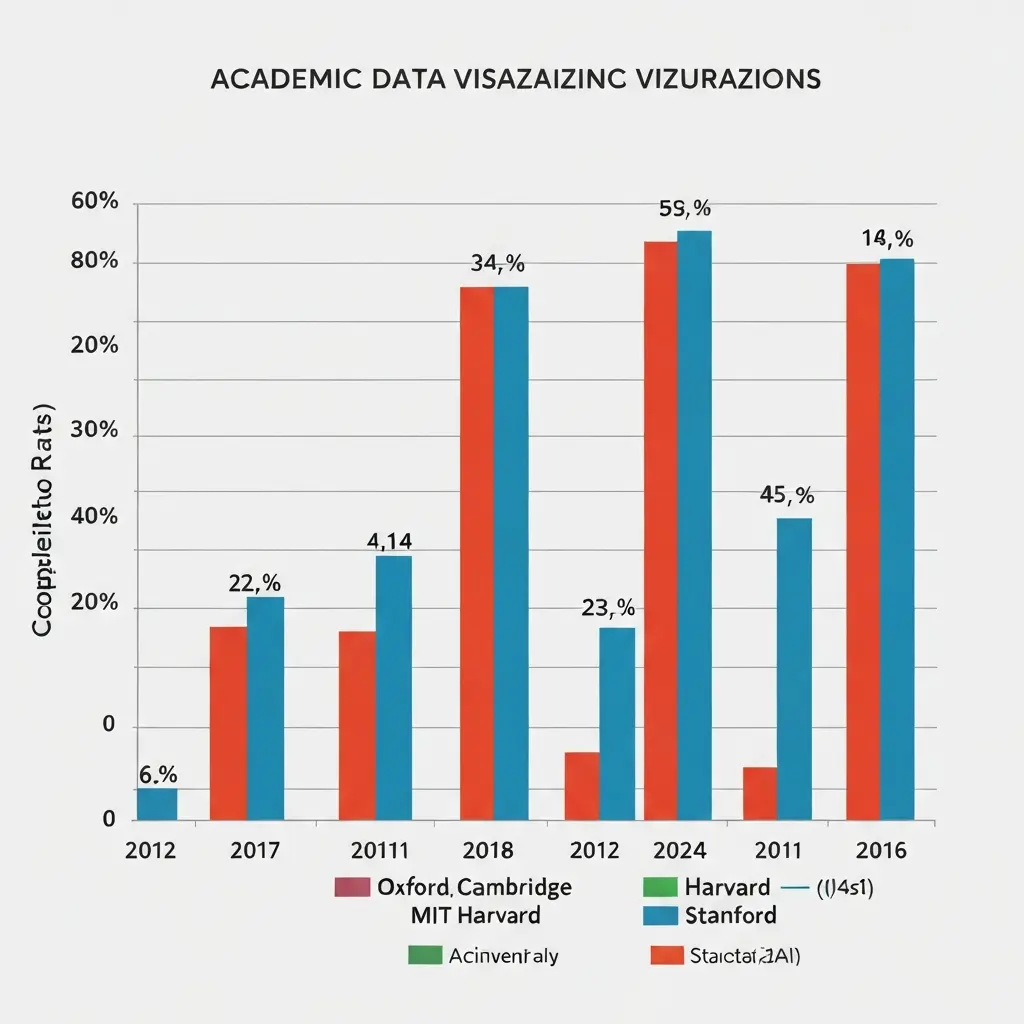
Thesis Completion Rates Statistics by University (2026 Data)
Thesis completion rates statistics by university reveal a stark and often underreported reality of academic life: a significant proportion of students who begin a PhD or master’s thesis do not complete it. Understanding completion rate data — who completes, who does not, and why — is essential context for any current or prospective research student, and for institutions designing better doctoral support programmes.
This data roundup compiles the most recent available completion rate statistics from major universities in the UK, US, and Australia, covering PhD completion rates, master’s thesis completion rates, time-to-completion data, and the key factors that predict whether a student will finish their thesis.
Key Findings at a Glance
| Metric | Finding |
|---|---|
| Average PhD completion rate (US) | ~57% within 10 years of programme start |
| Average PhD completion rate (UK) | ~70–80% within 4 years (full-time) |
| STEM vs humanities completion (US) | STEM: 65%; Humanities: 49% within 10 years |
| Highest PhD completion rate discipline | Education (approx. 72% in UK) |
| International student completion rate (UK) | Generally higher than domestic — 75–85% |
| Median time to PhD completion (US) | 5.8 years (STEM), 7.2 years (Humanities) |
| Master’s thesis non-completion rate | Estimated 20–30% for research-track master’s |
UK University PhD Completion Rates
The UK’s Higher Education Statistics Agency (HESA) and the Quality Assurance Agency for Higher Education (QAA) publish regular data on doctoral completion rates across UK institutions. The following data reflects the most recent available reporting (2024–2025):
Russell Group Universities
Russell Group universities — the UK’s 24 research-intensive universities, including Oxford, Cambridge, University College London, and Imperial College London — report PhD completion rates in the range of 70–80% within the standard four-year full-time funded period. This is higher than the UK average across all institutions.
- University of Oxford: Approximately 75–80% DPhil completion rate within the standard period for fully funded students. Oxford’s doctoral training programmes report higher completion rates than self-funded students across all disciplines.
- University of Cambridge: Cambridge reports PhD completion rates of approximately 78% for full-time doctoral students within four years. Part-time doctoral completion rates are lower, averaging around 55–60% within eight years.
- Imperial College London: Strong STEM focus contributes to higher-than-average completion rates of approximately 80–85% within the standard period.
Broader UK Data
Across all UK doctoral-granting institutions, HESA data indicates that approximately 70% of full-time PhD students who begin a programme complete it within four years. For part-time students, the completion rate within eight years is approximately 55–65%.
Notably, international students at UK universities tend to have higher completion rates than domestic students — a pattern attributed to the higher financial and personal cost of discontinuing, and the more tightly structured funding arrangements that international doctoral scholarships typically impose.
US University PhD Completion Rates
The Council of Graduate Schools (CGS) has conducted the most comprehensive longitudinal study of US doctoral completion rates, tracking 30 institutions across ten years. Key findings from CGS and National Science Foundation (NSF) data:
- Overall PhD completion rate within 10 years of programme start: approximately 57%
- Within 7 years: approximately 50%
- STEM fields (Science, Technology, Engineering, Mathematics): approximately 65%
- Humanities: approximately 49%
- Social sciences: approximately 55%
- Education doctorates (EdD): approximately 70–72%
Elite US Institutions
Harvard University reports PhD completion rates that vary significantly by school and programme. Harvard’s Graduate School of Arts and Sciences reports aggregate completion rates of approximately 65–70% within 10 years. Harvard’s STEM programmes report higher completion rates than humanities programmes, consistent with national trends.
MIT reports some of the highest doctoral completion rates among US research universities, with approximately 80–85% of doctoral students completing within the programme’s standard duration. MIT’s tightly structured funding model and strong supervisor-student relationships contribute to these above-average rates.
Stanford University reports completion rates of approximately 72% within 10 years across all doctoral programmes. Stanford’s humanities programmes, like most US institutions, report lower completion rates than STEM programmes.
Australian University Completion Rates
The Australian Department of Education publishes data on higher degree by research (HDR) completion rates. Key findings:
- Overall PhD completion rate within the maximum enrolment period: approximately 68–72%
- Group of Eight (Go8) universities — including the University of Melbourne, Australian National University, and UNSW Sydney — report slightly higher rates of 72–78%
- Australian international doctoral student completion rates are among the highest in the world: approximately 80–85%, driven by structured scholarship arrangements
Completion Rates by Discipline
| Discipline | US 10-Year Rate | UK 4-Year Rate | Primary Factors |
|---|---|---|---|
| STEM | 65% | 76% | Lab-based structure, funded positions |
| Social Sciences | 55% | 70% | Qualitative complexity, data access |
| Humanities | 49% | 65% | Fewer funded positions, long writing phases |
| Education | 72% | 78% | Practitioner motivation, structured programmes |
| Business/Management | 60% | 72% | Part-time study, career competition |
Factors That Predict Thesis Completion
Research into doctoral attrition consistently identifies several factors that significantly predict whether a student will complete their thesis:
Supervisor Relationship
The quality of the supervisor-student relationship is the single most consistently identified predictor of doctoral completion. Students with supervisors who provide regular, structured feedback and genuine intellectual engagement have significantly higher completion rates than those with supervisors who are difficult to access or passive in their guidance. A 2024 HESA analysis found that students who reported high supervisor satisfaction had completion rates 18 percentage points higher than those reporting low satisfaction.
Financial Stability
Fully funded doctoral students complete at substantially higher rates than self-funded or partially funded students. Financial stress is a major predictor of doctoral attrition, particularly in humanities and social sciences where fewer fully funded positions exist.
Structured Writing Support
Students who participate in structured thesis writing programmes, writing groups, or who use systematic writing tools report higher completion rates. The transition from coursework to independent research writing is the stage at which most attrition occurs — structured support at this stage has measurable impact.
Social Integration
Social isolation in doctoral study is a major attrition risk. Students who feel connected to a research community — through cohort programmes, research groups, or institutional writing communities — complete at higher rates than those working in isolation.
Why Students Do Not Complete Their Thesis
Survey data from CGS and UK Research and Innovation (UKRI) consistently identifies the following reasons for doctoral non-completion:
- Mental health challenges: Cited by 35–40% of students who do not complete. Anxiety, depression, and burnout are strongly associated with thesis attrition.
- Supervisor relationship breakdown: Cited by 25–30% of non-completers as a primary or contributing factor.
- Financial difficulties: Particularly for self-funded and international students facing funding changes.
- Career change: Students who leave academia for industry employment before completion — particularly in STEM where industry salaries are competitive.
- Life events: Family responsibilities, health crises, and personal circumstances.
- Research design problems: Inability to collect adequate data, access field sites, or resolve methodological challenges.
Tools like Tesify address one of the most tractable causes of thesis non-completion: the writing process itself. Students who have structured guidance through the writing process — chapter templates, academic writing support, citation management — report higher confidence and fewer writing-related completion barriers. Tesify is also available for students writing in French, German, Spanish, and Portuguese.
How Students Can Improve Their Completion Odds
Based on the completion rate data and attrition research, the following practices are associated with higher thesis completion probability:
- Establish a regular writing routine: Completion data consistently shows that students who write regularly (even 30–60 minutes per day) complete sooner and at higher rates than those who write in infrequent long sessions.
- Build supervisor contact into your schedule: Request regular meetings and treat them as non-negotiable. Students who meet supervisors monthly or more frequently have substantially higher completion rates.
- Use structured writing tools: Chapter templates, writing timelines, and progress tracking tools reduce the paralysis that many students experience during the independent writing phase.
- Connect with a peer writing community: Writing groups, cohort programmes, and institutional writing workshops counter the social isolation that drives attrition.
- Access mental health support proactively: Universities offer counselling and wellbeing services specifically for doctoral students. Accessing these before reaching crisis is far more effective than waiting.
- Set milestones and celebrate them: Breaking the thesis into concrete milestones — completing the literature review, collecting data, writing the first full chapter — makes the project feel achievable and provides regular motivation boosts.
Frequently Asked Questions
What is the average PhD completion rate by university?
PhD completion rates vary significantly by institution, country, and discipline. In the UK, Russell Group universities report 70–80% completion within four years for full-time students. In the US, the national average is approximately 57% within 10 years. MIT and Oxford report above-average rates of 75–85%. Humanities programmes consistently have lower completion rates than STEM programmes across all institutions.
What percentage of PhD students finish their dissertation?
Approximately 50–70% of PhD students who begin a programme complete it, depending on the country, institution, and discipline. US data from the Council of Graduate Schools puts the 10-year completion rate at approximately 57%. UK data from HESA reports approximately 70% of full-time students completing within four years. Completion rates are significantly higher for fully funded students and in STEM disciplines.
What is the PhD completion rate at Harvard?
Harvard’s Graduate School of Arts and Sciences reports aggregate PhD completion rates of approximately 65–70% within 10 years of programme start. Completion rates vary significantly between Harvard’s schools and departments — STEM programmes generally report higher rates than humanities programmes, consistent with national US trends.
Why do so many PhD students not finish their thesis?
The most common reasons PhD students do not complete include: mental health challenges (depression, anxiety, burnout — cited by 35–40%), supervisor relationship difficulties (25–30%), financial pressures, career changes, personal life events, and research design problems. Institutional support quality, funding status, and supervisor relationship quality are the most predictive factors for completion vs attrition.
What discipline has the highest PhD completion rate?
Education has one of the highest PhD completion rates among US disciplines (approximately 72% within 10 years), partly due to the practitioner motivation of students who enter doctoral programmes while working in education roles. STEM overall has completion rates of approximately 65%. Humanities has the lowest rates at approximately 49%, attributed to fewer funded positions, longer completion timelines, and competitive academic job markets.
How long does the average PhD take to complete?
In the US, median time to PhD completion is approximately 5.8 years for STEM disciplines and 7.2 years for humanities. In the UK, full-time PhDs are typically funded for 3–4 years; median actual completion (including writing up time) is approximately 4.5–5 years for STEM and 5–6 years for humanities. Part-time PhDs typically take 6–8 years in the UK.
Do international students complete PhDs at higher rates than domestic students?
Yes, in the UK and Australia, international doctoral students generally have higher completion rates than domestic students — approximately 75–85% compared to 65–75%. This pattern is attributed to the higher financial and personal cost of discontinuing, the structured nature of most international doctoral scholarships, and the high motivation associated with relocating internationally for a PhD programme.
What is the PhD dropout rate at Oxford?
Oxford’s DPhil dropout rate (non-completion) is approximately 20–25% of students who begin programmes, corresponding to a completion rate of approximately 75–80% within the standard funded period. Oxford’s MPLS division (sciences) has lower non-completion rates than the Humanities division, consistent with disciplinary patterns across all research universities.
What factors most increase PhD completion rates?
Research consistently identifies: full funding (vs self-funding or part-funding), high supervisor relationship quality, participation in structured writing support programmes, social integration into a research community, clear milestones and progress benchmarks, and access to mental health support as the most significant factors associated with higher PhD completion rates.
What is the master’s thesis completion rate?
Master’s thesis completion data is less systematically collected than PhD data, but available studies suggest non-completion rates of approximately 20–30% for research-track master’s programmes with a required thesis. Taught master’s programmes with optional dissertation components report higher completion rates. Financial pressures and the transition from coursework to independent research writing are the primary attrition drivers at master’s level.
Give Yourself the Best Chance of Completing Your Thesis
Structured writing support is one of the most reliable predictors of thesis completion. Tesify guides you through every chapter with academic templates, writing prompts, and citation tools — so the writing process is never the reason you don’t finish.






Leave a Reply