
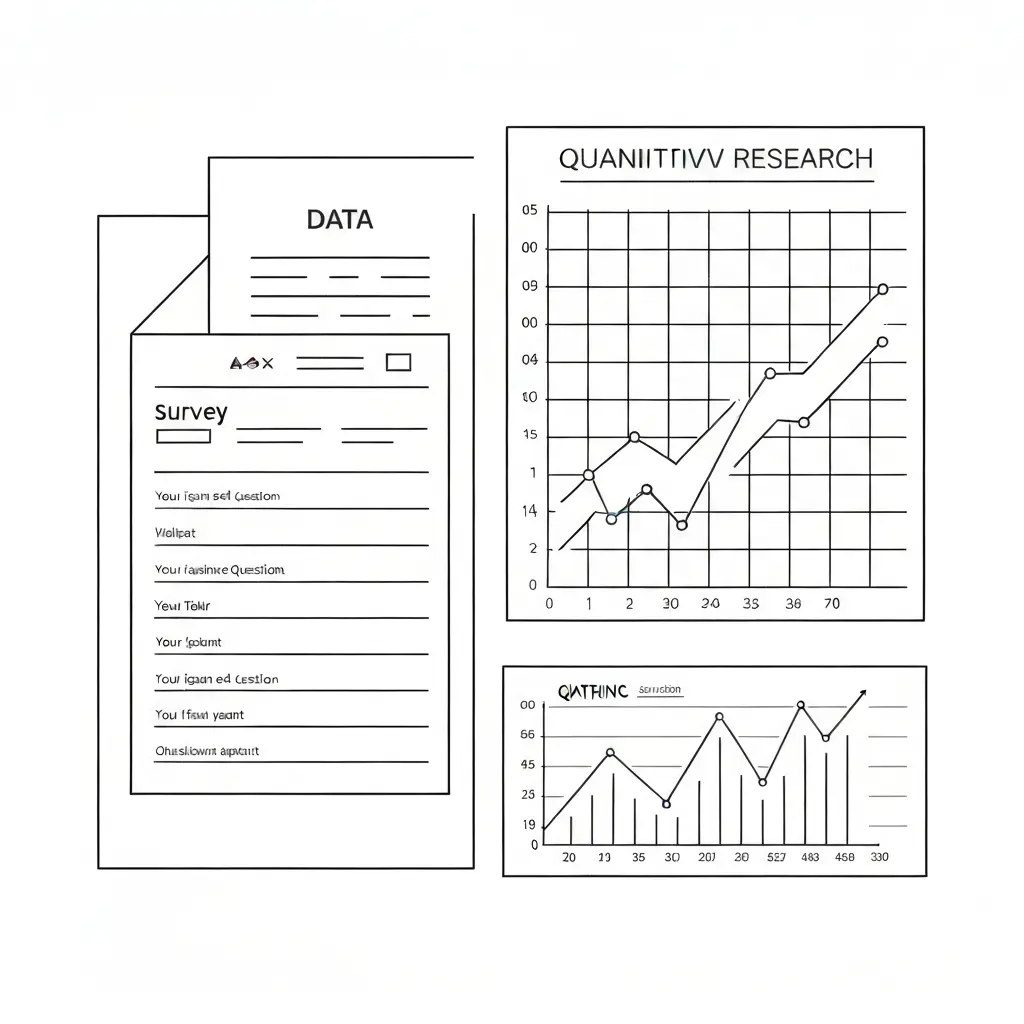
Quantitative Research Methods: Design, Data, and Analysis Guide
Quantitative research methods are the backbone of evidence-based inquiry in the social sciences, health sciences, psychology, economics, and engineering. When a researcher asks “how many?”, “how often?”, or “to what extent?”, the answer demands numbers — and numbers demand a rigorous methodology to generate them. This guide covers every stage of quantitative research: choosing a design, constructing instruments, sampling, collecting data, and applying the statistical analyses that turn raw numbers into defensible conclusions.
Whether you are designing a dissertation study, reviewing a paper for publication, or building a research proposal, understanding quantitative research methods is essential for producing work that stands up to peer scrutiny. This guide aligns with the standards expected by JSTOR-indexed journals, the American Psychological Association, and the UK Research Integrity Office.
What Is Quantitative Research?
Quantitative research is a systematic approach to investigating phenomena by collecting numerical data and subjecting it to mathematical or statistical analysis. It is grounded in the positivist philosophy — the assumption that there is an objective reality that can be measured independently of the researcher’s perspective.
The defining features of quantitative research:
- Structured data collection: Data is gathered using standardised instruments that produce numbers (Likert scales, measurement tools, performance tests).
- Large samples: To achieve statistical power and generalisability, quantitative studies typically require larger samples than qualitative ones (often n ≥ 30 for basic statistical tests; n ≥ 200 for structural equation modelling).
- Hypothesis testing: Most quantitative studies test a null hypothesis (H₀) against an alternative hypothesis (H₁).
- Statistical analysis: Data is analysed using descriptive statistics (mean, median, standard deviation) and inferential statistics (t-tests, ANOVA, regression, chi-square).
- Replicability: The method is described in enough detail that another researcher could repeat the study and expect comparable results.
Key Quantitative Research Designs
Experimental Design
The gold standard of quantitative research. Participants are randomly assigned to a treatment group (receives the intervention) and a control group (does not). Randomisation controls for confounding variables and allows causal claims. Used heavily in medicine (clinical trials), psychology, and education research.
Quasi-Experimental Design
Similar to experimental design but without random assignment. Used when random assignment is impractical or unethical (e.g., studying the effect of a policy on a population that cannot be randomly divided). Supports causal inference with caveats.
Survey Research
Data is collected from a representative sample using questionnaires. Can be cross-sectional (one point in time) or longitudinal (the same participants surveyed multiple times). Cross-sectional surveys are the most common design in social science research due to their efficiency.
Correlational Design
Examines the relationship between two or more variables without manipulation. Correlation does not imply causation — a fundamental principle that must be stated in any correlational study.
Longitudinal Design
Follows the same subjects over time to track changes and development. Valuable for studying trends, development, and long-term outcomes. The main challenge is participant attrition (dropout over time).
Cross-Sectional Design
Data is collected from a sample at one point in time. Efficient and cost-effective. Cannot establish causality or track change over time.
Sampling Strategies
Your sampling strategy determines who participates in your study and whether your findings can be generalised to a broader population.
| Strategy | Method | Best For |
|---|---|---|
| Simple random sampling | Every member has equal selection probability | Homogeneous populations |
| Stratified random sampling | Population divided into subgroups; random sample from each | Heterogeneous populations; ensuring subgroup representation |
| Cluster sampling | Population divided into clusters; whole clusters selected randomly | Geographically dispersed populations |
| Systematic sampling | Every nth member selected from a list | Large, ordered sampling frames |
| Convenience sampling | Participants selected based on availability | Pilot studies; limits generalisability |
Sample size calculation is essential. Use G*Power (a free statistical tool) to calculate the minimum sample size required for your intended statistical test, at your target power (typically 0.80) and significance level (typically α = 0.05).
Data Collection Instruments
The quality of quantitative findings depends entirely on the quality of the instrument used to collect data. The three main instrument types:
Questionnaires and Surveys
Must be pilot tested with a small sample before main data collection. Questions should be unambiguous, avoid leading language, and use validated scales where possible (e.g., the Beck Depression Inventory for mental health research, rather than self-constructed items).
Standardised Tests
Pre-existing instruments with established reliability and validity (e.g., Raven’s Progressive Matrices for cognitive ability). Using validated instruments strengthens your study’s credibility because you are building on established psychometric evidence.
Observations and Behavioural Measures
Structured observations with predefined categories and coding schemes. Inter-rater reliability (agreement between two or more observers) must be calculated and reported (typically using Cohen’s kappa or intraclass correlation coefficient).
Statistical Analysis Methods
Selecting the correct statistical test is one of the most common points of failure in student dissertations. The choice depends on: the number of variables, the level of measurement (nominal, ordinal, interval, ratio), the number of groups, and the distribution of the data.
Descriptive Statistics
Summarise the data: mean, median, mode, standard deviation, range, frequency distributions. Always report these before inferential statistics. They give readers a picture of what the data looks like before you test hypotheses.
Common Inferential Statistical Tests
- Independent-samples t-test: Compares the means of two independent groups on a continuous variable. Example: comparing exam scores of students taught by Method A vs. Method B.
- ANOVA (Analysis of Variance): Compares the means of three or more groups. Use post-hoc tests (Tukey, Bonferroni) to identify which groups differ.
- Chi-square test: Tests for associations between categorical variables. Example: is there a relationship between gender and course choice?
- Pearson/Spearman correlation: Measures the strength and direction of the relationship between two variables. Pearson for normally distributed data; Spearman for ordinal or non-normal data.
- Linear regression: Predicts a continuous outcome variable from one or more predictor variables.
- Logistic regression: Predicts a binary outcome (yes/no, pass/fail) from predictor variables.
Validity and Reliability
Two concepts that every quantitative researcher must demonstrate and discuss:
- Reliability: Consistency — if you measured the same thing again under the same conditions, would you get the same result? Assessed via test-retest reliability, internal consistency (Cronbach’s alpha; α ≥ 0.70 is generally acceptable), and inter-rater reliability.
- Internal validity: The extent to which your study design allows you to attribute changes in the outcome to the intervention rather than to confounding variables.
- External validity: The extent to which your findings generalise beyond your sample and setting. Determined primarily by your sampling strategy.
- Construct validity: Whether your measurement instrument actually measures the theoretical construct it claims to measure (e.g., does your “academic motivation” scale actually measure motivation, or something else?).
For qualitative counterparts to these concepts, see our article on qualitative research methods. For methodological guidance specific to literature reviews, see research proposal templates.
If you are writing your methodology in French, the same principles apply — resources are available at Tesify.fr. For Spanish-language research guidance, visit Tesify.es.
Quantitative vs Qualitative Research
| Dimension | Quantitative | Qualitative |
|---|---|---|
| Philosophy | Positivist | Interpretivist |
| Data type | Numerical | Textual, visual, observational |
| Sample size | Large (n ≥ 30 typically) | Small (n = 5–30 typically) |
| Analysis | Statistical | Thematic, narrative, discourse |
| Goal | Generalise, measure, predict | Understand, interpret, explore |
| Hypothesis | Tested (deductive) | Generated (inductive) |
Frequently Asked Questions
What is the difference between quantitative and qualitative research?
Quantitative research collects and analyses numerical data to test hypotheses, measure variables, and generalise findings. Qualitative research collects and analyses non-numerical data (interviews, observations, texts) to explore meaning, experience, and context. The choice depends on your research question: “how much/how many/to what extent” questions are quantitative; “why/how/what does it mean” questions are qualitative. Many dissertation designs combine both (mixed methods).
What sample size do I need for a quantitative dissertation?
There is no universal minimum, but general guidelines are: for basic inferential statistics (t-tests, chi-square), n ≥ 30 per group is widely cited. For regression analysis, the rule of thumb is at least 10–20 participants per predictor variable. For structural equation modelling, n ≥ 200 is typically required. Always use a power analysis (G*Power is free) to calculate the exact sample size required for your specific statistical test.
Is a survey always quantitative?
Not necessarily. A survey with closed-ended questions producing numerical responses (Likert scales, multiple choice with numerical codes) is quantitative. A survey with open-ended questions producing written responses is qualitative. Many surveys include both types of questions, making them mixed methods instruments. The distinction lies in the data produced, not the instrument itself.
What statistical software should I use for my dissertation?
The most common options are: SPSS (widely taught in social science programmes; user-friendly for standard analyses), R (free, open-source, very powerful, steep learning curve), and Stata (common in economics and epidemiology). Excel is acceptable only for basic descriptive statistics. Python with pandas and scipy is increasingly used in interdisciplinary research. Check what software your institution teaches and provides access to.
What is Cronbach’s alpha and when do I use it?
Cronbach’s alpha measures the internal consistency (reliability) of a multi-item scale — how well a group of items measures the same underlying construct. A value of α ≥ 0.70 is generally considered acceptable; α ≥ 0.80 is good; α ≥ 0.90 is excellent (though very high values may indicate item redundancy). Report Cronbach’s alpha whenever you use a questionnaire scale, before running any inferential tests.





Leave a Reply