
Master’s Thesis Example: Structure, Format, and What Examiners Look For
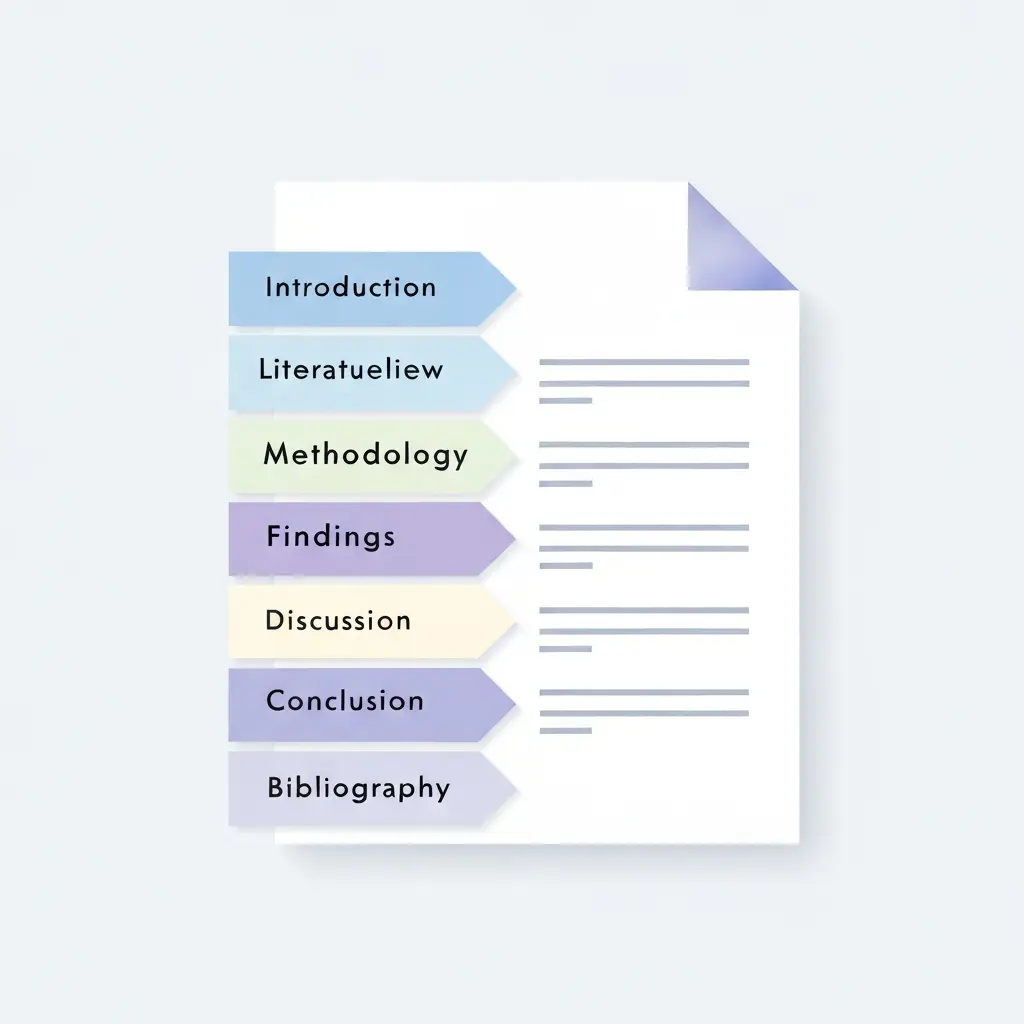
Understanding what a complete master’s thesis looks like — chapter by chapter, page by page — is one of the fastest ways to improve the quality of your own dissertation. Many students begin writing without a clear structural blueprint, producing drafts that meander or omit entire sections that examiners expect to see. This guide provides a complete master’s thesis example structure with word count guidance, formatting standards, and specific commentary on what examiners look for in each chapter.
A master’s thesis differs from an undergraduate dissertation primarily in depth, methodological rigour, and the expectation of an original contribution to knowledge — even if that contribution is modest. At doctoral level, the original contribution requirement is non-negotiable and substantial; at master’s level, you are typically expected to demonstrate the capacity for independent research and provide findings that add something meaningful, however incremental, to the scholarly conversation in your field.
Word Count and Chapter Structure
Word counts vary by discipline and institution, but the following ranges are typical for a social science or humanities master’s thesis of 15,000 words:
| Chapter | Word Count | % of Total |
|---|---|---|
| Abstract | 250–350 words | Not counted |
| Introduction | 1,000–1,500 | 7–10% |
| Literature Review | 3,000–4,500 | 20–30% |
| Methodology | 2,000–3,000 | 13–20% |
| Findings/Results | 3,000–4,000 | 20–27% |
| Discussion | 2,000–3,000 | 13–20% |
| Conclusion | 1,000–1,500 | 7–10% |
| References | Variable | Not counted |
Front Matter and Abstract
Before Chapter 1, the thesis front matter includes:
- Title page — thesis title, full name, degree programme, institution, year, supervisor name
- Declaration of originality — a signed statement that the work is your own and has not been submitted elsewhere
- Abstract — 250–350 words summarising: the research problem, methodology, key findings, and conclusion. The abstract must stand alone — readers should understand the thesis from the abstract without reading further.
- Acknowledgements — optional; thanks to supervisors, participants, and supporters
- Table of contents — with accurate page numbers for each chapter and sub-section
- List of tables and figures — required if the thesis contains tables or figures
- List of abbreviations — if abbreviated terms are used throughout
Introduction Chapter
The introduction answers three questions: What is the problem? Why does it matter? What are you going to do about it? A strong introduction includes:
- Context-setting — the broad scholarly or practical context in which the research sits
- Problem statement — the specific gap, question, or issue the thesis addresses
- Research aims and objectives — usually 1 aim and 3–5 specific research objectives
- Research questions — the questions the thesis will answer
- Rationale — why this research is needed and what value it adds
- Chapter overview — a paragraph describing what each subsequent chapter does
Examiners look for a clear, focused research question that is specific enough to be addressed within the scope of a master’s thesis. Overly broad questions signal unfocused research ahead.
Literature Review Chapter
The literature review demonstrates command of the scholarly field and identifies the gap your research fills. It should synthesise sources thematically — not summarise them sequentially. Examiners look for:
- Breadth of reading — engagement with key works across the field
- Critical evaluation — not just what sources say, but their strengths, limitations, and how they relate to each other
- Clear gap identification — an explicit statement of what is not yet known and why your thesis addresses it
- Theoretical framework — the conceptual lens through which you analyse your data
For detailed guidance on structuring the literature review, see our guide on literature review methodology.
Methodology Chapter
The methodology chapter justifies every research decision you made. It is not a description of what you did — it is a philosophical and methodological argument for why you did it that way. A strong methodology chapter includes:
- Research philosophy (ontology and epistemology) — how you understand reality and knowledge
- Research approach (inductive/deductive) and research design (qualitative, quantitative, mixed)
- Data collection methods — with full justification and ethical considerations
- Sampling strategy — who you studied and why, including inclusion/exclusion criteria
- Data analysis approach — including specific methods (thematic analysis, regression, discourse analysis)
- Reliability, validity, and/or trustworthiness — quality criteria appropriate to your methodology
For qualitative research, see our guide to thematic analysis. Students at German universities writing Masterarbeiten can access German-language methodology support at tesify.io; Spanish students writing TFMs can find equivalent support at tesify.es.
Findings/Results Chapter
The findings chapter presents your data without interpretation. In qualitative research, this means presenting themes with supporting quotes. In quantitative research, it means presenting results with tables, charts, and statistical outputs. The key rule is: present findings objectively here; interpretation belongs in the discussion chapter.
For qualitative findings chapters, organise content by theme, not by participant. Lead each section with a theme statement, present supporting evidence from multiple participants, and briefly note the significance of the theme — without interpretive commentary that belongs in the discussion.
Discussion Chapter
The discussion is where you interpret your findings in light of existing literature. It answers the question: what do these findings mean? A strong discussion:
- Compares your findings to prior literature — where do they align, and where do they diverge?
- Explains unexpected findings — do not ignore results that do not fit the hypothesis
- Builds the theoretical argument — how do your findings advance, challenge, or refine existing theory?
- Maintains analytical momentum — do not simply re-describe findings; interpret them
Conclusion Chapter
The conclusion synthesises findings, states theoretical and practical implications, acknowledges limitations, and directs future research. For a detailed breakdown with example language, see our dedicated guide on writing a thesis conclusion. Tesify also provides direct support for structuring conclusion chapters at master’s and doctoral level.
Formatting Standards
Standard formatting requirements for UK master’s theses include:
- Font: 12pt Times New Roman or 11pt Arial, consistently applied
- Line spacing: 1.5 or double spacing for body text; single spacing for block quotes and footnotes
- Margins: 3–4cm left (for binding), 2–2.5cm right, top, and bottom
- Page numbers: bottom-centre or bottom-right, starting from the first page of Chapter 1 (front matter uses Roman numerals)
- Headings: use a consistent hierarchy (H1 for chapter titles, H2 for sections, H3 for sub-sections)
- Citation style: as specified by your institution — APA, Harvard, Chicago, or discipline-specific style
Always check your institution’s specific dissertation formatting guidelines — they take precedence over general conventions.
Frequently Asked Questions
How long is a master’s thesis in the UK?
Most UK master’s dissertations are 12,000–20,000 words, with the specific requirement varying by institution and subject. STEM disciplines often require shorter dissertations (10,000–15,000 words) but with more data-heavy appendices. Humanities and social science dissertations are typically 15,000–20,000 words. Always check your institution’s specific word count requirements.
Can I use first person in a master’s thesis?
Yes, in many disciplines — particularly qualitative social science and humanities. Use of the first person (“I conducted,” “I argue”) is now widely accepted and often encouraged in reflexive, qualitative research. In scientific and STEM dissertations, third person or passive voice (“data were collected,” “the experiment showed”) remains more conventional. Check your supervisor’s preference and disciplinary convention.
What is the difference between a master’s dissertation and a master’s thesis?
In UK academic usage, “dissertation” and “thesis” are often used interchangeably at master’s level. Technically, “thesis” is more commonly used for research-focused programmes (MRes, MPhil) that involve an original empirical or theoretical contribution, while “dissertation” is used for taught master’s (MA, MSc) final projects. In the US, the terms are used in reverse — “dissertation” for doctoral work, “thesis” for master’s work.
Do I need to do primary research for a master’s thesis?
For most taught master’s dissertations, yes — primary research (interviews, surveys, experiments, or systematic literature review with a specific search strategy) is required. Pure secondary analysis (reviewing existing literature without a systematic methodology) is typically only appropriate for MRes-style theses or explicitly permitted systematic review topics. Check your programme’s requirements with your supervisor before finalising your methodology.
Write a Master’s Thesis That Passes First Time
Tesify helps master’s students structure their dissertations, write with academic precision, and meet examiner expectations at every chapter. From research proposal to conclusion, expert guidance is available throughout.





Leave a Reply