
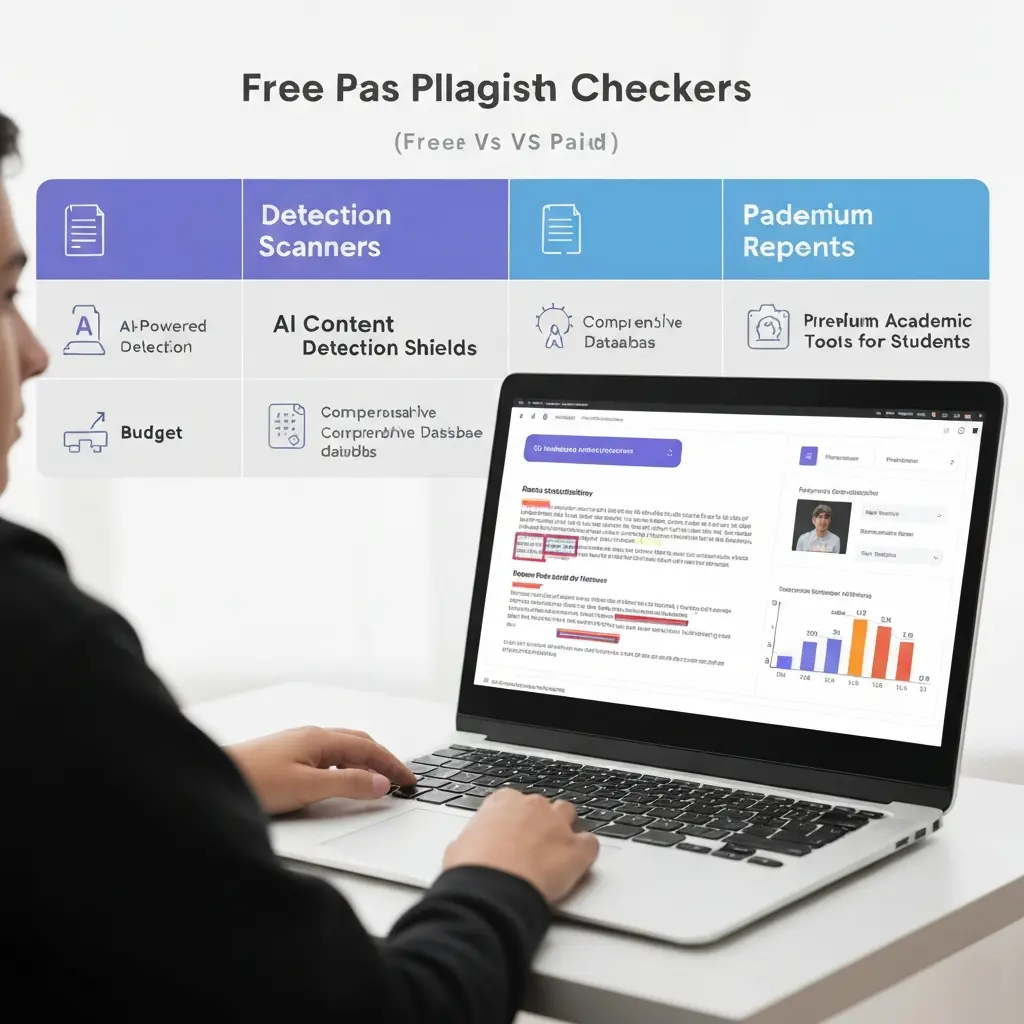
Free vs Paid Plagiarism Checkers for Students: Which Is Worth It? (2026)
The best plagiarism checkers for students compared in 2026 reveal a significant performance gap between free and paid tools — particularly for the AI-generated content detection that has become essential in the current academic environment. Most students default to whichever tool their university mandates (typically Turnitin), but that tool is unavailable for pre-submission self-checking at most institutions. The question that actually matters is: which tool should you use to check your own work before your institution’s detector does?
This comparison provides a data-driven evaluation of the leading options at every price point, with specific attention to AI-generated content detection accuracy — the capability that most distinguishes 2026 tools from their predecessors — and the specific scenarios where each tool is and is not appropriate.
Comparison Table: Top Plagiarism Checkers
| Tool | Price | AI Detection | Database Size | Best For |
|---|---|---|---|---|
| Turnitin | Institutional license | Yes (iThenticate AI) | Largest (peer-reviewed + web) | Official submission check |
| iThenticate | From $100/year | Yes | Large (research papers) | Researchers and PhD students |
| Copyscape Premium | $0.03–0.05/page | Limited | Web content focused | Web source checking |
| Originality.ai | From $0.01/100 words | Yes (strong) | Web + AI detection | AI content detection focus |
| Quetext | Free (limited) / $9.99/month | Limited (paid only) | Web content focused | Budget student option |
| Grammarly Plagiarism | Included in Premium ($12/month) | No | Web (no academic papers) | Casual check + grammar combo |
| Tesify (built-in) | Included with Tesify | Yes | Academic focus | Thesis pre-submission in workflow |
Free Plagiarism Checkers: What You Actually Get
Free plagiarism checkers are a reasonable starting point for basic checks, but have consistent limitations that matter specifically for thesis work:
Quetext Free Tier
Quetext’s free plan checks up to 500 words against web content and a limited academic database. For a 20,000-word master’s dissertation, this means checking approximately 2.5% of your document at a time — practically infeasible. The free plan does not include AI detection. For its price point, the paid tier at $9.99/month is more useful, but still limited compared to Turnitin for academic paper database coverage.
Grammarly Plagiarism Check
Grammarly’s plagiarism check (included in the $12/month Premium plan) checks against web content but not academic journal databases. This means it will catch copying from Wikipedia, news sites, and publicly available web pages, but not from the peer-reviewed journal articles that constitute the primary sources in a thesis. For thesis work, this is a significant limitation.
PlagScan
PlagScan offers a free check for the first document only. Its database includes academic papers but is smaller than Turnitin’s. Its AI detection capability is limited compared to paid-tier competitors.
Paid Plagiarism Checkers: When the Upgrade Is Worth It
Turnitin / iThenticate
Turnitin remains the gold standard specifically because of its database: it includes peer-reviewed journal articles, conference papers, student submissions from thousands of institutions globally, and web content. For doctoral dissertation pre-submission checking, iThenticate (Turnitin’s research paper version, available to individual users) is the closest available equivalent to what your institution will use.
Cost: iThenticate starts at approximately $100/year for individual researchers. This is a significant cost, but for students who are months from doctoral submission, it is typically worth it to identify problems before the examiner does.
Originality.ai
Originality.ai is the strongest AI content detection tool available in 2026 for users outside of institutional Turnitin access. Its per-page pricing ($0.01/100 words) makes it affordable for checking specific sections rather than entire documents. Its AI detection accuracy for clearly AI-generated text is among the highest of non-institutional tools.
Tesify’s Built-In Check
For students writing their thesis on Tesify, the built-in plagiarism check provides continuous pre-submission verification as you write — catching potential issues in real time rather than requiring a separate submission step. This integration is a significant workflow advantage over tools that require document export and upload. For French-speaking students, our guide to free anti-plagiat tools covers the European market equivalents.
AI-Generated Content Detection: 2026 Accuracy Data
AI detection capability has become a critical differentiator in 2026. Independent testing of tools against a benchmark of known-human and known-AI text reveals consistent performance patterns:
| Tool | Detection Rate (Pure AI Text) | False Positive Rate (Human Text) | AI Detection Available |
|---|---|---|---|
| Turnitin | ~98% (claimed) | 3–9% | Yes (iThenticate AI) |
| Originality.ai | ~96% | ~4–8% | Yes |
| GPTZero | ~91% | 4–16% | Yes |
| Quetext (paid) | ~72% | ~5% | Paid tier only |
| Grammarly | N/A | N/A | No |
The false positive rate deserves particular attention. Turnitin’s 3–9% false positive rate means that for every 100 human-written documents, 3–9 are incorrectly flagged as containing AI-generated content. For non-native English speakers, this rate is higher — research finds 2–4x more false positives for non-native speaker text. If your thesis was written by a non-native speaker in a formal academic register, a false positive flag is a real risk that deserves a pre-submission personal check.
University Tool vs Personal Check: Why Both Matter
Most students assume that since their institution uses Turnitin, running a personal check is redundant. This reasoning has two flaws:
- You cannot run Turnitin yourself: Institutional Turnitin access is for submission — you see results only after submitting through official channels, by which point any issues are already on record
- Institutional tools add your submission to their database: When you submit through your institution’s Turnitin, your document becomes part of the database. If you want to check drafts without adding them permanently to Turnitin’s database, you need an alternative tool for pre-submission checks
The best practice for thesis pre-submission is: run your own check with iThenticate, Originality.ai, or Tesify’s built-in check before your official institutional submission. This gives you time to address any issues — whether they are genuine problems or false positives — before they become formal academic integrity flags.
What Thesis Writers Specifically Need
For thesis and dissertation work specifically, the most important features in a plagiarism checker are:
- Academic database coverage: Must check against journal papers and books, not just web content
- AI detection capability: Essential in 2026 given the prevalence of AI-assisted writing
- Long document support: Must handle 70,000+ word documents for doctoral submissions
- Draft checking without database addition: You need to check drafts without adding them to the permanent database
- Detailed similarity reports: Must show specific matched passages, not just a percentage score
The built-in plagiarism check in Tesify is designed specifically for this use case — integrated directly into the writing workflow with the database coverage and AI detection capability that thesis submissions require. See our broader comparison of the best AI thesis writing tools for context on how plagiarism checking fits into the overall thesis writing workflow.
Frequently Asked Questions
What is the best free plagiarism checker for students?
Quetext’s free tier provides the most useful free plagiarism checking for students — it checks against a reasonable database including some academic content. However, free tools universally have limitations: smaller databases, no AI detection, and word/page count restrictions. For thesis work specifically, the limitations of free tools are significant enough that a low-cost paid option (Quetext paid, Originality.ai, or the check built into Tesify) is worth considering.
Is Turnitin the best plagiarism checker?
Turnitin has the largest database and remains the institutional standard. However, individual students generally cannot access Turnitin directly — it is institution-administered. iThenticate (Turnitin’s individual researcher product) provides equivalent capability for individual purchase. For AI detection specifically, Originality.ai is competitive with Turnitin at a significantly lower cost for individual users.
Can plagiarism checkers detect AI-written content?
Yes — the leading plagiarism checkers now include AI detection. Turnitin claims 98% accuracy for clearly AI-generated text, with 3–9% false positive rates. Originality.ai and GPTZero also have high detection rates. However, all tools are less accurate for AI-assisted human writing (where the student’s voice dominates but AI provided structural or phrasing assistance) than for fully AI-generated text.
How do I check my thesis for plagiarism before submission?
Use a tool with academic database coverage (not just web content) and AI detection capability. Options include: iThenticate (direct individual access to Turnitin’s database), Originality.ai (strong AI detection, pay-per-check), Tesify’s built-in check (integrated with your writing workflow), or Quetext paid tier. Run the check on your final draft before official institutional submission to identify and resolve any issues before they are formally flagged.
Will a plagiarism checker detect paraphrasing?
Advanced plagiarism checkers can detect paraphrased content through semantic similarity analysis — comparing the meaning of passages rather than just the words. Turnitin’s “similarity score” includes semantic matches for this reason. However, properly paraphrased content with correct citation is not plagiarism — the issue is when paraphrased content from a source is presented without citation, not when you paraphrase and cite correctly.
Write your thesis with AI
Structure, draft, cite, and format your thesis faster with Tesify’s AI writing tools, automatic bibliography, and plagiarism checker. Free to start, no credit card required.




Leave a Reply