
Footnotes vs Endnotes: When to Use Each in Academic Writing 2026
The debate between footnotes vs endnotes is one that academic writers encounter primarily when working within citation styles that use numbered note references — Chicago Notes and Bibliography, OSCOLA, and some history and humanities conventions. For students more familiar with in-text author-date citations (APA, Harvard), notes can feel unfamiliar and unnecessarily complicated. This guide clarifies what footnotes and endnotes are, how they differ, when to use each, and how to format them correctly.
What Are Footnotes?
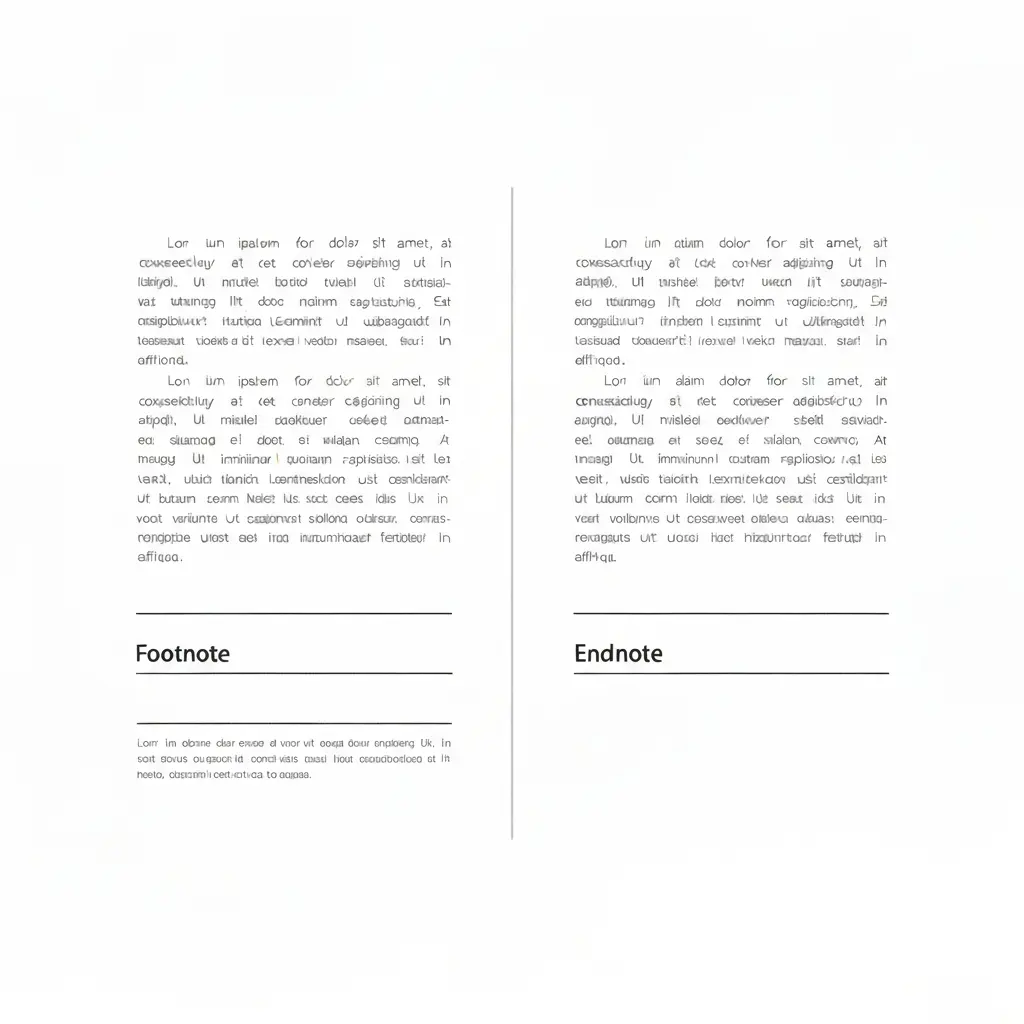
Footnotes are numbered references that appear at the bottom (foot) of the same page on which they are cited. When you reference a source or add supplementary commentary in the main text, you insert a superscript number (¹, ², ³). The full reference or note appears at the bottom of that page, separated from the main text by a horizontal rule.
The advantage of footnotes is immediacy: readers can check the reference without leaving the page. For academic work with extensive notes, footnotes keep the reading experience smooth. The disadvantage is that heavy footnote use can make pages look crowded and may disrupt the flow of your main argument.
What Are Endnotes?
Endnotes are identical in function to footnotes — they use the same superscript numbering system — but they are collected at the end of a chapter or the entire document rather than at the bottom of each page. Endnotes create a cleaner page layout with no footnote text at the bottom, but require readers to flip to the back of the document to check a reference.
Endnotes are common in published books (particularly in humanities) where the publisher prefers a clean page layout. For dissertations and essays, footnotes are generally more appropriate because they are more reader-friendly and allow examiners to follow your citations without turning pages.
Key Differences
| Feature | Footnotes | Endnotes |
|---|---|---|
| Location | Bottom of same page | End of chapter or document |
| Reader experience | Immediate access without page turn | Requires navigating to end section |
| Page appearance | Footnote text at page bottom | Clean, uncluttered pages |
| Common in | Dissertations, articles, essays | Published books, some journals |
| Numbering | Restarts on each page (or continues) | Continues sequentially throughout |
When to Use Footnotes vs Endnotes
The choice between footnotes and endnotes is often determined by your citation style guidelines or your institution’s submission requirements. When you have a free choice:
- Use footnotes for dissertations, essays, and any work where your reader needs quick access to citations without turning pages
- Use endnotes when your institution or journal specifically requires them, or when you have so many substantive commentary notes that footnotes would dominate the page layout
- Never mix footnotes and endnotes in the same document
Which Citation Styles Use Notes?
| Style | Uses Notes? | Footnotes or Endnotes? |
|---|---|---|
| Chicago Notes & Bibliography | Yes | Either (footnotes preferred) |
| OSCOLA (Law) | Yes | Footnotes |
| Oxford Referencing | Yes | Footnotes |
| APA 7th edition | Content notes only | Footnotes (not for citations) |
| Harvard | Not standard | N/A |
| MLA | Content notes only | Either |
Our guides to Chicago citation style and APA 7th edition explain the specific note conventions for each style.
Two Types of Note: Citation and Content
Both footnotes and endnotes serve two distinct purposes in academic writing:
- Citation notes: Provide the full reference for a source cited in the text. Used in Chicago N&B, OSCOLA, and Oxford referencing.
- Content notes: Provide supplementary information, qualifications, or commentary that would disrupt the main argument if included in the text but that is too important to omit entirely. Used in APA, MLA, and Chicago for material that does not fit in the main body.
In APA and Harvard (author-date systems), footnotes are used exclusively for content notes — never for citations. In Chicago Notes and Bibliography, footnotes serve both functions. Keep content notes brief: if they require more than three or four sentences, consider whether the material belongs in the main text or an appendix instead.
Formatting Footnotes and Endnotes
Chicago Notes and Bibliography footnote format (first citation):
¹ John Smith, Academic Writing in the Digital Age (Oxford: Oxford University Press, 2024), 45.
Chicago shortened footnote (subsequent citations of same work):
² Smith, Academic Writing, 82.
Key formatting rules:
- Notes are single-spaced with a blank line between notes
- The first line of each note is indented; subsequent lines are flush left (indented paragraph style)
- Superscript numbers in the text appear after punctuation (comma, period) — not before
- Use “Ibid.” (italicised) to refer to the immediately preceding source when citing the same work consecutively — though many style guides now recommend using the shortened form instead
Tips for Word and Google Docs
Both Word and Google Docs automate footnote and endnote formatting:
- Word: References tab → Insert Footnote (Ctrl+Alt+F) or Insert Endnote (Ctrl+Alt+D). Word automatically numbers and positions notes.
- Google Docs: Insert menu → Footnote (Ctrl+Alt+F). Google Docs supports footnotes but not endnotes natively — use a workaround (manually created note section) if endnotes are required.
- Change footnotes to endnotes in Word: References → Footnotes dialog box → Convert all footnotes to endnotes.
Reference management software like Zotero integrates with both Word and Google Docs to insert correctly formatted Chicago footnotes automatically. Tesify can help you check that your note formatting is consistent throughout your document.
Frequently Asked Questions
Do APA citations use footnotes?
APA does not use footnotes for citations — it uses in-text author-date citations with a reference list. APA does permit footnotes for content notes: supplementary information that would disrupt the main text. These should be brief and used sparingly. If you are using APA and find yourself wanting to add many content footnotes, consider whether the information belongs in the main text or an appendix instead.
What is the difference between footnotes and endnotes in Chicago style?
Chicago Notes and Bibliography style permits both footnotes and endnotes — they are formatted identically, just positioned differently. Footnotes appear at the page bottom; endnotes appear at the chapter or document end. For academic dissertations and essays, footnotes are generally preferred because readers can check references without leaving the page. Many published books use endnotes to keep pages visually clean. Always check your institution’s or journal’s submission guidelines for any specific preference.
How do I convert footnotes to endnotes in Microsoft Word?
In Microsoft Word: go to the References tab → click the small arrow at the bottom right of the Footnotes group to open the Footnote and Endnote dialog box → click “Convert” → select “Convert all footnotes to endnotes” → click OK. Word will move all footnote text to the end of the document and update numbering automatically. You can also convert individual notes manually by right-clicking on a footnote and selecting “Convert to Endnote”.
Can I use footnotes and in-text citations in the same document?
No — you should use a single citation system throughout a document. Mixing footnote citations (Chicago style) with in-text author-date citations (APA/Harvard style) creates confusion and inconsistency. Choose one style and apply it consistently throughout. APA does allow content footnotes alongside its in-text citation system — but these footnotes are for supplementary commentary, not citations.
Do law dissertations use footnotes?
Yes. UK law dissertations and legal academic writing use OSCOLA (Oxford University Standard for Citation of Legal Authorities), which is a footnote citation system. All citations appear in numbered footnotes; a bibliography at the end lists all cases, legislation, and secondary sources separately. OSCOLA is specific to legal sources — cases, statutes, treaties, and international materials — alongside standard academic sources.
Format Your Academic Notes Correctly with Tesify
Footnote and endnote formatting mistakes are easily avoided with the right support. Tesify helps you check citation consistency, note formatting, and the integration of references into your academic prose — so your work meets the standards your examiners expect.





Leave a Reply