
Dissertation Writing Not Working? Here Is the Real Fix
You open the document. The cursor blinks. You’ve read the same paragraph four times and written nothing new. Sound familiar? Almost every student doing dissertation writing reaches this exact wall — and most of the advice floating around (“just write every day!”, “try a Pomodoro timer!”) doesn’t actually touch the real problem.
The truth is, when your dissertation isn’t working, it’s rarely about motivation or discipline. It’s almost always one of five specific, fixable problems — each with a clear solution. This article breaks them all down, step by step.

- Why Dissertation Writing Really Fails (It’s Not What You Think)
- Diagnose Your Dissertation Problem in 5 Minutes
- Fix 1 — Sharpen a Blurry Research Question
- Fix 2 — Rebuild Your Dissertation Structure
- Fix 3 — Break Through the Writing Block
- Fix 4 — Tame Citation and Reference Chaos
- Fix 5 — Prove Your Original Contribution
- Your 48-Hour Dissertation Writing Action Plan
- Frequently Asked Questions
Why Dissertation Writing Really Fails (It’s Not What You Think)
Here’s the uncomfortable insight most guides skip: stalled dissertation writing is almost never a laziness problem. Research from the National Center for Science and Engineering Statistics’ Survey of Earned Doctorates (2023) shows that PhD completion rates in the US hover around 56% over 10 years — meaning nearly half of doctoral students never finish. That’s not a motivation crisis. That’s a systems failure.
Undergraduate and master’s dissertations follow a similar pattern. Students get stuck not because they’re bad writers, but because the underlying architecture of their project has a crack in it. Writing faster won’t fix a cracked foundation.
What most people miss is that there are five distinct failure modes in dissertation writing, and each one demands a completely different remedy. Applying the wrong fix wastes weeks. The diagnostic section below will get you pointed in the right direction in under five minutes.
Diagnose Your Dissertation Problem in 5 Minutes
Before you fix anything, you need to know what’s actually broken. Read through the table below and be honest with yourself about which description fits your current situation best.
| Symptom | Likely Root Cause | Go To Fix |
|---|---|---|
| Can’t write a single paragraph without feeling it’s “wrong” | Blurry research question | Fix 1 |
| Chapters feel disconnected; supervisor says it “doesn’t flow” | Structural collapse | Fix 2 |
| Staring at a blank page for hours; perfect sentences that get deleted | Writing-block psychology | Fix 3 |
| References are a mess; you’re not sure what you’ve cited | Citation chaos | Fix 4 |
| Supervisor asks “so what’s new here?” and you freeze | Unclear original contribution | Fix 5 |
More than one resonates? That’s normal. Start with the one that’s causing the most paralysis right now — fixing it will create enough momentum to tackle the others.
Fix 1 — Sharpen a Blurry Research Question
A vague research question is the single most common reason dissertation writing grinds to a halt. If your question is too broad, every sentence you write feels simultaneously relevant and irrelevant — and the result is a paralysing loop of rewrites.
The PICO/SPIDER Test for Your Research Question
Borrowed from systematic review methodology (and used extensively at Oxford’s Evidence-Based Medicine programme), these frameworks force specificity:
- PICO (for quantitative/clinical research): Population, Intervention, Comparison, Outcome
- SPIDER (for qualitative research): Sample, Phenomenon of Interest, Design, Evaluation, Research type
Try plugging your current research question into one of these frameworks. If you can’t fill in every box, your question isn’t finished yet. That’s not a failure — it’s just a diagnosis.
The “So What?” Ladder
Ask yourself “so what?” about your research question three times in a row. Each answer should get more concrete and significant. If you reach a dead end by the second rung, your question may need repositioning entirely — not just tightening.
Fix 2 — Rebuild Your Dissertation Structure
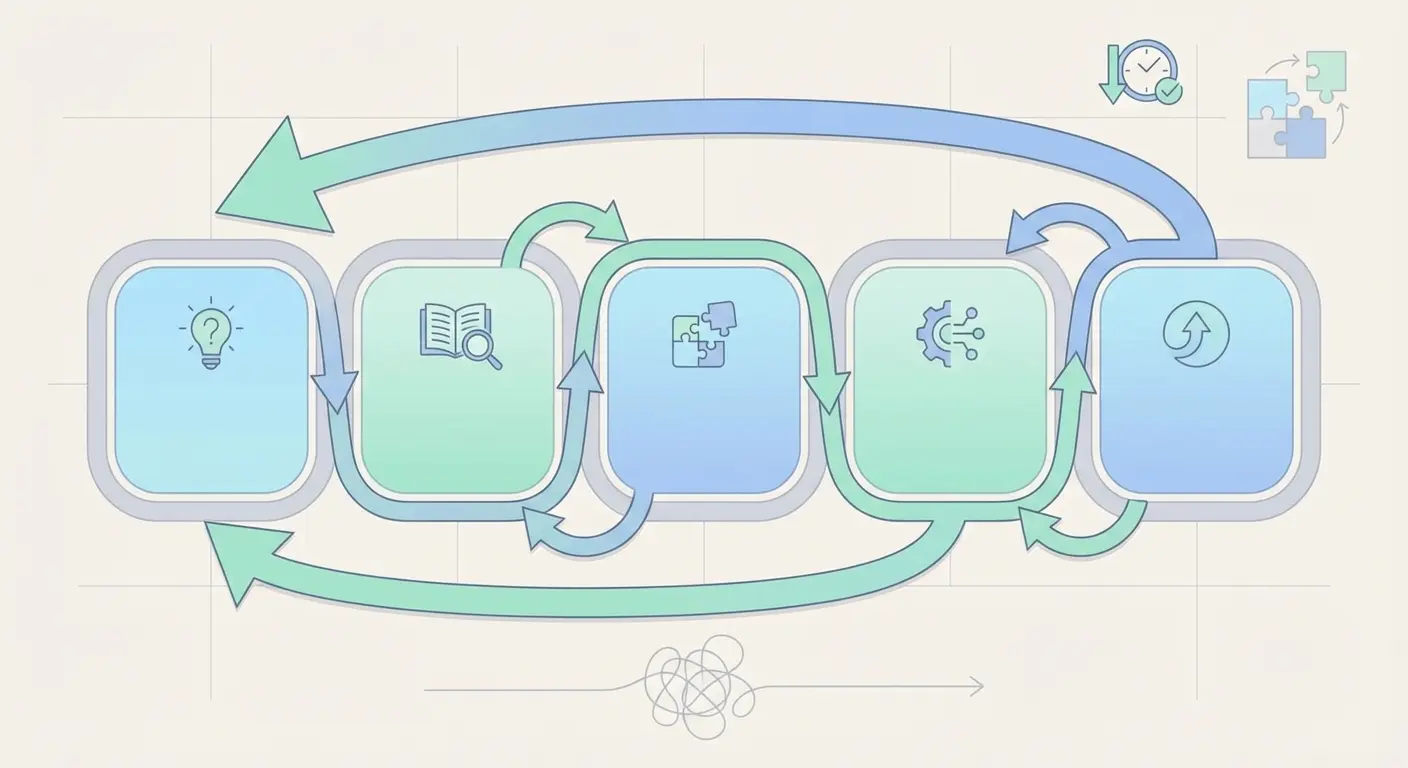
Structure problems in dissertation writing are sneaky — they often don’t show up until you’re 8,000 words in and suddenly nothing connects. Your supervisor might say the argument “doesn’t hang together.” What they mean is: the chapters aren’t doing a logical job in sequence.
The fix isn’t to rewrite everything. It’s to build a chapter-level reverse outline first.
How to Reverse Outline Your Dissertation
- Open a blank document. Don’t touch your existing draft yet.
- For each chapter you’ve written, write one sentence that describes what that chapter currently argues (not what you intended it to argue — what it actually says).
- Read those sentences in order. Does each one logically follow from the last? Does each one build toward your conclusion?
- Identify the gap. Where does the logic break? That’s where the structural problem lives.
- Rebuild the sequence on paper before touching a single word of prose.
This technique is taught in Harvard’s Writing Center and it’s worth the 45 minutes it takes. Structural repair done at the outline level saves dozens of hours of prose revision later.
For a deeper dive into planning and structural frameworks, the dissertation planning and structure guide at Tesify walks through intelligent tools that make this process faster and more reliable.
Fix 3 — Break Through the Writing Block
Writer’s block in dissertation writing isn’t a creativity problem — it’s a perfectionism problem. The second you open your document with the intent to “write well,” your editorial brain switches on before your generative brain has produced anything to edit. You end up with nothing.
The counterintuitive fix: write badly on purpose, at speed, for a fixed time.
The Shitty First Draft Protocol (Borrowed from Anne Lamott)
Anne Lamott’s concept from Bird by Bird has been adopted by writing centres at Stanford and UCL alike: give yourself explicit permission to write a terrible first draft. Set a 25-minute timer. Write without stopping, without editing, without deleting. The rule is that your fingers keep moving.
What comes out will be rough. Some of it will be unusable. But some of it — usually more than you’d expect — will contain the actual ideas you’ve been trying to access. Your job on the second pass is just to find those and develop them.
The “Talking Draft” Technique
Some students find it easier to speak their ideas than write them. Record yourself explaining a section out loud as if you were talking to a friend. Then transcribe it. The transcription — even in casual language — gives you raw material to polish. Several PhD candidates at Imperial College London report this as the technique that broke their longest writing stalls.
For students who want structured writing support beyond these techniques, exploring AI writing tools reviewed for dissertation work in 2025 can open up genuinely useful options — particularly for overcoming blank-page paralysis and drafting literature review sections at speed.
The Writing a PhD Thesis in 3 Months guide on YouTube also covers efficient drafting workflows that apply to dissertations at any level — well worth 20 minutes of your time.
Fix 4 — Tame Citation and Reference Chaos
Reference chaos is one of those problems that feels minor until it suddenly isn’t. You’re deep in Chapter 4, you need a citation, you can’t find it, you spend 40 minutes hunting through browser tabs and PDF folders — and the writing momentum dies completely. Multiply that by 200 citations and you’ve lost days.
The Two-Tool Solution
Most institutions — including Cambridge, MIT, and the University of Melbourne — recommend a reference manager from day one. The two most widely used options:
| Tool | Best For | Cost |
|---|---|---|
| Zotero | Most disciplines; excellent browser extension; syncs across devices | Free (cloud storage paid) |
| Mendeley | STEM fields; integrates with Elsevier databases | Free |
| EndNote | Institutional users; very large libraries | Paid (often free via university) |
| Overleaf + BibTeX | Mathematics, physics, engineering (LaTeX users) | Free basic / paid pro |
Download Zotero free here — it takes about 20 minutes to set up and will save you more hours than almost any other tool in your dissertation toolkit. If you’re writing in LaTeX, Overleaf’s thesis templates have BibTeX integration built in.
The Literature Review Citation System
For the literature review specifically — which involves the most citations — the approach recommended in PLOS Computational Biology’s Ten Simple Rules for Writing a Literature Review is to tag every source by theme before you start writing, not after. This means your citations are pre-organised by argument, not by author or date — which maps directly onto how your literature review chapter needs to be structured.
Fix 5 — Prove Your Original Contribution
“So what’s actually new here?” is the question that haunts every dissertation writer at some point. If you freeze when your supervisor asks it, you’re not alone — and the problem is almost always that the original contribution hasn’t been made explicit, even if the research itself is genuinely novel.
Here’s where it gets interesting: originality in a dissertation doesn’t always mean discovering something nobody has ever known. At master’s level, applying an existing framework to a new context is original. Combining two methodologies in a new way is original. Replicating a study in a different population with updated data is original. The issue is usually framing, not substance.
The Contribution Statement Exercise
- Write one sentence starting with: “This dissertation contributes to the field of [X] by [Y].”
- Ask: Has Y been done before in exactly this way? If not — that’s your originality claim.
- Check the literature specifically for papers that do something close to Y. If you can cite them and explain how your approach differs, your contribution is defensible.
- Put this sentence at the end of your introduction chapter. Explicitly. Don’t bury it.
For a much deeper treatment of this issue — particularly relevant to PhD students and those facing viva examinations — the guide on proving originality in doctoral dissertations covers five concrete strategies used by successful PhD candidates.
Your 48-Hour Dissertation Writing Action Plan
Theory is useful. But what you probably need right now is a concrete sequence of steps you can start today. Here’s a 48-hour sprint designed to restart stalled dissertation writing regardless of which fix applies to you.
- Use the diagnostic table above to identify your primary problem type
- Write your current research question in one sentence
- Write one sentence per chapter describing what each currently argues
- Set up Zotero (if you haven’t already) and import your existing sources
✅ Hours 5-12: Apply Your Fix
- Run your research question through the PICO/SPIDER framework (Fix 1)
- OR rebuild your chapter sequence on paper using reverse outlining (Fix 2)
- OR do two 25-minute shitty-first-draft sprints with no editing (Fix 3)
- OR tag all your Zotero sources by theme (Fix 4)
- OR write your contribution statement and place it in your introduction (Fix 5)
✅ Hours 13-24: Build a Micro-Schedule
- Break your next chapter into sections of 300-500 words each
- Assign one section to each writing session (don’t schedule more than 2 per day)
- Book a supervisor check-in if you’ve gone more than 2 weeks without contact
✅ Hours 25-48: Write and Review
- Complete at least three writing sessions using your micro-schedule
- Do not edit during writing sessions — flag issues with [brackets] and keep moving
- At the end of 48 hours, reverse-outline what you’ve written to check logic
- Read the Purdue OWL Thesis & Dissertation guide for formatting and structural standards
This won’t work for everyone at exactly the same pace — if you’re deep in data collection or waiting for ethical approval, some steps won’t apply. But the core logic holds: diagnose first, apply a targeted fix, then build a realistic micro-schedule. Momentum builds on itself.
For additional step-by-step planning frameworks that complement this sprint, the dissertation planning and structure guide at Tesify covers intelligent tools for managing your project over the longer term — not just the next 48 hours.
And if you want expert guidance on the writing process itself from an academic perspective, this PhD writing improvement guide on YouTube is one of the more practically useful resources available — it’s aimed at academics but the core principles apply directly to dissertation writing at any level.
Frequently Asked Questions About Dissertation Writing
How long does dissertation writing typically take?
Timelines vary significantly by level and institution. An undergraduate dissertation (typically 8,000–15,000 words) usually takes 3–6 months. A master’s dissertation (15,000–25,000 words) takes 6–12 months. A PhD thesis can take 3–7 years. The Survey of Earned Doctorates (2023) reports a US median of 5.8 years to PhD completion across all fields.
What should I do if my supervisor isn’t giving helpful feedback?
Start by making your feedback requests more specific — instead of submitting a full chapter and asking “what do you think?”, ask targeted questions like “Is my argument in Section 3.2 logically coherent?” or “Does my methodology justify my sampling approach?” Most supervisors respond better to focused questions. If the relationship is genuinely unworkable, most institutions have a formal process for requesting a second supervisor or advisor.
Is it acceptable to use AI tools in dissertation writing?
Policies vary by institution and are evolving rapidly. In general, AI tools are often permitted for tasks like grammar checking, brainstorming, and literature search assistance — but using AI to generate substantive arguments or prose you submit as your own work is typically considered academic misconduct. Always check your institution’s specific AI use policy before using any tool, and disclose AI assistance as required by your department’s guidelines.
What is the most common reason dissertations fail at examination?
According to examiners’ reports published by UK institutions including UCL and the University of Edinburgh, the most common reasons for revision requests (rather than outright failure, which is rare) are: insufficient engagement with existing literature, weak justification of methodology, and unclear articulation of the original contribution. Outright failure most commonly results from fundamental conceptual or methodological flaws identified during the viva.
How do I write a dissertation literature review that actually works?
A strong literature review is thematic, not chronological or purely descriptive. Organise sources by the arguments they make, not by author or year. Your job is to show how the existing body of work builds toward (and leaves space for) your research question. The PLOS Computational Biology “Ten Simple Rules” paper linked in this article is one of the best practical guides to this specific chapter.
How many words should I write per day to finish on time?
A realistic and sustainable target for most dissertation writers is 500–1,000 words of rough first-draft prose per writing session (roughly 2 hours). Over a consistent 5-day week, that’s 2,500–5,000 words — enough to draft a full master’s dissertation in 6–10 weeks of sustained effort. The key word is “rough” — productive drafting requires separating writing from editing entirely.
Keep the Momentum Going
You’ve got the diagnosis. You’ve got the fix. Now give yourself the best possible environment to execute it.
Explore more resources on dissertation planning, structure, and smart writing strategies at Tesify — built specifically for students navigating the pressure of academic writing.
📖 Read next: Dissertation Planning & Structure: Step-by-Step Guide
🛠️ Or explore: Best AI Writing Tools for Dissertations (2025 Review)





Leave a Reply