
Dissertation Writing: How to Finish a Draft in 6 Weeks
Dissertation writing feels impossible until you break it into pieces small enough to actually hold. Most students spend three months staring at a blank document, convinced they need more time — when what they actually need is a tighter plan. Six weeks is not a shortcut. It’s a focused sprint that mirrors how researchers at Oxford, MIT, and the University of Melbourne actually produce first drafts.
The average dissertation is between 10,000 and 80,000 words depending on your level and institution. That sounds terrifying until you do the maths: 6 weeks × 5 writing days × 500 words per day = 15,000 words. At 750 words per day, you’re at 22,500 words before you’ve even pushed yourself hard.
This guide gives you the exact week-by-week framework, daily writing targets, chapter-by-chapter structure, and practical tools to get from “I haven’t started” to “I have a complete first draft” in 42 days.
What Is Dissertation Writing (and Why Most Students Stall)
Dissertation writing is the process of producing an extended, original academic argument — typically ranging from 10,000 words (undergraduate) to 100,000 words (PhD) — that makes a genuine contribution to your field. It’s not a long essay. It’s a structured, evidence-led investigation with a defined methodology, a critical literature review, and conclusions grounded in your own data or analysis.
So why do students stall? According to the Advance HE Postgraduate Research Experience Survey (PRES), nearly 40% of postgraduate research students report significant difficulties managing their workload and staying on schedule. The root cause is almost never a lack of intelligence. It’s almost always a lack of structure.
Here’s what most guides miss: perfectionism and procrastination are the same thing in different clothes. Students stall because they’re trying to write a final draft instead of a first draft. The moment you give yourself permission to write badly — to produce a working document, not a polished one — everything speeds up dramatically.
The other silent killer? Writing out of order. Most students start with Chapter 1 (Introduction), which is actually one of the hardest chapters to write because it depends on knowing what the rest of the dissertation says. The 6-week plan below fixes this directly.
Before You Start: The 48-Hour Setup That Saves Weeks
Forty-eight hours of preparation prevents two weeks of circling back and rewriting. Before you write a single sentence of actual dissertation content, complete this setup phase.
Step 1: Define Your Dissertation’s Core Argument in One Sentence
Write this down: “This dissertation argues that [X] because [Y], which matters because [Z].” If you can’t do this, your research question isn’t tight enough yet. This one-sentence thesis will anchor every chapter you write.
Step 2: Create Your Master Reference Library
Export every source you’ve collected into a reference manager — Zotero, Mendeley, or EndNote are the most common. Group them by chapter or theme. This sounds administrative, but students who do this save an average of 8–12 hours during the final push. Automated citation tools for academic work can handle this almost entirely for you.
Step 3: Build Your Chapter Skeleton
Open a single document and create a heading for each chapter. Under each heading, write 5–10 bullet points of what that chapter needs to cover. Don’t write prose yet — just map the territory. This skeleton becomes your navigation system for the entire 6 weeks.
Step 4: Block Your Writing Time in Your Calendar
Not vaguely. Actually open your calendar and block 90-minute slots as recurring appointments. Research from the American Psychological Association suggests that implementation intentions — deciding exactly when and where you’ll perform a behaviour — increase follow-through by up to 300% compared to vague goals.
Step 5: Choose Your Writing Environment
Consistency matters more than perfection. Whether it’s a library carrel at Cambridge or a corner of your kitchen, the goal is conditioned focus — your brain should associate that spot with writing output, not browsing. Turn off notifications. Use a distraction-blocking app if needed.
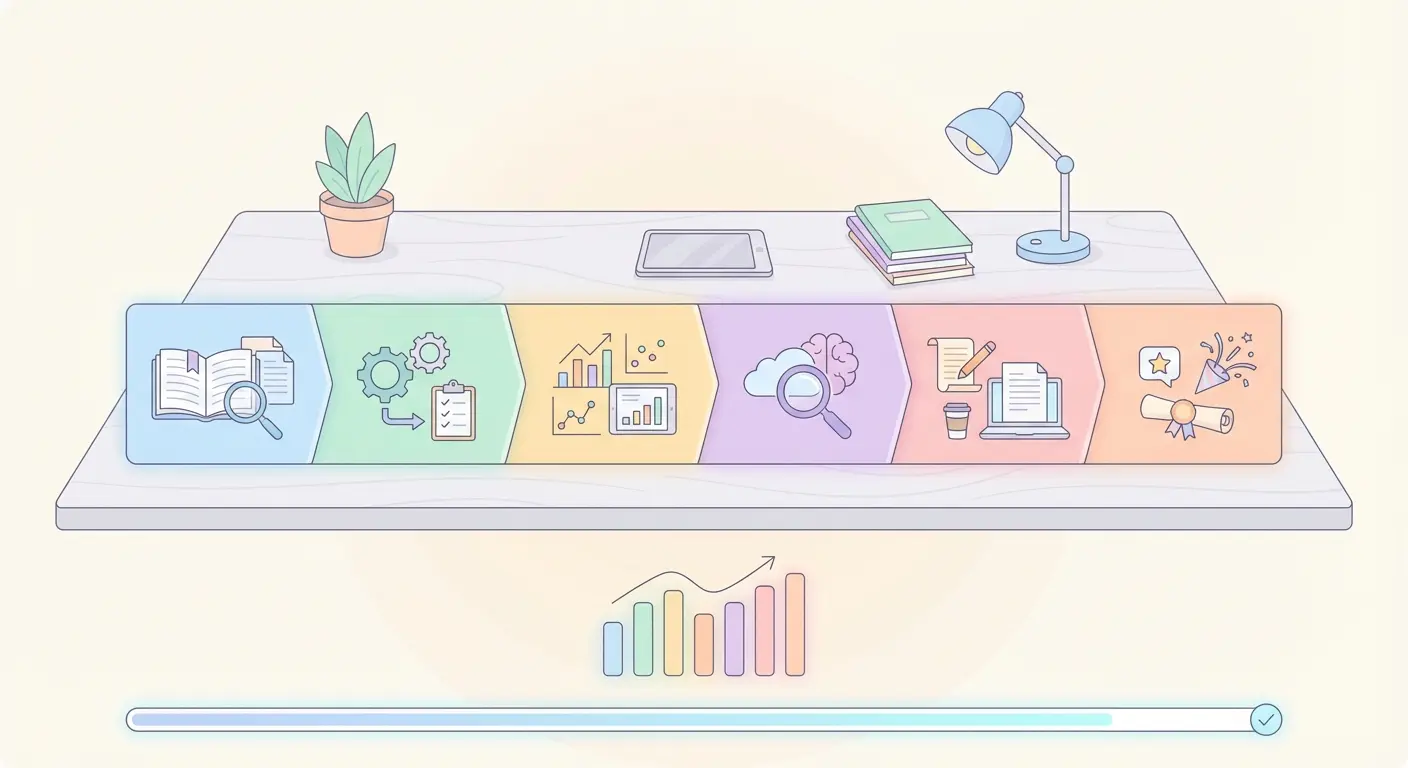
The 6-Week Dissertation Writing Plan (Week by Week)
This plan is calibrated for a 15,000–20,000 word dissertation (master’s level), but the proportions scale up or down for longer or shorter projects. Each week has a primary chapter target and a daily word count goal.
| Week | Primary Focus | Daily Target | Cumulative Words |
|---|---|---|---|
| Week 1 | Literature Review (Part 1) | 600 words/day | ~3,000 |
| Week 2 | Literature Review (Part 2) + Methodology | 700 words/day | ~6,500 |
| Week 3 | Results / Findings Chapter | 700 words/day | ~10,000 |
| Week 4 | Discussion / Analysis Chapter | 750 words/day | ~13,750 |
| Week 5 | Introduction + Conclusion | 600 words/day | ~16,750 |
| Week 6 | Abstract + Full Read-Through + Gap Fill | 400 words/day | ~18,750 |
Notice that Week 6 is not a writing week — it’s a consolidation week. You’re reading through your full draft, filling obvious gaps, writing the abstract, and making the document coherent. Editing and polishing comes later, after submission of the draft to your supervisor.
One counterintuitive but research-backed insight: Inger Mewburn (The Thesis Whisperer) at Australian National University argues that most academics can write 10,000 words in a single day if they already know what they want to say. The planning you do before writing is what determines your output speed, not your typing speed.
Chapter-by-Chapter Breakdown: What to Write and When
Here’s something your supervisor probably won’t tell you directly: the order in which you write chapters is not the order in which they appear in your dissertation. Writing strategically — starting with the chapters where you already have the most content — protects your momentum.
Start With the Literature Review
Most students have already read widely by the time they start drafting. That makes the literature review the logical first chapter to write. You’re not generating new ideas here — you’re organising and critically synthesising what you’ve already consumed.
Structure it thematically, not chronologically. Group sources by the argument they support, the gap they reveal, or the theoretical framework they represent. Aim for 3–5 major thematic sections. The University of Manchester Academic Phrasebank is genuinely excellent for finding precise academic language to frame your synthesis — bookmark it before Week 1.
Write Methodology Second
This is often the most technically straightforward chapter because you’re documenting what you actually did. Write it in past tense, justify every methodological choice, and be specific about your sample, instruments, and analysis approach. Don’t skip the limitations subsection — examiners specifically look for intellectual honesty here.
Results Come Before Discussion
Present your findings without interpretation first. Tables, charts, and descriptive summaries. If you’re writing a humanities or social science dissertation without quantitative data, this chapter becomes your “evidence” chapter — where you present the primary material before you analyse it.
Discussion Is the Heart of Your Dissertation
This is where your original thinking lives. Connect your findings back to the literature review. Explain what’s surprising, what confirms existing theory, and what genuinely new insight your research contributes. This chapter is worth spending extra time on — it’s often the deciding factor between a pass and a distinction.
Write Introduction and Conclusion Last
Both of these chapters require you to know what the dissertation actually says before you can write them well. An introduction written after the body chapters is specific, confident, and purposeful. One written first is usually vague and over-general.
For a detailed structural breakdown with templates, the Purdue OWL Thesis and Dissertation resource remains one of the most reliable free guides available — it covers APA, MLA, and Chicago formatting across all chapter types.
The Daily Writing System That Actually Works
Your daily writing system is the engine of this whole project. Get this wrong and the 6-week plan collapses. Get it right and 700 words before lunch starts to feel routine.
The 3-Block Writing Day
Split your writing time into three distinct blocks, each with a different purpose:
- Morning Block (60–90 min) — New Writing: Write new content only. No editing, no rereading yesterday’s work beyond the last two sentences. Put words on the page. This is your primary output window.
- Midday Block (30 min) — Research and Notes: Read the sources you’ll use tomorrow. Take structured notes. Write mini-summaries in your own words.
- Evening Block (20–30 min) — Planning: Write tomorrow’s bullet points. What specific argument will each paragraph make? You’re front-loading the thinking so tomorrow’s writing is just transcription.
This structure is used — with slight variations — by academics at institutions like Harvard Medical School and University College London to maintain consistent writing output during heavy research periods. It works because it separates cognitively distinct tasks: creation, research, and planning each require different mental modes.
The 500-Word Floor Rule
Never end a writing session with fewer than 500 words produced. Some days you’ll write 1,200 words and feel great. Other days you’ll grind out 510 words that feel terrible. Both days count the same. The floor rule prevents the psychological spiral of “I only wrote a little, so tomorrow I need to write loads, so today doesn’t matter” — which is how drafts die.
Stop Mid-Sentence
Ernest Hemingway famously stopped each day’s writing mid-sentence so he always knew exactly where to start the next day. This is not just literary trivia — it’s a practical strategy that eliminates blank-page anxiety. Try it. It genuinely works.
Tools, Templates, and Resources to Speed Up Drafting
The right tools don’t write your dissertation for you — but they can cut the friction out of almost every non-writing task so you spend more cognitive energy on what actually matters.
Reference Management
Zotero (free) and Mendeley (free) are the most widely used across UK and US universities. Both integrate with Microsoft Word and Google Docs to insert citations and auto-generate bibliographies. Set these up before Week 1 or you will spend Week 6 manually formatting 87 references at 2am.
For more detailed guidance on managing citations efficiently, see this guide on automated citation tools for academic work — the principles apply well beyond Germany.
Writing and Drafting Tools
Scrivener is built specifically for long-form writing projects — it lets you view your chapter skeleton alongside your active draft, which is invaluable when you’re 12,000 words in and need to check your argument thread. Microsoft Word and Google Docs are perfectly adequate if you use heading styles and document outline view.
If you’re in a STEM field or your institution uses LaTeX, Overleaf’s thesis template gallery has university-specific templates for Oxford, Cambridge, Imperial, MIT, and dozens of other institutions — already formatted to spec.
AI Writing Assistance
AI tools can accelerate your literature review synthesis, help rephrase awkward sentences, and generate structural outlines. They shouldn’t write your arguments for you — but they can make the difference between staring at a page for 40 minutes and getting unstuck in 5. For a current breakdown of what’s available, check this guide to the best AI writing tools for dissertations in 2025.
Planning and Structure Tools
If you need help turning a pile of research notes into a coherent chapter structure, planning and structuring your dissertation with intelligent tools walks through how to create a chapter-by-chapter map that keeps your argument coherent from Week 1 to Week 6.
5 Dissertation Writing Mistakes That Kill Momentum
Six weeks is tight enough that any of these five mistakes can derail your entire timeline. Most students make at least two of them. Being aware of the pattern is half the battle.
- Writing and editing simultaneously. This is the single biggest cause of slow progress. When you edit as you write, you’re running two cognitively competing processes at once. Your internal critic shuts down your generative voice. Write first, completely. Edit later, separately.
- Waiting for the “perfect” source before continuing. You find a gap in your literature review and spend two days hunting for one more paper to fill it. Meanwhile, the rest of the chapter waits. Leave a placeholder comment [FIND SOURCE ON X] and keep writing. Fill gaps in Week 6.
- Writing the introduction first. As discussed above, this leads to a vague, over-broad opening that you’ll rewrite entirely anyway. Save yourself the demoralising experience of scrapping 1,500 words of work. Write the introduction in Week 5, after the body chapters exist.
- Treating your supervisor’s feedback as urgent rewrites. If you receive feedback during your 6-week sprint, log it in a separate document and keep writing. You’re producing a draft, not a final submission. Rewrites happen after the full draft is complete.
- Underestimating non-writing time. Your weekly word count target assumes 5 writing days per week. But seminars, part-time work, research tasks, and life happen. Build one buffer day per week into your schedule from the start. Don’t plan to write 7 days a week — you’ll burn out by Day 10.
What to Do After You Finish Your Draft
Finishing your first draft is a genuinely significant achievement — one that most students who enrol in a dissertation module never reach. Take a day off. Actually close the laptop for 24 hours.
Then come back with a structured revision plan:
First Read-Through: Macro Structure
Read the entire draft in one sitting (or two, if it’s very long). Don’t edit sentences yet. You’re checking whether the overall argument flows — does each chapter logically lead to the next? Does your conclusion actually match what your findings say? Mark structural issues with comments, then fix the big problems before polishing sentences.
Second Pass: Chapter-Level Coherence
Each chapter should open with a paragraph that tells the reader what this chapter does and why, and close with a paragraph that summarises the chapter’s contribution and signals the next. Many students skip these signposting sections entirely during drafting. Add them now.
Third Pass: Paragraph-Level Flow
Check that every paragraph has a clear topic sentence and that adjacent paragraphs connect. The “old-new principle” — start each sentence with familiar information, end with new information — dramatically improves academic prose clarity without changing your argument.
Supervisor Submission
When you submit a full draft to your supervisor, include a short cover note identifying three specific areas where you know the draft is weak. This demonstrates academic self-awareness, shows you’ve reflected critically on your own work, and tends to result in more useful feedback. It also manages expectations: you’re submitting a draft, not a finished thesis.
For guidance on everything from proposal to defence, the Grad Coach dissertation writing guide covers the full lifecycle of a research thesis in practical, jargon-free terms.
6-Week Dissertation Writing Checklist
📋 Your 6-Week Dissertation Writing Checklist
Before Week 1 (Setup):
- ☐ One-sentence thesis statement written
- ☐ All sources imported into Zotero/Mendeley
- ☐ Chapter skeleton created (headings + bullet points)
- ☐ 90-minute daily writing blocks booked in calendar
- ☐ Writing environment prepared and tested
Week 1–2: Literature Review
- ☐ 3–5 thematic sections identified
- ☐ Sources grouped by theme in reference manager
- ☐ Critical synthesis written (not just summary)
- ☐ Gap in literature clearly identified
- ☐ Word count target hit: 3,000–6,500 words
Week 2–3: Methodology + Results
- ☐ Research design and approach justified
- ☐ Data collection methods described in detail
- ☐ Findings presented without interpretation
- ☐ Tables/figures titled and labelled
- ☐ Word count target hit: 6,500–10,000 words
Week 4: Discussion
- ☐ Findings connected back to literature review
- ☐ Original contribution clearly stated
- ☐ Unexpected or conflicting findings addressed
- ☐ Limitations section included
- ☐ Word count target hit: 13,750 words
Week 5: Introduction + Conclusion
- ☐ Introduction written after body chapters
- ☐ Research question/objectives clearly stated in introduction
- ☐ Conclusion summarises findings without introducing new material
- ☐ Implications and future research directions included
- ☐ Word count target hit: 16,750 words
Week 6: Consolidation
- ☐ Abstract written (200–350 words)
- ☐ Full draft read through for structural coherence
- ☐ [PLACEHOLDER] comments filled or flagged
- ☐ Bibliography checked in reference manager
- ☐ Draft submitted to supervisor with cover note
Frequently Asked Questions About Dissertation Writing
How long does it take to write a dissertation?
Most master’s dissertations (15,000–20,000 words) take between 3–6 months from first draft to final submission, though a focused first draft can be completed in 6 weeks with consistent daily writing of 600–750 words. Undergraduate dissertations (8,000–12,000 words) can be drafted in 3–4 weeks on the same schedule. The total time depends heavily on whether data collection is still ongoing when drafting begins.
What is the correct structure for a dissertation?
A standard dissertation structure includes: Title Page, Abstract, Table of Contents, Introduction, Literature Review, Methodology, Results/Findings, Discussion, Conclusion, References, and Appendices. Some disciplines (particularly humanities) combine Results and Discussion into a single analytical chapter. Always check your institution’s specific requirements — Oxford, Cambridge, and most Russell Group universities publish official dissertation formatting guides.
Can I write my dissertation introduction last?
Yes — and most experienced academic writers recommend it. Your introduction needs to accurately frame what the dissertation argues, signpost its structure, and establish the research gap. You can only do this confidently after you know what the body chapters actually say. Writing the introduction last typically produces a more focused, specific opening than one written at the start.
How many words should I write per day to finish my dissertation?
For a 6-week draft sprint, 500–750 words per writing day is a sustainable and achievable target for most students. At 600 words per day across 5 days a week, you produce 18,000 words in 6 weeks — enough for a complete master’s dissertation first draft. Trying to write 2,000+ words per day consistently leads to burnout and quality collapse; frequent, shorter sessions outperform sporadic marathon sessions.
What should I do if I’m stuck and can’t write anything?
Writing block during dissertation drafting is almost always caused by one of three things: you don’t know what argument you’re making (go back to your one-sentence thesis), you’re trying to write a perfect final draft instead of a working first draft (lower the bar deliberately), or you haven’t planned tomorrow’s writing today (spend 20 minutes bullet-pointing your next session). The worst thing you can do is wait for inspiration — sit down, write imperfectly, and the momentum will return.
Do I need to use LaTeX for my dissertation?
LaTeX is strongly recommended — and often expected — in STEM, computer science, mathematics, and physics dissertations at most research universities. For social sciences, humanities, and many master’s programmes, Microsoft Word or Google Docs is entirely acceptable. Check your department’s style guide. If your institution requires LaTeX, Overleaf provides university-specific thesis templates that handle all formatting automatically.
Finishing Your Dissertation Draft Is a System Problem, Not a Willpower Problem
Every student who sits down with a dissertation writing plan has enough intelligence to finish it. The ones who struggle aren’t less capable — they’re working without a system. The 6-week plan in this guide gives you the structure that converts research, notes, and expertise into a coherent, complete draft.
The core principles are simple: start with your strongest chapter, write daily rather than in bursts, separate writing from editing, plan tomorrow’s session tonight, and treat your first draft as a working document rather than a masterpiece. None of these ideas are complicated. Executing them consistently over 42 days is the whole job.
You don’t need to write a perfect dissertation. You need to write a complete one. A complete, imperfect draft can be revised. A perfect, unfinished draft cannot be submitted.
Start today. Even 200 words. Your six weeks begins the moment you open the document.
Ready to Structure Your Dissertation Properly?
The six-week plan works best when your chapter structure is solid before you start writing. Explore how intelligent planning tools can turn scattered research notes into a coherent chapter framework — before you write a single sentence.
Plan Your Dissertation Structure →
Explore AI Writing Tools →





Leave a Reply