
What Is the Difference Between a Thesis Statement and a Thesis? A Clear Guide (2026)
One of the most confusing aspects of academic writing for new students is the relationship between a thesis statement and a thesis. These terms are related but refer to very different things — and conflating them leads to genuine problems in academic work. A student who confuses the two might approach a 20,000-word dissertation project as if it were an essay, or fail to understand why a one-sentence argument claim is insufficient as a standalone submission.
This guide provides a clear, definitive explanation of both terms with examples, and explains how they relate to each other and to different levels of academic writing in 2026.
What Is a Thesis Statement?
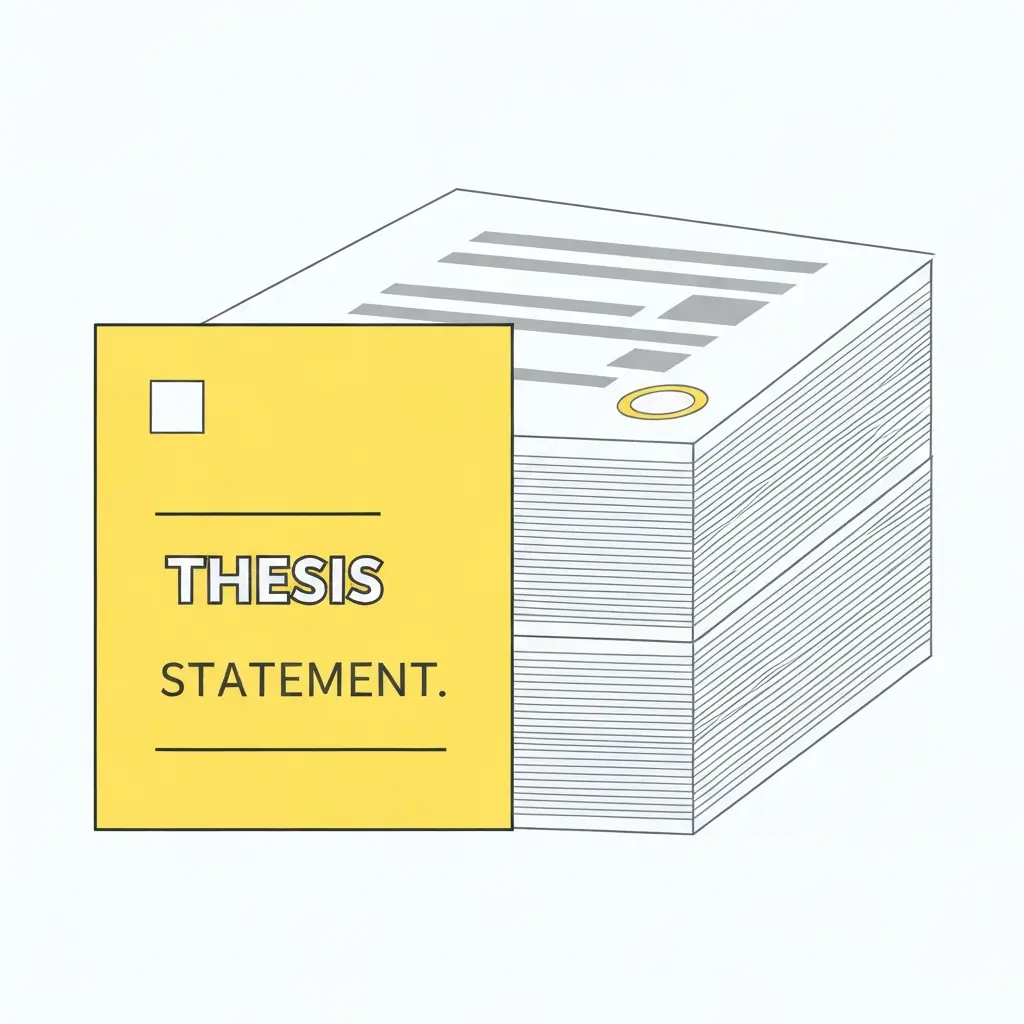
A thesis statement is a concise, declarative sentence — typically one to two sentences long — that states the main argument or central claim of an essay, research paper, or any shorter piece of academic writing. It tells the reader what the paper will argue, not merely what it will discuss.
A thesis statement:
- Presents a specific, arguable position (not a fact or a question)
- Appears near the beginning of the essay, usually at the end of the introduction
- Guides the structure of the argument — every paragraph should relate back to it
- Is specific enough that a reader knows exactly what the paper will argue
- Can be challenged or disagreed with by a reasonable person
A thesis statement is a feature of essay-length writing — typically assignments of 1,000–5,000 words. It is different from a research question (which asks something to be investigated) and different from a topic sentence (which introduces a single paragraph).
What Is a Thesis (the Document)?
A thesis, when used to mean the full academic document, refers to a formal, extended research project submitted in partial or full fulfilment of a degree. This includes:
- Undergraduate dissertation: 8,000–15,000 words; original research at a basic level
- Master’s thesis: 15,000–50,000 words; advanced research demonstrating subject mastery
- PhD thesis (doctoral thesis): 40,000–100,000+ words; an original contribution to human knowledge
A thesis document contains multiple chapters (introduction, literature review, methodology, results, discussion, conclusion), a bibliography, and often appendices. It is the product of months or years of systematic research. It is submitted for examination and typically defended in an oral examination (viva voce).
If you are writing a full thesis or dissertation, tools like Tesify’s AI thesis writing platform can help you structure and draft every chapter with academic precision. For specific guidance in other languages: German students can visit Tesify DE for Bachelorarbeit guidance; Portuguese and Brazilian students can find TCC resources at Tesify PT.
Key Differences at a Glance
| Feature | Thesis Statement | Thesis (Document) |
|---|---|---|
| Length | 1–2 sentences | 15,000–100,000+ words |
| What it is | A claim or argument | A complete research document |
| Where it appears | In the introduction of an essay | Submitted as a standalone document for a degree |
| Purpose | States the main argument | Presents original research |
| Contains research? | No — it’s a single claim | Yes — literature review, methodology, data, analysis |
| For what assignment? | Essays (1,000–5,000 words) | Dissertations and research degrees |
Examples of Strong Thesis Statements
Understanding what makes a thesis statement strong is as important as knowing what it is. Here are examples in different disciplines:
History: “The Treaty of Versailles created the conditions for the Second World War not primarily through its economic penalties but through the psychological humiliation it imposed on German national identity.”
Literature: “In 1984, Orwell constructs the telescreen not merely as a surveillance device but as a metaphor for the internalisation of state power — a process that renders external coercion redundant once citizens have learned to police themselves.”
Social Science: “Remote work policies that prioritise employee autonomy, rather than simply providing access to home working, produce significantly better mental health outcomes among UK service sector workers.”
What makes each strong: Each is specific, arguable, and tells the reader exactly what the paper will claim. None is a fact, a question, or a vague topic description.
Where Does the Thesis Statement Appear?
In most essay structures, the thesis statement appears at the end of the introduction — after you have established context and before the body paragraphs begin. In shorter essays (500–1,000 words), it may be the first or second sentence. In longer essays (3,000–5,000 words), the introduction may be several paragraphs long, with the thesis statement providing the transition into the main body.
Do Research Theses Also Have Thesis Statements?
Yes, in a sense. The introduction of a full thesis document typically contains a clear statement of the research aim, research questions, and the central argument or contribution the thesis will make. This functions similarly to a thesis statement but is more expansive — it outlines the entire scope of the research rather than reducing it to a single sentence. Some academic writers explicitly include a “central argument” or “contribution to knowledge” statement that parallels the function of a thesis statement in essay writing.
US vs. UK Terminology Differences
The terminology can be confusing because the UK and US use these terms differently:
- In the UK, a “thesis” typically refers specifically to a doctoral (PhD) document; a master’s document is usually called a “dissertation”
- In the US, the terminology is often reversed: “dissertation” is the doctoral work; “thesis” is the master’s work
- A “thesis statement” (the single sentence) is used identically in both UK and US academic writing
Writing Tips for Both
Writing a Strong Thesis Statement
- Make it arguable — it should state a position, not a fact
- Be specific — “Shakespeare uses language to convey emotion” is too vague; “Shakespeare’s use of iambic pentameter in Hamlet enacts the tension between rational control and emotional chaos” is specific
- Write it last — draft the rest of your essay first, then refine the thesis statement to accurately reflect what you have argued
- Keep it concise — one to two sentences
Planning Your Full Thesis Document
- Start with your research question — the whole document answers this
- Structure your chapters before you start writing individual sections
- Use Tesify’s thesis writing AI to help draft chapter outlines and develop arguments
- Write the abstract and introduction last — you cannot summarise a thesis you haven’t yet written
Frequently Asked Questions
How long should a thesis statement be?
A thesis statement should be one to two sentences long — typically 25–50 words. It must be specific enough to state your position clearly without becoming so long that it summarises your entire argument. If your thesis statement is running to three or four sentences, you are likely trying to include too much detail — pare it back to the single central claim.
Can a thesis statement be a question?
No. A thesis statement must be a declarative statement that takes a position — not a question. A question is a research question, not a thesis statement. “Is social media harmful to democracy?” is a research question. “Social media platforms have undermined democratic discourse by enabling selective exposure to information that reinforces existing political beliefs” is a thesis statement that answers that question.
Does every essay need a thesis statement?
In argumentative and analytical essays, yes — the thesis statement is essential. In some descriptive or narrative essays, a controlling idea replaces the explicit thesis statement, but an equivalent central purpose still exists. In UK A-level and undergraduate essays, some disciplines (particularly history and English) expect an explicit thesis statement; others are more flexible. Check your assignment guidelines or ask your tutor.
What is the difference between a thesis and a dissertation?
In the UK, a thesis typically refers to a doctoral research document (PhD thesis), while a dissertation is the research project submitted for a master’s or undergraduate degree. In the US, the terminology is reversed: a dissertation is the doctoral work, and a thesis is the master’s work. Both refer to extended original research documents submitted for academic degrees — the terminology simply varies by country and institution.
Where should the thesis statement go in an essay?
The thesis statement typically appears at the end of the introduction — after you have established the topic context and before the main body arguments begin. In a short essay (500–1,500 words), this is often in the first paragraph. In a longer essay (3,000+ words), the introduction may span several paragraphs before the thesis statement appears. Some academic traditions (particularly in UK humanities) prefer the thesis to emerge gradually through the argument rather than being stated explicitly upfront — check your discipline’s conventions.
Writing a Thesis? Tesify Has You Covered
Whether you’re crafting a thesis statement for an essay or writing a full 60,000-word doctoral thesis, Tesify provides AI-powered academic writing support designed for university students. Structure your argument, generate citations, and write with confidence.





Leave a Reply