
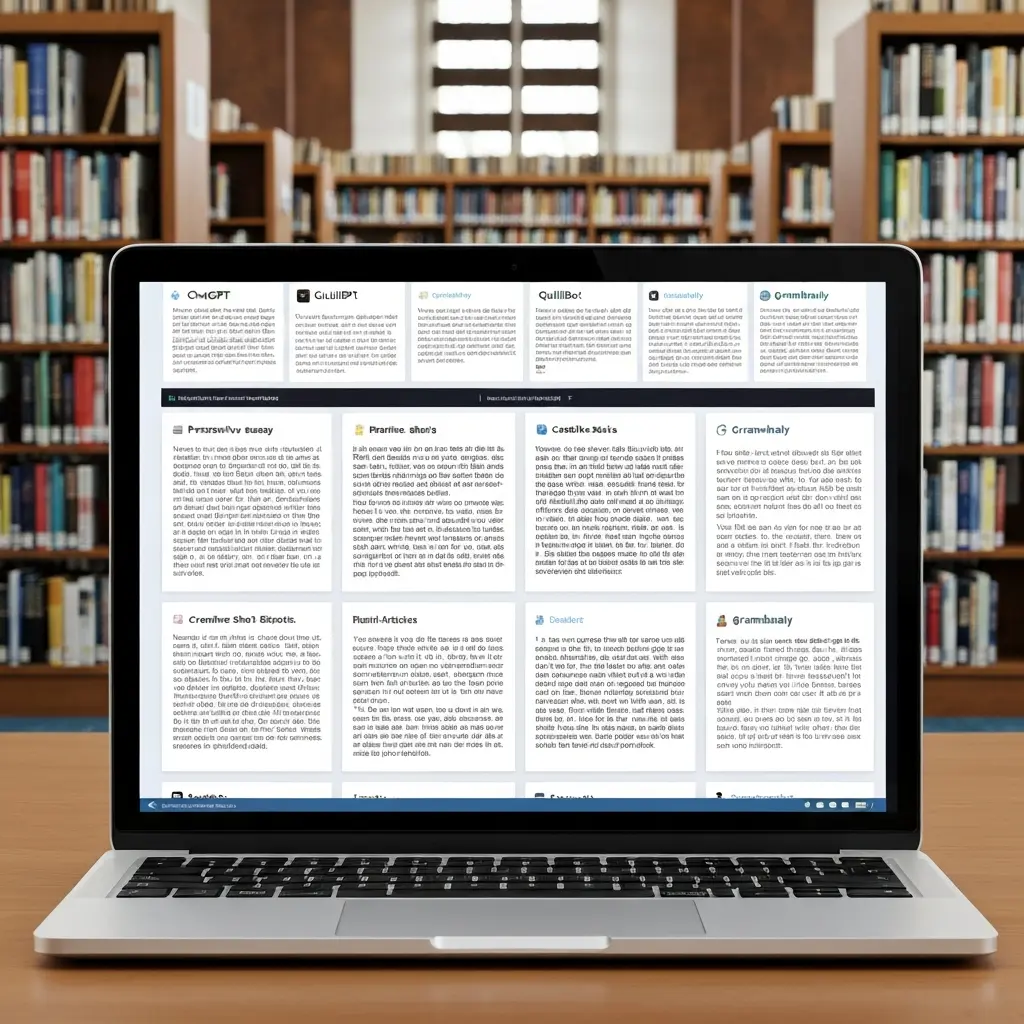
ChatGPT Alternative for Academic Writing: Best Options in 2026
ChatGPT is the most widely known AI writing tool on the planet — but it was not designed for academic writing, and the gap shows. It fabricates citations, ignores institutional style guides, produces text that reads generically, and has no mechanism for plagiarism avoidance. For a casual email or a marketing brief, these limitations barely matter. For a dissertation, a thesis, or a journal submission, they can be catastrophic.
The search for a reliable ChatGPT alternative for academic writing has intensified as universities have tightened their AI policies and students have discovered that general-purpose AI tools create as many problems as they solve. This guide evaluates the leading alternatives — what each does well, what it does not, and which type of student it is best suited for in 2026.
Why ChatGPT Falls Short for Academic Work
To be precise: ChatGPT (specifically GPT-4o and its successors) is a powerful general-purpose language model. The problems arise specifically in academic contexts:
- Hallucinated citations: ChatGPT regularly produces plausible-sounding but entirely fabricated references — wrong authors, wrong journals, wrong years, non-existent DOIs. Submitting these is academic fraud, even if unintentional.
- No plagiarism check: ChatGPT does not know whether its output is similar to existing published work. Students who submit ChatGPT-generated text have found it flagged by Turnitin for similarity to sources ChatGPT was trained on.
- Generic academic voice: GPT output in academic mode tends toward formulaic phrasing that experienced readers — especially examiners — recognise immediately.
- No citation style compliance: ChatGPT cannot reliably produce APA 7th, Harvard, or Chicago-formatted references without significant errors.
- No institutional context: ChatGPT does not know your university’s requirements, your programme’s expectations, or your supervisor’s feedback.
Tesify Write — Built for Students
Tesify is an AI writing platform designed specifically for academic use. Unlike general-purpose tools, it integrates writing assistance with plagiarism checking and automatic bibliography generation in a single environment.
What Tesify does well:
- Provides structured writing assistance for thesis chapters without generating text you submit verbatim
- Generates accurate references in APA, Harvard, MLA, Chicago, and Vancouver from DOI or URL input
- Checks your draft for plagiarism against academic databases before you submit to your institution
- Supports academic English for non-native speakers without homogenising their voice
- Operates within the boundaries of academic integrity policies
Best for: Students writing dissertations, theses, or research papers who want comprehensive academic support in a single tool. Available in English, French (tesify.fr), Spanish (tesify.es), and German (tesify.io).
Elicit — AI Research Assistant
Elicit is an AI research tool that finds relevant academic papers, extracts key information, and summarises findings across multiple studies. It is not a writing tool — it will not help you draft prose. But for the literature review phase, it is exceptional.
What Elicit does well:
- Finds papers from Semantic Scholar’s database of 200+ million academic articles
- Extracts specific data points from papers (study design, sample size, key findings)
- Synthesises findings across multiple papers for a given research question
- Generates accurate citations for every paper it surfaces
Limitation: It does not write — it researches. You still need a writing tool.
Consensus — Evidence-Based AI Search
Consensus is a search engine that answers questions with evidence from peer-reviewed research. Ask “Does exercise improve academic performance?” and Consensus returns a synthesis of what the research says, with citations to real papers. It is excellent for quickly establishing what the literature says on a specific question — and for finding sources to support or challenge your arguments.
Best for: Early-stage literature search, finding evidence for specific claims, checking whether a hypothesis has prior support in the literature.
Perplexity — AI with Citations
Perplexity is a search-driven AI that provides cited answers — every claim links to a source. It is more accurate than ChatGPT for factual queries because it retrieves information from current sources rather than generating from training data.
Academic use case: Background research on a topic, finding recent news and developments, checking facts. Not suitable for generating academic prose — but better than ChatGPT for research starting points.
Claude — Nuanced Writing Assistance
Anthropic’s Claude is widely considered the most nuanced large language model for extended writing tasks. It maintains context across long documents, produces prose that is less formulaic than ChatGPT, and is less likely to generate confident-sounding false information.
Academic use case: Revising and clarifying your own prose, restructuring arguments, generating outlines, discussing research methodology. Like ChatGPT, it does not produce citations and requires verification of any factual claims.
Feature Comparison Table
| Tool | Writing Assistance | Real Citations | Plagiarism Check | Academic-Specific |
|---|---|---|---|---|
| Tesify | Yes | Yes (auto-generated) | Yes (built-in) | Yes |
| Elicit | No | Yes | No | Yes (research only) |
| Consensus | No | Yes | No | Yes (research only) |
| Perplexity | Limited | Yes (web sources) | No | No |
| Claude | Yes | No | No | No |
| ChatGPT | Yes | No (hallucinated) | No | No |
For more on AI thesis writing tools, see our guide on how AI thesis writers are changing academic writing in 2026 and our review of AI academic writing tools compared.
Frequently Asked Questions
What is the best ChatGPT alternative for writing a dissertation?
Tesify is the best purpose-built alternative for dissertation writing — it combines AI writing assistance with plagiarism checking and automatic bibliography generation in a single academic-focused platform. For literature research specifically, Elicit and Consensus are excellent complements. No single tool does everything; the most effective approach uses specialised tools for each phase of the dissertation process.
Does ChatGPT give fake references?
Yes, frequently. ChatGPT “hallucinates” citations — generating plausible-looking but non-existent references with real author names, journal titles, and volume numbers, but incorrect details or entirely fabricated papers. Never use a reference from ChatGPT without verifying it exists via Google Scholar, your library database, or DOI lookup. Submitting fabricated references is academic misconduct.
Is there a free ChatGPT alternative for academic writing?
Elicit offers a free tier with limited queries. Consensus has a free version. Perplexity is free for basic use. Tesify offers free access to start — no subscription required to try its core features. Claude.ai offers a free tier. The most capable versions of all these tools require a paid subscription for unlimited access.
Can universities detect if I used ChatGPT or an AI alternative?
Yes, with increasing accuracy. Turnitin’s AI detection, GPTZero, and institutional review processes can identify AI-generated text with high reliability. More importantly, experienced academics often recognise AI writing patterns without needing a detector — generic phrasing, absent specificity, and a distinctive “smoothness” are common tells. Detection risk aside, AI-written work typically lacks the analytical depth that earns high marks.
What AI tools are allowed for academic writing?
Policies vary by institution and are updated frequently. Generally permitted in 2026: AI for grammar checking (Grammarly), reference management (Zotero, Tesify Auto Bibliography), literature search (Elicit, Consensus), and proofreading. Generally prohibited: submitting AI-generated text as your own work. Always check your specific institution’s AI use policy — many require disclosure of AI tools used even when they are permitted.





Leave a Reply