
Can You Use AI to Write Your Dissertation and Still Pass the Viva? (2026 Guide)
Can I use AI to write my dissertation? In 2026, this is no longer a simple yes-or-no question — it depends on which university you attend, which department you are in, what kind of AI assistance you are using, and, critically, what “writing my dissertation” actually means. The more urgent question for doctoral students is one that most discussions ignore: even if AI-assisted text passes plagiarism detection software, will you be able to defend your dissertation in a viva voce examination when an examiner probes the arguments you did not personally develop?
This guide addresses the full landscape: what universities allow in 2026, what detection tools actually catch, what examiners are trained to probe, and how to use AI assistance in ways that genuinely support your dissertation success rather than creating a trap you walk into at the worst possible moment.
What Universities Actually Allow in 2026
University policies on AI use in dissertations have evolved rapidly since 2022. The current landscape as of March 2026 shows significant institutional variation:
| Policy Type | % of Universities | Typical Stance |
|---|---|---|
| Blanket prohibition | ~8% | No AI tools permitted for dissertation at any stage |
| Restricted (task-specific ban) | ~34% | AI permitted for editing/search; not for content generation |
| Disclosure required | ~41% | AI use permitted with mandatory disclosure in appendix |
| No formal policy | ~17% | Default to pre-existing academic integrity standards |
The most significant trend is the growth of “disclosure required” policies — now the most common approach. Rather than banning AI entirely (unenforceable and increasingly counterproductive), universities are requiring students to document what AI tools they used, for what purpose, and what content was AI-assisted. This creates a disclosure requirement analogous to the use of statistical software or research assistance.
However, even institutions with “disclosure required” policies typically specify that the intellectual argument, analysis, and conclusions must be the student’s own. Using AI to generate the argumentative content of your literature review or discussion chapter remains a violation regardless of whether you disclose it, because the intellectual contribution is not yours.
The Viva Problem: Why AI-Written Dissertations Fail Oral Defenses
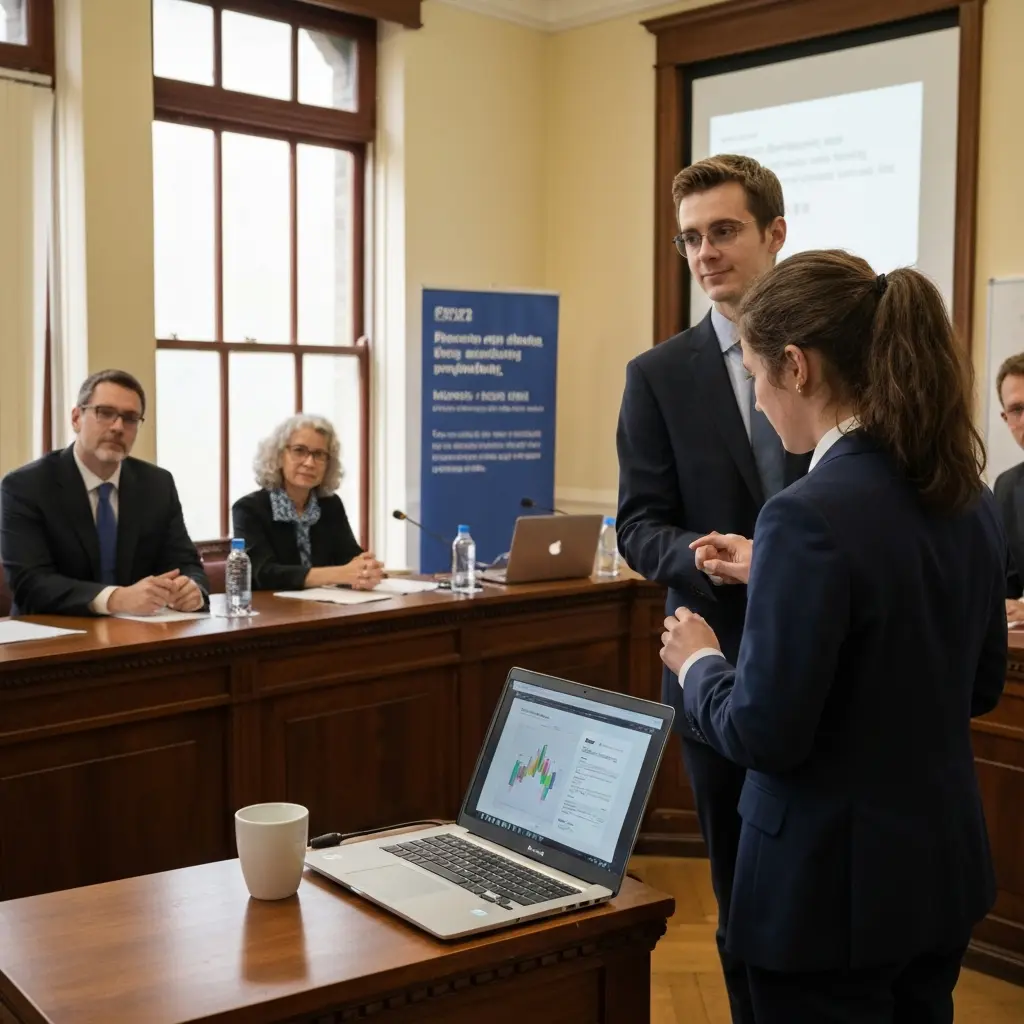
The viva voce (oral defense) creates a fundamental accountability mechanism that written plagiarism detection cannot replicate. In a viva, examiners probe whether the candidate understands, can defend, and can extend the arguments in their dissertation. Students who used AI to generate arguments they do not fully understand face a problem that begins the moment the examiner asks “can you explain in your own words why you argued X rather than Y?”
University of Cambridge examining guidelines (2024) specifically state that examiners are trained to probe for:
- The candidate’s ability to explain the reasoning behind argumentative choices in their own words
- Knowledge of the primary literature that the dissertation claims to be based on
- Understanding of the methodological limitations and why specific choices were made
- The ability to extend arguments to new cases or evidence not in the dissertation
These probes are specifically designed to distinguish students who wrote their dissertation from students who had it written for them — whether by a human ghost-writer or an AI system. Detection tools check the text; examiners check the student.
What Detection Tools Actually Catch
The technical capabilities of AI detection tools matter for students making risk assessments. Current detection tools in 2026:
- Highly accurate for: Large blocks of unmodified AI-generated text; characteristic AI sentence structures; citation patterns inconsistent with the student’s sourcing
- Moderately accurate for: AI-generated text that has been manually edited; text from multiple AI generation sessions interspersed with human writing
- Low accuracy for: AI-assisted writing where the student’s own voice and analysis are primary; editing assistance on human-written drafts; brainstorming-to-human-writing workflows
The practical implication: using AI as a scaffold for your own writing (generating outline, suggesting phrasing options, improving grammar of your drafts) is both less detectable and, per the academic integrity framework, genuinely appropriate. Using AI to produce substantive content is both more detectable and academically inappropriate — creating a doubly bad outcome.
How to Use AI Legitimately for Your Dissertation
The following uses of AI assistance are generally permitted under most institutional policies and do not create viva defense problems because the intellectual content remains genuinely yours:
Literature Discovery
Using Elicit, Consensus, or Semantic Scholar to identify relevant papers, synthesize findings across large literature bodies, or map research gaps. You read the papers; the AI helps you find them more efficiently. Tesify integrates research discovery with the writing process, ensuring the literature you find directly informs your drafting.
Structural Feedback
Asking AI to evaluate the logical structure of your argument, identify gaps in your reasoning, or suggest organizational improvements — before you write, not to replace writing. This parallels the feedback role of a writing group or supervisor, and most institutions consider it appropriate.
Grammar and Language Editing
Using AI tools for grammar correction, sentence clarity improvement, and academic register consistency. This is analogous to professional proofreading and is permitted universally. Tools like Paperpal and Grammarly Academic specialize in this role.
Citation Formatting
Using Zotero, Mendeley, or Tesify’s citation tools to format references correctly. This is considered appropriate everywhere — the intellectual work of identifying which sources to cite is yours; the formatting assistance is mechanical.
Drafting Scaffolding
Using Tesify to draft initial sections based on your research notes and sources, which you then substantively revise, extend with your own analysis, and make genuinely your own. This is the most contested area, but increasingly recognized as acceptable with disclosure when the student’s analytical contribution is primary.
AI Disclosure Requirements: What You Must Declare
Under the emerging standard (required at Cambridge, Oxford, UCL, and many US research universities), dissertation AI use disclosures should include:
- The specific AI tools used
- For what tasks they were used
- At which stage of the dissertation process
- What content or sections were AI-assisted
- How the AI output was reviewed, verified, and integrated into the student’s own work
A sample disclosure statement: “AI writing assistance (Tesify) was used for initial structural drafting in Chapters 3 and 4. All AI-generated text was reviewed, substantially revised, and extended with my own analysis. All citations were verified against original sources. The intellectual argument and conclusions are my own.”
AI Use Rules by Dissertation Chapter Type
| Chapter | AI Use — Generally Permitted | AI Use — Generally Restricted |
|---|---|---|
| Introduction | Grammar editing, structure feedback | Generating research problem statement |
| Literature Review | Paper discovery, synthesis summaries for review only | Generating critical analysis of literature |
| Methodology | Formatting, grammar, structure | Justifying methodological choices |
| Results/Analysis | Data visualization assistance, grammar | Interpreting and explaining findings |
| Discussion/Conclusion | Grammar, structure checking | Generating arguments and implications |
For a comparison of tools appropriate for each of these use cases, see our comparison of the best AI thesis writing tools. French-language students can consult our guide on Tesify vs ChatGPT for mémoire writing.
Frequently Asked Questions
Can I use AI to write my dissertation?
You can use AI to assist with your dissertation — for research discovery, grammar editing, structural feedback, and drafting scaffolding. Using AI to generate the intellectual arguments and analysis in your dissertation is problematic under most institutional policies and creates viva defense risks. The key test: is the intellectual argument genuinely yours, and can you defend it in oral examination without the AI?
Will examiners know if AI wrote my dissertation?
Experienced examiners use multiple signals: AI detection software, style inconsistencies in the written text, and — most tellingly — probing questions in the viva that reveal whether the candidate understands the arguments in their dissertation. A 2025 survey found 71% of UK doctoral examiners reported noticing suspected AI-generated content in at least one recent dissertation. Text detection tools are supplemented by human judgment.
What happens if you use AI in a dissertation without disclosure?
Consequences vary by institution but typically escalate with the severity of undisclosed use. Minor undisclosed editing assistance may result in warnings or disclosure requirements. Significant undisclosed AI generation of content is typically treated as academic misconduct, with consequences ranging from required revision to degree revocation depending on severity and the institution’s policy. Proactive disclosure before submission is always preferable to post-discovery penalties.
Do all universities have the same AI policy for dissertations?
No — policies vary significantly. As of 2026, approximately 8% have blanket prohibitions, 34% restrict AI to non-content tasks, 41% require disclosure of AI use, and 17% have no formal policy. Students must check their specific institution’s current policy, as policies are evolving rapidly and what was true in 2023 may not apply today.
What AI tools are safe to use for dissertation research?
Tools generally considered safe and appropriate under most institutional policies include: Elicit and Consensus (literature discovery), Zotero and Mendeley (citation management), Grammarly Academic and Paperpal (grammar and language editing), and Tesify (structured drafting assistance from your own uploaded sources). Using these tools transparently for their designated purposes — with appropriate disclosure — is legitimate academic assistance.



Leave a Reply