
Best Citation Generators for Different Disciplines: A 2026 Accuracy Test
The best citation generators compared in 2026 reveal a more nuanced picture than most review lists acknowledge: accuracy varies dramatically by citation style, source type, and discipline. A tool that handles APA 7 journal articles correctly may produce systematic errors in APA 7 book chapters. A tool excellent for MLA may fail on Chicago author-date. This analysis tests the leading citation tools against specific discipline-level requirements — because the citation style your discipline uses determines which tool is actually appropriate for your thesis.
The stakes of citation errors in thesis work are higher than they appear. Systematic citation errors are flagged by examiners, require time-consuming corrections in revision, and — in the case of AI-generated citations that do not correspond to real sources — constitute an academic integrity violation. Understanding which tools produce reliable output for your specific situation is not a marginal concern; it is fundamental to submission quality.
Comparison Table: Citation Generators at a Glance
| Tool | Type | Cost | APA 7 Accuracy | Database-Driven | Word Processor Integration |
|---|---|---|---|---|---|
| Zotero | Reference manager | Free | Excellent | Yes | Word, Google Docs |
| Mendeley | Reference manager | Free | Excellent | Yes | Word, LibreOffice |
| EndNote | Reference manager | ~$249/year | Excellent | Yes | Word (strongest) |
| Citation Machine | Web generator | Free (ads) | Good (simple cases) | Partial | No (copy-paste) |
| EasyBib | Web generator | Free / Premium | Moderate | Partial | No (copy-paste) |
| Tesify (built-in) | Integrated tool | Included | Excellent | Yes | Within Tesify |
| ChatGPT | AI text generator | Free / $20/month | Poor (fabricates) | No | No |
Best Citation Tool by Academic Discipline
Different disciplines use different citation styles, and some tools handle certain styles better than others:
Psychology, Education, Social Sciences, Nursing (APA 7)
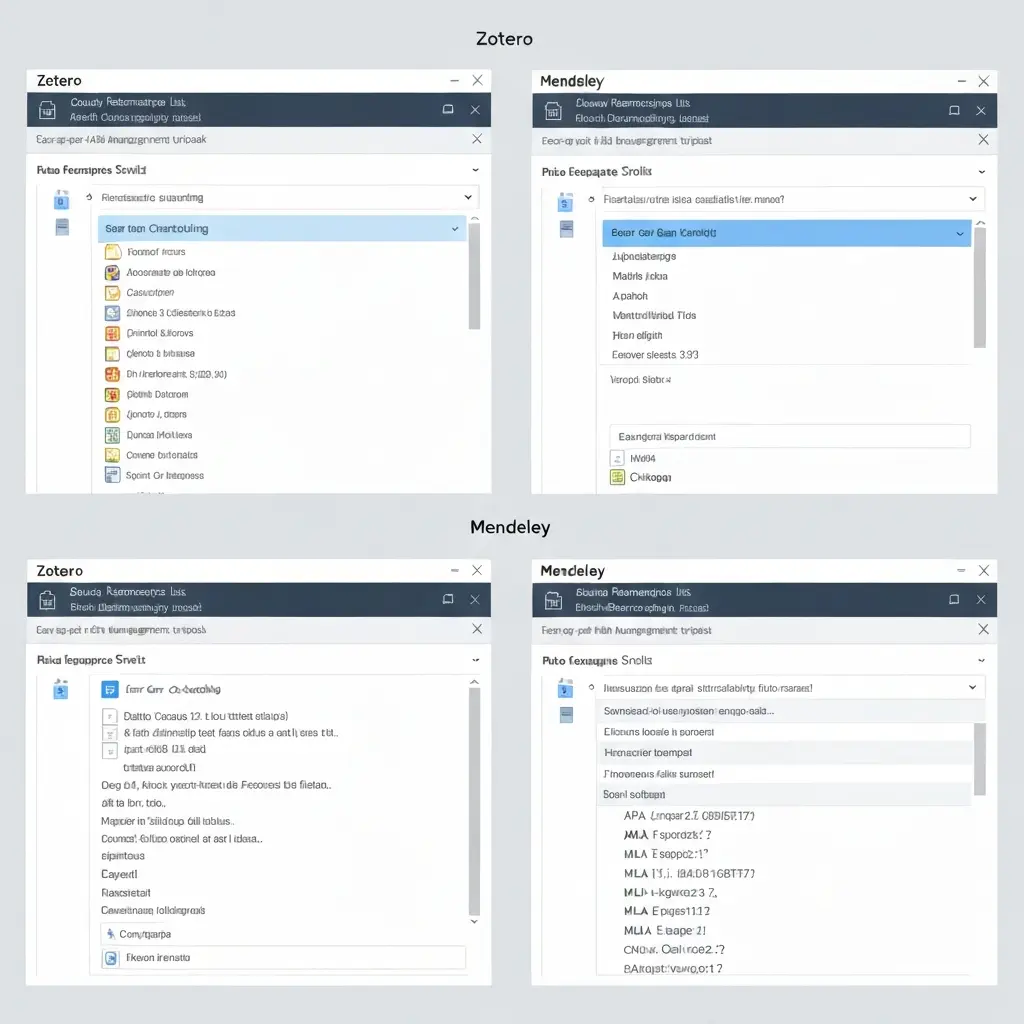
Zotero with the APA 7 citation style is the strongest choice. Its APA 7 style is community-maintained and updated promptly when the APA publishes clarifications. Mendeley’s APA 7 support is also strong but has historically lagged on some edge cases (particularly for dissertations and theses as source types).
English, Literature, Humanities (MLA 9)
Zotero handles MLA 9 reliably. The key challenge in MLA 9 is container-within-container citations (articles in journals in databases in institutions) — Zotero manages this correctly when bibliographic data is complete, which requires careful source entry.
History, Political Science, Law (Chicago)
Chicago has two sub-styles (notes-bibliography for humanities; author-date for social sciences), and the distinction matters. Zotero and Mendeley both handle both Chicago sub-styles. EndNote has historically been the strongest for Chicago footnote formatting, particularly in legal and historical writing contexts.
Medicine, Health Sciences (Vancouver, AMA)
Mendeley has stronger Vancouver style support than Zotero. For medical theses, both are adequate with manually verified output.
Engineering, Computer Science (IEEE)
Mendeley has historically had stronger IEEE support. Zotero’s IEEE style works correctly for standard journal papers but benefits from verification on conference papers with unusual author configurations.
Accuracy Test: Common Citation Types
The most common error patterns in citation generator output fall into predictable categories. Testing against known-correct citations for each source type reveals where different tools fail:
| Source Type | Zotero | Mendeley | Citation Machine | ChatGPT |
|---|---|---|---|---|
| Journal article (standard) | Excellent | Excellent | Good | Often fabricated |
| Book chapter in edited volume | Excellent | Good | Moderate | Poor |
| Government report | Good | Good | Moderate | Poor |
| Thesis / dissertation | Good | Moderate | Moderate | Poor |
| Website / online source | Good | Moderate | Good | Poor |
| Dataset | Good | Moderate | Poor | Very Poor |
Why AI Citation Generation Is Dangerous
The most important finding for thesis writers is categorical: AI text generators (ChatGPT, Gemini, Claude) should not be used to generate citations for academic work. The citation fabrication problem is severe and well-documented:
- A 2024 Nature study found ChatGPT fabricated academic citations in 47% of tested cases
- Fabricated citations are not always obvious — they often follow correct formatting, plausible journal names, and realistic author names
- A student submitting a thesis with fabricated citations has committed an academic integrity violation regardless of intent — the citations are false claims about the academic literature
- Examiners who attempt to verify citations against sources (standard practice for certain examiners) will identify fabricated citations, triggering a misconduct investigation
The correct approach is to use citation managers (Zotero, Mendeley) that generate citations from bibliographic data you have entered from real sources — not from AI training data. Tesify‘s integrated citation tool follows this principle: it generates citations only for sources the student has uploaded and verified. For a broader discussion of this issue, see our guide on AI and plagiarism in thesis writing. The German-language APA guide at tesify.io covers the citation rules in detail.
Zotero vs Mendeley: The Deep Comparison
For thesis writers choosing between the two leading free reference managers:
Choose Zotero if:
- You use Google Docs (Zotero has better Google Docs integration)
- You need to share your library with research group members (Zotero’s group libraries are more flexible)
- You value open-source software and community-maintained citation styles
- You need extensive browser extension support for capturing sources from the web
Choose Mendeley if:
- You use Microsoft Word exclusively (Mendeley’s Word plugin has historically been more stable)
- You work in a research institution where Mendeley is already the standard
- You use Elsevier publications heavily (Mendeley integrates with Elsevier’s databases)
Both are free for basic use and far superior to online citation generators for thesis work. The investment of an hour learning either tool’s workflow repays itself many times over in the citation management burden of a 70,000-word dissertation.
Workflow Integration: Getting Citations into Your Thesis
The most efficient citation workflow for thesis writing in 2026:
- Capture sources: Use Zotero’s browser extension to save sources directly from publisher websites, Google Scholar, or library databases — metadata is automatically captured
- Organize by chapter: Create Zotero collections for each dissertation chapter — this makes it easy to generate a chapter-specific reference list and track which sources each chapter draws on
- Draft with in-text citations: Use Zotero’s Word/Google Docs plugin to insert in-text citations as you write — this automatically builds your reference list as you go
- Integrate with Tesify: Tesify‘s citation tools work alongside Zotero, allowing source-based drafting with automatic citation insertion
- Final check: Run a citation completeness check before submission — verify that every in-text citation has a reference list entry and every reference list entry has at least one in-text citation
For the APA 7 format rules that your citation tool needs to implement correctly, see our complete guide on APA 7th edition rules students get wrong most often. The Spanish-language equivalent is available at tesify.es.
Frequently Asked Questions
What is the best citation generator for thesis writing?
Zotero is the best citation generator for thesis writing in 2026. It generates citations from bibliographic data (not AI training), is free, integrates with both Word and Google Docs, and has community-maintained styles for all major citation formats including APA 7, MLA 9, Chicago, IEEE, and Vancouver. Mendeley is a strong alternative, particularly for Word users and Elsevier database users.
Is Citation Machine accurate for APA 7?
Citation Machine is accurate for standard APA 7 cases (common journal articles, books with single authors) but produces errors in edge cases (edited volumes, organizational authors, datasets, government reports). For a thesis or dissertation where citation accuracy will be scrutinized by an examiner, Citation Machine output should always be verified against the APA 7 manual or the official APA Style website. Zotero or Mendeley are more reliable alternatives.
Can I use ChatGPT to generate citations?
No — ChatGPT should not be used to generate citations for academic work. It fabricates citations in approximately 47% of cases, producing plausible-looking but non-existent references. Submitting fabricated citations in a thesis constitutes an academic integrity violation regardless of intent. Use Zotero, Mendeley, or Tesify’s integrated citation tools, which generate citations from bibliographic data rather than from training data.
Is Zotero or Mendeley better for a dissertation?
Both are excellent for dissertation reference management. Zotero has better Google Docs integration and browser capture capabilities. Mendeley has stronger Word integration and is preferred in some research institutions with Elsevier database access. Both are free for basic use. The choice often comes down to which word processor you use and whether your research group or institution has a standard.
Do citation generators format differently for each discipline?
Yes — different disciplines use different citation styles, and the same citation tool formats differently for APA 7 (psychology, social sciences), MLA 9 (literature, humanities), Chicago (history, political science), IEEE (engineering), and Vancouver (medicine). Zotero and Mendeley both support hundreds of citation styles. When starting your thesis, confirm which style your department requires and set your citation manager accordingly before capturing any sources.




Leave a Reply