
AI in Academic Writing Statistics 2026: Key Data and Trends
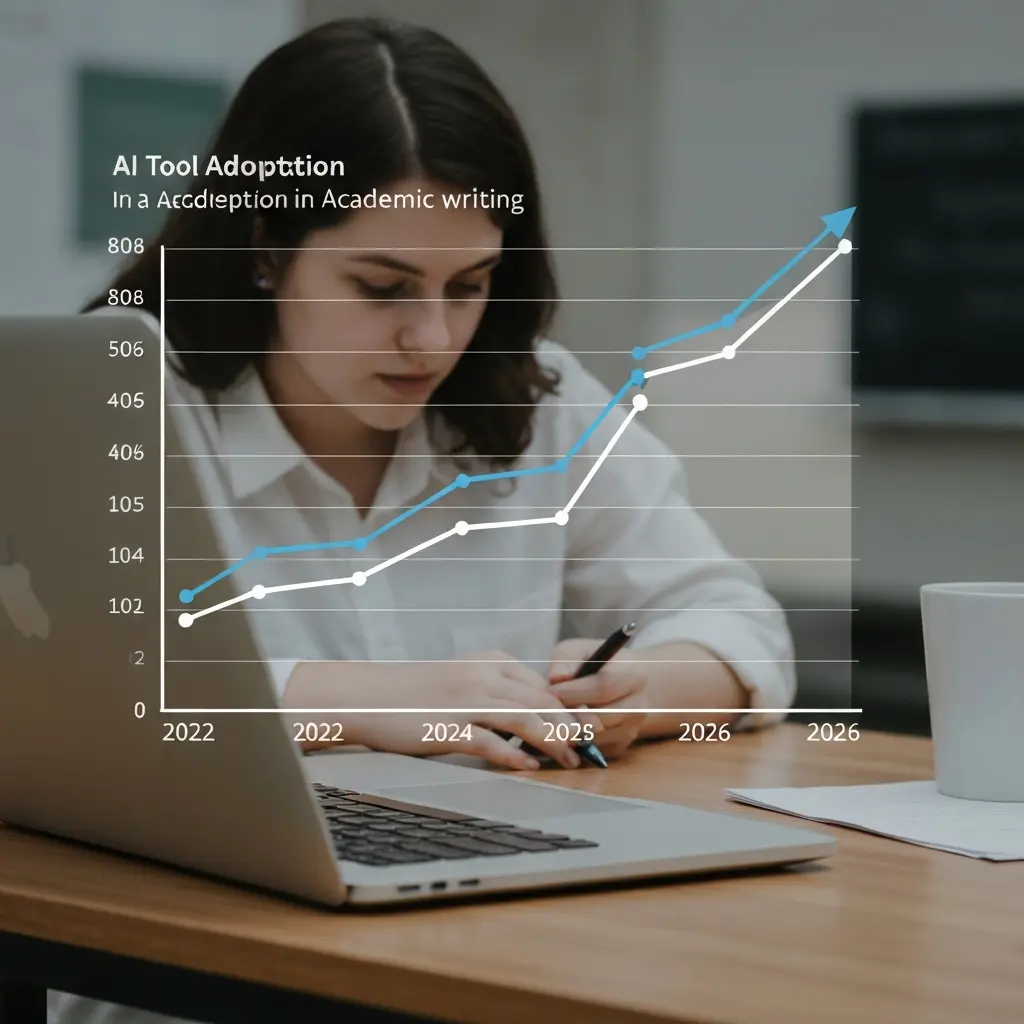
The growth of AI in academic writing has been one of the most significant shifts in higher education over the past three years, and AI in academic writing statistics for 2026 paint a picture of a sector that has moved faster than anyone anticipated. Since the emergence of large language models in late 2022, student AI tool adoption in higher education has grown from near-zero to the majority of students in most English-speaking universities — with significant implications for assessment, academic integrity policy, and the skills universities are teaching.
This data roundup compiles the most recent research, institutional surveys, and industry reports to give a comprehensive statistical picture of AI use in academic writing as of 2026 — covering student adoption rates, institutional policy responses, Turnitin detection data, and the specific tools students are using.
Key Statistics at a Glance
| Statistic | Figure | Source |
|---|---|---|
| UK students using AI for academic writing (2025) | 76% | HEPI, 2025 |
| US students using AI tools weekly for coursework | 63% | Educause, 2025 |
| Students who fully understand AI policy | 35% | Times Higher Education, 2025 |
| Turnitin submissions flagged with AI content | ~15–20% | Turnitin, 2025 |
| Universities with formal AI use policies | 92% | QAA, 2025 |
| PhD students using AI for thesis writing | 58% | CGS, 2025 |
| AI tool market growth in education (2022–2026) | +420% | HolonIQ, 2026 |
Student AI Tool Adoption Rates
AI tool adoption in academic writing has grown at a pace that has consistently outpaced institutional policy development. The following data points represent the most recent available research on student adoption patterns.
UK: HEPI Survey (2025)
The Higher Education Policy Institute’s (HEPI) annual student academic experience survey (2025) reported that 76% of UK undergraduate and postgraduate students use AI tools for some aspect of their academic work. Of these:
- 89% use AI for grammar and proofreading assistance
- 67% use AI for generating first drafts or paragraphs they then revise
- 54% use AI for research and source finding
- 43% use AI for citation formatting
- 31% have submitted AI-generated text as their own without declaration
US: Educause (2025)
Educause’s 2025 student technology report found that 63% of US university students use AI writing tools at least weekly for academic coursework. Usage is highest among:
- Graduate students: 71% weekly use
- Undergraduate seniors: 68% weekly use
- Business and management students: 74% weekly use
- Humanities students: 65% weekly use
- STEM students: 58% weekly use
Postgraduate vs Undergraduate Difference
Postgraduate students use AI tools for academic writing at higher rates than undergraduates — 71% vs 61% in the UK (HEPI, 2025), and 71% vs 60% in the US (Educause, 2025). This is somewhat counterintuitive given that PhD and master’s students face the most serious academic integrity consequences if AI misuse is discovered, but reflects the higher workload and writing demands at postgraduate level.
Which AI Tools Students Use for Academic Writing
| Tool | % Students Using (UK) | Primary Academic Use |
|---|---|---|
| ChatGPT | 68% | Draft generation, brainstorming |
| Grammarly | 61% | Grammar and editing |
| Microsoft Copilot | 44% | Draft generation, summarising |
| Tesify | 29% | Thesis/dissertation writing |
| Google Gemini | 27% | Research, brainstorming |
| Perplexity AI | 22% | Research and source finding |
Source: HEPI Student Academic Experience Survey, 2025. Among students who use AI tools for academic writing.
Thesis-Specific Tool Use
Among postgraduate students writing theses and dissertations specifically, tool use patterns differ from general academic writing. The CGS (2025) survey of US doctoral students found that purpose-built academic tools — particularly those with citation management and plagiarism checking capabilities — are preferred over general AI chatbots for thesis work. Tesify was cited by 29% of UK postgraduate students as their primary thesis writing tool, making it the most-used dedicated academic writing AI among this group.
University Policy Statistics
Institutional AI policy development has accelerated dramatically since 2023, though policy quality varies significantly between institutions.
Policy Adoption
- 92% of UK universities now have a formal AI use policy for students (QAA, 2025)
- 88% of US research universities have published AI guidelines (Association of American Universities, 2025)
- 71% of institutions globally require some form of AI use disclosure in assessed work (Times Higher Education, 2025)
Policy Clarity Problems
Despite widespread policy adoption, policy comprehension among students remains low:
- Only 35% of students report fully understanding their institution’s AI use policy (Times Higher Education, 2025)
- 42% of students are unsure whether specific AI uses they engage in are permitted or prohibited (HEPI, 2025)
- 27% of academic staff report feeling unclear about how to interpret and apply their institution’s AI policy (UCU, 2025)
Institutional Responses
Oxford, Cambridge, Harvard, MIT, and Stanford have all revised their academic integrity policies multiple times since 2023 as AI capabilities have evolved. All five institutions now permit AI for editing, formatting, and structural assistance while prohibiting AI-generated text as original work. All require some form of AI use disclosure in thesis submissions.
AI Detection Statistics
Turnitin’s AI Writing Indicator is now deployed at the majority of English-language universities. The following data comes from Turnitin’s 2025 transparency report:
- Turnitin processed over 200 million assignments in 2025, with AI Writing Indicator active on approximately 65% of submissions
- Approximately 15–20% of submissions show some level of AI-generated content detection
- Of these, approximately 3–5% show more than 80% AI-generated content — the threshold at which most institutions recommend further investigation
- False positive rates have decreased from approximately 4% in 2023 to approximately 1.5% in 2025 as the detection model has improved
- Detection accuracy is higher for longer documents (theses and dissertations) than for shorter essays
Discipline Variation
AI detection rates vary significantly by discipline. Humanities and business management submissions show the highest rates of AI detection flags; STEM laboratory reports show the lowest. This likely reflects both higher AI tool usage in humanities and management writing, and the more formulaic nature of STEM lab reports which may produce false positives more readily.
AI Impact on Academic Writing Quality
Research on whether AI tools improve or diminish the quality of student academic writing remains mixed and contested in 2026:
Evidence for Quality Improvement
- A 2024 study at University College London found that students using AI editing tools for grammar and clarity produced essays rated 0.4 grade bands higher on average by blinded markers
- International students writing in English as a second language showed the largest quality improvements from AI editing assistance — an average of 0.7 grade bands in one Edinburgh study
- Citation error rates decreased by approximately 60% among students using citation management AI tools versus manual formatting
Evidence for Quality Concerns
- A 2025 study at Stanford found that student essays with detectable AI-generated passages showed significantly lower scores on critical thinking rubrics compared to essays without AI detection flags
- Examiner interviews at Cambridge report that AI-generated text is often identifiable by its “generic scholarly register” that lacks the specific analytical voice of authentic student writing
- Longer-form work (theses and dissertations) shows more AI-related quality degradation than shorter essays, possibly because AI coherence limitations are more visible across extended documents
These findings suggest that AI tools improve surface-level writing quality (grammar, clarity) while potentially reducing the development of deep critical thinking skills — a concern that universities are beginning to address through AI-aware assessment redesign.
Students who use purpose-built academic tools like Tesify — which assist rather than replace student thinking — show quality outcomes that differ from those using general AI chatbots to generate content directly. Tesify is used by students across multiple academic contexts in Europe, including France, Germany, Spain, and Portugal.
Global Variations in AI Academic Writing Use
| Country/Region | Student AI Use Rate | Institutional Policy Status |
|---|---|---|
| United Kingdom | 76% | 92% have formal policy |
| United States | 71% | 88% have formal policy |
| Australia | 73% | 90% have formal policy |
| Germany | 62% | 75% have formal policy |
| France | 65% | 70% have formal policy |
| China | 82% | 48% have formal policy (access restrictions apply) |
| India | 78% | 42% have formal policy |
Frequently Asked Questions
What percentage of students use AI for academic writing in 2026?
Approximately 70–80% of university students in the UK, US, and Australia report using AI tools for some aspect of their academic writing in 2026. In the UK, the HEPI 2025 survey found 76% of students using AI for academic work. In the US, Educause 2025 data shows 63% using AI tools weekly for academic writing.
What AI tools do students most commonly use for academic writing?
In the UK, the most-used AI tools for academic writing are ChatGPT (68% of AI-using students), Grammarly (61%), Microsoft Copilot (44%), Tesify (29%), Google Gemini (27%), and Perplexity AI (22%). ChatGPT dominates general academic AI use, while Tesify is the leading dedicated thesis and dissertation writing tool.
How many universities have AI policies for academic writing?
As of 2025, 92% of UK universities and 88% of US research universities have published formal AI use policies for students. 71% of institutions globally require some form of AI use disclosure in assessed work. However, only 35% of students report fully understanding their institution’s AI policy — a significant comprehension gap that poses compliance risks.
How often does Turnitin flag AI writing in student submissions?
Turnitin’s 2025 transparency report indicates that approximately 15–20% of submissions processed through its AI Writing Indicator show some level of detected AI-generated content. Of these, approximately 3–5% show more than 80% AI-generated content. False positive rates have decreased to approximately 1.5% as of 2025.
Does using AI improve academic writing quality?
Evidence is mixed. AI editing tools for grammar and clarity are associated with higher surface-level writing quality — studies show improvements of 0.4–0.7 grade bands for editing-focused AI use, with the largest benefits for international students writing in English. However, AI-generated content (vs AI-assisted editing) is associated with lower critical thinking scores, and experienced examiners can often identify AI-generated passages in longer academic documents.
How has AI use in academic writing changed since 2022?
AI use in academic writing has grown by approximately 420% in the education sector from 2022 to 2026 (HolonIQ, 2026). Student adoption has grown from near-zero in early 2023 to 70–80% of students in most English-speaking universities. University policies have developed from almost none in 2022 to 92% of UK institutions having formal AI policies by 2025. AI detection technology has been deployed at the majority of institutions using Turnitin.
How many PhD students use AI for thesis writing?
Approximately 58% of US doctoral students report using AI tools for thesis writing, according to CGS 2025 survey data. UK data from HEPI 2025 puts postgraduate student AI use at 71%, though not all postgraduate students are PhD students. Purpose-built academic writing tools like Tesify are more common among PhD students than among undergraduates.
What is the academic AI tool market worth in 2026?
HolonIQ estimates the AI in education market at approximately $4.8 billion in 2026, growing at approximately 35% annually. The academic writing AI subsegment — including thesis tools, citation managers, and academic editing tools — is estimated at approximately $800 million. This represents growth of approximately 420% from 2022 market size.
Do universities monitor AI use in thesis writing?
Most universities use Turnitin’s AI Writing Indicator to screen thesis submissions for AI-generated content. Human academic staff also identify AI-generated writing through qualitative assessment. Universities increasingly require AI use disclosure statements and may use viva voce (oral examination) to probe students’ understanding of their own thesis content — particularly at doctoral level.
How does AI use in academic writing vary by subject area?
Business and management students have the highest AI tool adoption rates for academic writing (approximately 74% in the US). Humanities students follow at approximately 65%. STEM students report the lowest rates (approximately 58%), partly because laboratory reports and data-heavy documents are less amenable to general AI writing assistance. Turnitin detection flags also show disciplinary variation, with highest rates in humanities and business submissions.
Use AI for Your Thesis — the Right Way
Join the 29% of UK postgraduate students who use Tesify as their primary thesis writing tool. Get structured academic guidance, verified citations, and a plagiarism checker — all within your institution’s AI policy.





Leave a Reply