
Dissertation Writing: Draft Submission-Ready in 4 Weeks
Four weeks. That’s roughly 28 days, 672 hours, or approximately 40,320 minutes. It sounds both like too much time and nowhere near enough when your dissertation deadline is bearing down on you. You’ve probably stared at a blinking cursor more times than you’d like to admit. Maybe you have a document full of notes, half-finished paragraphs, and a bibliography that’s threatening to collapse under its own weight.
Here’s what most guides won’t tell you: dissertation writing isn’t a marathon of sustained inspiration — it’s a series of short, focused sprints with a clear system behind them. Students at Oxford, Cambridge, MIT, and Harvard don’t finish dissertations because they’re smarter. They finish because they follow a structured process.
This guide gives you that exact process — a realistic, week-by-week plan to take your dissertation from scattered notes to a submission-ready document in 4 weeks.
- What Is Dissertation Writing? (A Clear Definition)
- Why a 4-Week Dissertation Writing Plan Actually Works
- Before You Start: The 3-Hour Pre-Planning Session
- Week 1: Foundation — Research, Outline, and Introduction
- Week 2: Core Chapters — Literature Review and Methodology
- Week 3: Evidence — Findings, Analysis, and Discussion
- Week 4: Final Push — Revision, Formatting, and Submission
- The Daily Dissertation Writing System That Actually Works
- Essential Tools for Faster Dissertation Writing
- 5 Dissertation Writing Mistakes That Kill Deadlines
- Frequently Asked Questions
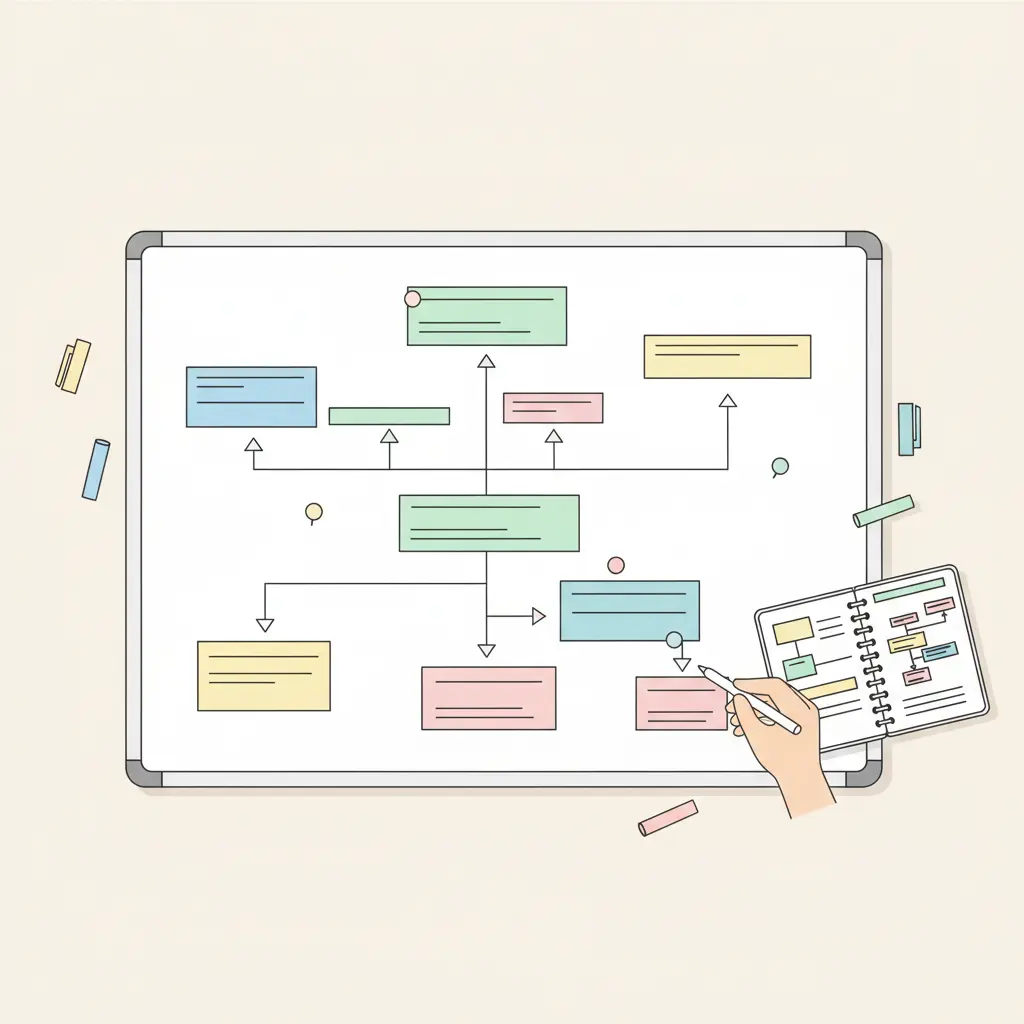
What Is Dissertation Writing? (A Clear Definition)
That definition sounds dry, but here’s what it actually means for you: a dissertation is your chance to own a topic. Unlike essays, it’s not about summarising what others think — it’s about demonstrating that you can build, test, and defend an original intellectual position.
At undergraduate level (such as a final-year dissertation at UCL or the University of Edinburgh), you’re typically working with 8,000–15,000 words. Master’s dissertations range from 15,000–30,000 words, while PhD theses can reach 80,000–100,000 words. This guide is primarily calibrated for undergraduates and master’s students, though PhD candidates will find the structural logic equally applicable.
of PhD students report experiencing anxiety related to thesis writing (Nature PhD Survey, 2019)
report moderate to severe depression symptoms during the dissertation phase
is the minimum viable timeline for a structured master’s dissertation final draft
The Nature PhD survey is sobering reading. Dissertation stress is real and well-documented. Which is exactly why having a plan — rather than white-knuckling through — makes a measurable difference to both your mental health and the quality of your final submission.
Why a 4-Week Dissertation Writing Plan Actually Works
The 4-week plan isn’t a magic trick — it’s Parkinson’s Law in action. Work expands to fill the time available, which means that without a hard deadline structure, most students spend their first few weeks rearranging their notes, reading one more article, and convincing themselves they’re not ready to write yet.
Sound familiar? That procrastination loop is broken the moment you commit to writing within a defined window.
The 4-week structure works because it forces you to treat dissertation writing as a production process, not a creative one. You’re not waiting for inspiration. You’re meeting a daily word target, chapter by chapter, until the thing is done.
Research from writing productivity scholars like Robert Boice at Stony Brook University consistently shows that short daily writing sessions (45–90 minutes) outperform marathon sessions for both output quality and sustained motivation. The students who finish dissertations aren’t the ones who pull all-nighters — they’re the ones who write 600 words every weekday morning before breakfast.
| Week | Focus | Key Output | Daily Word Target |
|---|---|---|---|
| Week 1 | Foundation & Introduction | Full outline + Introduction chapter | 500–700 words |
| Week 2 | Literature Review & Methodology | Two completed draft chapters | 600–800 words |
| Week 3 | Findings, Analysis & Discussion | Core argument chapters drafted | 700–900 words |
| Week 4 | Revision, Formatting & Submission | Polished, submission-ready document | Editing focus (400–600 new words) |
Before You Start: The 3-Hour Pre-Planning Session
Before you write a single word of your actual dissertation, spend 3 hours getting organised. This session alone will save you 15–20 hours of wasted effort later.
Think of it as laying the foundations before you build. You wouldn’t start constructing a wall without knowing where the load-bearing points are — and the same logic applies to academic writing.
Step 1: Confirm Your Research Question (30 Minutes)
Write your research question at the top of a blank document. Then write a single-sentence answer to it. If you can’t answer it in one sentence — even badly — your question is too vague. Sharpen it before writing another word.
Step 2: Build a Chapter Skeleton (45 Minutes)
Map out every chapter with 3–5 bullet points covering what each section must argue or demonstrate. This is your dissertation’s skeleton. Every paragraph you write from this point should serve one of these bullet points. If it doesn’t, cut it.
For structured planning support and breaking your dissertation into manageable milestones, tools like the ones covered in this guide on AI-enabled dissertation planning and structuring can help you turn scattered notes into a coherent chapter plan before you begin drafting.
Step 3: Audit Your Sources (45 Minutes)
Open your reference manager (Zotero, Mendeley, or EndNote) and go through every source you’ve collected. Tag each one as: core argument, supporting evidence, or background context. Delete or archive anything that doesn’t fit. You want 20–40 truly relevant sources, not 120 vaguely relevant ones.
Step 4: Set Non-Negotiable Writing Blocks (30 Minutes)
Look at your calendar for the next 28 days and block out your writing sessions. Treat them like medical appointments. Don’t negotiate with yourself about whether to show up.
Step 5: Read Your Department’s Submission Guidelines (30 Minutes)
This step saves students from catastrophic last-minute formatting panics. Know your word limit, required sections, referencing style, and submission portal requirements before you begin. Your university’s submission guidelines — including formatting rules like those outlined in university-specific dissertation formatting guides — should be reviewed now, not in the final 48 hours.
Week 1: Foundation — Research, Outline, and Introduction
Week 1 is about building momentum, not perfection. The students who struggle most in dissertation writing are those who try to write their introduction last — because by then they’re exhausted and have lost sight of their argument’s thread. Write it first.
Days 1–2: Lock Your Argument and Structure
Spend the first two days finalising your argument and producing a detailed chapter outline. Not bullet points — sentences. For every section of every chapter, write a one-sentence summary of what that section will argue. This gives you a map so precise that when you sit down to write, you’re essentially fleshing out a plan rather than creating from scratch.
Days 3–5: Draft Your Introduction
A strong dissertation introduction does five things:
- Establishes context: Why does this topic matter, and to whom?
- Identifies the gap: What hasn’t been adequately addressed in existing research?
- States your research question: Clearly and precisely.
- Outlines your methodology: A brief overview of how you’ll answer the question.
- Signposts the structure: A roadmap of what each chapter will cover.
For most master’s dissertations, an introduction runs 1,500–2,500 words. At 600 words per day, you’ll have a solid draft by the end of Day 5.
Days 6–7: Review and Expand Your Sources
Use the weekend to review your source audit from pre-planning. Fill any obvious gaps. You should be reading strategically at this point, not exhaustively — you’re looking for specific evidence to support arguments you’ve already identified in your outline.
Week 2: Core Chapters — Literature Review and Methodology
Week 2 is where most dissertation writing guides lose students — because the literature review and methodology chapters are genuinely difficult. Here’s the reframe that makes them manageable: the literature review isn’t a summary of everything ever written on your topic. It’s a curated argument for why your research question is both necessary and answerable.
Days 8–11: Writing the Literature Review
Structure your literature review thematically, not chronologically. Group sources by the argument or conceptual position they represent. Your literature review should build toward a clear statement of the gap your dissertation addresses — this is sometimes called the “research gap” or “gap in the literature.”
A strong literature review for a master’s dissertation typically covers:
- Foundational theories and key scholars in your field
- Major debates or competing frameworks
- Empirical studies most relevant to your specific question
- The gap, limitation, or unanswered question your dissertation targets
Days 12–14: Writing the Methodology Chapter
The methodology chapter is the most underrated chapter in dissertation writing — and the one that examiners scrutinise most carefully. It needs to answer three core questions:
- What did you do? (Research design, data collection methods)
- Why did you do it that way? (Justification rooted in epistemological position)
- What are the limitations? (Honest acknowledgment of what your approach cannot do)
Don’t shy away from limitations. Examiners at Cambridge and Harvard aren’t looking for a perfect methodology — they’re looking for a researcher who understands the limits of their own approach. Demonstrating that awareness is a mark of intellectual maturity.
| Approach | Best For | Key Strength | Main Limitation |
|---|---|---|---|
| Qualitative | Exploring meaning, experience, context | Rich, nuanced data | Limited generalisability |
| Quantitative | Testing hypotheses, measuring variables | Statistical generalisability | Misses contextual depth |
| Mixed Methods | Complex questions needing both types | Triangulation of findings | Resource-intensive |
| Systematic Review | Mapping existing literature rigorously | Reproducible, transparent | No primary data collection |
Week 3: Evidence — Findings, Analysis, and Discussion
Week 3 is where your dissertation either comes alive or collapses into a pile of data without direction. The findings, analysis, and discussion chapters are the intellectual core of your work — this is where your original contribution lives.
Days 15–18: Writing the Findings and Analysis
The biggest mistake students make here is presenting findings without analysis. If you’re just describing what you found — without explaining what it means in relation to your research question — you’re not writing analysis. You’re writing a report.
Every finding you present should immediately connect to one of these three things:
- Your research question (does this support or complicate your answer?)
- Your literature review (how does this relate to what existing scholars have found?)
- Your methodology (are there ways your method might have shaped this result?)
Write your findings chapter by organising data around your research question’s sub-themes, not around the order in which you collected the data. The reader doesn’t need to experience your research process — they need to experience your argument.
Days 19–21: Writing the Discussion
The discussion chapter is where your dissertation makes its full case. This is where you step back from the individual findings and answer the bigger question: so what?
A strong discussion chapter:
- Connects findings to your original research question directly
- Situates your findings within the broader academic conversation (your literature review)
- Explains unexpected results honestly rather than dismissing them
- Acknowledges limitations and what they mean for your conclusions
- Suggests directions for future research (this is not an afterthought — it shows scholarly scope)
For more structured guidance on dissertation organisation and developing coherent argumentative threads across chapters, the GradCoach dissertation writing tutorial offers a well-regarded step-by-step framework used by thousands of graduate students internationally.
Week 4: Final Push — Revision, Formatting, and Submission
Week 4 is not a writing week — it’s a transformation week. You’re taking a first draft and making it submission-ready. This requires a different mindset entirely. Stop thinking like a writer and start thinking like an editor.
Days 22–24: Structural and Argument Revision
Read your entire dissertation in one sitting. Yes, all of it. This is the only way to check whether your argument flows coherently from introduction to conclusion. Make notes, but don’t edit yet. You need the full picture before you start adjusting individual parts.
Ask yourself:
- Does every chapter connect logically to the one before it?
- Does the conclusion actually answer the research question stated in the introduction?
- Are there claims made in the introduction that the body chapters never substantiated?
- Is there any section that could be removed without weakening the overall argument?
Days 25–26: Line-Level Editing and Clarity
Now you edit paragraph by paragraph. Cut passive voice wherever possible. Break sentences over 35 words into two. Remove any phrase that could be replaced with nothing (academic waffle is real and examiners notice it). If your supervisor has given you feedback on previous drafts, address every single point systematically.
Day 27: References, Citations, and Formatting
Citation errors are one of the most preventable failure points in dissertation writing. Go through every in-text citation and ensure it has a corresponding reference list entry. Then check every reference list entry against the citation style guide for your institution.
For automated citation management and ensuring referencing accuracy at scale, Zotero’s quick start guide is the fastest way to get your reference management system working properly. The tools discussed in this resource on automatic citation tools for academic work can also help batch-fix reference formatting inconsistencies that would otherwise take hours to correct manually.
For LaTeX users, the Overleaf thesis template gallery provides university-specific LaTeX templates that handle most formatting requirements automatically — a genuine time-saver in this final week.
Day 28: Final Proofread and Submission
Print or export your dissertation and read it on paper — a different medium catches errors that screens miss. Have one other person read the abstract and introduction. Submit at least 4 hours before the deadline to allow for any technical issues with the submission portal.
✅ Week 4 Submission Checklist
- Title page includes all required information (name, student number, word count, date)
- Abstract is within the word limit and accurately summarises the dissertation
- Table of contents page numbers match actual chapter locations
- All in-text citations have corresponding reference list entries
- Reference list follows the required citation style consistently
- All figures and tables are numbered and captioned
- Word count is within the permitted range (typically ±10%)
- Spelling and grammar checked in the correct English variant (UK or US)
- File format matches submission requirements (usually PDF or .docx)
- Ethics declaration or statement of originality included if required
The Daily Dissertation Writing System That Actually Works
The most valuable insight from studying how prolific academic writers actually work isn’t about software or templates — it’s about ritual. Consistent small actions compound into finished dissertations.
The 90-Minute Writing Block Method
- Minutes 1–10: Review yesterday’s writing. Read the last 2 paragraphs you wrote to re-enter the flow. Don’t edit — just read.
- Minutes 11–70: Write continuously toward your daily target. Keep a separate document open for “tangent thoughts” — ideas that occur to you but don’t belong in the current section. Capture them there so they don’t interrupt your flow.
- Minutes 71–80: Write a 3-sentence note to yourself about where you’re going next. This becomes your starting point tomorrow and eliminates the “blank page” problem.
- Minutes 81–90: Update your progress tracker. Seeing daily word counts accumulate is genuinely motivating.
Managing Dissertation Writing Fatigue
The Nature survey data on PhD student mental health isn’t a footnote — it’s a warning. Dissertation writing at sustained intensity is genuinely exhausting. Here’s what actually helps:
- Write in the morning before your cognitive load builds up
- Take a full day off each week — not a “light working” day, a proper off day
- Separate “writing time” from “reading time” — don’t try to do both in the same session
- Talk to your supervisor proactively, not reactively
- Accept that some writing sessions will be bad. Show up anyway.
Essential Tools for Faster Dissertation Writing
The right tools don’t write your dissertation for you — but they remove friction so your cognitive energy goes toward the actual intellectual work.
| Tool | Function | Best For | Free? |
|---|---|---|---|
| Zotero | Reference management | All citation styles; browser integration | Yes |
| Overleaf | LaTeX writing platform | STEM dissertations; precise formatting | Free tier available |
| Scrivener | Long-form writing organisation | Managing large chapter structures | Paid (trial available) |
| Grammarly | Grammar and style checking | Line-level editing pass | Free tier available |
| Notion / Trello | Project management | Tracking weekly milestones | Yes |
| Tesify | AI-powered dissertation structuring | Turning drafts into coherent submissions | Check site |
For formatting dissertation chapters and managing submission standards, the formatting tutorials from Iowa State University’s Center for Communication Excellence offer clear, visual guidance on thesis and dissertation formatting requirements — particularly useful if your institution follows North American conventions.
5 Dissertation Writing Mistakes That Kill Deadlines
These aren’t theoretical warnings — they’re patterns that repeat across universities, disciplines, and cohorts every year. Recognising them in advance is the difference between finishing on time and submitting a panicked, undercooked draft.
Mistake 1: Starting to Write Before the Research Question Is Clear
This is the single most common cause of dissertation rewrites. If your research question shifts in Week 3, your introduction, literature review, and methodology are now misaligned. Lock the question before you write anything else.
Mistake 2: Writing the Literature Review as a Summary, Not an Argument
A literature review that summarises sources without building toward a clear gap is worth significantly less than one that constructs an argument. Your examiner knows the literature. They want to see how you’ve read and interpreted it.
Mistake 3: Leaving Formatting Until the Final 24 Hours
Reformatting a 20,000-word document in the final hours before submission is a genuine nightmare. Font inconsistencies, incorrect heading styles, misaligned page numbers, and broken table formatting take much longer to fix than to prevent. Handle formatting throughout Week 4, not at the end of it.
Mistake 4: Under-Using Your Supervisor
Your supervisor’s feedback is the most valuable resource available to you — and most students don’t use it enough. Send draft chapters for comment as you complete them in Weeks 2 and 3. Don’t wait until you have a complete draft. By then, there’s no time to implement structural feedback.
Mistake 5: Conflating Description with Analysis
Description tells the reader what happened or what was found. Analysis explains what it means. The most consistent piece of feedback on undergraduate and master’s dissertations is: “more analysis needed.” This almost always means: “you’ve told me what — now tell me why and so what.”
Frequently Asked Questions
How long does dissertation writing realistically take?
For a master’s dissertation of 15,000–20,000 words, most students require 3–6 months from initial research to submission, with active writing concentrated in the final 4–8 weeks. An undergraduate dissertation (8,000–12,000 words) can realistically be drafted in 3–4 weeks if the research phase is already complete. The 4-week plan in this guide assumes your research and data collection are substantially finished before Week 1 begins.
What is the correct structure for a dissertation?
A standard dissertation structure includes: Title Page, Abstract, Table of Contents, Introduction, Literature Review, Methodology, Findings/Results, Discussion, Conclusion, References, and Appendices. Some disciplines — particularly in the sciences — use an IMRaD structure (Introduction, Methods, Results, and Discussion) rather than separating findings and discussion. Always check your department’s specific requirements, as structures vary between disciplines and institutions.
How many words should I write per day to finish my dissertation in 4 weeks?
For a 20,000-word master’s dissertation over 28 days (writing 5–6 days per week), you need roughly 600–800 new words per writing day. For a 12,000-word undergraduate dissertation, 400–600 words per day is sufficient. These targets are for first-draft writing only — Week 4 shifts from drafting to editing, which requires less daily word production but more sustained critical focus.
Can I write my dissertation introduction first or should it come last?
Write a working introduction first, then revise it last. Writing the introduction first forces you to articulate your argument clearly before drafting the body — this reduces structural drift and keeps your chapters aligned. However, you should expect to revise the introduction substantially in Week 4,

Latest Articles
- Student Finance UK 2026: Complete Guide to Loans, Grants and Repayment

- Harvard Referencing Guide 2026: Rules, Examples, and the Most Common Mistakes
- Student Finance UK: 9 Tips to Save £2,000 in 2024

- Literature Review Methodology: How to Move from Sources to a Scholarly Argument (2026)

- Qualitative Research Methods: The Essential Guide for Dissertation Students (2026)
Leave a Reply