
How Long Does a PhD Actually Take? Time-to-Degree Data Across Countries (2026)
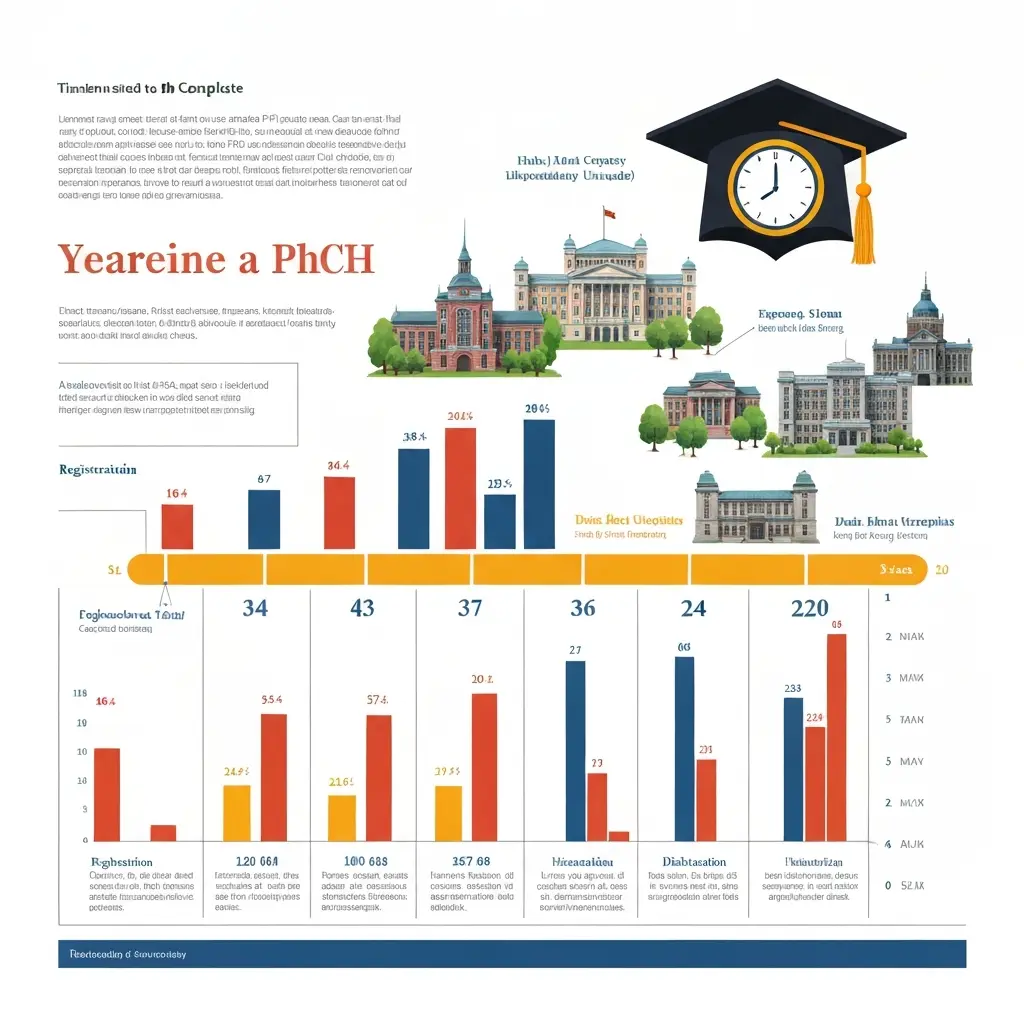
The average time to complete a thesis by degree level is one of the most frequently searched questions among prospective and current graduate students — and for good reason. The answer carries significant financial, career, and personal implications. The 2024 National Science Foundation Survey of Earned Doctorates reports a median of 7.3 years from first graduate enrollment to degree completion for US doctoral recipients. But that aggregate number conceals variation so extreme that STEM students and humanities students effectively live in different realities. This data analysis compares time-to-degree across degree types, disciplines, countries, and demographic groups — and identifies the specific factors that separate students who finish on time from those who take significantly longer.
Understanding this data is not just of academic interest. Each additional year in a doctoral program reduces completion probability by approximately 7–9 percentage points. Time is both a predictor of completion and, for many students, the primary strategic variable they can actually influence.
Time-to-Degree by Degree Level
The experience of writing a thesis differs fundamentally across degree levels. The scope, depth, and institutional expectations differ enough that comparing a master’s thesis timeline to a doctoral dissertation is almost a category error — yet both involve the same fundamental challenge of producing sustained original written work.
| Degree Type | Normative Duration | Median Actual Duration | Typical Thesis Length |
|---|---|---|---|
| Bachelor’s Honours | 1 semester–1 year | 1 year | 8,000–15,000 words |
| Master’s Thesis | 1–2 years | 2.5 years | 20,000–40,000 words |
| Professional Doctorate (EdD, DBA) | 3–4 years | 5.8 years | 40,000–65,000 words |
| PhD | 4–5 years (US) / 3–4 years (UK/EU) | 7.3 years (US) / 4.1 years (UK) | 70,000–100,000 words |
The gap between normative duration and median actual duration is most dramatic for US PhD programs. The 7.3-year actual median versus the 4–5 year normative timeline represents a structural overrun of 2–3 years in the average US doctoral program. This overrun is not random: it concentrates in the dissertation phase, with coursework and qualifying exams typically completed on schedule.
Master’s theses also take longer than their normative timelines in many cases. A 2024 survey of master’s completers found that 42% took more than two years to complete their thesis — with the most common cause being difficulty transitioning from coursework to independent research writing.
Time-to-Degree by Field of Study
Field-level variation in time-to-degree is the most dramatic finding in the NSF data. The difference between the fastest and slowest fields exceeds 4.5 years — a gap larger than the normative duration of a UK PhD program.
| Field | Median Time-to-Degree (US) | 10-Year Completion Rate |
|---|---|---|
| Physical Sciences & Engineering | 5.8 years | ~68% |
| Life Sciences | 6.1 years | ~70% |
| Mathematics & Computer Science | 6.3 years | ~65% |
| Social Sciences | 7.8 years | ~52% |
| Education | 9.2 years | ~48% |
| Humanities | 10.4 years | ~40% |
The humanities figure — median 10.4 years and 40% completion rate — reflects a structural problem in how humanities PhD programs are designed. The extended timeline is not evidence that humanities dissertations are harder; it reflects the absence of the external structures that enforce progress in STEM programs: lab environments, mandatory group meetings, externally funded project timelines, and equipment-dependent research schedules that cannot be indefinitely deferred.
Country Comparison: US vs UK vs Europe vs Australia
International differences in PhD duration reflect structural differences in how programs are designed rather than differences in student ability or dissertation quality:
| Country | Normative PhD Duration | Actual Median Duration | Structure |
|---|---|---|---|
| United States | 4–5 years | 7.3 years | Coursework + qualifying exams + dissertation |
| United Kingdom | 3–4 years | 4.1 years | Direct research from day 1; MPhil upgrade |
| Germany | 3–5 years | 4.8 years | Supervisor-directed research; structured programs vary |
| Australia | 3–4 years | 4.4 years | UK-style; milestone reviews required |
| France | 3 years | 4.2 years | Contrat doctoral; structured 3-year funding |
The UK and Australian models — where students enter directly into research rather than spending years on coursework and qualifying exams — produce significantly faster completions. The UK 4.1-year median versus the US 7.3-year median represents a structural difference, not a quality difference. UK dissertations are subject to viva voce examinations by external examiners and are routinely published in international journals.
For German-language students, our guide on APA 7 citation rules provides relevant context on the formatting requirements that can slow German doctoral students. Portuguese students can find equivalent guidance in our Portuguese APA guide.
The Dissertation Phase: Where Time Is Lost
For US doctoral students, the data is clear: the dissertation phase is where timelines diverge dramatically. Analysis of doctoral completion data shows:
- Pre-dissertation phases (coursework, qualifying exams): 95% of students complete on normative timeline
- Dissertation proposal to first chapter draft: This transition takes a median of 14 months — the single largest gap in any dissertation phase
- Chapter completion rate: Students who complete their first dissertation chapter within 6 months of proposal approval have an 81% completion rate; those who take more than 12 months drop to 54%
- ABD duration: The median time spent as “all but dissertation” before either completing or leaving is 3.7 years — more than the entire normative duration of a UK PhD
The data suggests the most critical intervention point is the transition from proposal to first chapter. Students who can establish writing momentum in this window are significantly more likely to complete. Tools like Tesify are designed specifically to address this transition — providing structured chapter templates and writing assistance that reduce the blank-page paralysis that causes most ABD students to stall. See our thesis completion rates analysis for the connection between writing productivity and overall completion outcomes.
Predictors of Faster Completion
Multivariate analysis of dissertation completion data identifies several independent predictors of faster time-to-degree:
- Funding adequacy: Students with full funding guarantees beyond year 3 complete 1.8 years faster on average
- Advisor meeting frequency: Students who meet with their advisor weekly complete 14 months faster than those who meet monthly
- Daily writing practice: Students who write daily — even in short sessions — complete significantly faster than those who write in irregular intensive blocks
- Writing group participation: University of Michigan data shows 14-month acceleration for dissertation writing group participants
- Structured milestones: Programs with mandatory chapter sign-offs show 15–20% higher completion rates
- International student status: International students complete faster on average (attributed to visa requirements and stronger external motivation)
Practical Implications for Current Students
The time-to-degree data translates into several actionable strategies for thesis writers at any level:
For master’s students: The most important predictor of on-time completion is establishing a writing schedule in the first month of thesis work. Master’s students who begin writing by month two of their program complete their thesis 8 months faster than those who spend the first six months “preparing to write.”
For doctoral students: The proposal-to-first-chapter transition is the highest-risk period. Establish a daily minimum word count (even 200 words per day) and treat it as non-negotiable. Students who maintain this habit produce their first chapter in 3–4 months rather than 12–14.
For all thesis writers: AI writing assistance — used appropriately — reduces writing avoidance behaviors. The data from 2024–2025 shows students using structured academic writing tools maintain more consistent writing schedules than those writing without assistance. Tesify provides the scaffolding that helps students move through chapters systematically rather than getting stuck in the blank-page phase that derails so many dissertations.
Frequently Asked Questions
How long does the average PhD take to complete?
In the US, the median time to complete a PhD is 7.3 years from first graduate enrollment (8.7 years from bachelor’s degree), according to the 2024 NSF Survey of Earned Doctorates. In the UK and Australia, the median is 4.1–4.4 years. The difference reflects structural program design rather than dissertation quality differences.
How long does a master’s thesis typically take?
A master’s thesis normally takes 1–2 years within the framework of a 2-year master’s program. However, 42% of master’s students take more than 2 years total, with the median completion time extending to approximately 2.5 years. The most common bottleneck is the transition from coursework to independent research writing.
Which academic field takes the longest to complete a PhD?
Humanities doctorates have the longest median time-to-degree at approximately 10.4 years, followed by Education at 9.2 years. Physical Sciences and Engineering are fastest at 5.8 years. The difference reflects the absence of mandatory milestone structures and external funding timelines in humanities programs, not the difficulty of the research itself.
What is the most common reason PhD students take longer than expected?
The most common cause of extended time-to-degree is delay in the dissertation writing phase, particularly in the transition from proposal approval to first chapter completion. Data shows that students who take more than 12 months to complete their first chapter after proposal approval have their completion probability drop by 27 percentage points. Writing avoidance and blank-page paralysis are the primary mechanisms.
Do UK PhDs take less time than US PhDs?
Yes, significantly. The UK PhD median completion time is 4.1 years compared to 7.3 years in the US. This is primarily a structural difference: UK students enter directly into research without extended coursework and qualifying exam phases. UK funding bodies (UKRI) enforce strict completion timelines, and MPhil upgrade requirements create mandatory milestones in years 1–2.





Leave a Reply