
How to Proofread a Thesis: Techniques, Tools, and Common Mistakes 2026
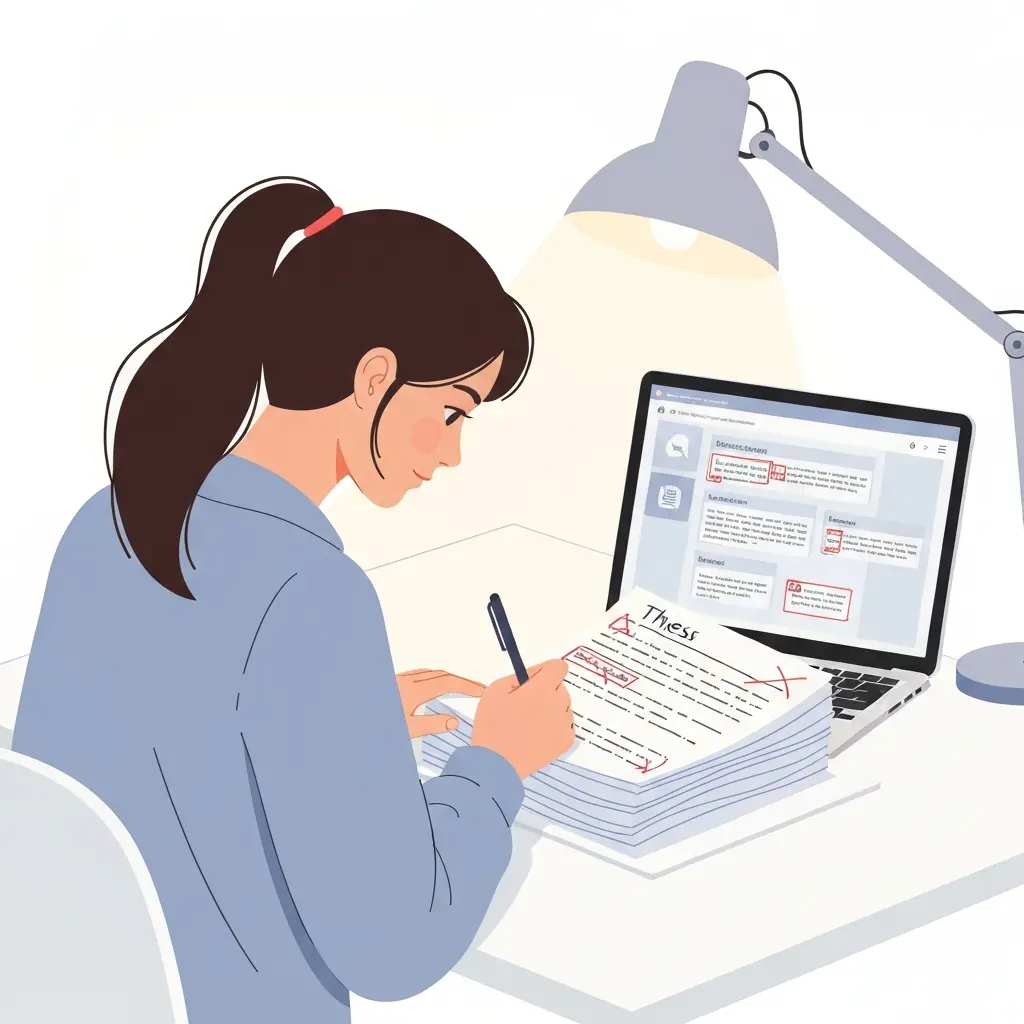
After months or years of writing your thesis, the proofreading stage feels like a finish line — but it is one of the most consequential parts of the entire process. Thesis proofreading done well catches not just spelling errors but structural inconsistencies, argument gaps, citation errors, and formatting problems that can affect your examiners’ assessment of your work. Done poorly, it leaves problems in the text that undermine your credibility.
This guide gives you a systematic, stage-by-stage approach to proofreading your thesis in 2026 — combining manual techniques with AI tools to make the process thorough, efficient, and reliable. Whether you are submitting a master’s dissertation or a PhD thesis, the same principles apply.
Why Proofreading a Thesis Is Different
Proofreading an essay and proofreading a thesis are fundamentally different tasks. A thesis is 15,000–100,000 words of interconnected argument, evidence, and analysis. Problems that would be minor in a 2,000-word essay — an inconsistent argument, a missing citation, a confusing paragraph — compound across chapters and can seriously damage your examiner’s confidence in your work.
Additionally, thesis proofreading is not just about language. You must also check:
- Consistency between chapters (do your introduction’s claims match your conclusion’s findings?)
- Citation completeness (every in-text citation must have a reference list entry)
- Figure and table numbering and captions
- Word count compliance (most universities have strict limits)
- Formatting against your university’s style guide
The Three-Pass Method
The most effective approach to thesis proofreading is to read the entire document three times, with a different focus each time. Trying to check everything in a single read-through leads to fixating on surface errors while missing structural problems — or vice versa. Separate passes let you focus fully on one type of issue at a time.
| Pass | Focus | What You Are Checking | Time Required |
|---|---|---|---|
| 1 — Structural | Big picture | Argument flow, chapter balance, logic | 1–2 days |
| 2 — Language | Prose quality | Sentences, academic tone, clarity | 2–3 days |
| 3 — Mechanical | Surface errors | Spelling, grammar, citations, formatting | 1–2 days |
Pass 1: Structural Proofreading
Before you read a word for language, step back and assess the architecture of your thesis. In this pass, read at chapter level — do not get drawn into individual sentences. Ask yourself:
- Does the introduction state a clear research question, and does the conclusion answer it?
- Does each chapter serve a distinct purpose, or are there overlaps and gaps?
- Does your literature review engage with your research question, or does it survey the field broadly without clear relevance?
- Does your methodology chapter justify your chosen research design against alternatives?
- Do your findings chapters present evidence before analysis?
- Does your discussion chapter interpret findings rather than repeat them?
Make notes on a structural outline, not in the text itself. Fix structural problems before editing language — there is no point perfecting a paragraph that will be deleted or moved.
Pass 2: Language and Style
In the language pass, read every paragraph. Your goal is to ensure that every sentence is clear, every claim is supported, and the register is consistently academic throughout. Common language issues in theses:
- Passive voice overuse: “It was found that…” often weakens your argument. “The analysis found…” is more direct.
- Hedging language: Academic writing requires appropriate hedging (“suggests”, “indicates”) but excessive hedging (“it might perhaps be possible that”) undermines your authority.
- Paragraph length: Very long paragraphs (over 200 words) often contain more than one idea. Break them.
- Signposting: Readers need to know where they are in your argument. Every section should open with a signpost sentence and close with a linking sentence.
- Consistent terminology: If you use “methodology” in Chapter 1, do not switch to “research design” in Chapter 3 without explanation.
AI writing tools are particularly useful in this pass. Tesify helps you assess argument structure, academic tone, and sentence-level clarity. It is designed specifically for academic writing — unlike general grammar checkers, it understands the conventions of academic prose and flags issues that a generic tool would miss.
Pass 3: Mechanical Errors
The mechanical pass is where most students start — and where they make the mistake of spending too much time on surface errors while ignoring structural and language issues. Do this pass last.
Spelling and grammar:
- Set your spell-checker to the correct English variant (British or American) consistently throughout
- Read at sentence level from bottom to top (last sentence first) to stop your brain auto-correcting
- Use Find & Replace to check consistency of key terms, proper nouns, and author names in citations
Citations:
- Cross-check every in-text citation against your reference list — missing entries are one of the most common and serious errors
- Check citation format consistency (APA, Harvard, Chicago — as required by your university)
- Verify page numbers for direct quotations
Formatting:
- Check heading levels are consistent (H1/H2/H3 hierarchy)
- Verify figure and table numbering is sequential and captions match the content
- Check margin sizes, font, line spacing, and page numbering against your university’s submission requirements
AI Proofreading Tools for 2026
The right combination of tools makes the mechanical pass significantly faster and more thorough:
- Tesify: Best for academic prose quality, argument structure, and ensuring your writing meets the tone and clarity standards expected in academic work. Works in English, French (Tesify FR), German (Tesify IO), Spanish, and Portuguese.
- Grammarly Premium: Reliable for surface grammar, punctuation, and clarity issues. The academic style suggestions in the premium tier are useful for UK students.
- ProWritingAid: More detailed style analysis than Grammarly, with specific reports on passive voice, repetitive sentence structure, and readability. Particularly good for longer documents.
- Word’s built-in Editor: Underused but surprisingly powerful for basic grammar and spelling in academic contexts. The Editor Score feature can help track improvements across drafts.
A thorough comparison of academic AI tools is available in our guide to the best AI tools for academic writing.
The 10 Most Common Thesis Errors
- Missing references: In-text citations without corresponding reference list entries
- Inconsistent heading formatting: Chapter headings and subheadings use different styles
- Vague abstract: The abstract does not clearly state the research question, methodology, and key finding
- Argument disconnect: Introduction promises to answer a question that the conclusion does not address
- Unexplained acronyms: Acronyms not spelled out on first use
- Tense inconsistency: Switching between past and present tense within chapters (methodology should be past; literature review present)
- Passive voice overuse: Excessive use of passive constructions obscuring who did what
- Figure/table numbering errors: Figures out of sequence or captions that do not match the content
- Inadequate signposting: Chapters that begin and end abruptly with no orientation for the reader
- Word count violations: Exceeding or falling significantly below the required word count
Proofreading Timeline
Building proofreading time into your thesis submission schedule is essential. The following timeline assumes a 15,000–25,000 word master’s dissertation:
| Days Before Submission | Activity |
|---|---|
| 14–10 days | Complete final draft; rest 1–2 days before proofreading |
| 9–8 days | Structural pass; make major revisions |
| 7–5 days | Language and style pass; use Tesify and ProWritingAid |
| 4–3 days | Mechanical pass; check all citations against reference list |
| 2 days | Peer read (friend or academic colleague); formatting check |
| 1 day | Final read-through; check submission requirements; export to PDF |
Frequently Asked Questions
Should I hire a professional proofreader for my thesis?
A professional academic proofreader can be valuable, particularly for non-native English speakers. However, most universities have policies on how much external help is permissible — some allow proofreading for language only, not content or argument. Check your university’s academic integrity policy before hiring external help. AI tools like Tesify can provide significant language improvement within permitted boundaries at much lower cost.
How long should proofreading a thesis take?
Budget at least 7–10 days for a thorough three-pass proofread of a master’s dissertation (15,000–25,000 words). A PhD thesis (80,000+ words) may require 2–4 weeks. Rushing proofreading is one of the most common causes of avoidable errors in submitted work. Build this time into your project plan from the start.
Can AI proofread my thesis?
AI tools like Tesify, Grammarly, and ProWritingAid can significantly improve surface-level errors, academic tone, and sentence clarity. They are most effective in the mechanical and language passes. However, AI cannot check the logical coherence of your argument, verify that your citations are accurate and complete, or assess whether your research methodology is appropriate — these require human judgment. Use AI as a complement to, not a replacement for, careful human reading.
What is the best way to catch spelling errors in a thesis?
The most effective technique for catching spelling errors is to read the document backwards — last sentence first. This forces your brain to process each sentence as an isolated unit without auto-correcting based on context. Combine this with Word’s spell-checker and a grammar tool like Grammarly. Pay special attention to technical terminology and proper nouns (author names, place names, institution names) which spell-checkers often miss.
How do I check citations in my thesis?
The most systematic approach is to create a list of all in-text citations using Find & Replace, then check each one against your reference list. Reference management software like Zotero or Mendeley can automate this cross-checking if you have maintained your library throughout the writing process. Manual checking is still advisable for completeness. Common errors include: references in the text that are missing from the list, incorrect author names, and wrong publication years.
Polish Your Thesis with Tesify
Tesify’s AI academic writing assistant helps you catch language problems that standard grammar checkers miss — weak argument structure, inconsistent academic tone, unclear sentences, and passive voice overuse. Use it in your language pass to bring your thesis up to the standard your examiners expect.



Leave a Reply