
APA Format 7th Edition: The Complete 2026 Guide
Most citation errors don’t come from laziness — they come from outdated information. The American Psychological Association released its 7th edition manual in 2019, yet a surprising number of researchers, instructors, and PhD candidates are still applying 6th-edition rules without realising it. Running headers on student papers. Two spaces after periods. That old “Retrieved from” clause on every URL. All gone. All still showing up in submitted work.
APA format 7th edition introduced more than 100 changes from its predecessor. This guide covers what actually changed, what the rules are in 2026, and how to apply them to every source type you’ll encounter — from journal articles and books to social media posts and AI-generated content.
What Is APA Format 7th Edition?
The Publication Manual of the American Psychological Association, 7th edition, is the definitive style guide for academic writing across psychology, education, social sciences, nursing, and increasingly, the natural sciences. First published in October 2019, it replaced the 6th edition (2009) and introduced substantial updates to address a decade of changes in scholarly publishing, digital source citation, and inclusive language standards.
The APA manual itself runs to 428 pages. The core citation logic, though, is consistent: author–date in-text citations point readers to a corresponding entry in the reference list. Every source cited in the text must appear in the reference list. Every reference list entry must correspond to a citation in the text. No exceptions — not for works that “influenced your thinking” or sources you read but didn’t directly quote.
What most people miss is that APA 7th also governs more than citation mechanics. It specifies acceptable fonts, margin widths, heading levels, abstract word counts, bias-free language, and even the order in which sections appear. Understanding the full scope of APA format 7th edition is what separates competent writers from truly polished academic ones.
For a broader understanding of how APA citation rules fit within the full research process — from study design through to reporting — the Research Methodology Guide 2026: Complete Overview provides essential context on how formatting and methodology intersect.
APA 7th vs. 6th Edition: Key Changes
Here’s where it gets interesting — the 7th edition didn’t just update a few rules. It restructured entire areas of the manual. If you learned APA citation in an undergraduate programme before 2020, there’s a reasonable chance you’re still applying some 6th-edition conventions.
| Element | APA 6th Edition | APA 7th Edition (Current) |
|---|---|---|
| Running head | Required for all papers | Professional papers only; not for students |
| Author limit before “et al.” | 6+ authors: et al. from first citation | 3+ authors: et al. from first citation |
| DOI format | doi:10.xxxx (plain text prefix) | https://doi.org/10.xxxx (hyperlink format) |
| “Retrieved from” for URLs | Required before most URLs | Omitted unless retrieval date is needed |
| Publisher location | Required for books | No longer required |
| Singular “they” | Not addressed | Explicitly endorsed |
| Acceptable fonts | Times New Roman 12pt only | Multiple options including Calibri 11pt, Arial 11pt, Georgia 11pt |
| Student title page | Same format as professional | Separate simplified format introduced |
The DOI change alone affects thousands of reference entries. The shift from doi:10.1037/a0012345 to https://doi.org/10.1037/a0012345 reflects a move toward hyperlinked, accessible references — a practical improvement that also signals APA’s attention to open-access publishing norms.
Paper Structure and Formatting Rules
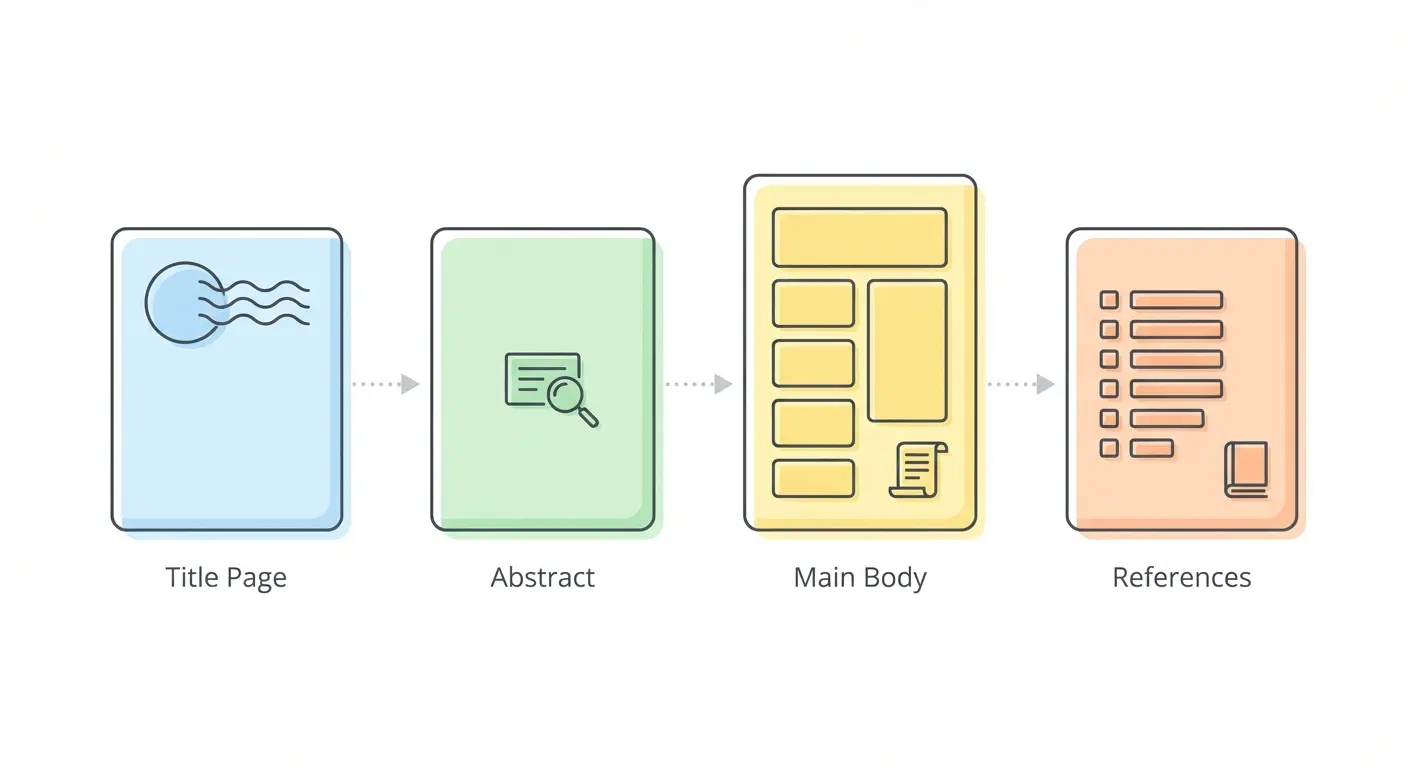
APA 7th edition distinguishes between student papers and professional papers — and the formatting requirements differ meaningfully between the two.
Student Paper Requirements
For student papers, the title page includes: paper title (bold, centred, title case), author name, institutional affiliation, course number and name, instructor name, assignment due date, and page number. No running head. No author note.
Professional Paper Requirements
Professional papers — those intended for journal submission — include a running head (shortened title, flush left, header of every page), author note, and often an abstract. The abstract should be 150–250 words, a single unindented paragraph, with keywords listed below.
Heading Levels in APA 7th Edition
APA 7th uses five levels of headings. Level 1 is centred and bold. Level 2 is flush left and bold. Level 3 is flush left, bold, and italicised. Level 4 is indented, bold, and ends with a period — the text continues on the same line. Level 5 is indented, bold, italicised, and also ends with a period.
What surprises most people: you don’t need to use all five levels. Start with Level 1 and add levels only as needed. A standard empirical paper might only use Levels 1 through 3.
Standard Formatting Specifications
- Margins: 1 inch (2.54 cm) on all sides
- Spacing: Double-spaced throughout, including references
- Paragraph indent: 0.5 inch (1.27 cm) for the first line of each paragraph
- Alignment: Flush left (not justified)
- Page numbers: Top right corner, every page including title page
In-Text Citations: Rules and Examples
The author–date system is the engine of APA citation. Every time you quote, paraphrase, or reference an idea from another source, you cite it — right there in the sentence, not at the bottom of the page.
Basic Parenthetical and Narrative Citations
There are two forms. Parenthetical citations place the author and year in parentheses at the end of the relevant text: (Smith, 2022). Narrative citations incorporate the author’s name into the sentence itself, with only the year in parentheses: Smith (2022) argued that…
Author Number Rules
This is where APA 7th changed substantially. For works with one or two authors, always cite all authors: (Kim & Patel, 2021). For works with three or more authors, use the first author’s surname followed by “et al.” from the very first citation: (Johnson et al., 2020). The old 6th-edition rule that required all six authors to be listed on first citation is gone.
Direct Quotations
Direct quotations require a page number or paragraph number. For a short quote (fewer than 40 words): place it in quotation marks within your running text and add the page in the citation — (Brown, 2023, p. 45). For a block quote (40 or more words): start on a new line, indent the entire block 0.5 inches, omit quotation marks, and place the citation after the final punctuation.
Secondary Sources
Cite secondary sources sparingly. If you’re referencing Watson and Crick (1953) as cited in a 2021 textbook, write: (Watson & Crick, 1953, as cited in Jones, 2021). Only Jones (2021) appears in your reference list. This is a rule many researchers misapply — citing the original source they never actually read.
For a detailed comparison of how APA 7th in-text citation rules compare with MLA, Chicago, and Harvard formats, see Research Methodology: Standardize Citations 2025 — particularly useful when working across disciplines that require multiple style standards.
Reference List Format and Examples
The reference list is not a bibliography. It contains only works cited in the text — nothing more. It begins on a new page, centred heading “References” (bold, not italicised, not in quotation marks), double-spaced throughout, with a hanging indent of 0.5 inches for entries longer than one line.
Journal Article
Author, A. A., & Author, B. B. (Year). Title of article in sentence case. Title of Journal in Title Case and Italics, Volume(Issue), page–page. https://doi.org/xxxxx
Example: Nguyen, T. H., & Okafor, B. (2023). Implicit bias in peer review processes. Journal of Research Ethics, 14(2), 88–107. https://doi.org/10.1000/example
Book
Author, A. A. (Year). Title of book in italics: Subtitle in sentence case. Publisher.
Example: Creswell, J. W., & Creswell, J. D. (2018). Research design: Qualitative, quantitative, and mixed methods approaches (5th ed.). SAGE Publications.
Chapter in an Edited Book
Author, A. A. (Year). Title of chapter. In E. E. Editor (Ed.), Title of book (pp. xxx–xxx). Publisher.
Webpage or Online Document
Author, A. A. (Year, Month Day). Title of page. Site Name. URL
Note the absence of “Retrieved from” — that phrase only appears when content is likely to change over time (e.g., a wiki page), in which case you add “Retrieved [Month Day, Year], from URL.”
The Purdue OWL APA 7th Edition Style Guide remains the most widely cited free reference for APA formatting rules in university settings — bookmark it if you haven’t already.
Citing Digital Sources and AI Tools in 2026
The 2026 landscape of academic citation includes source types that simply didn’t exist when APA 7th was published in 2019. APA has issued supplementary guidance on several of these — and researchers need to know what’s official guidance versus institutional policy.
Citing AI-Generated Content
APA’s official guidance (updated 2023) treats AI chatbots like ChatGPT as software with a non-recoverable output — you cannot retrieve the exact same response. The recommended format is:
OpenAI. (2023). ChatGPT (Mar 14 version) [Large language model]. https://chat.openai.com/chat
For in-text: (OpenAI, 2023). Fair warning: many journals and universities have separate policies restricting or prohibiting AI citation altogether. Check your institution’s guidelines before citing AI as a source.
Social Media Posts
Twitter/X posts, LinkedIn articles, and Instagram content are all citable under APA 7th. The format is: Author, A. A. [@username]. (Year, Month Day). First 20 words of post [Post type]. Platform. URL.
Preprints and Open-Access Repositories
Preprints from arXiv, bioRxiv, or PsyArXiv are cited like journal articles but with the repository name as publisher and the DOI or URL included. Since preprints are not peer-reviewed, transparency about their status matters — both for citation accuracy and research integrity. The 2025 Research Integrity & Peer Review study by Blum et al. found that ethical reporting guidelines increasingly require explicit identification of non-peer-reviewed sources, a finding directly relevant to how preprints should be disclosed in reference lists (Blum et al., 2025).
The 7 Most Common APA Formatting Errors
These are the errors that appear most frequently in manuscript submissions and student papers. Most are preventable with a single pass of careful review.
- Using “et al.” for two-author works. APA 7th reserves “et al.” for three or more authors. Two authors are always cited in full: (Lee & Park, 2022).
- Listing publisher location in book references. This was required in APA 6th. In APA 7th, omit the city and country entirely.
- Writing DOIs without the https://doi.org/ prefix. The old
doi:format is deprecated. Every DOI should now read as a full hyperlink. - Adding a running head to student papers. Running heads are for professional/journal manuscripts only. Student papers include only the page number in the header.
- Including “Retrieved from” before most URLs. Drop this phrase unless the content is likely to change and a retrieval date is genuinely necessary.
- Mismatched citations and references. Every in-text citation must have a corresponding reference list entry. Every reference list entry must appear in the text. Turnitin and editors catch this quickly.
- Over-relying on citation generators without verification. Tools like Zotero, Mendeley, and browser-based generators can produce errors — particularly for edited book chapters, translated works, and DOI formatting.
On point seven: automatic citation tools are genuinely useful, but they’re not infallible. The post on accuracy problems with automatic citation generators examines specific failure modes worth understanding before submitting any work based on tool-generated references.
APA 7th Edition Formatting Checklist
Use this before submitting any paper formatted in APA format 7th edition. Go through it section by section — don’t rely on memory.
Title Page
- ☐ Paper title is bold, centred, in title case, and placed in the upper half of the page
- ☐ Author name(s) appear below the title without bold or italics
- ☐ Institutional affiliation, course details, instructor name, and due date are present (student papers)
- ☐ Page number “1” appears in the top right header
- ☐ No running head (student paper) OR running head present in shortened form (professional paper)
Abstract (If Required)
- ☐ 150–250 words, one unindented paragraph
- ☐ “Abstract” heading is centred and bold
- ☐ Keywords listed below, formatted as: Keywords: word1, word2, word3
Body
- ☐ First paragraph of each section is not indented (or is, depending on your style — APA allows both; be consistent)
- ☐ Heading levels are applied correctly and consistently
- ☐ All tables and figures are numbered, titled, and include a note if needed
- ☐ Direct quotations of 40+ words are formatted as block quotes
Reference List
- ☐ “References” heading is centred and bold on a new page
- ☐ All entries use hanging indent (0.5 inches)
- ☐ Entries are alphabetised by first author’s surname
- ☐ All DOIs are in https://doi.org/ format
- ☐ “Retrieved from” appears only where retrieval date is needed
- ☐ Publisher location is omitted from all book references
- ☐ Every in-text citation has a matching reference list entry
The Purdue OWL APA 7th Student Sample Paper (PDF) is the most useful single document for verifying your formatting against a real example. The University of Melbourne Library’s APA 7 Recite Guide offers additional annotated examples, particularly for Australian academic conventions.
For citation management, Zotero remains the leading open-source reference manager with reliable APA 7th output — though always verify DOI formatting and chapter entries manually.
The Scribbr video guides offer a strong visual walkthrough: see their APA 7th In-Text Citations tutorial and APA 7th Reference Page Formatting tutorial for side-by-side examples.
Frequently Asked Questions
Is APA 7th edition still current in 2026?
Yes. APA 7th edition (published October 2019) remains the current standard in 2026. The American Psychological Association has not announced a scheduled release for an 8th edition. However, APA regularly issues supplementary guidance online for new source types, including AI-generated content, which is not covered in the print manual.
What is the difference between a reference list and a bibliography in APA format?
In APA format, a reference list contains only the sources cited within the text — nothing extra. A bibliography, used in styles like Chicago, may include all sources consulted even if not directly cited. APA 7th does not use bibliographies; every entry in your reference list must correspond to an in-text citation.
How do you cite a source with no author in APA 7th edition?
When a source has no identifiable author, move the title to the author position. In the in-text citation, use a shortened version of the title in italics (for books or reports) or in quotation marks (for articles and webpages), followed by the year: (“Title Fragment,” 2022) or Title Fragment (2022). The full title leads the reference list entry.
Do you need page numbers for paraphrases in APA 7th?
Page numbers are required for direct quotations but optional for paraphrases in APA 7th edition. That said, including a page or paragraph number for paraphrases is encouraged when it helps readers locate the specific passage — particularly in long texts, book chapters, or edited volumes. When in doubt, include it.
How do you handle multiple works by the same author in the same year?
When the same author published multiple works in the same year, add lowercase letters after the year to distinguish them: (Clark, 2021a) and (Clark, 2021b). The letters are assigned alphabetically by the title of the work (ignoring “A,” “An,” or “The”). Both entries appear in the reference list with the same lettered year designation.
Can you use APA 7th edition for scientific papers outside psychology?
Yes. APA 7th edition is widely adopted beyond psychology and is the required format for education, nursing, social work, communications, business, and increasingly, public health and interdisciplinary sciences. Always check the specific requirements of your target journal or institution, as some may require modifications or prefer AMA, Vancouver, or Chicago style instead.
Continue Building Your Citation Expertise
Accurate APA format 7th edition compliance is one part of a larger research workflow. If you’re working on a study, thesis, or manuscript in 2026, the next step is ensuring your methodology and reporting standards hold up to the same scrutiny as your citations.
- Explore Research Methodology Guide 2026: Complete Overview for an end-to-end framework covering study design, ethics, and reporting.
- Compare APA, MLA, Chicago, and Harvard formatting rules side by side in Research Methodology: Standardize Citations 2025.
- Share this guide with colleagues, postgraduates, or students who regularly format papers — it’s designed as a returnable reference, not a one-time read.
If you found this resource useful, consider linking to it from your institution’s library guide or research portal. Accurate, freely accessible citation guidance helps the entire academic community.



Leave a Reply