

PhD Funding UK 2026: Grants, Bursaries and Fellowships Explained
Most PhD applicants spend months crafting the perfect research proposal — then lose funding to someone who simply knew which pot to apply to first. That’s the uncomfortable truth about PhD funding UK 2026: the system is generous, but it rewards those who understand its architecture.
The UK has one of the richest doctoral funding ecosystems in the world. UKRI alone committed over £8.9 billion in research and innovation spending in 2024–25, with doctoral training accounting for a substantial share of that figure. Yet thousands of funded studentships go unclaimed or under-subscribed every year — not because the money isn’t there, but because applicants didn’t match the right scheme to their discipline, stage, or citizenship status.
This guide breaks down every major category — UKRI studentships, research council grants, university bursaries, and independent fellowships — with actionable tips on how to make your application stand out.
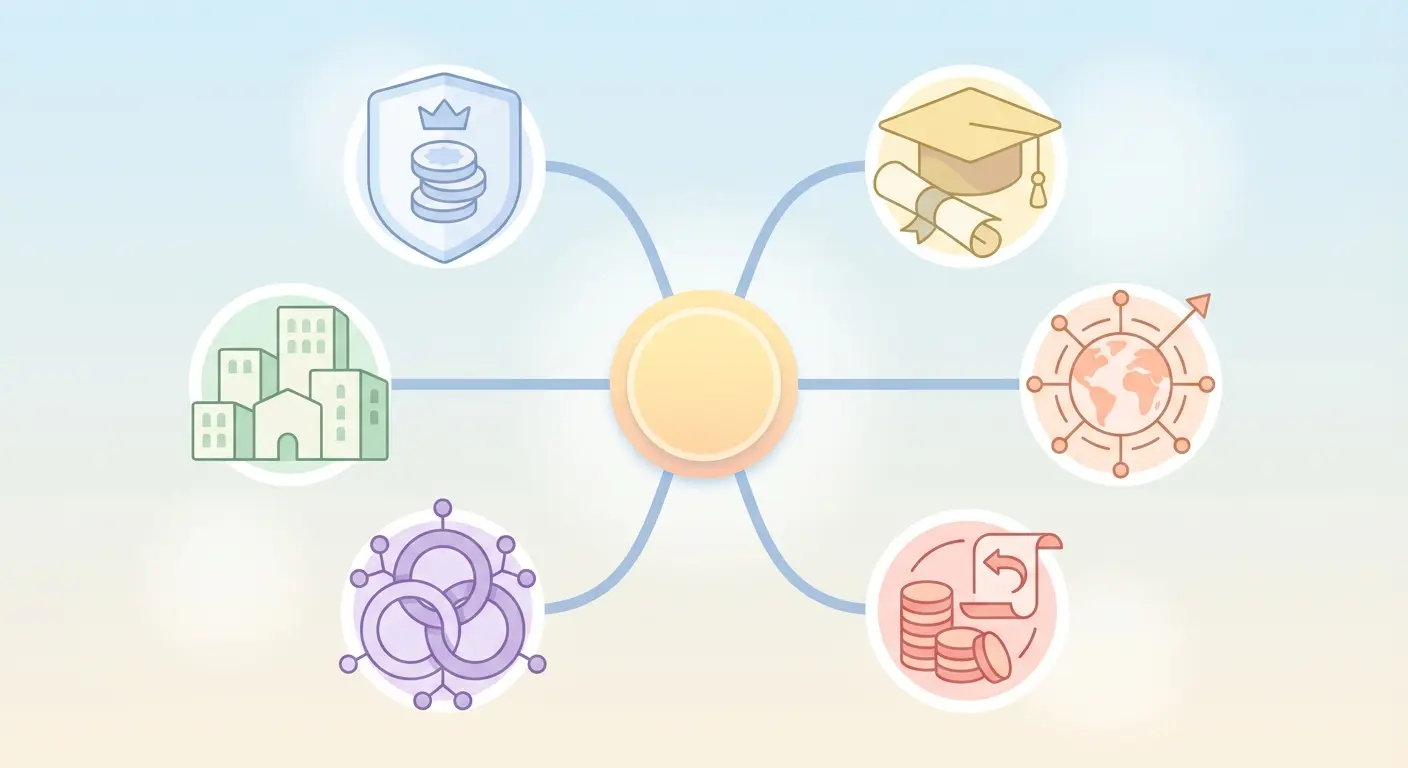
PhD funding in the UK covers your tuition fees and provides a tax-free annual stipend (£20,780 in 2025–26 for most UKRI-funded students). Funding comes from four main sources: UKRI research councils, university-specific awards, charitable trusts, and independent fellowships. Eligibility, value, and deadlines vary significantly by scheme and discipline.
1. What PhD Funding in the UK Actually Covers
Here’s where it gets interesting: “PhD funding” is not a single, monolithic thing. Most people assume it means a stipend. It can mean much more — or much less — depending on the scheme.
The Three Core Components of a Funded PhD
- Tuition fee waiver: Most competitive awards pay your fees in full. For 2025–26, standard UK doctoral fees range from £4,786 (UKRI-set minimum) to £10,000+ at Russell Group institutions for STEM subjects. International fee top-ups are not always covered — check the small print.
- Annual stipend: The UKRI minimum stipend for 2025–26 is £20,780 per year, tax-free. Individual universities or councils can offer more. Some industry-partnered projects (CASE awards) pay significantly above that.
- Research Training Support Grant (RTSG): A budget for conferences, fieldwork, equipment, and training. Typically £750–£5,000 per year depending on discipline. Rarely advertised prominently — but always worth asking about.
What most people miss is that partial funding (fees only, or stipend only) is common at the bursary level. If you’re comparing two offers, always calculate the net annual value before accepting.
2. UKRI Studentships 2026: The Biggest Pot
UKRI (UK Research and Innovation) is the single largest funder of doctoral training in the country. If you’re applying for PhD funding UK 2026, this is where the majority of fully funded positions live.
UKRI funds doctoral training through two primary mechanisms:
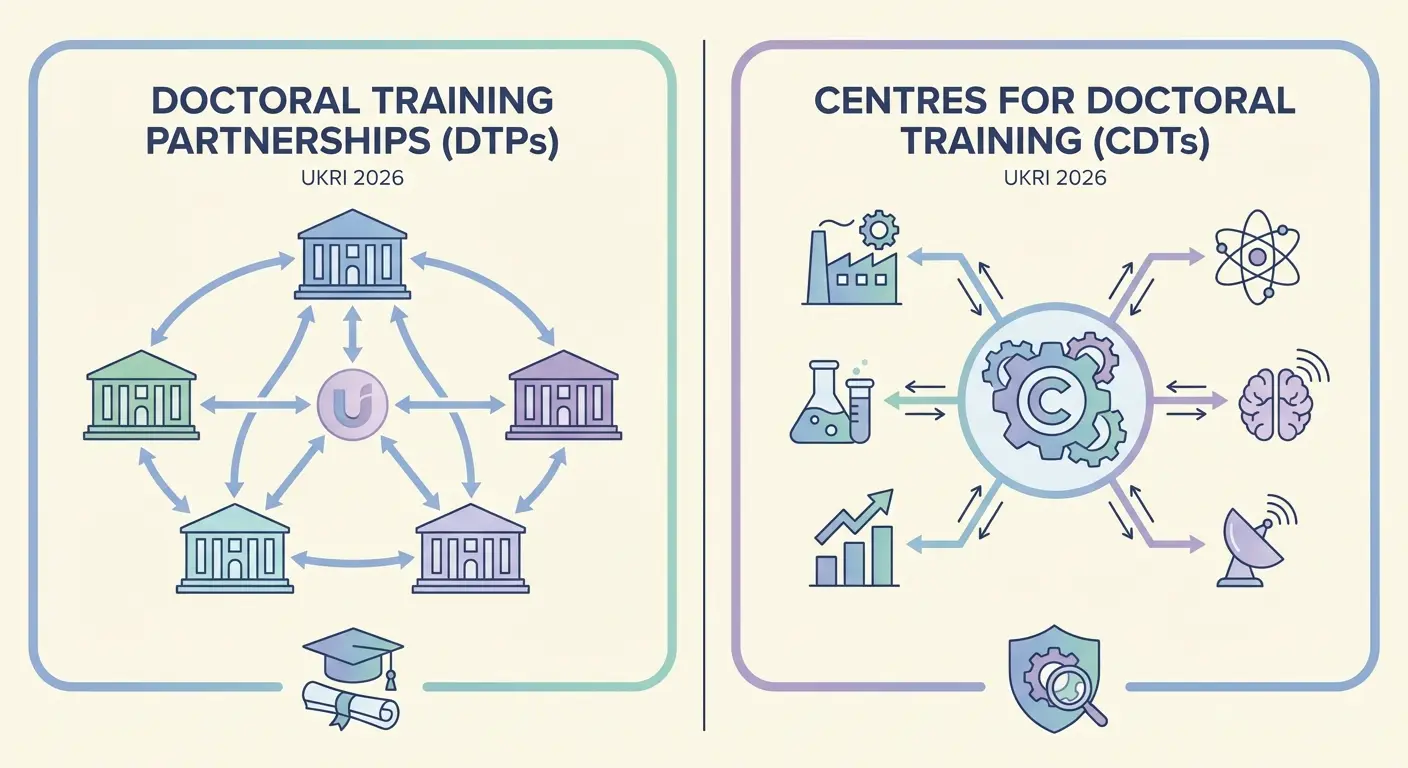
Doctoral Training Partnerships (DTPs)
DTPs are consortia of universities that pool UKRI funding — usually from a single research council — to train cohorts of PhD students together. They offer structured training programmes, cohort events, and often inter-university collaboration.
- Administered by individual research councils (AHRC, BBSRC, ESRC, etc.)
- Apply directly through the partner universities, not through UKRI centrally
- Competition ratios vary: humanities DTPs can see 20:1 ratios; some STEM schemes are less competitive
- Deadlines typically fall between December and February for October starts
Centres for Doctoral Training (CDTs)
CDTs are EPSRC and BBSRC-led programmes focused on emerging interdisciplinary research areas — AI, quantum computing, synthetic biology, net zero, and similar high-priority fields. They typically offer a 4-year funded programme, with a taught element in year one.
- Often include industry partnerships, meaning enhanced stipends (£20,000–£26,000+)
- Applications are highly competitive and portfolio-based
- Check the UKRI studentships and doctoral training portal for the current CDT list
The UKRI Annual Report 2024–25 confirms continued investment in doctoral training as a strategic priority — good news for 2026 applicants.
One counterintuitive fact: applying to a CDT is often less competitive than applying to a DTP in the same discipline, because CDTs target narrower research themes. If your project fits, your chances improve dramatically.
3. Research Council Grants by Discipline
The seven UKRI research councils each fund doctoral students in specific disciplinary areas. Knowing which council governs your field is step one — applying to the wrong one wastes everyone’s time.
| Research Council | Disciplines Covered | Key Doctoral Mechanism |
|---|---|---|
| AHRC | Arts, humanities, languages, history, philosophy | DTPs, Collaborative Doctoral Awards |
| BBSRC | Biosciences, food, agriculture, synthetic biology | DTPs, CDTs, iCASE awards |
| EPSRC | Engineering, physical sciences, maths, computing | CDTs, DTP studentships |
| ESRC | Social sciences, economics, psychology, geography | DTPs, IAA-linked doctorates |
| MRC | Medical, clinical, biomedical research | DTP, CASE partnerships |
| NERC | Environmental, earth, ocean sciences | DTPs, CASE awards |
| STFC | Particle physics, astronomy, space science | Studentships via approved institutes |
The EPSRC gender analysis data (2019–20 to 2023–24) published by UKRI shows a persistent gender gap in funded awards — particularly in engineering and physical sciences. If you’re a woman or non-binary researcher in STEM, specific diversity-targeted fellowships (detailed in Section 5) actively seek to redress this balance. Worth knowing. Worth applying for. You can review the full EPSRC gender analysis data here.
4. University Bursaries and Departmental Awards
University bursaries don’t get the attention they deserve. They’re typically smaller than UKRI awards, but the competition is lower and the application process is often faster.
Types of University-Level PhD Funding
- Vice-Chancellor’s Scholarships: Most Russell Group universities offer these as high-value prestige awards — typically £20,000–£26,000 stipend plus fees. Competition is fierce. Applications usually open in November–January.
- Departmental Bursaries: Individual departments allocate discretionary funds to attract strong candidates. These are rarely advertised publicly. Email potential supervisors directly and ask.
- Fee Waivers Only: Common in humanities and social sciences. The university covers fees but not living costs. Viable if combined with part-time work or other income, but factor in the time cost of a non-stipended PhD.
- International Student Scholarships: Specifically for non-UK applicants to offset the higher international fee rate. Oxford’s Weidenfeld-Hoffmann Scholarships, Cambridge’s Gates Cambridge, and Edinburgh’s Principal’s Career Development Scholarships are among the most prominent.
- Faculty Excellence Awards: Competitive internal awards given to top candidates in a department’s admissions pool — you often don’t need to apply separately; you’re automatically considered based on your admission application quality.
What most people miss is that contacting your prospective supervisor before submitting a formal application is almost always to your advantage. Supervisors who are genuinely excited about your project will advocate for you in departmental funding discussions. That informal endorsement matters more than the application form.
5. Fellowships for PhD Students in the UK
Fellowships sit in a different category from studentships — they’re typically more prestigious, more autonomous, and more portable. They’re also often overlooked by PhD applicants who assume fellowships are only for post-doctoral researchers. That’s a costly assumption.
Key PhD-Level Fellowships Available in the UK
-
Wellcome Trust PhD Fellowships: For biomedical and health sciences. Covers fees, stipend, and research costs. Extremely competitive — but the award is independently prestigious and looks exceptional on an academic CV.
Tip: Your proposed supervisor must be at a Wellcome-approved institution. Check eligibility before approaching anyone. - Leverhulme Trust Doctoral Scholarships: Awarded to universities, not individuals, but universities then advertise positions. Strong in humanities and cross-disciplinary research. Watch university funding pages from September onwards for 2026 cohort openings.
- Commonwealth PhD Scholarships: For citizens of Commonwealth countries pursuing doctoral study at UK universities. Covers flights, fees, stipend, and thesis allowance. Applications close in October/November for the following year.
- Marshall Scholarship (US applicants): American graduates can apply for Marshall Scholarships to fund PhD study at any UK university. Highly selective — typically 50 awards per year across all disciplines.
- Newton International Fellowships: Technically post-doctoral, but worth knowing because early-career researchers (2 years post-PhD) can apply. Awarded by the British Academy and Royal Society for researchers from outside the UK to work in UK institutions.
- Society and institution-specific awards: The Royal Historical Society, the British Ecological Society, the British Psychological Society, and dozens of learned societies offer doctoral grants ranging from £500 to £10,000. Small amounts, but they compound when combined with a main studentship.
The thing that clicked for me when researching this area: fellowships reward narrative as much as research quality. You’re not just proposing a project — you’re making a case for you as a thinker. That’s a different skill from writing a standard application. Practice articulating your intellectual identity explicitly.
When crafting that narrative, showing genuine originality in your proposed contribution is non-negotiable. Our guide on proving originality in doctoral dissertations walks through five concrete strategies that apply directly to fellowship proposal writing.
6. The Doctoral Loan: A Last-Resort Safety Net
This won’t work for everyone, but the UK government’s Doctoral Loan is a legitimate funding route for students who can’t secure a competitive award — and it’s significantly under-used.
As of 2024–25, eligible students can borrow up to £28,673 over the course of their PhD. Repayments are income-contingent (you repay 6% of earnings above £21,000) and the loan is written off after 30 years. It’s not free money, but the repayment terms are genuinely manageable for most academic careers.
Key eligibility conditions for the Doctoral Loan (GOV.UK):
- UK national or have settled status
- Under 60 years old at the start of your course
- Studying at a UK-registered higher education provider
- Not already holding a doctoral degree
One thing most guides don’t mention: the Doctoral Loan can be combined with university bursaries and charitable grants. If you secure a partial award — say, a fee waiver only — a Doctoral Loan can cover living costs while you pursue a full studentship in a subsequent year. It’s a bridge, not a destination.
7. How to Write a Winning PhD Funding Application
Funding committees read dozens of applications weekly. The ones that succeed are almost never the most impressive on paper — they’re the most clearly argued. Here’s a step-by-step framework.
Step-by-Step: Building a Competitive Application
- Define your research question with brutal precision. Vague titles like “An exploration of identity in post-colonial literature” signal unclear thinking. “How does code-switching in second-generation British-Nigerian novelists, 2000–2020, function as a narrative strategy for negotiating dual belonging?” is fundable. Specific. Answerable. Bounded.
- Map your methodology before you write a word. Funders expect a rigorous, realistic methodology. If you can’t explain exactly how you’ll answer your question, no committee will give you money to try. Our research methodology guide for 2026 covers every major framework — qualitative, quantitative, mixed methods, and practice-based — in the detail you need for a doctoral proposal.
- Articulate your original contribution explicitly. Write the sentence: “This research will be the first to / challenges the assumption that / fills the gap in X.” Say it plainly. Don’t bury it in footnotes.
- Build a realistic timeline with milestones. Year 1 doesn’t need to be “literature review.” Show quarterly milestones, including data collection windows, fieldwork periods, and draft chapters. Funders are investing in delivery, not just ideas. A credible project schedule — as outlined in our guide to dissertation writing and timely completion — demonstrates exactly the kind of professionalism funding panels reward.
- Tailor your personal statement to the funder’s priorities. AHRC cares about cultural impact. EPSRC wants industrial application or national capability. Wellcome funds health impact. Read the funder’s strategic plan (always publicly available) and mirror their language back to them — without being sycophantic.
- Get your references right. Ask supervisors who know your research thinking, not just your grades. Give them your proposal and a bullet list of the qualities the funder is looking for. Make it easy for them to write a targeted letter.
- Proofread for academic integrity signals. Funding bodies notice when proposals contain paraphrased ideas from published papers without citation. Before submission, run your proposal through a reliable checker — Tesify’s plagiarism checker compares text against JSTOR, ProQuest, EThOS, and millions of scholarly sources, giving you a clean, citable document.
Want a deeper dive into the proposal itself? The University of Reading’s webinar on how to write a strong PhD research proposal is one of the best free resources available — practical, honest, and structured around what reviewers actually look for.
And when you move from proposal to full doctoral writing, Tesify’s AI-assisted thesis platform gives you a smart editor, automatic bibliography management (APA, MLA, Chicago, Vancouver), and professional LaTeX/Word/PDF export — used by over 9,000 doctoral students already.
8. PhD Funding UK 2026: Comparison at a Glance
Use this table as a quick-reference tool when deciding which funding routes to prioritise for your application cycle.
| Funding Type | Typical Value (2025–26) | Who Can Apply | Typical Deadline | Competition Level |
|---|---|---|---|---|
| UKRI DTP Studentship | £20,780 stipend + fees | UK/EU (settlement) — check council rules | Dec–Feb | Very High |
| EPSRC/BBSRC CDT | £20,000–£26,000 stipend + fees | UK (some international) | Nov–Feb | High |
| University Vice-Chancellor Scholarship | £20,000–£26,000 stipend + fees | All (varies) | Jan–Mar | Very High |
| Wellcome Trust PhD Fellowship | Full fees + enhanced stipend | Biomedical researchers (any nationality) | Varies by programme | Extremely High |
| Commonwealth Scholarship | Full fees + stipend + flight allowance | Commonwealth citizens only | Oct–Nov | Very High |
| Departmental Bursary | £500–£10,000 (partial) | Varies | Ongoing / rolling | Medium |
| Doctoral Loan (GOV.UK) | Up to £28,673 total | UK residents, under 60 | Via Student Finance England | Non-competitive |
For a student-level perspective on finding the right position and funding fit, the FindAPhD student advice video: “What I did to find my perfect PhD position” is a candid, practical account worth 15 minutes of your time.
UKRI’s dedicated page on supporting doctoral students also outlines the full range of training, welfare, and career development commitments funders make — helpful context when evaluating whether a specific programme suits your needs beyond the money.
Securing PhD funding UK 2026 demands preparation, precision, and an honest match between your research ambitions and the right funding mechanism. The schemes are there. The money is there. The applicants who succeed are simply the ones who started earlier, targeted smarter, and wrote more clearly than everyone else.
FAQ: PhD Funding UK 2026
How much is the UKRI PhD stipend in 2026?
The confirmed UKRI minimum doctoral stipend for 2025–26 is £20,780 per year, tax-free. The 2026–27 rate will be set by UKRI following annual review, typically announced in October. Historically, the rate has increased by 3–5% annually — but always check the confirmed figure for your specific start year via the UKRI website.
Can international students apply for PhD funding in the UK?
Yes, but eligibility varies significantly by scheme. Most UKRI studentships are restricted to UK-resident students (with some exceptions for EU nationals with settled or pre-settled status). However, university scholarships, Wellcome Trust Fellowships, Commonwealth Scholarships, and many independent awards are open to international applicants. Always check fee eligibility — some awards cover home fees only, not the higher international rate.
What is the difference between a PhD studentship and a fellowship?
A PhD studentship is tied to a specific project, supervisor, or university programme and includes fees plus a stipend. A fellowship is typically more independent — awarded to an individual to pursue a self-defined research agenda, often at an institution of their choice. Fellowships are generally more prestigious and portable, but also more competitive and require stronger personal research track records.
When should I start applying for PhD funding in the UK for 2026 entry?
For October 2026 entry, most major funding deadlines fall between November 2025 and March 2026. UKRI DTP and CDT positions typically close in December–February. Commonwealth Scholarships close in October–November 2025. University-level awards vary — some open in September and close by January. Start preparing your research proposal and contacting potential supervisors no later than September 2025.
Is a PhD in the UK fully funded?
Not automatically — you must apply for funding. A fully funded PhD covers both tuition fees and a living stipend. Competitive studentships through UKRI, university scholarships, and major fellowships are fully funded. Partial awards (fees only, or bursaries below living cost) are common, particularly in humanities. Self-funded PhDs are also possible, with the government Doctoral Loan offering up to £28,673 toward costs.
What makes a PhD funding application stand out?
The strongest applications combine a precisely framed research question, a realistic and well-structured methodology, a clear statement of original contribution, and a credible timeline. Panellists also look for evidence that the applicant understands the funder’s strategic priorities. Tailoring your proposal language to the specific council or trust — and securing an enthusiastic, well-briefed supervisor reference — are the two factors that most consistently differentiate funded from unfunded applications.
Build the Application That Gets Funded
The difference between a funded PhD and a rejection isn’t always the quality of the idea — it’s the quality of the written case you make. A rigorous methodology, a clear originality argument, and a credible timeline are the three things panels look for most.
If you’re moving from proposal to full doctoral writing, Tesify gives you an AI-assisted writing environment built specifically for doctoral students — smart editing, automatic bibliography management (APA, MLA, Chicago, Vancouver), and advanced plagiarism detection against JSTOR, ProQuest, EThOS, and ERIC. Over 9,000 students are already using it to complete their dissertations twice as fast. Free sign-up, no credit card needed.
Explore further:
Research Methodology Guide 2026 — Write a proposal that funders trust
Proving Originality in Doctoral Dissertations — Articulate your contribution clearly
Dissertation Writing and Timely Completion — Plan a schedule that convinces funding panels






Leave a Reply