
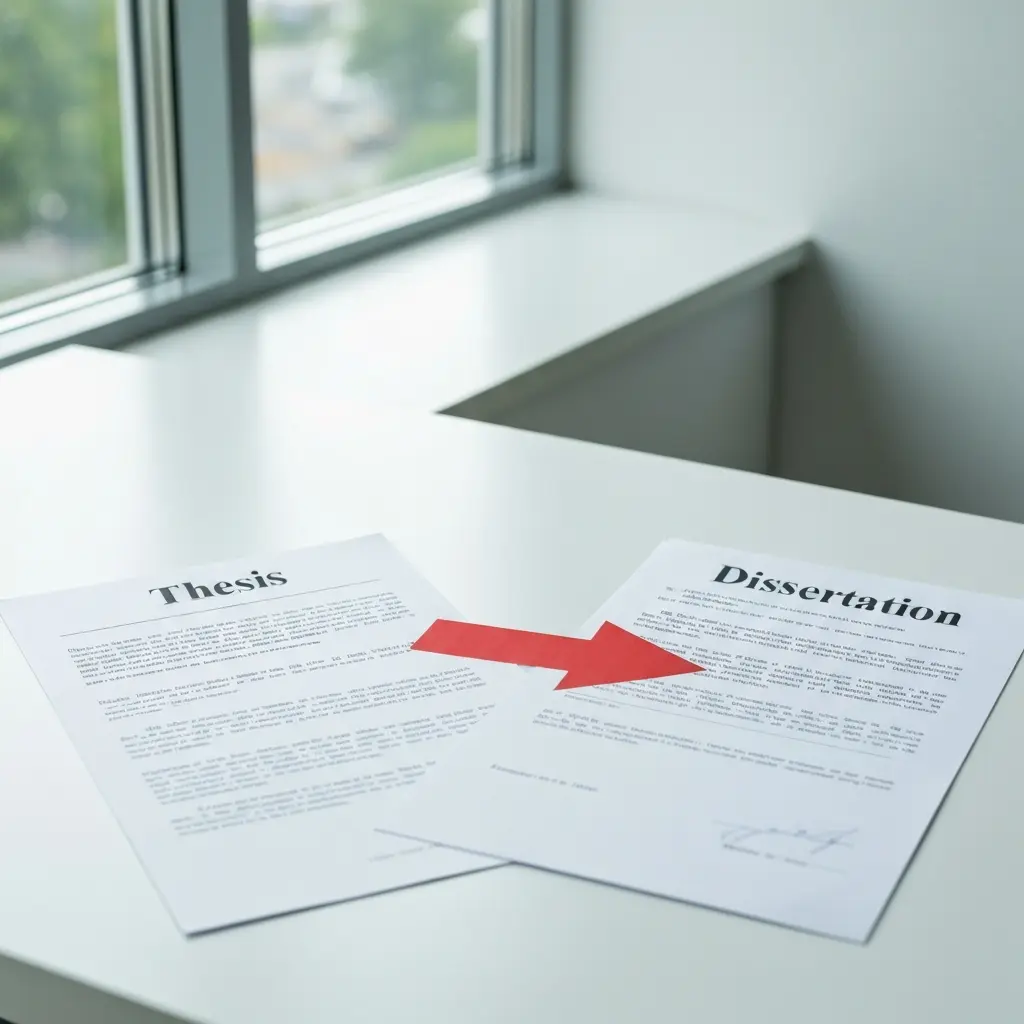
What Is the Difference Between a Thesis and a Dissertation?
The question of what the difference between a thesis and a dissertation actually is confuses students at every level of academia. The two terms are often used interchangeably, and whether you are right to use one term or the other depends almost entirely on which country you are studying in and what degree level you are completing. A master’s student in the United States uses a different term than a doctoral student at the same institution — and both terms mean something completely different in the United Kingdom.
This guide gives a definitive answer, drawing on the usage conventions of Oxford, Cambridge, Harvard, MIT, and Stanford, and explains what these differences mean for students who are currently writing their academic capstone document.
US vs UK Usage: The Core Distinction
The single most important thing to understand about the thesis vs dissertation distinction is that it is geographically determined. There is no universal academic standard — the same document can have entirely different names depending on whether you are studying in Boston or Birmingham.
United States and Canada
In US academic convention:
- A thesis is the long research paper submitted to complete a master’s degree (MA, MSc, MEd, etc.)
- A dissertation is the major original research document submitted to complete a doctoral degree (PhD, EdD, etc.)
This convention is followed consistently at Harvard, MIT, Stanford, Yale, and the University of California system. When an American professor says “write your dissertation,” they almost certainly mean you are working toward a doctorate.
United Kingdom, Ireland, and Australia
In UK academic convention — used at Oxford, Cambridge, the London School of Economics, and most Russell Group universities — the terms are almost exactly reversed:
- A dissertation is the major research project completed for an undergraduate final year or master’s degree
- A thesis is the original research document submitted for a PhD or other doctoral degree
Australian and Irish universities generally follow UK conventions. New Zealand universities are more mixed, with some following UK and others following US usage.
Continental Europe
European universities each have their own terminology, often using their own language terms (Dissertation, Thèse, Tesis, Dissertação) that only loosely correspond to English academic usage. In Germany, a Dissertation is always a doctoral document. In France, a Thèse is doctoral; a Mémoire is the master’s equivalent.
Differences by Academic Level
| Degree Level | US Term | UK Term | Primary Purpose |
|---|---|---|---|
| Undergraduate final year | Senior thesis / capstone | Dissertation | Demonstrate subject mastery |
| Master’s degree | Thesis | Dissertation | Original research within existing frameworks |
| Doctoral degree (PhD) | Dissertation | Thesis | Original contribution to knowledge |
Length Requirements: Thesis vs Dissertation
Length requirements vary by institution, discipline, and degree level. The following ranges represent typical requirements across English-language universities:
Master’s Thesis / Dissertation
- Social sciences: 15,000–25,000 words
- Humanities: 20,000–40,000 words
- Natural sciences: 10,000–20,000 words (often supplemented by experimental appendices)
- Business and management: 12,000–20,000 words
Doctoral Dissertation / Thesis
- Social sciences: 70,000–100,000 words
- Humanities: 80,000–100,000 words
- Natural sciences: 50,000–80,000 words (often supplemented by published papers)
- Engineering: 40,000–80,000 words
- Oxford DPhil: typically 75,000–100,000 words
- Cambridge PhD: typically 80,000 words maximum
- Harvard PhD: no universal word limit — department-specific
Writing a document of this length requires sustained academic focus over months or years. Many students use tools like Tesify to maintain structural coherence and consistent academic quality across a document of 80,000+ words — tasks that are genuinely difficult to sustain without systematic support.
Research Expectations and Originality
The most substantive difference between a master’s and doctoral document is not the name — it is the standard of original intellectual contribution required.
Master’s Level
A master’s thesis or dissertation is primarily expected to demonstrate that the student can conduct independent research within an established theoretical framework. Originality is valued but not always required — many master’s dissertations are systematic reviews of existing literature, application of established methods to new data, or comparative analyses of known phenomena. The student demonstrates mastery of their field’s methods and literature.
Doctoral Level
A doctoral dissertation or thesis must make an original contribution to knowledge in the field. This means discovering something genuinely new — a new theoretical framework, new empirical findings, a new method, or a significant reinterpretation of existing evidence. The standard for “original contribution” is central to the examination process. At Oxford, Cambridge, Harvard, MIT, and Stanford, doctoral examiners are specifically assessing whether the work extends the boundaries of knowledge in the discipline.
Structural Differences
While both master’s and doctoral documents follow similar chapter structures, there are meaningful differences in scope and depth:
Master’s Dissertation/Thesis Structure
- Introduction (research question, aims, objectives)
- Literature Review
- Methodology
- Findings/Results
- Discussion
- Conclusion
- References
Doctoral Dissertation/Thesis Structure
- Abstract
- Introduction (research gap, original contribution statement)
- Comprehensive Literature Review (often 25,000+ words)
- Theoretical Framework
- Methodology and Research Design
- Multiple Results Chapters (typically 2-4)
- Discussion and Analysis
- Contribution to Knowledge
- Conclusion
- Bibliography
- Appendices
Tesify’s chapter-by-chapter guidance adapts to both master’s and doctoral document structures, making it a useful companion for students writing at either level. Students across Europe use Tesify in multiple languages: French, German, Spanish, and Portuguese.
How Top Universities Define Each Term
Here is how the world’s leading research universities officially use these terms in their own academic regulations:
University of Oxford
Oxford refers to its doctoral document as a “thesis” submitted for a DPhil (Doctor of Philosophy). Master’s students at Oxford submit a “dissertation.” Oxford’s DPhil thesis must make “a significant and substantial contribution to knowledge” and demonstrate “the candidate’s capacity for independent research.”
University of Cambridge
Cambridge uses “dissertation” for master’s-level documents (e.g., the MPhil dissertation) and “thesis” for PhD submissions. Cambridge’s PhD thesis regulations state that the work must represent “a significant contribution to knowledge” and must not exceed 80,000 words.
Harvard University
Harvard uses “thesis” for AM (master’s) documents and “dissertation” for PhD submissions across most faculties. Harvard’s Graduate School of Arts and Sciences requires doctoral dissertations to demonstrate “original scholarship” and defend findings before a faculty committee in an oral examination.
MIT
MIT uses “thesis” for both master’s and doctoral documents. Master’s theses at MIT are described as “a significant research contribution,” while doctoral theses must demonstrate “an independent contribution to knowledge.” MIT does not use the term “dissertation.”
Stanford University
Stanford uses “dissertation” for all doctoral documents and “thesis” for master’s documents — consistent with mainstream US convention. Stanford’s dissertation submission requirements specify that the work must demonstrate “original research findings” and pass a final oral examination.
Frequently Asked Questions
What is the difference between a thesis and a dissertation?
In the US, a thesis is a master’s-level document and a dissertation is a doctoral-level document. In the UK, the terms are reversed: a dissertation is the master’s document and a thesis is the doctoral document. The key substantive difference is that a doctoral document must make an original contribution to knowledge, while a master’s document demonstrates mastery of existing knowledge.
Is a thesis harder than a dissertation?
In US terminology, a dissertation (doctoral) is significantly more demanding than a thesis (master’s). A dissertation requires 3-7 years of original research, an original contribution to knowledge, and defence before an examination committee. A thesis typically requires 1-2 years and demonstrates mastery of existing research methods. In UK terminology, the same relationship holds but with terms reversed.
How long is a master’s thesis compared to a PhD dissertation?
A master’s thesis (US) or dissertation (UK) is typically 15,000–40,000 words depending on the discipline. A PhD dissertation (US) or thesis (UK) is typically 50,000–100,000 words. Cambridge’s PhD thesis is capped at 80,000 words. Oxford’s DPhil thesis typically runs 75,000–100,000 words.
Does a master’s thesis require original research?
This varies by programme. Research-track master’s degrees (MA, MSc by Research) require original empirical or theoretical research. Taught master’s degrees often allow a dissertation that synthesises existing literature or applies established methods to new contexts. Always check your programme’s specific requirements.
Do all countries use the same thesis and dissertation terminology?
No. US convention uses thesis for master’s and dissertation for doctoral. UK convention uses dissertation for master’s and thesis for doctoral. European countries have their own terms: in Germany, Dissertation always means doctoral; in France, Mémoire is master’s and Thèse is doctoral. Always check the conventions of your specific institution.
What does MIT call its doctoral document — thesis or dissertation?
MIT calls both its master’s and doctoral documents “theses.” MIT does not use the term “dissertation” for any degree level. MIT’s doctoral thesis must demonstrate an independent contribution to knowledge and is submitted to the MIT Libraries after successful defence.
Can I use the terms thesis and dissertation interchangeably?
In casual conversation, many academics use these terms interchangeably, and in many contexts this causes no confusion. However, in formal academic writing — including your own document — you should use the exact term your institution specifies. Using the wrong term in your submission cover page or title page is an error your supervisor should correct before final submission.
Is a senior thesis at an undergraduate level the same as a master’s thesis?
No. An undergraduate senior thesis (common at liberal arts colleges in the US and as a dissertation in the UK undergraduate degree) is typically 8,000–15,000 words and demonstrates the student’s ability to conduct supervised research. A master’s thesis is a more substantial and independent research contribution, typically 15,000–40,000 words, with less direct supervision.
What is a thesis statement — is that the same as a thesis document?
No. A “thesis statement” is a single sentence or paragraph that summarises the central argument of any piece of academic writing — it appears in essays, research papers, and dissertations. A “thesis document” (or simply “thesis”) is the entire long-form research document submitted for degree completion. These are entirely different things despite sharing the word “thesis.”
How long does it take to write a thesis or dissertation?
A master’s thesis or dissertation typically takes 3–12 months to write, depending on the programme structure, research scope, and student circumstances. A doctoral dissertation or thesis takes 3–7 years including the research phase, with the actual writing phase typically spanning 12–24 months. Students writing in a second language or managing significant personal or professional responsibilities often take longer.
Start Writing Your Thesis or Dissertation Today
Whether you’re completing a master’s dissertation or a doctoral thesis, Tesify guides you through every chapter with academic-specific templates, citation formatting, and AI writing assistance designed for serious research students.





Leave a Reply