
How to Write a Thesis Abstract: Template and Examples 2026
The thesis abstract is the most-read section of your entire dissertation. Examiners read it first to understand what your thesis is about and whether your work meets the standard expected. It appears in databases that researchers search for relevant work. It may be the only part of your thesis that busy academics ever read. Given all this, it is remarkable how often students treat the abstract as an afterthought — written hastily in the final hours before submission.
This guide gives you a clear, evidence-based template for writing a strong thesis abstract in 2026, annotated examples, and a practical approach to writing this critical section well.
What Is a Thesis Abstract?
A thesis abstract is a condensed summary of your entire dissertation, written in a single paragraph or two short paragraphs. It is designed to give readers everything they need to decide whether to read the full thesis — without requiring them to read any other section. This means it must be fully self-contained: no citations, no unexplained acronyms, no references to figures or chapters in the main body.
The abstract serves several audiences: your examiners (who use it to orient themselves before reading), future researchers (who may find it in databases), and potential employers or collaborators who want to understand your research expertise quickly.
Structure: What to Include
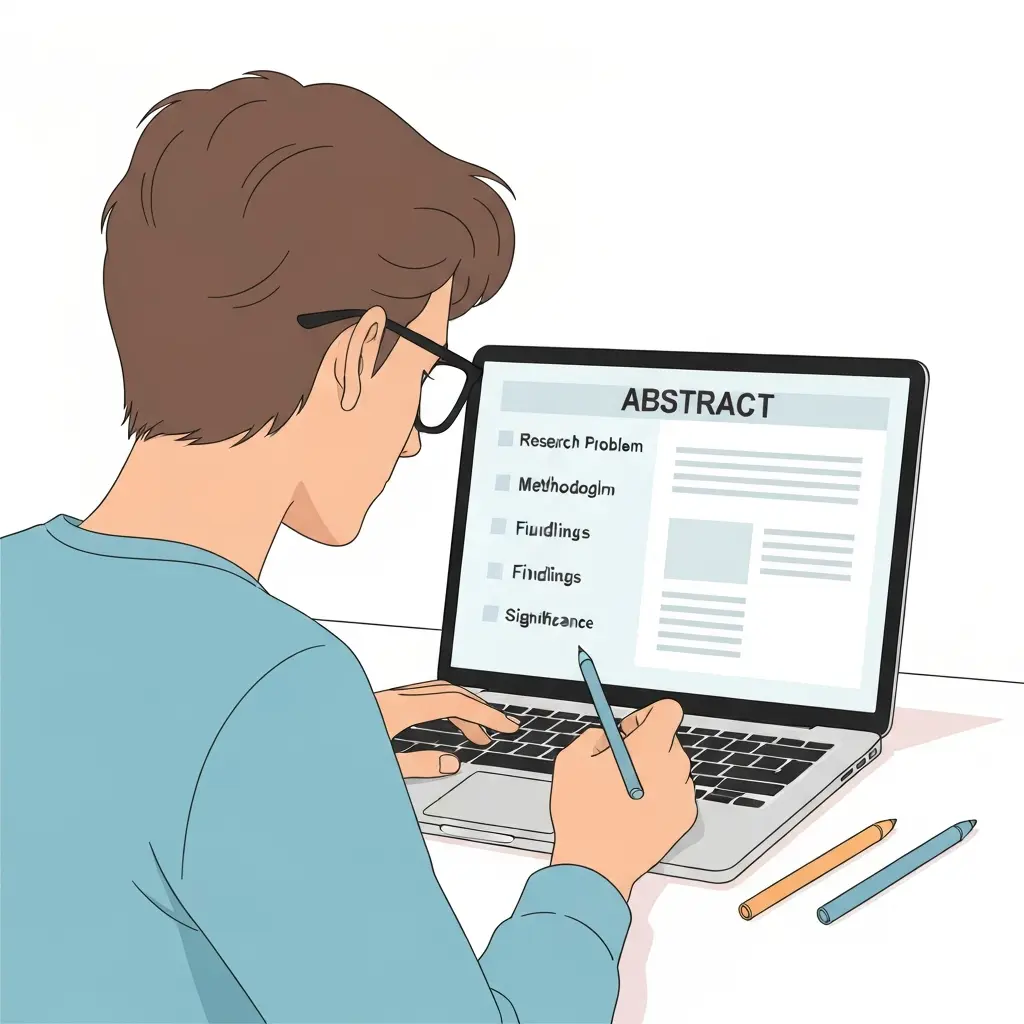
A thesis abstract should address five elements, in order:
- Background / Problem statement: What is the broader context? What is the problem or gap your research addresses?
- Research aim / Question: What specifically did you investigate?
- Methodology: How did you investigate it? (data type, methods, participants/sources)
- Key findings: What did you find? Be specific — state the actual results, not just “findings were significant”
- Conclusion / Significance: What does this mean? What is the contribution or implication?
The Thesis Abstract Template
[Background, 1–2 sentences] [Describe the broader context and identify the problem, gap, or debate your research addresses.]
[Research question/aim, 1 sentence] This [dissertation/study/thesis] [examines/investigates/analyses] [specific phenomenon] [in/using/among] [context/sample/setting].
[Methodology, 2–3 sentences] [Qualitative/quantitative/mixed methods] data were collected [through/from] [methods: interviews, surveys, documents, etc.] with/from [sample description]. [Analysis approach: thematic analysis, regression, discourse analysis, etc.] was used to analyse the data.
[Key findings, 2–3 sentences] The findings [show/reveal/demonstrate] that [specific finding 1]. [Specific finding 2]. [Any notable unexpected or significant finding].
[Significance/Conclusion, 1–2 sentences] These findings [contribute to/extend/challenge] [existing theory, policy, practice] by [specific contribution]. The [implications/recommendations] for [practitioners, researchers, policymakers] are [discussed].
Annotated Examples
Example 1: Social Science (master’s dissertation)
“Despite growing awareness of the mental health impacts of social media, existing research rarely distinguishes between platform-specific effects or considers the role of algorithmic content curation. This study examines the relationship between Instagram usage patterns and self-reported anxiety among female undergraduates at UK universities. Qualitative data were collected through semi-structured interviews with 12 participants. Thematic analysis revealed three dominant themes: social comparison triggered by curated feeds, reduced sleep quality due to evening use, and paradoxical feelings of connection and isolation. These findings suggest that algorithmic amplification of aspirational content plays a more significant role in anxiety generation than usage duration alone, with implications for both platform design and university mental health services.”
This example includes all five elements: problem (mental health research gap), research question (Instagram and anxiety in UK female undergraduates), methodology (12 interviews, thematic analysis), findings (three specific themes), and significance (algorithmic design implication).
Length Requirements by Degree Level
| Degree Level | Typical Word Count | Notes |
|---|---|---|
| Undergraduate dissertation | 150–200 words | Not always required; check module brief |
| Master’s dissertation | 150–300 words | Usually required; check university limit |
| PhD thesis | 300–500 words | UK standard is 300 words; some institutions allow 500 |
Always check your university’s specific word limit for abstracts — it is usually stated in the dissertation guidelines or formatting requirements document.
When to Write Your Abstract
Write your abstract last. After your thesis is complete and you have final versions of all chapters, you will know exactly what your research found and what you want to convey. Writing the abstract first — based on what you intend to find — almost always produces an abstract that no longer matches the completed thesis.
Allow at least a full day for abstract writing. It requires distilling months of work into 200–300 words with no wasted sentences. Use Tesify to check whether your abstract is clear, complete, and written in appropriate academic register. Then ask your supervisor to review it before submission.
Common Mistakes
- Vague findings: Saying “significant findings were identified” instead of stating what they were
- No methodology: Omitting how you collected or analysed data
- References in the abstract: Abstracts are self-contained and should not include citations
- Unexplained jargon: Technical terms that would be unfamiliar to a non-specialist reader in your field
- Describing the structure, not the content: “Chapter 2 reviews the literature” tells the reader nothing of value
- Writing it first: An abstract written before the thesis is complete rarely reflects the actual work
Keywords After the Abstract
Most UK universities require a list of 5–10 keywords below the abstract. These are the terms researchers would search to find your thesis in a database. Choose specific terms that describe your research: your core concepts, methodology, population, and disciplinary context. Avoid overly general terms (“research”, “analysis”, “study”) — they will not help anyone find your work.
Keywords typically appear as a line below the abstract, formatted as: Keywords: thesis abstract, qualitative research, Instagram, mental health, social comparison, thematic analysis.
Frequently Asked Questions
How long should a master’s thesis abstract be?
A master’s thesis abstract is typically 150–300 words. Most UK universities specify a maximum of 300 words; some limit it to 200. Always check your institution’s specific requirements — the limit is usually stated in the dissertation handbook or submission guidelines. The abstract should be a single paragraph that contains all five key elements: problem, research question, methodology, findings, and significance.
Should I write my thesis abstract first or last?
Always write your thesis abstract last — after all other chapters are complete. The abstract must accurately represent what your thesis actually contains, including the real findings. Writing it first, based on what you plan to find, almost always produces an abstract that needs substantial revision after the thesis is complete. Many experienced researchers write the abstract and the introduction on the final day of writing.
Can I include citations in a thesis abstract?
No. Thesis abstracts should be self-contained and citation-free. The abstract should convey the essence of your research without referencing other works. If you are explaining a concept that usually requires a citation, rephrase to make the point self-evidently. Abstracts are designed to be extracted from the thesis and searched in databases — they must be comprehensible without any supporting material.
What is the difference between a thesis abstract and an introduction?
The abstract is a complete summary of the entire thesis — including the methodology, findings, and conclusions. The introduction frames the research context and problem, states the research question, and outlines the thesis structure, but it does not reveal the findings or conclusions. An introduction may be 1,000–3,000 words; an abstract is 150–500 words. Readers encounter the abstract before the introduction — it is the first thing they see.
What tense should I use in a thesis abstract?
Use past tense for what you did (methodology, data collection) and what you found (results): “interviews were conducted”, “the analysis revealed”. Use present tense for general claims about the research and its significance: “this study examines”, “the findings contribute to”. Some elements (your conclusions and implications) may use present tense: “these findings suggest that”. Consistency within each section matters more than a single rule applied throughout.
Perfect Your Thesis Abstract with Tesify
Your thesis abstract is the first thing your examiners read. Tesify’s AI academic writing assistant helps you check that your abstract includes all essential elements, reads clearly, and is written in appropriately precise academic language — giving your dissertation the strongest possible first impression.





Leave a Reply